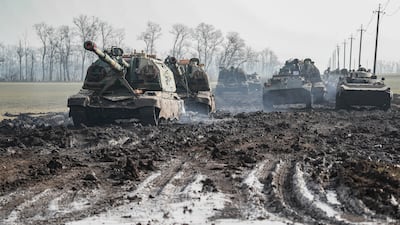
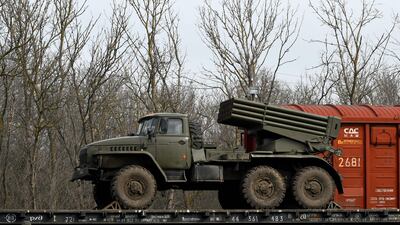
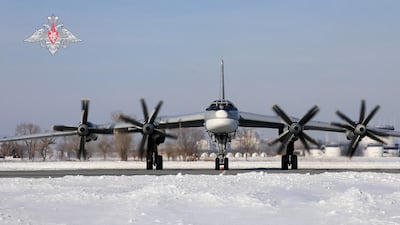
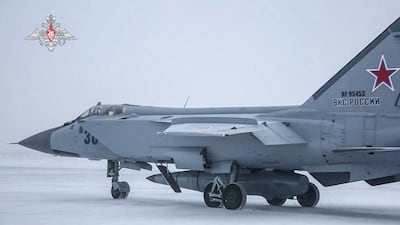
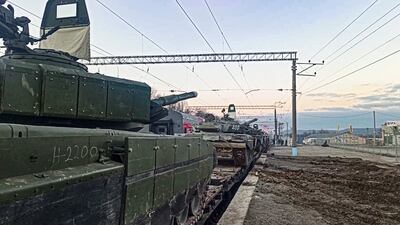
After 10 months, Russia’s war in Ukraine grinds on despite Moscow’s numerical superiority and in some cases, better weapons.
“What the Ukrainians have done will be studied at war colleges for a long time,” says James L Regens, founding director of the University of Oklahoma Centre for Intelligence and National Security.
But Ukraine’s ability to hold back a materially superior adversary is not unique.
Libya's failed invasion of Chad in 1987 and the Iraqi collapse in Mosul in 2014 are two occasions on which an army was defeated by a lightly armed enemy, proving that superior numbers and weapons alone are not enough to guarantee victory.
Experts tell The National the reasons for these defeats almost always come down to dysfunctional political control of the military.
Chain of command
“Everything starts with leadership,” says Robert K Brigham, a military historian at Vassar College, New York.
“If the chain of command is not reliable, if the enlisted men don't feel somehow connected to the leadership, then there's always going to be structural problems that can never really be overcome.”
In Nato and its allies, such as Ukraine, ultimate command lies at the very top, but emphasis in the chain of command is placed on the initiative of small unit commanders at the sharp end of battle, freeing them from micromanaging generals far from the front line.
Junior ranks must feel “comfortable exercising reasonable initiative without fear of reprisal from their chain of command”, one US officer wrote last year.
By contrast, many non-Nato armies place strong emphasis on strictly managing their forces from the highest level of command, which can slow down the flow of vital information and hinder initiative.
Some of the worst military defeats involved generals who were chosen by the elite, picked for loyalty rather than competence. The independence of smaller unit commanders on the front lines in these tightly controlled situations is limited.
“Tasks requiring resolution, which in the West would be resolved at much lower levels, get passed up the chain for decision,” a Russian officer said recently.
This can lead to inflexible armies faced with rapidly changing situations. Decisions have to be made quickly. An officer forced to wait for a general’s command might find the guidance comes far too late.
“Those who fail are usually replaced or threatened with punishment. Far from incentivising success, this often leads to dishonest reporting,” a report on the Ukraine war by UK think tank RUSI recently said.
In Russia, non-commissioned officers “are not empowered at all”.
“Their junior officers aren't empowered. It's a very top-down thing, as is their political system,” says Mr Regens.
This relationship between the government and the military goes a long way to explain Russia's ongoing setbacks despite major advantages.
According to RUSI, Russia initially had a 12 to one numerical advantage on the Kyiv front. Russia also had an advantage in the air of at least three to one, as well as better air-to-air missiles.
Ukraine received a surge in Nato support before February, but Ukraine’s generals say it was their own artillery that did the most damage to the initial Russian thrust towards Kyiv, pushing them back from their initial gains in spring, shown below.
A supply of high-tech, US Himars missile launchers in June helped blunt Russia's artillery advantage, but Moscow still has the edge.
A Nato supply of howitzers didn’t materialise until spring, but remains a fraction of Ukraine’s artillery force. Likewise, anti-aircraft weaponry supplied could only threaten Russia's air force at lower altitudes.
'Coup proofing' to the end
“The Ukrainians are demonstrating that Ukraine is a European country. They're structuring their military, subordinate to civilian control, but actually having a military that's functional, as opposed to coup-proofed,” says Mr Regens.
“Coup proofing” is where generals are chosen for political loyalty over ability, to stop military plots against the government.
According to Mr Brigham, unqualified but loyal generals are more likely to promote less able officers at lower ranks — spreading the dysfunction. Military experts call this unchecked military power “praetorianism” after the immense political power of the Roman military.
In the praetorian system, the military empowers and serves itself more than the nation, neglecting its duty to win wars.
“If you're not doing anything other than domestic repression, you're not embodying the nation. To win, it better be a real fast war, against a relatively inept opponent,” Mr Regens says.
Mr Brigham also points to the idea of "palace guardism," where the military exists simply to protect the elite. An example was America’s ally South Vietnam, where successive dictators prioritised coup-proofing.
Loyal but unqualified South Vietnamese generals lacked the experience needed to plan complex military operations, organising fuel, food and ammunition for tens of thousands of troops, co-ordinating different branches of the forces night and day, while planning against highly motivated communists.
This was on display at the 1963 battle of Ap Bac, when thousands of South Vietnamese soldiers with artillery, armoured vehicles and air power, were held off by a lightly equipped force thought to have numbered no more than 400 communists.
“There is corruption at the top because with President [Ngo Dinh] Diem especially you got promoted by loyalty, not necessarily merit. There's a lot of coup-proofing going on. At Ap Bac, he withheld some of the divisions that probably would have made a difference that were kept for coup protection in Saigon,” says Mr Brigham.
A decade later, as the US left Vietnam, little had changed.
By the early 1970s South Vietnam had the fourth largest air force in the world, as well as helicopter-borne troops and masses of tanks. But coup-proofing persisted and they lacked the skilled generals that would have enabled them to co-ordinate this might against the communists.
Military disasters of other authoritarian regimes have been very similar.
Muammar Qaddafi’s hand-picked generals who invaded Chad in 1987 were defeated by lightly armed Chadians in fleets of Toyotas. Chad defeated the inflexible Libyan force, which was repeatedly surrounded and ambushed by a more mobile enemy, despite Libya possessing air power, heavy artillery and tanks — none of which the Chadians had.
In 1982, when Britain embarked to recapture the Falkland Islands, Argentinian dictator Leopoldo Galtieri gave a loyal but inexperienced general Mario Menendez the job of protecting the islands.
Despite a roughly equal-sized defending force and a five to one superiority in aircraft, Gen Menendez failed to co-ordinate the full forces available to him, missing opportunities to smash British forces before they could land enough troops on the islands.
More recently, former Iraqi prime minister Nouri Al Maliki watched in horror as a small force of ISIS terrorists overwhelmed Iraqi forces around the city of Mosul in the summer of 2014. Lightly armed ISIS fighters seized about a third of Iraq, despite facing tens of thousands of men with modern, US-made M1A1 tanks, GPS-guided artillery shells and a small air force.
Mr Al Maliki appointed loyal but corrupt generals who ran their army into the ground before ISIS began its offensive.
'Now go and fight'
In all of the cases above, politically loyal generals were accused of rampant corruption.
This, Mr Brigham says, thoroughly undermined their forces. It also undermined vital tasks such as ensuring complex weapons were adequately maintained and ready for battle.
“It's not just equipment,” Mr Brigham says. “Obviously, the Ukrainians are getting high-tech equipment, but it's about the ability to absorb it, to learn, to have the logistical systems in place. You can't just throw equipment at a bunch of men and go, ‘there you go, right, now go and fight’.”

Ferrari 12Cilindri specs
Engine: naturally aspirated 6.5-liter V12
Power: 819hp
Torque: 678Nm at 7,250rpm
Price: From Dh1,700,000
Available: Now
How to wear a kandura
Dos
- Wear the right fabric for the right season and occasion
- Always ask for the dress code if you don’t know
- Wear a white kandura, white ghutra / shemagh (headwear) and black shoes for work
- Wear 100 per cent cotton under the kandura as most fabrics are polyester
Don’ts
- Wear hamdania for work, always wear a ghutra and agal
- Buy a kandura only based on how it feels; ask questions about the fabric and understand what you are buying
COMPANY PROFILE
Name: Kumulus Water
Started: 2021
Founders: Iheb Triki and Mohamed Ali Abid
Based: Tunisia
Sector: Water technology
Number of staff: 22
Investment raised: $4 million
Conflict, drought, famine
Estimates of the number of deaths caused by the famine range from 400,000 to 1 million, according to a document prepared for the UK House of Lords in 2024.
It has been claimed that the policies of the Ethiopian government, which took control after deposing Emperor Haile Selassie in a military-led revolution in 1974, contributed to the scale of the famine.
Dr Miriam Bradley, senior lecturer in humanitarian studies at the University of Manchester, has argued that, by the early 1980s, “several government policies combined to cause, rather than prevent, a famine which lasted from 1983 to 1985. Mengistu’s government imposed Stalinist-model agricultural policies involving forced collectivisation and villagisation [relocation of communities into planned villages].
The West became aware of the catastrophe through a series of BBC News reports by journalist Michael Buerk in October 1984 describing a “biblical famine” and containing graphic images of thousands of people, including children, facing starvation.
Band Aid
Bob Geldof, singer with the Irish rock group The Boomtown Rats, formed Band Aid in response to the horrific images shown in the news broadcasts.
With Midge Ure of the band Ultravox, he wrote the hit charity single Do They Know it’s Christmas in December 1984, featuring a string of high-profile musicians.
Following the single’s success, the idea to stage a rock concert evolved.
Live Aid was a series of simultaneous concerts that took place at Wembley Stadium in London, John F Kennedy Stadium in Philadelphia, the US, and at various other venues across the world.
The combined event was broadcast to an estimated worldwide audience of 1.5 billion.
The%20specs%20
%3Cp%3E%3Cstrong%3EEngine%3A%20%3C%2Fstrong%3E2.0-litre%204cyl%20turbo%0D%3Cbr%3E%3Cstrong%3EPower%3A%20%3C%2Fstrong%3E261hp%20at%205%2C500rpm%0D%3Cbr%3E%3Cstrong%3ETorque%3A%20%3C%2Fstrong%3E400Nm%20at%201%2C750-4%2C000rpm%0D%3Cbr%3E%3Cstrong%3ETransmission%3A%20%3C%2Fstrong%3E7-speed%20dual-clutch%20auto%0D%3Cbr%3E%3Cstrong%3EFuel%20consumption%3A%20%3C%2Fstrong%3E10.5L%2F100km%0D%3Cbr%3E%3Cstrong%3EOn%20sale%3A%20%3C%2Fstrong%3ENow%0D%3Cbr%3E%3Cstrong%3EPrice%3A%20%3C%2Fstrong%3EFrom%20Dh129%2C999%20(VX%20Luxury)%3B%20from%20Dh149%2C999%20(VX%20Black%20Gold)%3C%2Fp%3E%0A
MATCH INFO
Uefa Champions League, last-16 second leg
Paris Saint-Germain (1) v Borussia Dortmund (2)
Kick-off: Midnight, Thursday, March 12
Stadium: Parc des Princes
Live: On beIN Sports HD
What can victims do?
Always use only regulated platforms
Stop all transactions and communication on suspicion
Save all evidence (screenshots, chat logs, transaction IDs)
Report to local authorities
Warn others to prevent further harm
Courtesy: Crystal Intelligence
NYBL PROFILE
Company name: Nybl
Date started: November 2018
Founder: Noor Alnahhas, Michael LeTan, Hafsa Yazdni, Sufyaan Abdul Haseeb, Waleed Rifaat, Mohammed Shono
Based: Dubai, UAE
Sector: Software Technology / Artificial Intelligence
Initial investment: $500,000
Funding round: Series B (raising $5m)
Partners/Incubators: Dubai Future Accelerators Cohort 4, Dubai Future Accelerators Cohort 6, AI Venture Labs Cohort 1, Microsoft Scale-up
The specs: 2018 Nissan 370Z Nismo
Price, base / as tested: Dh182,178
Engine: 3.7-litre V6
Power: 350hp @ 7,400rpm
Torque: 374Nm @ 5,200rpm
Transmission: Seven-speed automatic
Fuel consumption, combined: 10.5L / 100km
Mercer, the investment consulting arm of US services company Marsh & McLennan, expects its wealth division to at least double its assets under management (AUM) in the Middle East as wealth in the region continues to grow despite economic headwinds, a company official said.
Mercer Wealth, which globally has $160 billion in AUM, plans to boost its AUM in the region to $2-$3bn in the next 2-3 years from the present $1bn, said Yasir AbuShaban, a Dubai-based principal with Mercer Wealth.
“Within the next two to three years, we are looking at reaching $2 to $3 billion as a conservative estimate and we do see an opportunity to do so,” said Mr AbuShaban.
Mercer does not directly make investments, but allocates clients’ money they have discretion to, to professional asset managers. They also provide advice to clients.
“We have buying power. We can negotiate on their (client’s) behalf with asset managers to provide them lower fees than they otherwise would have to get on their own,” he added.
Mercer Wealth’s clients include sovereign wealth funds, family offices, and insurance companies among others.
From its office in Dubai, Mercer also looks after Africa, India and Turkey, where they also see opportunity for growth.
Wealth creation in Middle East and Africa (MEA) grew 8.5 per cent to $8.1 trillion last year from $7.5tn in 2015, higher than last year’s global average of 6 per cent and the second-highest growth in a region after Asia-Pacific which grew 9.9 per cent, according to consultancy Boston Consulting Group (BCG). In the region, where wealth grew just 1.9 per cent in 2015 compared with 2014, a pickup in oil prices has helped in wealth generation.
BCG is forecasting MEA wealth will rise to $12tn by 2021, growing at an annual average of 8 per cent.
Drivers of wealth generation in the region will be split evenly between new wealth creation and growth of performance of existing assets, according to BCG.
Another general trend in the region is clients’ looking for a comprehensive approach to investing, according to Mr AbuShaban.
“Institutional investors or some of the families are seeing a slowdown in the available capital they have to invest and in that sense they are looking at optimizing the way they manage their portfolios and making sure they are not investing haphazardly and different parts of their investment are working together,” said Mr AbuShaban.
Some clients also have a higher appetite for risk, given the low interest-rate environment that does not provide enough yield for some institutional investors. These clients are keen to invest in illiquid assets, such as private equity and infrastructure.
“What we have seen is a desire for higher returns in what has been a low-return environment specifically in various fixed income or bonds,” he said.
“In this environment, we have seen a de facto increase in the risk that clients are taking in things like illiquid investments, private equity investments, infrastructure and private debt, those kind of investments were higher illiquidity results in incrementally higher returns.”
The Abu Dhabi Investment Authority, one of the largest sovereign wealth funds, said in its 2016 report that has gradually increased its exposure in direct private equity and private credit transactions, mainly in Asian markets and especially in China and India. The authority’s private equity department focused on structured equities owing to “their defensive characteristics.”
Key products and UAE prices
iPhone XS
With a 5.8-inch screen, it will be an advance version of the iPhone X. It will be dual sim and comes with better battery life, a faster processor and better camera. A new gold colour will be available.
Price: Dh4,229
iPhone XS Max
It is expected to be a grander version of the iPhone X with a 6.5-inch screen; an inch bigger than the screen of the iPhone 8 Plus.
Price: Dh4,649
iPhone XR
A low-cost version of the iPhone X with a 6.1-inch screen, it is expected to attract mass attention. According to industry experts, it is likely to have aluminium edges instead of stainless steel.
Price: Dh3,179
Apple Watch Series 4
More comprehensive health device with edge-to-edge displays that are more than 30 per cent bigger than displays on current models.
Islamophobia definition
A widely accepted definition was made by the All Party Parliamentary Group on British Muslims in 2019: “Islamophobia is rooted in racism and is a type of racism that targets expressions of Muslimness or perceived Muslimness.” It further defines it as “inciting hatred or violence against Muslims”.
Desert Warrior
Starring: Anthony Mackie, Aiysha Hart, Ben Kingsley
Director: Rupert Wyatt
Rating: 3/5
Killing of Qassem Suleimani
Expo details
Expo 2020 Dubai will be the first World Expo to be held in the Middle East, Africa and South Asia
The world fair will run for six months from October 20, 2020 to April 10, 2021.
It is expected to attract 25 million visits
Some 70 per cent visitors are projected to come from outside the UAE, the largest proportion of international visitors in the 167-year history of World Expos.
More than 30,000 volunteers are required for Expo 2020
The site covers a total of 4.38 sqkm, including a 2 sqkm gated area
It is located adjacent to Al Maktoum International Airport in Dubai South
The years Ramadan fell in May
FROM%20THE%20ASHES
%3Cp%3EDirector%3A%20Khalid%20Fahad%3C%2Fp%3E%0A%3Cp%3EStarring%3A%20Shaima%20Al%20Tayeb%2C%20Wafa%20Muhamad%2C%20Hamss%20Bandar%3C%2Fp%3E%0A%3Cp%3ERating%3A%203%2F5%3C%2Fp%3E%0A
Auron Mein Kahan Dum Tha
Starring: Ajay Devgn, Tabu, Shantanu Maheshwari, Jimmy Shergill, Saiee Manjrekar
Director: Neeraj Pandey
Rating: 2.5/5
Avatar: Fire and Ash
Director: James Cameron
Starring: Sam Worthington, Sigourney Weaver, Zoe Saldana
Rating: 4.5/5
What vitamins do we know are beneficial for living in the UAE
Vitamin D: Highly relevant in the UAE due to limited sun exposure; supports bone health, immunity and mood.
Vitamin B12: Important for nerve health and energy production, especially for vegetarians, vegans and individuals with absorption issues.
Iron: Useful only when deficiency or anaemia is confirmed; helps reduce fatigue and support immunity.
Omega-3 (EPA/DHA): Supports heart health and reduces inflammation, especially for those who consume little fish.
UK’s AI plan
- AI ambassadors such as MIT economist Simon Johnson, Monzo cofounder Tom Blomfield and Google DeepMind’s Raia Hadsell
- £10bn AI growth zone in South Wales to create 5,000 jobs
- £100m of government support for startups building AI hardware products
- £250m to train new AI models
APPLE IPAD MINI (A17 PRO)
Display: 21cm Liquid Retina Display, 2266 x 1488, 326ppi, 500 nits
Chip: Apple A17 Pro, 6-core CPU, 5-core GPU, 16-core Neural Engine
Storage: 128/256/512GB
Main camera: 12MP wide, f/1.8, digital zoom up to 5x, Smart HDR 4
Front camera: 12MP ultra-wide, f/2.4, Smart HDR 4, full-HD @ 25/30/60fps
Biometrics: Touch ID, Face ID
Colours: Blue, purple, space grey, starlight
In the box: iPad mini, USB-C cable, 20W USB-C power adapter
Price: From Dh2,099
Global Fungi Facts
• Scientists estimate there could be as many as 3 million fungal species globally
• Only about 160,000 have been officially described leaving around 90% undiscovered
• Fungi account for roughly 90% of Earth's unknown biodiversity
• Forest fungi help tackle climate change, absorbing up to 36% of global fossil fuel emissions annually and storing around 5 billion tonnes of carbon in the planet's topsoil
Racecard
6pm: Mina Hamriya – Handicap (TB) $75,000 (Dirt) 1,400m
6.35pm: Al Wasl Stakes – Conditions (TB) $60,000 (Turf) 1,200m
7.10pm: UAE Oaks – Group 3 (TB) $150,000 (D) 1,900m
7.45pm: Blue Point Sprint – Group 2 (TB) $180,000 (T) 1,000m
8.20pm: Nad Al Sheba Trophy – Group 3 (TB) $200,000 (T) 2,810m
8.55pm: Mina Rashid – Handicap (TB) $80,000 (T) 1,600m