


There are numerous environmental and scientific challenges looming next year, with climate change — and efforts to deal with it — among the most significant.
Cop28 in the UAE in November will represent a landmark in the fight to limit rising temperatures, while negotiations will continue on a legally binding treaty about plastic pollution.
In Brazil, the recent election of Luiz Inacio Lula da Silva gives environmentalists hope that deforestation in the Amazon region could slow.
Meanwhile, China, as well as promising to deal with its air pollution, shows signs of transitioning from its controversial zero-Covid policy, a trend likely to accelerate next year.
The use of mRNA vaccines has been pivotal in the fight against Covid-19 and next year could prove important in the development of similar inoculations against other infectious diseases, with new clinical trials to begin.
Climate change and energy
-

Climate activists take part in a protest during the Cop27 summit in Sharm El Sheikh. Reuters -
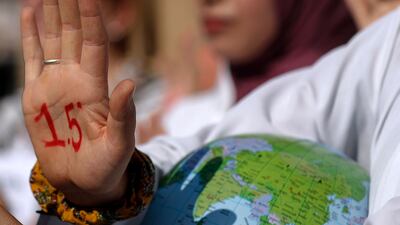
An activist demands action to limit the global temperature rise to 1.5°C compared to pre-industrial levels during the demonstration at the Cop27 event. AFP -
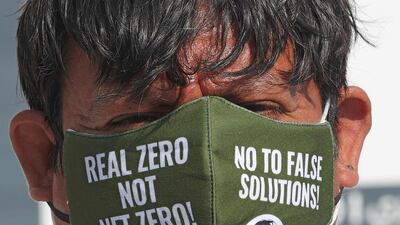
Protesters make their point outside Sharm El Sheikh International Convention Centre. AFP -

A protester from the '1.5 to Survive' movement. EPA -
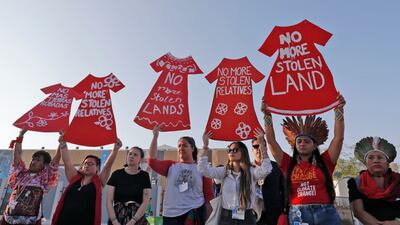
Placards bearing slogans in Spanish and English are held aloft in the Red Sea resort city. AFP -

Activists dance on leaflets with objectives for climate change written on them at the Resilience Pavilion at the conference centre in Sharm El Sheikh. AFP -

A climate activist demanding the cancellation of developing nations' debts draws attention to his cause. AFP


After Cop27 in Egypt disappointed climate activists concerned that commitments to limit greenhouse gas emissions were not strengthened, all eyes will be on Cop28 at Expo City Dubai.
As part of this UN climate change conference, the first global stocktake to assess progress since the Paris Agreement in 2015 will be concluded.
Michael Grubb, professor of energy and climate change at University College London, suggested a divergence between nations may emerge.
"Some are going to get more ambitious and more enthusiastic," Prof Grubb said.
"Those with great technological confidence and fossil fuel importers, they will say, ‘low carbon, we can do it and then reduce our dependence on the geopolitics of oil and gas.’
"Others will say, ‘we’re too poor, we cannot manage this technology unless we’re paid.’ And [then there are] producers, for which it’s an existential threat.
"Some fossil fuel exporters are wanting to diversity their economies. It’s difficult when you’re making so much money from fossil fuels.
"We’ll see an interest-led split … but I think there will be a strengthening of commitments from a number of key countries."
A recent report from the UN’s World Meteorological Organisation said this year’s average temperature was likely to be 1.15°C above pre-industrial levels, highlighting the difficulties in limiting rises to the Paris Agreement’s target of 1.5°C.
According to the UN Environment Programme, the international community "is falling far short of the Paris goals" and "only an urgent system-wide transformation can avoid climate disaster".
This includes heavy investment in renewable energy, cuts in the use of fossil fuels, particularly coal, and a transition to electric road transport.
Environment
-

A burnt area of the Amazon rainforest in Para state, Brazil, in 2019. AP -
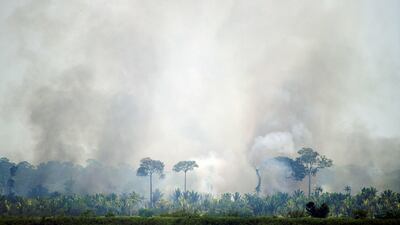
The Amazon region has lost 10 per cent of its native vegetation, mostly tropical rainforest, in almost four decades. AFP -
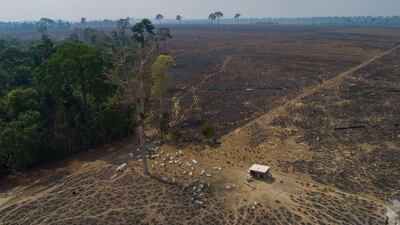
Cattle graze on land recently burnt and deforested by cattle farmers near Novo Progresso, Para state. AP -
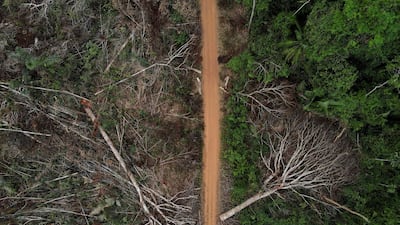
In almost four decades, 19 per cent of Brazil's rainforest has been destroyed, due mainly to cattle ranching expansion supported by the opening of roads. Reuters -
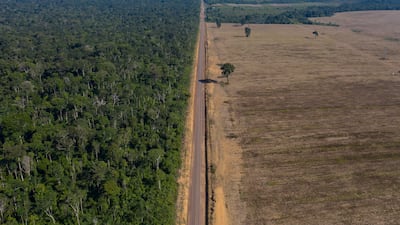
A motorway stretches between the Tapajos National Forest, left, part of the Amazon, and a field in Belterra, Para state. AP -

An illegal gold mine inside an environmental preservation area in the Amazon rainforest, in Itaituba, Para state. Reuters -
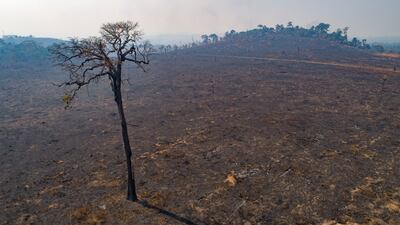
Almost half of Brazil’s carbon emissions comes from deforestation. AP


An area of the Amazon rainforest the size of Qatar — about 11,600 square kilometres — was cleared in the 12 months to the end of July, reflecting the way that deforestation rates soared under former Brazilian president Jair Bolsonaro.
While this figure was actually down 11 per cent on the previous 12-month period, clearing increased by almost 60 per cent during Mr Bolsonaro’s rule, environmental groups have said.
Things in Brazil could change next year, however, because the man known as Lula, who has previously served two terms as president, takes the reins for a four-year term on January 1 after narrowly defeating Bolsonaro in October’s election.
Lula will face difficulties in suppressing deforestation, however, with environmental agencies having been weakened under his predecessor and illegal logging having increased.
The environment is also under focus in China, where President Xi Jinping promised in October to "eliminate" major air and water pollution.
Pollution has been an acute problem in the country for many years as a result of heavy traffic, coal-fired power stations and heavy industry.
Work will continue next year on the forging of an international agreement to end plastic pollution, another environmental concern.
In 1950, two million tonnes of plastic were generated each year but the figure now is about 460 million tonnes, according to the UN Environment Programme. It said unless action is taken, the figure could triple by 2060.
In March, following a UN Environment Assembly meeting in Nairobi, Kenya, an intergovernmental negotiating committee was set up to produce a draft, legally binding agreement on plastic use that should be completed by the end of 2024.
This proposed deal, which has been compared to the Paris Agreement on climate change, could reduce demand for single-use plastics significantly.
Covid-19
-
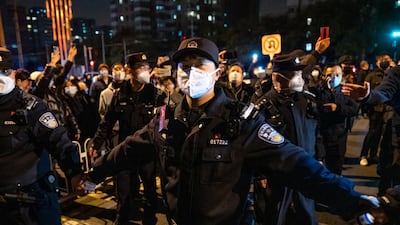
Police stand guard during a protest against Covid-19 restrictions, in China's capital Beijing. Bloomberg -
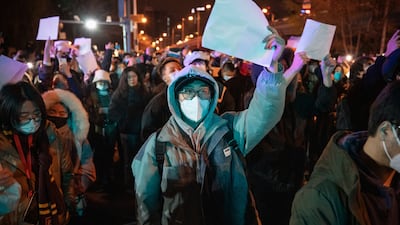
Demonstrators hold blank signs during a protest in Beijing, China. Bloomberg -
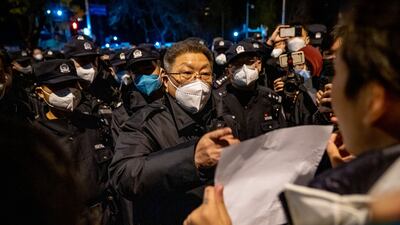
An official speaks with a demonstrator holding a blank sign, during a protest in Beijing. Bloomberg -
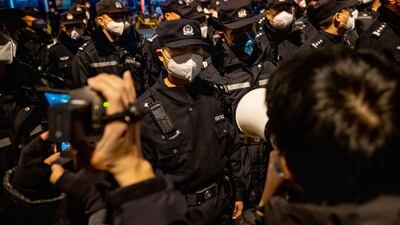
The death of at least 10 people in a fire in Urumqi, north-west China, which is under strict Covid restrictions, has led to protests nationwide. Bloomberg -
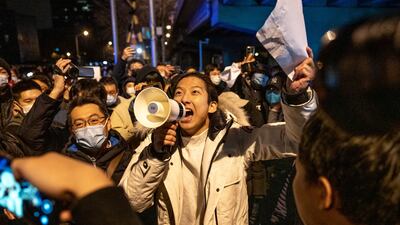
Demonstrators in Beijing. Protesters blame the deaths in Urumqi on strict Covid restrictions on leaving buildings. The authorities deny this. Bloomberg -
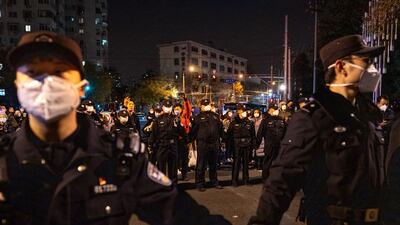
Police form a chain at Beijing protests. Demonstrations have also been reported in cities including, Shanghai, Nanjing, Chengdu, Lanzhou, Guangzhou and Wuhan – where Covid-19 was first reported. Bloomberg -
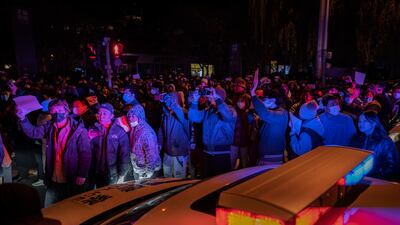
Protesters march past a police vehicle during a demonstration against China's strict zero-Covid measures, in Beijing. Getty -
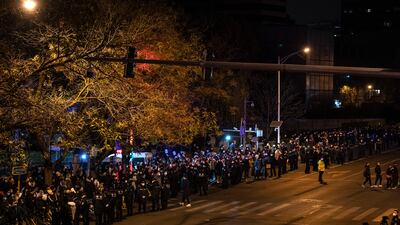
Protesters and police in Beijing. Chinese stocks fell over concerns about the impact of the demonstrations. Getty -

Demonstrators rally in Beijing. China reported more than 40,000 new cases of Covid-19 on Monday. AFP


As the year draws to a close, much of the world has moved out of the pandemic into a situation where Covid-19 is an endemic infection, thus resembling illnesses such as influenza. Short of an unexpected emergence of a much more virulent variant, this is likely to continue.
A notable exception has been China, where the zero-Covid policy, in which outbreaks lead to lockdowns in an attempt to prevent further infections, was still in place earlier this month.
Improvements in vaccination rates among elderly people may enable the country to reduce the risks of reopening.
"In China, it’s still a cause for alarm because their vaccine coverage is not so good and they’ve used the CanSino vaccine, which is not so good," said Ian Jones, professor of virology at the University of Reading in the UK.
"Maybe they need to keep on vaccinating because their immunity in the population is not at a sufficient level."
Covid-related travel restrictions were lifted entirely by many nations this year, so visitors often do not need to provide evidence of vaccination or a negative Covid-19 test to gain entry at international border control.
Exceptions remain, however, although the number of them is likely to fall next year as governments look to help their tourist industries.
In large part because the pandemic’s influence on travel is receding, the Economist Intelligence Unit forecasts that global tourism revenue will increase 30 per cent next year, on top of what it expects to be a 60 per cent increase in turnover this year.
However, even with this level of growth, the organisation said the sector would remain smaller than before the pandemic.
Medicine
A key trend set to continue next year is the move towards precision or personalised medicine, in which treatment is tailored more closely to the needs of patients.
More sophisticated genetic testing is one reason why precision medicine is advancing and the recent opening by the US biotechnology company Illumina of a centre in Dubai to carry out training in using such technology should ensure that the Middle East does not fall behind.
But other factors, too, play a role in this brave new world, with artificial intelligence and the capability to analyse large amounts of data also important.
Among the most exciting areas of precision medicine is the possible use of therapeutic messenger RNA (mRNA) vaccines against cancer.
The genetic analysis of a patient’s tumour can be used to produce an mRNA vaccine that codes for antigens specific to the tumour. The immune system then synthesises antibodies that target tumour cells.
BioNTech, the company behind one of the key mRNA Covid-19 vaccines, is set to continue work on developing its cancer mRNA vaccines next year and will begin clinical trials of mRNA vaccines for as many as five infectious diseases, including tuberculosis.
Separately, University of Pennsylvania scientists had promising lab results with an mRNA vaccine against all types of influenza. With clinical trials yet to start, that vaccine is unlikely to become widely available before 2024.
Dr Andrew Freedman, an infectious diseases specialist at Cardiff University in Wales, said mRNA was "probably the way forward for many vaccines in the future".
"Flu is the one people are focusing on and reformulated Covid vaccines. We’re already using a bivalent Covid vaccine," he said, referring to the fact that a Covid-19 vaccine that protects against both the original coronavirus and the Omicron variant is already being administered.
"They’re looking at a pan-coronavirus vaccine — it could potentially be very useful. And things like cancer vaccines. It allows all sorts of applications."

