Private companies are making travel to the Moon easier for space agencies and researchers looking to send cargo to the lunar surface.
They are taking over the difficult part of Moon missions by developing landers and technology that help achieve the complicated process of a lunar landing.
This allows scientists and engineers to focus on the science objectives during the mission.
Several companies have won contracts to deliver cargo to the lunar surface within the coming years for different countries.
In the case of private companies, I only need to focus on building my experiment and the company will deliver the payload to the Moon rather quickly
Dimitra Atri,
astrophysicist at New York University in Abu Dhabi
Japanese lunar exploration company ispace is on track to carry out the first commercial cargo mission to the Moon when it launches this month.
It will be delivering payloads from multiple countries, including rovers from the UAE and Japan and artificial intelligence technology built by a Canadian company.
US-based company Astrobotic plans to launch its Peregrine lander in early 2023, with payloads from eight countries.
Dimitra Atri, an astrophysicist at the New York University in Abu Dhabi, said this business model also benefits scientists.
“If I want to carry out a scientific experiment on the Moon, I will have to design the entire mission, propose it to a space agency, and the launch will be in about a decade from conception,” he told The National.
“In the case of private companies, I only need to focus on building my experiment and the company will deliver the payload to the Moon rather quickly.
This is more cost-effective and will create opportunities for scientists in an emerging space sector such as the UAE, Mr Atri said.
“Small missions can be carried out on two-to-three-year time scales, at a much lower cost – the UAE’s Rashid rover being a prime example.”
Landing on the Moon is no easy task and about one-third of missions fail.
Only the US, the former Soviet Union and China have achieved soft landings on the lunar surface.
Most recently, landers by India and Israel crash-landed on the surface.
“Landing on the Moon is very difficult because, unlike Earth or Mars, it does not have an atmosphere, so parachutes cannot be deployed to slow down the spacecraft,” said Dr Atri.
“Instead, one has to carry out very complex manoeuvres using thrusters, which is technologically challenging and there is no room for error.
“India and Israel’s recent attempts to land on the moon failed because of minor errors.”
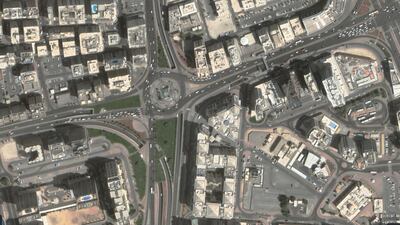
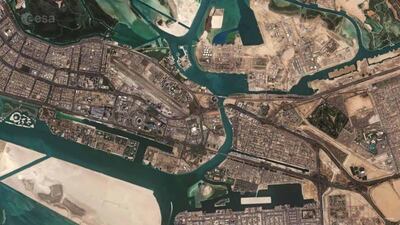
UAE landmarks from space - in pictures
Apart from delivering cargo, companies are also looking to win contracts from space agencies in space mining – a process where space resources are collected and ownership is transferred.
ispace and three other companies have been contracted by Nasa to collect regolith, or lunar soil, during their mission and then transfer ownership to the space agency.
On Tuesday, ispace announced that it received a licence from the Japanese government to carry out ‘business activity' on the lunar surface, so the regolith collection and ownership transfer can take place.
“If ispace transfers ownership of lunar resources to Nasa in accordance with its plan, it will be the first case in the world of commercial transactions of space resources on the Moon by a private operator,” said Sanae Takaichi, Japan’s Minister of State for Space Policy.
“This will be a groundbreaking first step toward the establishment of commercial space exploration by private operators.”
The Mission 1 lander will collect lunar soil on the footpad of the landing gear during touchdown.
It will photograph the collected regolith and will then carry out an ‘in-place’ transfer of ownership to Nasa.
This will make the lunar soil property of Nasa under the Artemis programme, a project by the space agency that aims to build a long-term presence of astronauts on the Moon.
Private companies will be playing an important role in the Artemis programme, including Elon Musk's SpaceX.
The company won a $2.89 billion contract in 2021 to develop the first commercial human lander that will carry the next two American astronauts to the lunar surface.

More from Armen Sarkissian
How green is the expo nursery?
Some 400,000 shrubs and 13,000 trees in the on-site nursery
An additional 450,000 shrubs and 4,000 trees to be delivered in the months leading up to the expo
Ghaf, date palm, acacia arabica, acacia tortilis, vitex or sage, techoma and the salvadora are just some heat tolerant native plants in the nursery
Approximately 340 species of shrubs and trees selected for diverse landscape
The nursery team works exclusively with organic fertilisers and pesticides
All shrubs and trees supplied by Dubai Municipality
Most sourced from farms, nurseries across the country
Plants and trees are re-potted when they arrive at nursery to give them room to grow
Some mature trees are in open areas or planted within the expo site
Green waste is recycled as compost
Treated sewage effluent supplied by Dubai Municipality is used to meet the majority of the nursery’s irrigation needs
Construction workforce peaked at 40,000 workers
About 65,000 people have signed up to volunteer
Main themes of expo is ‘Connecting Minds, Creating the Future’ and three subthemes of opportunity, mobility and sustainability.
Expo 2020 Dubai to open in October 2020 and run for six months
UAE currency: the story behind the money in your pockets
THE SIXTH SENSE
Starring: Bruce Willis, Toni Collette, Hayley Joel Osment
Director: M. Night Shyamalan
Rating: 5/5
UPI facts
More than 2.2 million Indian tourists arrived in UAE in 2023
More than 3.5 million Indians reside in UAE
Indian tourists can make purchases in UAE using rupee accounts in India through QR-code-based UPI real-time payment systems
Indian residents in UAE can use their non-resident NRO and NRE accounts held in Indian banks linked to a UAE mobile number for UPI transactions
Ten tax points to be aware of in 2026
1. Domestic VAT refund amendments: request your refund within five years
If a business does not apply for the refund on time, they lose their credit.
2. E-invoicing in the UAE
Businesses should continue preparing for the implementation of e-invoicing in the UAE, with 2026 a preparation and transition period ahead of phased mandatory adoption.
3. More tax audits
Tax authorities are increasingly using data already available across multiple filings to identify audit risks.
4. More beneficial VAT and excise tax penalty regime
Tax disputes are expected to become more frequent and more structured, with clearer administrative objection and appeal processes. The UAE has adopted a new penalty regime for VAT and excise disputes, which now mirrors the penalty regime for corporate tax.
5. Greater emphasis on statutory audit
There is a greater need for the accuracy of financial statements. The International Financial Reporting Standards standards need to be strictly adhered to and, as a result, the quality of the audits will need to increase.
6. Further transfer pricing enforcement
Transfer pricing enforcement, which refers to the practice of establishing prices for internal transactions between related entities, is expected to broaden in scope. The UAE will shortly open the possibility to negotiate advance pricing agreements, or essentially rulings for transfer pricing purposes.
7. Limited time periods for audits
Recent amendments also introduce a default five-year limitation period for tax audits and assessments, subject to specific statutory exceptions. While the standard audit and assessment period is five years, this may be extended to up to 15 years in cases involving fraud or tax evasion.
8. Pillar 2 implementation
Many multinational groups will begin to feel the practical effect of the Domestic Minimum Top-Up Tax (DMTT), the UAE's implementation of the OECD’s global minimum tax under Pillar 2. While the rules apply for financial years starting on or after January 1, 2025, it is 2026 that marks the transition to an operational phase.
9. Reduced compliance obligations for imported goods and services
Businesses that apply the reverse-charge mechanism for VAT purposes in the UAE may benefit from reduced compliance obligations.
10. Substance and CbC reporting focus
Tax authorities are expected to continue strengthening the enforcement of economic substance and Country-by-Country (CbC) reporting frameworks. In the UAE, these regimes are increasingly being used as risk-assessment tools, providing tax authorities with a comprehensive view of multinational groups’ global footprints and enabling them to assess whether profits are aligned with real economic activity.
Contributed by Thomas Vanhee and Hend Rashwan, Aurifer
ALRAWABI%20SCHOOL%20FOR%20GIRLS
%3Cp%3ECreator%3A%20Tima%20Shomali%3C%2Fp%3E%0A%3Cp%3EStarring%3A%C2%A0Tara%20Abboud%2C%C2%A0Kira%20Yaghnam%2C%20Tara%20Atalla%3C%2Fp%3E%0A%3Cp%3ERating%3A%204%2F5%3C%2Fp%3E%0A
Quick pearls of wisdom
Focus on gratitude: And do so deeply, he says. “Think of one to three things a day that you’re grateful for. It needs to be specific, too, don’t just say ‘air.’ Really think about it. If you’re grateful for, say, what your parents have done for you, that will motivate you to do more for the world.”
Know how to fight: Shetty married his wife, Radhi, three years ago (he met her in a meditation class before he went off and became a monk). He says they’ve had to learn to respect each other’s “fighting styles” – he’s a talk it-out-immediately person, while she needs space to think. “When you’re having an argument, remember, it’s not you against each other. It’s both of you against the problem. When you win, they lose. If you’re on a team you have to win together.”
Our family matters legal consultant
Name: Hassan Mohsen Elhais
Position: legal consultant with Al Rowaad Advocates and Legal Consultants.
How England have scored their set-piece goals in Russia
Three Penalties
v Panama, Group Stage (Harry Kane)
v Panama, Group Stage (Kane)
v Colombia, Last 16 (Kane)
Four Corners
v Tunisia, Group Stage (Kane, via John Stones header, from Ashley Young corner)
v Tunisia, Group Stage (Kane, via Harry Maguire header, from Kieran Trippier corner)
v Panama, Group Stage (Stones, header, from Trippier corner)
v Sweden, Quarter-Final (Maguire, header, from Young corner)
One Free-Kick
v Panama, Group Stage (Stones, via Jordan Henderson, Kane header, and Raheem Sterling, from Tripper free-kick)
THE BIO
Age: 30
Favourite book: The Power of Habit
Favourite quote: "The world is full of good people, if you cannot find one, be one"
Favourite exercise: The snatch
Favourite colour: Blue
Ferrari 12Cilindri specs
Engine: naturally aspirated 6.5-liter V12
Power: 819hp
Torque: 678Nm at 7,250rpm
Price: From Dh1,700,000
Available: Now