

Countries on the front lines of the climate crisis are using the annual UN gathering in New York this week to focus on combating global warming and call for a fossil-fuel non-proliferation treaty.
“The time is up — action is required now,” Nikenike Vurobaravu, President of the low-lying Pacific island of Vanuatu, told the General Assembly on Friday.
The non-proliferation treaty would aim to scale down coal, oil and gas production to limit the rise in temperatures to the globally agreed 1.5° Celsius.
It would also “enable a global just transition for every worker, community and nation with fossil fuel dependence”, Mr Vurobaravu said.
The UN's Intergovernmental Panel on Climate Change (IPCC) has said that emissions are on track to push global warming past the 1.5ºC limit to about 3.2ºC by the end of century.
Vanuatu, a carbon-negative country, has also asked the International Court of Justice to issue an opinion on the right to be protected from the adverse impacts of climate change, a move that Mr Vurobaravu said “is not a silver bullet for increasing climate action, but only one tool to get us closer to the goal of a safe planet for humanity”.
Pakistan Prime Minister Shehbaz Sharif, whose country has suffered floods that killed more than 1,500 people and caused damage estimated at $30 billion, asked world leaders why his people were paying the price of warming.
“Pakistan has never seen a more stark and devastating example of the impact of global warming. Life in Pakistan has changed forever,” Mr Sharif told the General Assembly on Friday. “Nature has unleashed her fury on Pakistan, without looking … at our carbon footprint.”
-
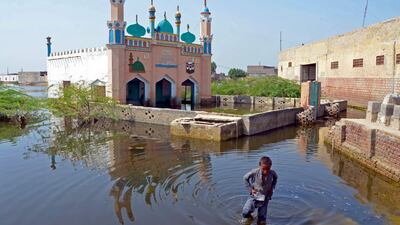
A boy wades through floodwater at Sohbatpur, Balochistan province. AFP -
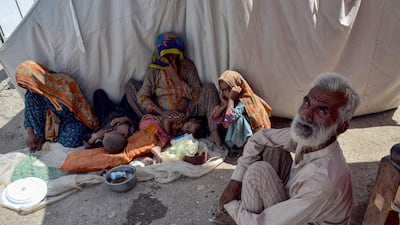
Millions of people were displaced by the floods in Pakistan. AFP -
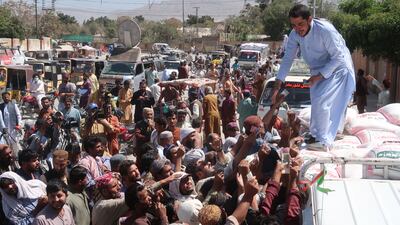
Basic food is in short supply in many areas. EPA -
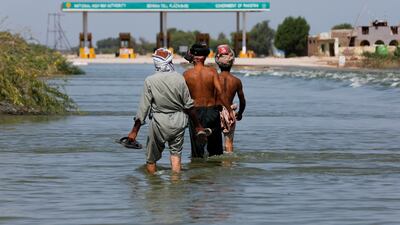
Motorways in Sehwan are flooded, making road travel impossible. Reuters -
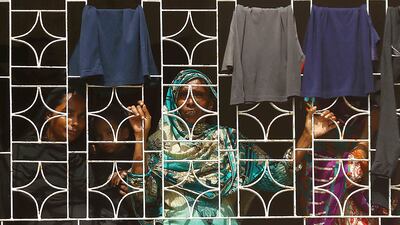
People take shelter inside a school in the aftermath of floods in Karachi. EPA -
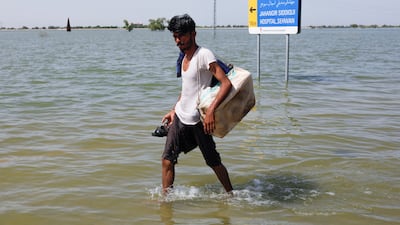
Much of the country remains submerged after torrential monsoon rain. Reuters -

Displaced families queue for relief aid in Jaffarabad. AP -

Actress and humanitarian Angelina Jolie attends a briefing at the National Flood Response and Coordination Centre in Islamabad. She said she was horrified by the aftermath of the flooding. Reuters -
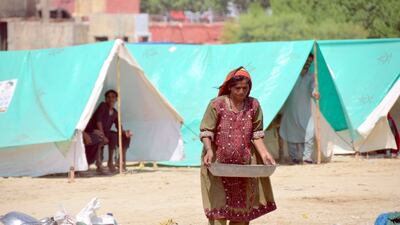
A pregnant woman carries water as she take a refuge at a camp in Jaffarabad. AP -
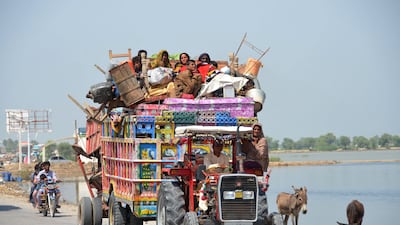
Displaced flood-affected families travel on a tractor trailer with their belongings near a makeshift camp at Dera Allah Yar in Jaffarabad. AFP -

Edhi rescue workers search for bodies of flood victims who were washed away in the Indus river near Hyderabad, Sindh province. EPA -

Food rations to be distributed to flood-affected people are sorted in Larkana. EPA -
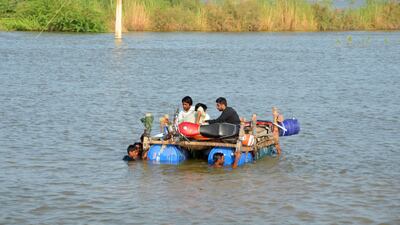
About 160 bridges and 5,000km of roads have been destroyed or damaged, 3.5 million acres of crops affected and about 800,000 livestock lost nationwide. AFP -
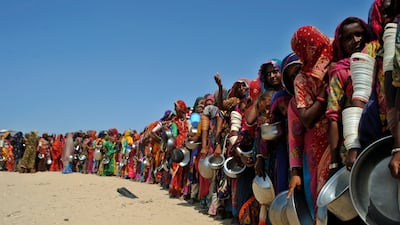
More than 33 million people have been affected by floods in Pakistan. AP


Mr Sharif said that since countries like Pakistan have emitted less than 1 per cent of the greenhouse gases that have contributed to the planet’s rapid warming, it was “entirely reasonable” for his country to expect “some approximation of justice for this loss and damage, not to mention building back better with resilience and strength”.
Around the world on Friday, young campaigners rallied for climate action, staging protests from New Zealand and Japan to Germany and the streets of New York to demand that rich countries pay for global warming damage to the poor.
The protests take place six weeks before Egypt hosts this year's UN climate summit, known as Cop27, where vulnerable countries plan to push for compensation for climate-related destruction to homes, infrastructure and livelihoods, not just funding for adaptation and mitigation.
The Paris Accord called for wealthy nations to give $100 billion a year by 2020 to help developing nations cope with climate change. That year, $83.3bn was committed, including through private sources, according to Organisation for Economic Co-operation and Development figures.
“The rich countries, the developed countries, this is their responsibility. They should come forward. But we are not getting that much response from them. That is the tragedy,” Bangladeshi Prime Minister Sheikh Hasina said in an interview with AFP in New York.
President David Kabua of the Marshall Islands called for “total war” on climate change.
President of the Marshall Islands
“We renew our call to the world to declare total war on this century's greatest challenge: the climate change monster. And yet, after all these years, the world has failed to break our addiction to fossil fuels,” Mr Kabua told the General Assembly on Tuesday.
Philippines President Ferdinand Marcos Jr said the least responsible for climate change were suffering the most.
“The Philippines is a net carbon sink, absorbing more carbon dioxide than we emit. And yet, we are the fourth most vulnerable country to climate change,” he told the UN gathering.
UN Secretary General Antonio Guterres said on Friday that the world was “not even close” to making enough progress on climate change, telling a meeting of Pacific Island leaders: “Those who did nothing to create this crisis are paying the highest price.”
Mr Guterres has also urged rich countries to tax windfall profits of fossil fuel companies and to use that money to help countries harmed by the climate crisis and people who are struggling with rising food and energy prices.
Fiji Prime Minister Frank Bainimarama said the climate war was being fought with “apathy, denial, and a lack of courage to do what we all know what must be done”, and appealed for the world to step up its efforts.
“Fiji is ready to make the coming years count for our people and for the planet — our question to you is this: Are you with us? Don't tell us yes unless you plan to show it.”
— With reporting from agencies.

