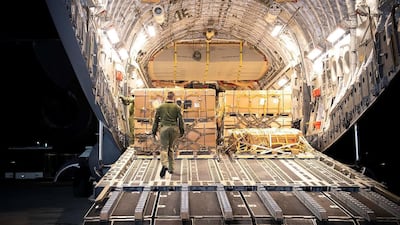
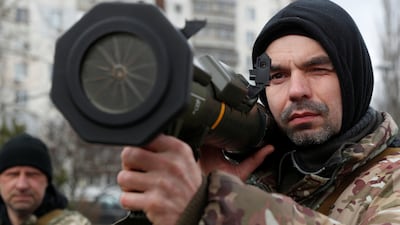
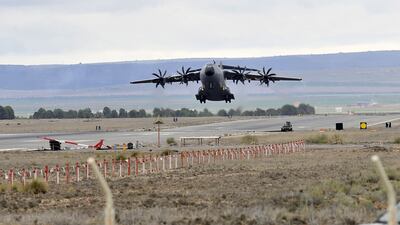
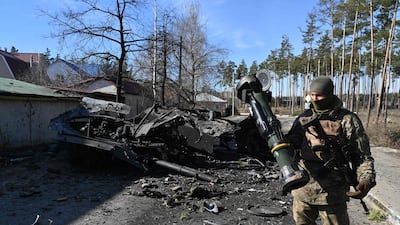
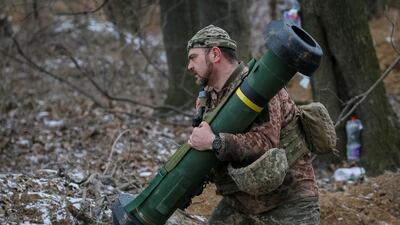
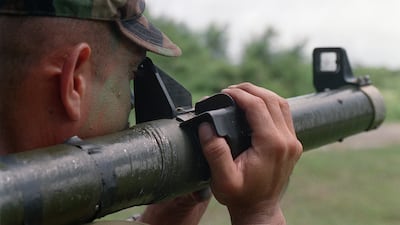
The US on Monday announced it has sent AGM-88 Harm missiles to Ukraine, designed to track and destroy radar systems — a move that could significantly boost countermeasures against Russian air defences.
Analysts have yet to determine exactly how Ukraine has used the weapon, designed to be mounted on US aircraft, as the Ukrainian air force inventory still comprises planes designed in the Soviet-era.
While a number of systems supplied to the Ukrainians are so new as to have never been used in combat, such as the NLAW anti-tank missiles supplied by the UK or Switchblade explosive drones supplied by the US, the Harm (high-speed anti-radiation missile) entered service in 1985.
The purpose of the weapon, say designers Raytheon, is to “suppress or destroy surface-to-air missile radar and radar-directed air defence artillery systems”.
It does this by identifying enemy radar signals and riding their radar beams to the target at nearly 2,300 kilometres per hour — turning the hunter into the hunted.
One of the fastest air-to-surface missiles in operation, the AGM-88, can cover 40 kilometres per minute, giving enemy air defences little time to react at distances of up to 110 kilometres, its maximum range.
It is worth noting that speed is not necessarily the winning factor — the US has invested heavily in slower, stealthy missiles to combat enemy air defences at much longer range. Such missiles, including the JASSM, were also not designed to be used with Soviet-era aircraft.
Russia has also fielded a similar missile to the AGM-88, the Kh-31P, which has a similar range and manufacturer Rosoboronexport says is “designed to destroy medium and long-range surface-to-air systems’ radars, air operations control radars and early warning radars”.
First used in 1986 during US bombing raids in Libya, the AGM-88 was used against Soviet-supplied defence systems, destroying a dozen missile batteries during the US Operation El Dorado Canyon against former dictator Muammar Qaddafi’s forces.
Can Russia defend against the Harm?
One tactic air defence systems use to avoid detection is to move quickly from one location to another and temporarily deactivate radar systems, the US military says, an approach simply known as the “switch off”.
Recent variants of the Harm, such as the AGM-88E, can defeat the switch-off approach provided they have located the enemy radar first — in this case, the AGM-88E can continue to the co-ordinates of the enemy air defence system, a capability known as “counter shutdown”.
A war of attrition
In this tactical game of cat and mouse, Russia may be able to count on absorbing higher losses than the Ukrainians.
As the conflict increasingly becomes a war of attrition where both sides seek to exhaust the enemy, Russia has sent more Buk air defence systems, according to a recent assessment by the US think tank the Institute for the Study of War.
This would add to a significant inventory of surface-to-air systems.
Russia began the conflict with an estimated 350 Buk missile launchers ― each highly capable against Ukrainian jets ― and as many as 800 S-300 launchers and the newer S-400, of which Moscow claims to have more than 200.
The last two systems have caused considerable debate among western military analysts as to whether Russia could create a “Anti-Access Area Denial” strategy, or A2AD, preventing Nato forces from entering air space near Russia.
For Ukraine, which has a far smaller air force than anything Nato can deploy, an A2AD strategy encroaching on Ukrainian territory would present a huge challenge, provided Russia can find enough trained system crews.
Russia will likely avoid deploying most of this arsenal in the conflict, holding some anti-aircraft missile batteries back to defend territory such as Kaliningrad, its territory on the Baltic coast where some S-400s are based.
Considering this, Ukraine probably faces a long war before it can degrade Russian air defences.
The analysts Stijn Mitzer and Jakub Janovsky, who have tracked Russia’s military losses since the start of the conflict on the Oryx blog, say the invasion force has lost 13 radar systems and nearly 70 surface-to-air missile systems — a fraction of its initial inventory.

What are the influencer academy modules?
- Mastery of audio-visual content creation.
- Cinematography, shots and movement.
- All aspects of post-production.
- Emerging technologies and VFX with AI and CGI.
- Understanding of marketing objectives and audience engagement.
- Tourism industry knowledge.
- Professional ethics.
Greatest of All Time
Starring: Vijay, Sneha, Prashanth, Prabhu Deva, Mohan
Jawan
%3Cp%3E%3Cstrong%3EDirector%3A%20%3C%2Fstrong%3EAtlee%3C%2Fp%3E%0A%3Cp%3E%3Cstrong%3EStars%3A%3C%2Fstrong%3E%20Shah%20Rukh%20Khan%2C%20Nayanthara%2C%20Vijay%20Sethupathi%26nbsp%3B%3C%2Fp%3E%0A%3Cp%3E%3Cstrong%3ERating%3A%20%3C%2Fstrong%3E4%2F5%3C%2Fp%3E%0A
How to donate
Text the following numbers:
2289 - Dh10
6025 - Dh 20
2252 - Dh 50
2208 - Dh 100
6020 - Dh 200
*numbers work for both Etisalat and du
Pharaoh's curse
British aristocrat Lord Carnarvon, who funded the expedition to find the Tutankhamun tomb, died in a Cairo hotel four months after the crypt was opened.
He had been in poor health for many years after a car crash, and a mosquito bite made worse by a shaving cut led to blood poisoning and pneumonia.
Reports at the time said Lord Carnarvon suffered from “pain as the inflammation affected the nasal passages and eyes”.
Decades later, scientists contended he had died of aspergillosis after inhaling spores of the fungus aspergillus in the tomb, which can lie dormant for months. The fact several others who entered were also found dead withiin a short time led to the myth of the curse.
FROM%20THE%20ASHES
%3Cp%3EDirector%3A%20Khalid%20Fahad%3C%2Fp%3E%0A%3Cp%3EStarring%3A%20Shaima%20Al%20Tayeb%2C%20Wafa%20Muhamad%2C%20Hamss%20Bandar%3C%2Fp%3E%0A%3Cp%3ERating%3A%203%2F5%3C%2Fp%3E%0A
PROFILE OF HALAN
Started: November 2017
Founders: Mounir Nakhla, Ahmed Mohsen and Mohamed Aboulnaga
Based: Cairo, Egypt
Sector: transport and logistics
Size: 150 employees
Investment: approximately $8 million
Investors include: Singapore’s Battery Road Digital Holdings, Egypt’s Algebra Ventures, Uber co-founder and former CTO Oscar Salazar
The specs
Engine: 4.0-litre, six-cylinder
Transmission: six-speed manual
Power: 395bhp
Torque: 420Nm
Price: from Dh321,200
On sale: now
About RuPay
A homegrown card payment scheme launched by the National Payments Corporation of India and backed by the Reserve Bank of India, the country’s central bank
RuPay process payments between banks and merchants for purchases made with credit or debit cards
It has grown rapidly in India and competes with global payment network firms like MasterCard and Visa.
In India, it can be used at ATMs, for online payments and variations of the card can be used to pay for bus, metro charges, road toll payments
The name blends two words rupee and payment
Some advantages of the network include lower processing fees and transaction costs
Benefits of first-time home buyers' scheme
- Priority access to new homes from participating developers
- Discounts on sales price of off-plan units
- Flexible payment plans from developers
- Mortgages with better interest rates, faster approval times and reduced fees
- DLD registration fee can be paid through banks or credit cards at zero interest rates
Anghami
Started: December 2011
Co-founders: Elie Habib, Eddy Maroun
Based: Beirut and Dubai
Sector: Entertainment
Size: 85 employees
Stage: Series C
Investors: MEVP, du, Mobily, MBC, Samena Capital
Mercer, the investment consulting arm of US services company Marsh & McLennan, expects its wealth division to at least double its assets under management (AUM) in the Middle East as wealth in the region continues to grow despite economic headwinds, a company official said.
Mercer Wealth, which globally has $160 billion in AUM, plans to boost its AUM in the region to $2-$3bn in the next 2-3 years from the present $1bn, said Yasir AbuShaban, a Dubai-based principal with Mercer Wealth.
“Within the next two to three years, we are looking at reaching $2 to $3 billion as a conservative estimate and we do see an opportunity to do so,” said Mr AbuShaban.
Mercer does not directly make investments, but allocates clients’ money they have discretion to, to professional asset managers. They also provide advice to clients.
“We have buying power. We can negotiate on their (client’s) behalf with asset managers to provide them lower fees than they otherwise would have to get on their own,” he added.
Mercer Wealth’s clients include sovereign wealth funds, family offices, and insurance companies among others.
From its office in Dubai, Mercer also looks after Africa, India and Turkey, where they also see opportunity for growth.
Wealth creation in Middle East and Africa (MEA) grew 8.5 per cent to $8.1 trillion last year from $7.5tn in 2015, higher than last year’s global average of 6 per cent and the second-highest growth in a region after Asia-Pacific which grew 9.9 per cent, according to consultancy Boston Consulting Group (BCG). In the region, where wealth grew just 1.9 per cent in 2015 compared with 2014, a pickup in oil prices has helped in wealth generation.
BCG is forecasting MEA wealth will rise to $12tn by 2021, growing at an annual average of 8 per cent.
Drivers of wealth generation in the region will be split evenly between new wealth creation and growth of performance of existing assets, according to BCG.
Another general trend in the region is clients’ looking for a comprehensive approach to investing, according to Mr AbuShaban.
“Institutional investors or some of the families are seeing a slowdown in the available capital they have to invest and in that sense they are looking at optimizing the way they manage their portfolios and making sure they are not investing haphazardly and different parts of their investment are working together,” said Mr AbuShaban.
Some clients also have a higher appetite for risk, given the low interest-rate environment that does not provide enough yield for some institutional investors. These clients are keen to invest in illiquid assets, such as private equity and infrastructure.
“What we have seen is a desire for higher returns in what has been a low-return environment specifically in various fixed income or bonds,” he said.
“In this environment, we have seen a de facto increase in the risk that clients are taking in things like illiquid investments, private equity investments, infrastructure and private debt, those kind of investments were higher illiquidity results in incrementally higher returns.”
The Abu Dhabi Investment Authority, one of the largest sovereign wealth funds, said in its 2016 report that has gradually increased its exposure in direct private equity and private credit transactions, mainly in Asian markets and especially in China and India. The authority’s private equity department focused on structured equities owing to “their defensive characteristics.”