


Nasa will release the "deepest image of the universe" on July 12, the first of the scientific photographs taken by the space agency’s $10 billion James Webb Space Telescope.
The in-depth, full-colour pictures will depict places much further away taken those by the Hubble Space Telescope of galaxies formed a few hundred million years after the birth of the universe.
The Hubble was launched into low Earth orbit in 1990 and remains in operation.
Nasa officials held a virtual media briefing on Wednesday, to offer an idea of what the pictures taken by the world’s most powerful space telescope would reveal.
Some photos have already been taken by James Webb to test the telescope, but now the science operations have started.
“We are going to give humanity a new view of the cosmos, it’s a view we have never seen before,” said Bill Nelson, Nasa’s administrator.
“One of those images is the deepest image of our universe that has ever been taken.
“This is further than humanity has ever looked before and we’re only beginning to understand what Webb can and will do.
“It will explore objects in the solar system, atmospheres of exoplanets orbiting other stars, giving us clues if their atmospheres are similar to our own.”

Scientific images are produced within a specific discipline for research purposes and those to be presented on July 12 are likely to include a spectrum of planets outside of our solar system.
This could help astronomers to find out how the planet was formed.
“It may answer some questions that we have, where do we come from, what more is out there, who are we and of course it’ll answer some questions that we don’t even know what the questions are,” said Mr Nelson.
“In many ways, Webb’s journey has just begun.”
It was also revealed that the telescope, which took more than 20 years to build and was launched in December, has enough fuel for 20 years of operation.
Pamela Melroy, deputy administrator of Nasa, said it will be the focus of the space agency’s astrophysics mission.
“Not only will those 20 years allow us to go deeper into history and time, but we’ll go deeper in science because we have the time to learn and grow and make new observations,” she said.
Described as a time-travel machine, the space observatory is 100 times more powerful than the Hubble, which for 31 years has made countless discoveries and provided millions of images of planets, galaxies, nebulas and stars.
It is orbiting the Sun, in a place called the Lagrange Point — a position in space that allows the telescope to reach deeper into the universe.
The observatory’s cameras are so sensitive they can spot the heat signature of a bumblebee on the Moon's surface.
James Webb Telescope launch - in pictures
-
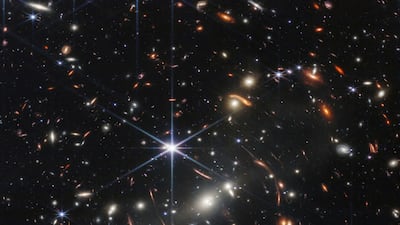
The first full-color image from Nasa's James Webb Space Telescope shows the galaxy cluster SMACS 0723. Photo: Nasa -
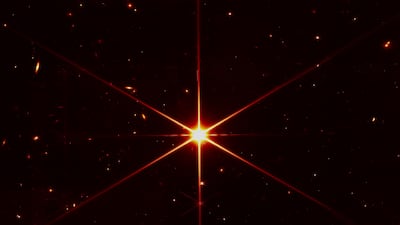
The hexagonal shape of the James Webb Telescope's mirrors and its filters made this shimmering star look more red and spiky. Some photos have already been taken by James Webb to test the telescope, but now the scientific operations have started and new images will be revealed next month. Photo: Nasa / AP -
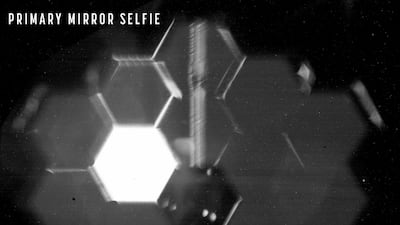
This photo provided by NASA shows a “selfie” created using a specialized pupil imaging lens inside of the NIRCam instrument that was designed to take images of the primary mirror segments instead of images of space. (NASA via AP) -
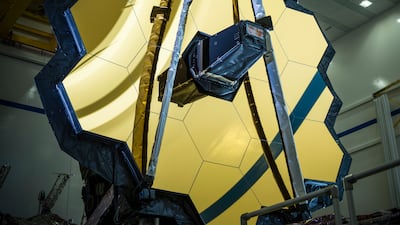
Webb is able to look back in time 13 billion years, a mere 100 million years after the Big Bang. AP -
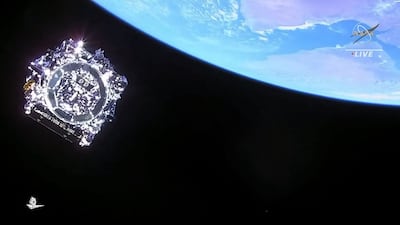
The James Webb Space Telescope separates from Arianespace's Ariane 5 rocket. AFP -
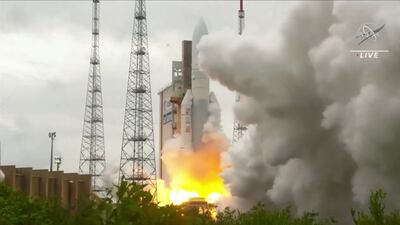
Arianespace's Ariane 5 rocket, with Nasa's James Webb Space Telescope on board, takes off from the Guiana Space Centre in Kourou, French Guiana, on December 25, 2021. Reuters -
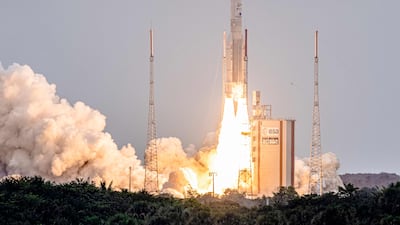
The James Webb Space Telescope will help answer fundamental questions about the universe, peering back in time 13 billion years. AFP -
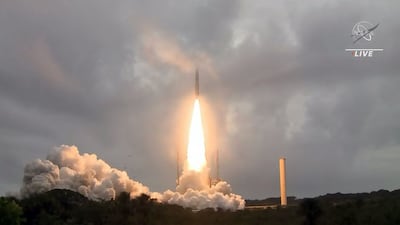
Three decades and billions of dollars in the making, the world's most powerful space telescope will take up its position 1.5 million kilometres from the Earth. AFP -
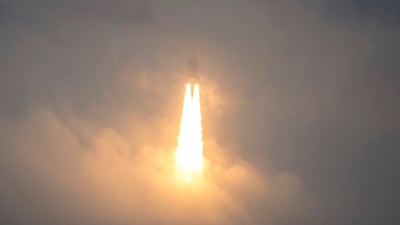
Nasa's James Webb Space Telescope is carried by rocket from Europe's Spaceport in French Guiana. AFP -

This combination of images from an animation made available by Nasa shows the unfolding of the components of the James Webb Space Telescope. Webb is so big that it had to be folded origami-style to fit into the nose cone of the Ariane rocket. AP



