The Boynuyogun refugee camp in Hatay, Turkey, on September 16, 2019, which houses around 8,500 refugees from northern Syria. Getty

Turkey's President Erdogan clarifies controversial Syrian refugee plan after criticism


  • English
  • Arabic

President Recep Tayyip Erdogan’s ruling Justice and Development Party (AKP) has been forced to clarify a plan to repatriate one million Syrian refugees who have sought refuge in the country, following the decade-long civil war that displaced around 12 million Syrians.

Mr Erdogan reiterated at a meeting with the Turkish business community on Monday that Syrians in Turkey would not be forced to return to their home country and would be “protected until the end” if they wished to remain.

Turkey hosts one of the largest refugee populations in the world, with around four million Syrian refugees taking refuge in the country.

Parts of northern and central Syria still see sporadic violence between the regime of Bashar Al Assad and militant Syrian rebel groups. Many refugees say they do not want to return, fearing security forces could detain them for suspected sympathy for rebels.

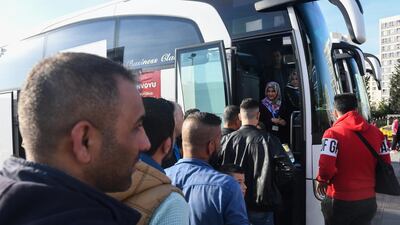
  • Syrian refugees board buses to take them back to their country in the Esenyurt district of Istanbul on November 6, 2019. Emrah Gurel for The National
    Syrian refugees board buses to take them back to their country in the Esenyurt district of Istanbul on November 6, 2019. Emrah Gurel for The National
  • A total of 143 Syrian refugees were sent back to their homelands in Jarablus, Damascus, Aleppo, Azaz, Al Bab and Afrin in Syria. Emrah Gurel for The National
    A total of 143 Syrian refugees were sent back to their homelands in Jarablus, Damascus, Aleppo, Azaz, Al Bab and Afrin in Syria. Emrah Gurel for The National
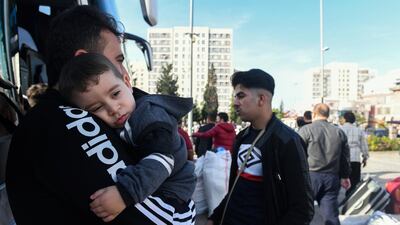
  • A Syrian refugees holds his child as they board one of the buses at Esenyurt Municipality garden in Istanbul, Turkey. Emrah Gurel for The National
    A Syrian refugees holds his child as they board one of the buses at Esenyurt Municipality garden in Istanbul, Turkey. Emrah Gurel for The National
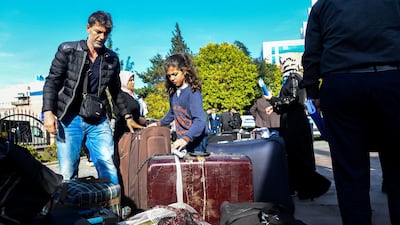
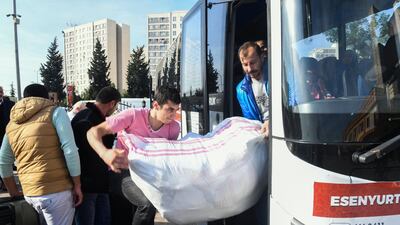
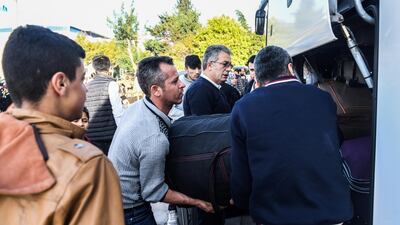
  • Syrian families load their belongings on to buses at the Esenyurt Municipality garden in Istanbul before being driven to Syria. Emrah Gurel for The National
    Syrian families load their belongings on to buses at the Esenyurt Municipality garden in Istanbul before being driven to Syria. Emrah Gurel for The National
  • Syrian families load their belongings on to buses at the Esenyurt Municipality garden in Istanbul before being driven to Syria. Emrah Gurel for The National
    Syrian families load their belongings on to buses at the Esenyurt Municipality garden in Istanbul before being driven to Syria. Emrah Gurel for The National
  • Syrians to prepare to return to their homeland aboard buses departing from the Esenyurt Municipality garden in Istanbul, Turkey. Emrah Gurel for The National
    Syrians to prepare to return to their homeland aboard buses departing from the Esenyurt Municipality garden in Istanbul, Turkey. Emrah Gurel for The National
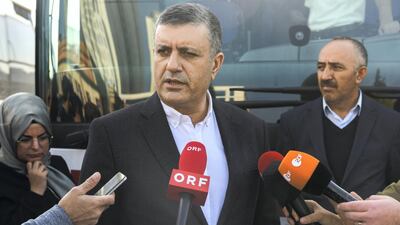
  • The mayor of Esenyurt, Kemal Deniz Bozkurt holds a press briefing about the departure of the Syrian refugees. Emrah Gurel for The National
    The mayor of Esenyurt, Kemal Deniz Bozkurt holds a press briefing about the departure of the Syrian refugees. Emrah Gurel for The National
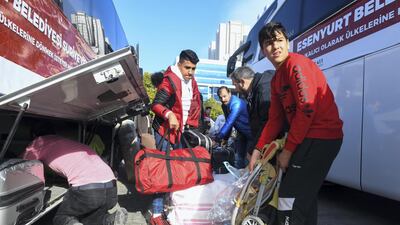
  • Syrian families load their belongings on to buses at the Esenyurt Municipality garden in Istanbul before being driven to Syria. Emrah Gurel for The National
    Syrian families load their belongings on to buses at the Esenyurt Municipality garden in Istanbul before being driven to Syria. Emrah Gurel for The National
  • Syrian families load their belongings on to buses at the Esenyurt Municipality garden in Istanbul before being driven to Syria. Emrah Gurel for The National
    Syrian families load their belongings on to buses at the Esenyurt Municipality garden in Istanbul before being driven to Syria. Emrah Gurel for The National
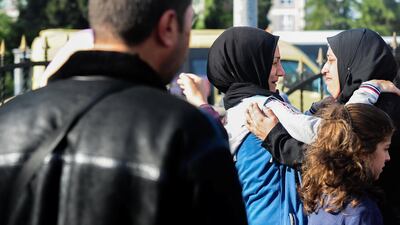
  • Syrian refugees board buses taking them back to Syria from Turkey at the Esenyurt Municipality garden in Istanbul on November 6, 2019. Emrah Gurel for The National
    Syrian refugees board buses taking them back to Syria from Turkey at the Esenyurt Municipality garden in Istanbul on November 6, 2019. Emrah Gurel for The National
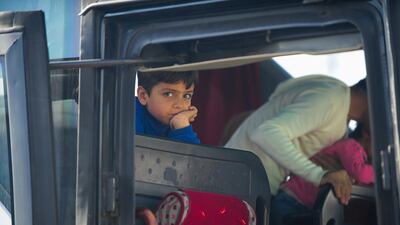
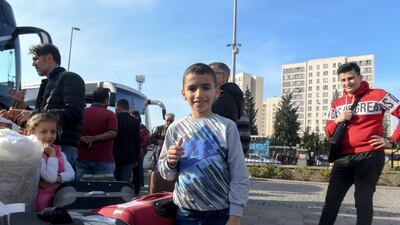
  • A Syrian boy gestures as he waits to leave for Syria with his family at the Esenyurt Municipality garden in Istanbul, Turkey. Emrah Gurel for The National
    A Syrian boy gestures as he waits to leave for Syria with his family at the Esenyurt Municipality garden in Istanbul, Turkey. Emrah Gurel for The National

But since 2016, Turkish forces have occupied parts of Syria after staging a number of military operations to counter Syrian-Kurdish militia forces, the People’s Protection Units, or YPG, and the terror group ISIS.

Those areas, dubbed “safe zones” by Turkey, are a mixture of Kurdish majority areas occupied by Turkish forces and allied Syrian rebel groups, who are funded and trained by Ankara, as well as Arab majority areas around the governorate of Idlib and parts of Aleppo.

“We will protect these brothers who have fled war to the end,” Mr Erdogan said on Monday in Istanbul. “They may go if they wish, but we will never chase them away. We won’t throw them onto the laps of murderers.”

Ankara has since spent about $100 billion on housing, medical care and schooling for Syrians over more than a decade, as it opposed the regime of Bashar Al Assad.

But support for that policy has fallen as a surging cost-of-living crisis engulfs ordinary Turks, and the debate is set to intensify ahead of elections next year.

Mr Erdogan said last week the government wanted to enable the voluntary return of one million Syrians to areas secured by Turkish and allied forces in northern Syria.

That kicked off criticism by opponents including the main opposition Republican People’s Party, which said the president was making a U-turn on his refugee policy to appease voters.

On Monday, Erdogan urged his business audience to contribute to building homes for migrants that wished to go back.


Mercer, the investment consulting arm of US services company Marsh & McLennan, expects its wealth division to at least double its assets under management (AUM) in the Middle East as wealth in the region continues to grow despite economic headwinds, a company official said.

Mercer Wealth, which globally has $160 billion in AUM, plans to boost its AUM in the region to $2-$3bn in the next 2-3 years from the present $1bn, said Yasir AbuShaban, a Dubai-based principal with Mercer Wealth.

Within the next two to three years, we are looking at reaching $2 to $3 billion as a conservative estimate and we do see an opportunity to do so,” said Mr AbuShaban.

Mercer does not directly make investments, but allocates clients’ money they have discretion to, to professional asset managers. They also provide advice to clients.

“We have buying power. We can negotiate on their (client’s) behalf with asset managers to provide them lower fees than they otherwise would have to get on their own,” he added.

Mercer Wealth’s clients include sovereign wealth funds, family offices, and insurance companies among others.

From its office in Dubai, Mercer also looks after Africa, India and Turkey, where they also see opportunity for growth.

Wealth creation in Middle East and Africa (MEA) grew 8.5 per cent to $8.1 trillion last year from $7.5tn in 2015, higher than last year’s global average of 6 per cent and the second-highest growth in a region after Asia-Pacific which grew 9.9 per cent, according to consultancy Boston Consulting Group (BCG). In the region, where wealth grew just 1.9 per cent in 2015 compared with 2014, a pickup in oil prices has helped in wealth generation.

BCG is forecasting MEA wealth will rise to $12tn by 2021, growing at an annual average of 8 per cent.

Drivers of wealth generation in the region will be split evenly between new wealth creation and growth of performance of existing assets, according to BCG.

Another general trend in the region is clients’ looking for a comprehensive approach to investing, according to Mr AbuShaban.

“Institutional investors or some of the families are seeing a slowdown in the available capital they have to invest and in that sense they are looking at optimizing the way they manage their portfolios and making sure they are not investing haphazardly and different parts of their investment are working together,” said Mr AbuShaban.

Some clients also have a higher appetite for risk, given the low interest-rate environment that does not provide enough yield for some institutional investors. These clients are keen to invest in illiquid assets, such as private equity and infrastructure.

“What we have seen is a desire for higher returns in what has been a low-return environment specifically in various fixed income or bonds,” he said.

“In this environment, we have seen a de facto increase in the risk that clients are taking in things like illiquid investments, private equity investments, infrastructure and private debt, those kind of investments were higher illiquidity results in incrementally higher returns.”

The Abu Dhabi Investment Authority, one of the largest sovereign wealth funds, said in its 2016 report that has gradually increased its exposure in direct private equity and private credit transactions, mainly in Asian markets and especially in China and India. The authority’s private equity department focused on structured equities owing to “their defensive characteristics.”

Gender pay parity on track in the UAE

The UAE has a good record on gender pay parity, according to Mercer's Total Remuneration Study.

"In some of the lower levels of jobs women tend to be paid more than men, primarily because men are employed in blue collar jobs and women tend to be employed in white collar jobs which pay better," said Ted Raffoul, career products leader, Mena at Mercer. "I am yet to see a company in the UAE – particularly when you are looking at a blue chip multinationals or some of the bigger local companies – that actively discriminates when it comes to gender on pay."

Mr Raffoul said most gender issues are actually due to the cultural class, as the population is dominated by Asian and Arab cultures where men are generally expected to work and earn whereas women are meant to start a family.

"For that reason, we see a different gender gap. There are less women in senior roles because women tend to focus less on this but that’s not due to any companies having a policy penalising women for any reasons – it’s a cultural thing," he said.

As a result, Mr Raffoul said many companies in the UAE are coming up with benefit package programmes to help working mothers and the career development of women in general. 

The National's picks

4.35pm: Tilal Al Khalediah
5.10pm: Continous
5.45pm: Raging Torrent
6.20pm: West Acre
7pm: Flood Zone
7.40pm: Straight No Chaser
8.15pm: Romantic Warrior
8.50pm: Calandogan
9.30pm: Forever Young

UAE currency: the story behind the money in your pockets
The specs: 2018 Jaguar E-Pace First Edition

Price, base / as tested: Dh186,480 / Dh252,735

Engine: 2.0-litre four-cylinder

Power: 246hp @ 5,500rpm

Torque: 365Nm @ 1,200rpm

Transmission: Nine-speed automatic

Fuel consumption, combined: 7.7L / 100km

COMPANY%20PROFILE
%3Cp%3E%3Cstrong%3ECompany%20name%3A%3C%2Fstrong%3E%20Switch%20Foods%3Cbr%3E%3Cstrong%3EStarted%3A%3C%2Fstrong%3E%202022%3Cbr%3E%3Cstrong%3EFounder%3A%3C%2Fstrong%3E%20Edward%20Hamod%3Cbr%3E%3Cstrong%3EBased%3A%3C%2Fstrong%3E%20Abu%20Dhabi%2C%20UAE%3Cbr%3E%3Cstrong%3EIndustry%3A%3C%2Fstrong%3E%20Plant-based%20meat%20production%3Cbr%3E%3Cstrong%3ENumber%20of%20employees%3A%3C%2Fstrong%3E%2034%3Cbr%3E%3Cstrong%3EFunding%3A%3C%2Fstrong%3E%20%246.5%20million%3Cbr%3E%3Cstrong%3EFunding%20round%3A%3C%2Fstrong%3E%20Seed%3Cbr%3E%3Cstrong%3EInvestors%3A%3C%2Fstrong%3E%20Based%20in%20US%20and%20across%20Middle%20East%3C%2Fp%3E%0A
Other acts on the Jazz Garden bill

Sharrie Williams
The American singer is hugely respected in blues circles due to her passionate vocals and songwriting. Born and raised in Michigan, Williams began recording and touring as a teenage gospel singer. Her career took off with the blues band The Wiseguys. Such was the acclaim of their live shows that they toured throughout Europe and in Africa. As a solo artist, Williams has also collaborated with the likes of the late Dizzy Gillespie, Van Morrison and Mavis Staples.
Lin Rountree
An accomplished smooth jazz artist who blends his chilled approach with R‘n’B. Trained at the Duke Ellington School of the Arts in Washington, DC, Rountree formed his own band in 2004. He has also recorded with the likes of Kem, Dwele and Conya Doss. He comes to Dubai on the back of his new single Pass The Groove, from his forthcoming 2018 album Stronger Still, which may follow his five previous solo albums in cracking the top 10 of the US jazz charts.
Anita Williams
Dubai-based singer Anita Williams will open the night with a set of covers and swing, jazz and blues standards that made her an in-demand singer across the emirate. The Irish singer has been performing in Dubai since 2008 at venues such as MusicHall and Voda Bar. Her Jazz Garden appearance is career highlight as she will use the event to perform the original song Big Blue Eyes, the single from her debut solo album, due for release soon.

COMPANY%20PROFILE
%3Cp%3E%3Cstrong%3ECompany%20name%3A%3C%2Fstrong%3E%20Silkhaus%3C%2Fp%3E%0A%3Cp%3E%3Cstrong%3EStarted%3A%3C%2Fstrong%3E%202021%3C%2Fp%3E%0A%3Cp%3E%3Cstrong%3EFounders%3A%3C%2Fstrong%3E%20Aahan%20Bhojani%20and%20Ashmin%20Varma%3C%2Fp%3E%0A%3Cp%3E%3Cstrong%3EBased%3A%3C%2Fstrong%3E%20Dubai%2C%20UAE%3C%2Fp%3E%0A%3Cp%3E%3Cstrong%3EIndustry%3A%3C%2Fstrong%3E%20Property%20technology%3C%2Fp%3E%0A%3Cp%3E%3Cstrong%3EFunding%3A%3C%2Fstrong%3E%20%247.75%20million%3C%2Fp%3E%0A%3Cp%3E%3Cstrong%3EInvestors%3A%3C%2Fstrong%3E%20Nuwa%20Capital%2C%20VentureSouq%2C%20Nordstar%2C%20Global%20Founders%20Capital%2C%20Yuj%20Ventures%20and%20Whiteboard%20Capital%3C%2Fp%3E%0A
Some of Darwish's last words

"They see their tomorrows slipping out of their reach. And though it seems to them that everything outside this reality is heaven, yet they do not want to go to that heaven. They stay, because they are afflicted with hope." - Mahmoud Darwish, to attendees of the Palestine Festival of Literature, 2008

His life in brief: Born in a village near Galilee, he lived in exile for most of his life and started writing poetry after high school. He was arrested several times by Israel for what were deemed to be inciteful poems. Most of his work focused on the love and yearning for his homeland, and he was regarded the Palestinian poet of resistance. Over the course of his life, he published more than 30 poetry collections and books of prose, with his work translated into more than 20 languages. Many of his poems were set to music by Arab composers, most significantly Marcel Khalife. Darwish died on August 9, 2008 after undergoing heart surgery in the United States. He was later buried in Ramallah where a shrine was erected in his honour.

The specs

Engine: 2.0-litre 4-cylturbo

Transmission: seven-speed DSG automatic

Power: 242bhp

Torque: 370Nm

Price: Dh136,814

Updated: May 10, 2022, 7:54 AM