Timeline of the formation and breakup of Yugoslavia, 30 years on - in pictures
-

Timeline of Yugoslavia's formation and breakup: Nazi soldiers of the German Wehrmacht advance in Nis, Yugoslavia, in April 1941. Getty -

Field Marshal Harold Alexander, left, confers over a large map with Gen Josip Tito at the latter's residence, the White Palace in Belgrade. Tito was president of Yugoslavia from 1953 until his death in 1980. Getty -
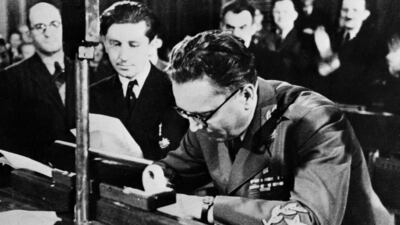
Tito signs the declaration establishing the Federal People's Republic of Yugoslavia in Belgrade on March 7, 1945. AFP -
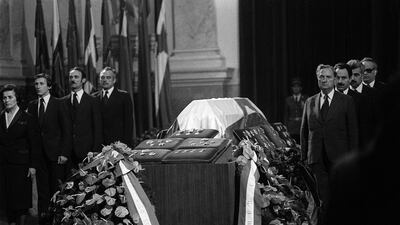
Personalities attend Tito's funeral at the Yugoslav parliament on May 8, 1980, in Belgrade. AFP -
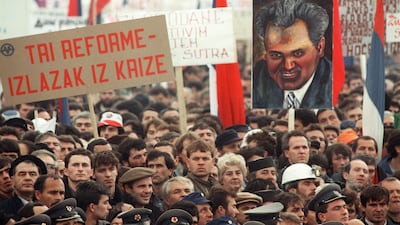
After Tito's death, Serbia seeks to establish greater control over the country, leading to tensions with other ethnic groups. Here, demonstrators attend a Serbian nationalist rally in Belgrade on November 19, 1988, hours after ethnic Albanians took to the streets in Kosovo to protest Serbian repression. AFP -

Slobodan Milosevic addresses Serbs in Gazimestan, the field in Kosovo where Serbs lost a battle against the Turks six centuries prior, on June 28, 1989. Milosovic became president of Serbia in 1989. AP -
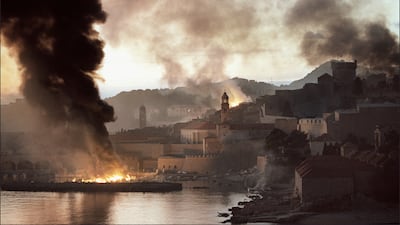
Smoke and flames rise from the walled city of Dubrovnik on November 12, 1991. The city was heavily bombarded by the Serbian-dominated Yugoslavian Federal Army after Croatia declared independence. AFP -
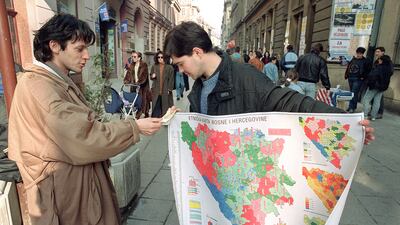
A street seller holds a map showing the ethnic distribution of Bosnia-Herzegovina on March 1, 1992 amid a state-wide vote on independence. AFP -

A Bosnian soldier returns fire as he and civilians come under fire from Serbian snipers in downtown Sarajevo on April 6, 1992. Serb extremists were shooting from the roof of a hotel at a peace demonstration of about 30,000 people as fighting between Bosnian and Serb fighters escalated. AFP -
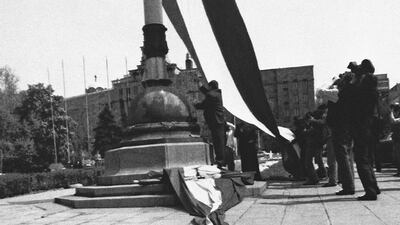
The old Yugoslav flag, with the Socialist red star symbol, is removed as the new one without the red star is flown on Monday, April 27, 1992 in Belgrade after the proclamation of the constitution in New Yugoslavia. The new state was announced as the unification of Serbia and Montenegro, despite western threats that the new state could lose diplomatic recognition and UN membership as the old Yugoslavia. AP -
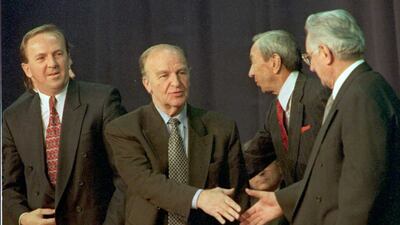
Federation of Bosnia-Herzegovina President Kresimir Zubak, left, looks on as Bosnian President Alija Izetbegovic, second left, and Republic of Croatia President Franjo Tudjman, right, shake hands on November 10, 1995. Bosnia and Croatia signed an agreement toward reconciliation in the former Yugoslavia. AFP -
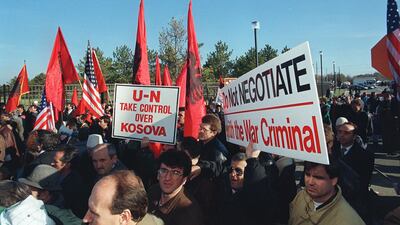
Hundreds of ethnic Albanians from the Serbian province of Kosovo protest against the inclusion of Serbia and its president Slobodan Milosevic in the peace talks between Bosnia, Croatia and Serbia, on November 19, 1995. AFP -

Inside a US Airforce KC-135 tanker for inflight refuelling over the skies of Albania on June 17, 1998, as part of "Operation Determined Falcon". Nato forces stepped up military exercises as the conflict in Kosovo spread beyond the borders of Serbia. Nato would go on to intervene by striking Bosnian Serb forces. Getty -
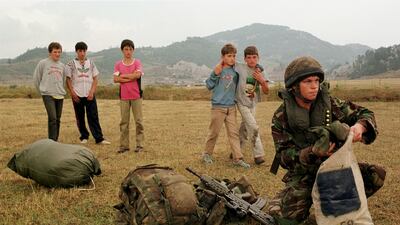
A UK paratrooper captures the attention of young Albanians after a parachute jump on August 17, 1998, during the Kosovo War. Getty -
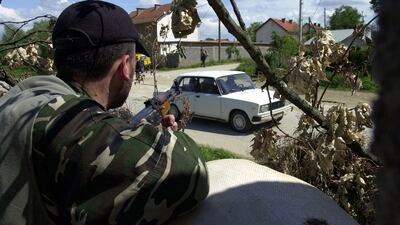
A rebel of the ethnic Albanian UCK movement mans a position on May 13, 2001 in the northern Macedonian town of Slupcane. Fighting ended with a Nato ceasefire monitoring force and the Albanian side agreed to give up separatist demands. AFP -
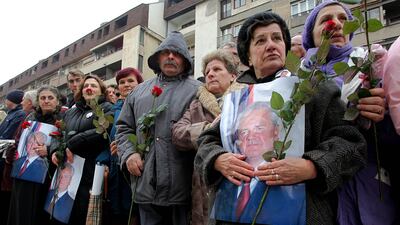
Supporters of Milosevic mourn their idol as they line the route of the funeral procession on March 18, 2006, in Pozarevac, Serbia and Montenegro. He died in his prison cell in The Hague while being tried for crimes against humanity. Getty Images -
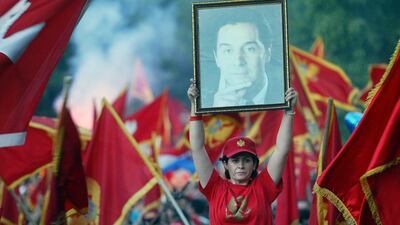
Montenegrin pro-independence supporters celebrate their newly found independence on May 22, 2006 in the town of Cetinje. Montenegro laid its own claim to nation status after voting narrowly in favour of independence, consigning the last vestiges of former Yugoslavia to history. AFP -
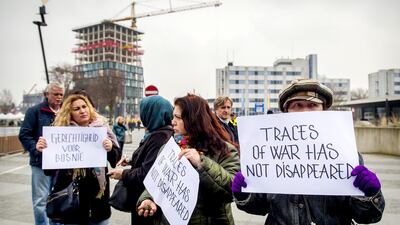
Protesters outside the International Criminal Tribunal for Former Yugoslavia in The Hague, on March 24, 2016, before the verdict in the trial of former Bosnian Serb leader Radovan Karadzic. He was found guilty of genocide and sentenced to 40 years in jail over the worst atrocities in Europe since the Second World War. AFP -

Signs are changed at the border between Macedonia and Greece near Gevgelija on February 13, 2019, to read North Macedonia after objections from Athens because Greece has a northern province of the same name. AFP


Most popular today

