


In November 2021, defence analysts noticed that Russian tanks were sporting strange cages on top of their turrets.
Unmistakably, this was “slat armour”, or cage armour, designed to deflect incoming anti-tank missiles or shells, knocking them off trajectory, crushing their fuses before they hit the tank’s main armour or detonating them before they reach the tank.
Evidently, the armour has not been effective, as shown by conflict monitors who have identified hundreds of destroyed Russian tanks, many with the cages lying idly beside the wrecks.
-
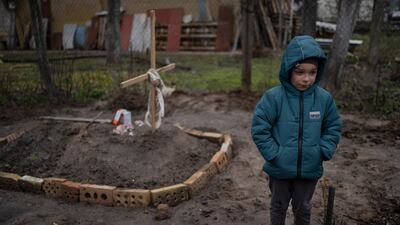
In the courtyard of their house, Vlad Tanyuk, 6, stands near the grave of his mother Ira Tanyuk, who died because of starvation and stress due to the war, on the outskirts of Kyiv. AP -
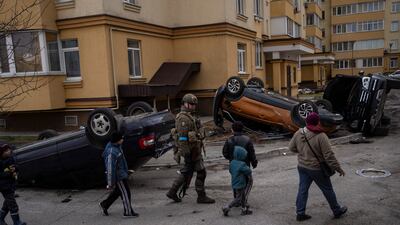
A Ukrainian soldier walks with children passing destroyed cars due to the war against Russia, in Bucha, on the outskirts of Kyiv, Ukraine. AP -
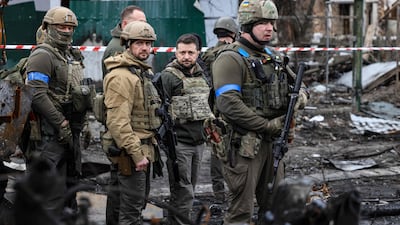
President Volodymyr Zelenskyy surveys the destruction in Bucha. AFP -
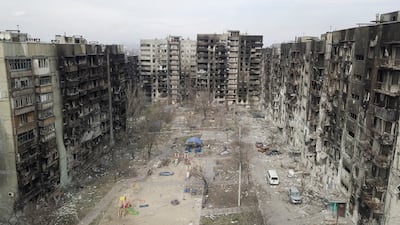
Residential buildings damaged during fighting in the southern port city of Mariupol. Reuters -

A bridge damaged by shelling in Bucha. EPA -

A soldier stationed in Bucha, after the city was the recaptured by the Ukrainian army. EPA -

Chervona Voloshin kisses Varvara Statenova goodbye as she heads home to Kyiv after being housed at a shelter for displaced people in Lviv, Ukraine. Getty Images -
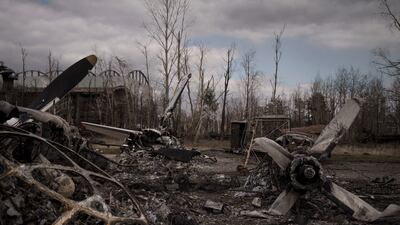
Parts of a destroyed aircraft at the Antonov airport in Hostomel, outskirts of Kyiv. AP -
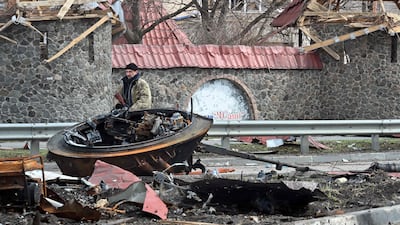
A Ukrainian territorial defence serviceman walks past a destroyed Russian armoured personnel carrier in the town of Borodianka, north-west of Kyiv. AFP -

Tanya Nedashkivska recounts how her husband Vasyl Ivanovych, who served in Ukraine’s navy, was killed by Russian soldiers, in Bucha, Ukraine. He was arrested by Russian soldiers. Tanya looked for him for days and found him in a building's basement where two bodies were lying. She recognised him by his shoes and trousers. AP -
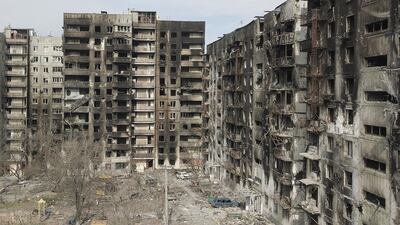
Damaged residential buildings in the southern port city of Mariupol. Reuters -
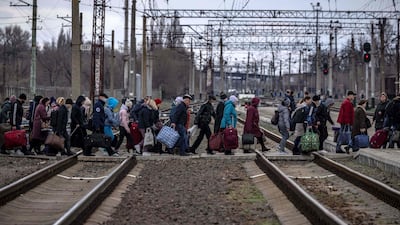
Families arrive to board a train at Kramatorsk central station as they flee the eastern city, in the Donbas region. AFP -

Romanian politicians listen to President Zelenskyy’s speech by video link, on a screen in the parliament in Bucharest. AP -
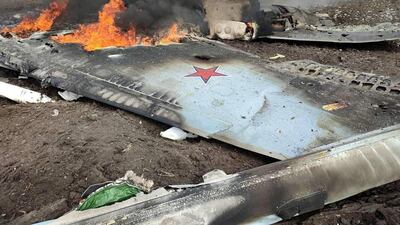
The remains of a Russian Su-35 aircraft that was hit by the Ukrainian armed forces in Kharkiv. Reuters -
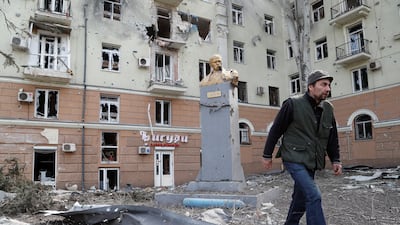
A damaged monument to Ukrainian poet Taras Shevchenko in the besieged city of Mariupol, southern Ukraine. Reuters -

A man removes a door covering the opening to an underground concrete enclosure in which bodies of civilians killed by Russian forces, residents say, were dumped as people were unable to transport them to a cemetery in Bucha, Ukraine. AP -

A Ukrainian soldier tries to convince a puppy to drink milk as residents wait for distribution of food products in Motyzhyn, Ukraine, which was until recently under the control of the Russian military. AP -

The pain of war is evident as women wait for food aid in the village of Motyzhyn. AP -

Ukraine's President Volodymyr Zelenskyy appears on screen during the 64th Grammy Awards at the MGM Grand Garden Arena in Las Vegas. AFP -
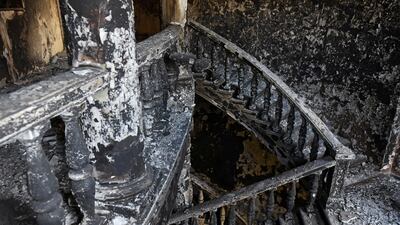
The gutted interior of a theatre in central Mariupol, destroyed in the course of Ukraine-Russia conflict. Reuters -
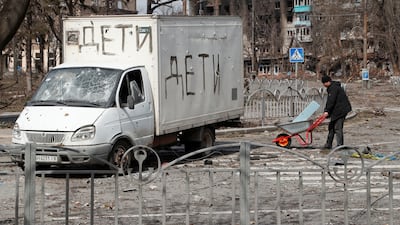
Desolation in Mariupol which has suffered intense bombardment. Reuters -

A Ukrainian soldier walks in front of the remains of an Antonov An-225 Mriya cargo plane, the world's biggest aircraft, destroyed by Russian troops at an airfield in the city of Hostomel, in the Kyiv region. Reuters -

A local woman salutes Ukrainian soldiers in the Chernihiv region. Reuters -
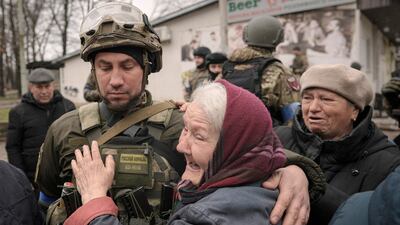
A woman hugs a Ukrainian soldier after a convoy of military and aid vehicles arrived in the formerly Russian-occupied town of Bucha, near Kyiv. AP -
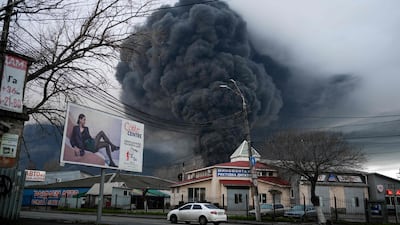
Smoke rises after an attack by Russian forces in Odesa. AFP -

Ukraine's President Volodymyr Zelenskyy presents an award to an injured Ukrainian service member at a military hospital in Kyiv. Reuters -
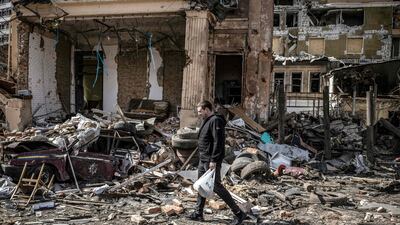
A destroyed building in the eastern Ukrainian city of Kharkiv. AFP -

People, mainly women and children, pass through the Medyka border crossing on their journey out of Ukraine and into Poland. Getty


For small missile and rocket-propelled grenade warheads, analysts say this kind of cage armour has a decent chance of success and is used by militaries the world over.
But why was it placed on the tank’s roof?
The type of shoulder-launched weapons that cage armour can stop, such as the rocket-propelled grenade launcher (RPG) are typically fired horizontally at the front, back or sides of a tank.
Some modern anti-tank missiles supplied to Ukraine, such as the Javelin and Next Generation Light Anti-Tank Weapon (NLAW) are designed to explode above a tank's thin roof armour – leading some observers to think the cages were a haphazard DIY defence against this "top attack".
But this might not be the case. In December, one Russian defence analyst had observed how cage armour would not stop a modern anti-tank missile.
Dmitry Litovkin told Russia's Tass news agency that slat armour was "less effective against tandem-charge high-explosive munitions", or weapons that have two explosive charges, one to blast away defensive armour, and a bigger, main charge.
That is exactly how Javelin and NLAW missiles work, suggesting the Russians might have had another defence in mind, possibly drones with small missile warheads attacking from above, or RPGs being fired from rooftops in urban battles, a problem Russia encountered in Chechnya.
On a Russian T-72 tank, frontal armour is the equivalent of about 500mm of steel, but on the roof it is far less – as little as 30mm.
Top attack weapons
Modern anti-tank weapons such as the Javelin, which was already in service in Ukraine before the invasion, have what is called a “top attack” mode precisely for this reason – targeting thin top turret armour.
A number of analysts recently explained that the problem with these cages is that a lot of anti-tank weapons in use in Ukraine do not have a fuse in the nose – negating one of the cage’s protective methods of crushing the fuse.
The principle behind cage armour dates back to the Second World War when German tanks were fitted with “spaced armour” to destroy or deflect incoming anti-tank shells.
Arms research service Calibre Obscura describes the usual circumstances where the armour can work.
“Essentially the main thing with these cages is that they seek to replicate slat, or cage armour, which has genuine effectiveness when it comes to armoured vehicles, as it has the ability to disrupt some (but not all) RPG variants, such as the PG-7V and reduce the likelihood of a successful hit,” according to Calibre Obscura.
US forces briefly experimented with cage armour during the Vietnam war but decided it limited vehicle mobility because of its bulk and weight.
Lightweight cage armour variants, including aluminium armour, were later used by coalition forces in Iraq and Afghanistan.
Why the cages can't stop Javelins
In the late 1980s, modern anti-tank weapons were developed to target tank turret roofs.
Some Russian tanks subsequently have explosive armour on their roofs to deflect missiles, but modern anti-tank weapons have a "tandem charge" that explodes to detonate the armour, before the more powerful main warhead detonates.
For the main warhead, missiles such as the Javelin and the NLAW use what is known as a shaped explosive charge which concentrates explosive power to defeat armour.
Test videos of American Tow missiles in top attack mode against Soviet era T-72 tanks show the missile exploding far above the tank’s roof – well above the height of any cage.
Sensors in the missile know exactly when it is flying over the target.
The Tow missile explodes several metres above the T-72, causing a catastrophic explosion. Similarly, the top attack mode of the NLAW and the Javelin have a proximity fuse, meaning that it does not have to make contact with cage armour before detonating.
In both cases, a jet of superheated metal is directed into the tank – capable of penetrating hundreds of millimetres of steel. Any cage therefore, would be rendered useless.
Calibre Obscura believes that even in cases where the slat armour could be useful, perhaps against small "kamikaze drones" or small munitions fired or dropped from drones, the DIY nature of the Russian cages could still be a fatal flaw.
Quality engineering "does not apply to the 'cope cage'," the group wrote, using a popular online term for the armour.
"The 'grill' appears to be less dense than proper cage armour and constructed from random household materials in some cases."
The US recently sent Ukraine Switchblade 600 loitering munitions, or "kamikaze drones", which can be used to attack the roofs of tanks, although there is no evidence they have been used in the conflict so far.

