

Shanghai on Wednesday made some concessions to a child separation Covid policy, in a nod to growing public frustration as it extends a citywide lockdown that left some residents struggling to buy food.
The lockdown of China's most populous city, which started in parts of Shanghai 10 days ago and has since been expanded to confine practically all its 26 million residents to their homes, has significantly disrupted daily life and business.
Public criticism over the curbs, part of Beijing's elimination strategy, has ranged from complaints over crowded and unsanitary quarantine centres to difficulties in buying food or accessing medical treatment.
-

Nearly empty roads amid a phased lockdown due to Covid-19 in Shanghai, China. The country's largest city reported more than 13,000 daily Covid cases for the first time, as a sweeping lockdown of its 25 million residents and mass testing uncovered extensive spread of the highly infectious Omicron variant. Bloomberg -

Medical workers gather near a banner that reads 'Unite as one, resolutely win the battle against epidemic' during a departure ceremony before leaving for Shanghai, in Jinan, east China's Shandong Province. AP -
China has sent more than 10,000 health workers from across the country to Shanghai, including 2,000 military medical staff, as it struggles to tackle the rapidly spreading Covid-19 outbreak. AFP -
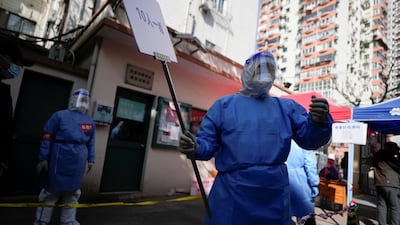
Workers in protective suits direct residents lining up for Covid testing. Reuters -
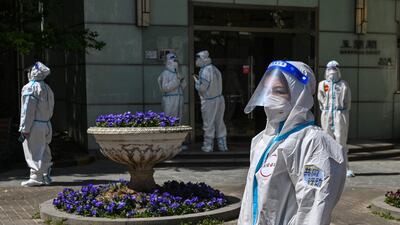
Medical workers and volunteers in a compound where residents are being tested for Covid-19. AFP -
Authorities are building the world’s largest makeshift isolation centre to help contain the outbreak in Shanghai. AFP -
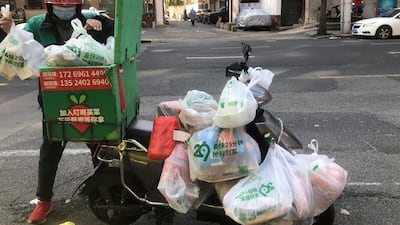
A delivery man arranges his orders during lockdown in the Jingan district of western Shanghai. AP -
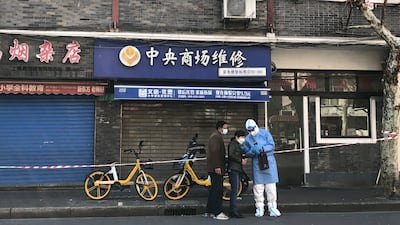
A worker in protective gear chats with residents outside shuttered shops in the Jingan district of western Shanghai. AP -

The number of cases continues to rise in Shanghai and Jilin, a north-eastern province. AP -
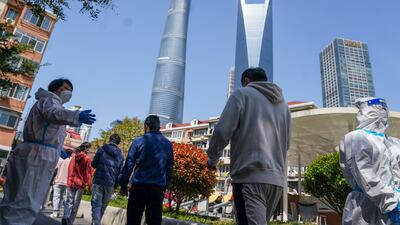
Residents wait to submit samples for tests at a community centre in the Pudong New Area of Shanghai. AP -
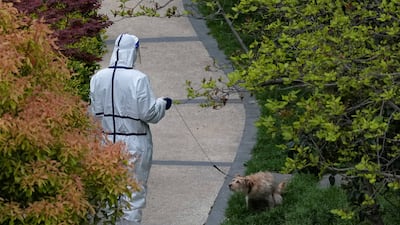
A person walks a dog. Reuters -
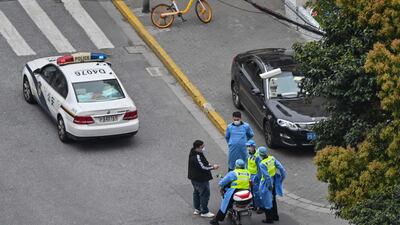
Policemen wearing protective gear on a street during patrols. AFP -
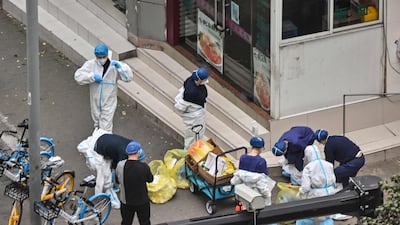
Workers remove their protective gear at the entrance of a neighbourhood. AFP -
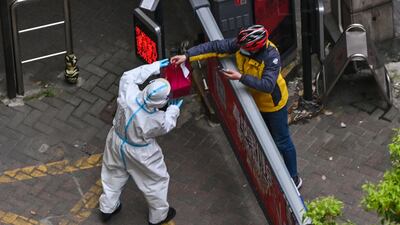
Food shortages and shuttered manufacturing plants have hit residents hard. AFP -

Workers unload groceries from a truck before distributing them to residents. AP -

A man helps a woman to consume a packet of traditional Chinese medicine, as she sits by the side of a road outside a residential compound. Reuters -
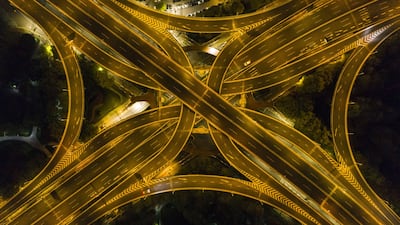
Empty highways at night in Shanghai. Bloomberg


But the most controversial policy is Shanghai's practice of separating Covid-positive children from their parents, which came to the fore on Saturday and triggered widespread anger across the country.
In the face of such criticism, the Shanghai government two days ago said it would relax the policy slightly to allow parents to accompany children if they were also infected.
But children will still be separated from parents who are not Covid-positive, prompting further complaints.
On Wednesday, a Shanghai health official said guardians of children with special needs who are infected with Covid-19 could now apply to escort them, but would need to comply with certain rules and sign a letter saying they were aware of the risks.
He did not provide further details and the Shanghai government did not immediately respond to a request for comment.
The comments brought widespread public relief, especially among parents, although some questioned why there was still a need to apply. A hashtag on the subject on China's Weibo social media platform drew more than 40 million views by Wednesday afternoon.
"This is the right thing to do, carry out management in a humane way," said one widely liked Weibo comment.
Shanghai also said on Wednesday it would conduct another round of citywide tests, a mix of antigen and nucleic acid testing. Movement restrictions on residents will continue until it can evaluate testing results, officials said.
There are signs that the curbs, which were initially scheduled to last about five days for most, are fraying residents' nerves. Many are beginning to worry about food and drinking water, as supermarkets stay shut and deliveries are restricted.
Some have complained of having to wake up at dawn for a chance at booking a grocery delivery, but finding them sold out within seconds. Others have turned to community WeChat groups to try to bulk buy fruit and vegetables.
Liu Min, vice-head of Shanghai's commerce commission, said that authorities were working hard to resolve bottlenecks and take care of the "basic living needs" of the population.
She said efforts would be made to ship food and other necessities to Shanghai from other provinces, and to build emergency supply stations in and around the city to ensure vegetable supplies. But she said the biggest challenge was getting deliveries to homes.
Shanghai will also work to "release delivery capacity", saying the 11,000 riders working for major e-commerce platforms in the city could go to work if they submitted daily negative Covid-19 nucleic acid and antigen tests, she said.

