

Live updates: follow the latest news on Russia-Ukraine
Turkey on Monday said it was blocking warships from the key Bosphorus and Dardanelles straits under a convention that gives it control over the passage of military ships in the area.
"We have alerted both countries of the region and elsewhere not to pass warships through the Black Sea," Foreign Minister Mevlut Cavusoglu said. "We are applying the Montreux Convention."
The 1936 Montreux Convention governs the free movement of commercial ships in peacetime through the Bosphorus and the Dardanelles straits.
But it grants Turkey the right to block the passage of warships in both straits, which connect the Aegean, Marmara and Black Sea, in wartime if threatened.
Turkish President Recep Tayyip Erdogan had just clarified Turkey's position as a Nato member "not to abandon either Russia or Ukraine" and not to "cede Turkey's national interests".
"We have decided to use the Montreux Convention to prevent the escalation of the crisis," Mr Erdogan said after a Cabinet meeting.
Ukraine last week officially asked Turkey to close the Dardanelles Strait, and thus access to the Black Sea, to Russian ships.
Nato member Turkey, which has strong ties with Russia and Ukraine, did not immediately respond to the request.
-
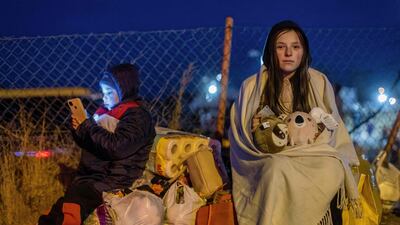
Helena, right, and her brother Bodia, from Lviv, wait at the Medyka border crossing in eastern Poland. AFP -

A brother and sister share a bowl of soup after they and their mother fled the Russian invasion of Ukraine and crossed the border at Medyka, Poland. Reuters -
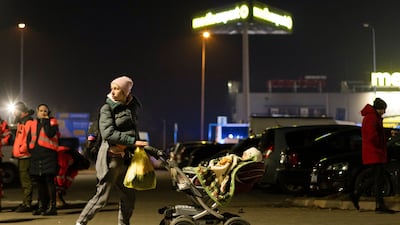
Nadia, a Ukrainian woman, walks around with her baby in a car park in Przemysl, Poland as she waits for help with transport and accommodation. Reuters -

A woman searches through donated clothes for useful items after she and her children fled the Russian invasion in Ukraine and crossed the border in Medyka, Poland. Reuters -
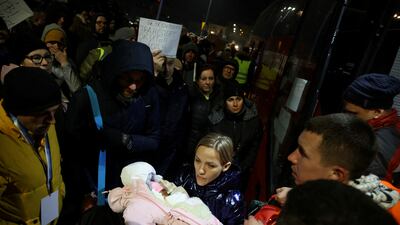
Oksana, 30, holds a seven-day-old child after arriving by bus at a rendezvous point organised to help Ukrainian refugees with accommodation and transport to different cities in Poland. Reuters -
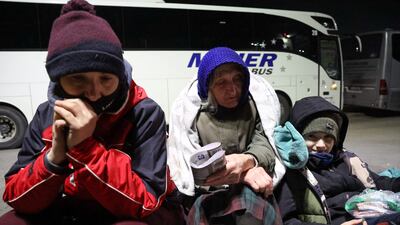
Refugees wait for help in Przemysl, Poland. Reuters -

People wait in a Polish car park to help refugees arriving from Ukraine. Reuters -
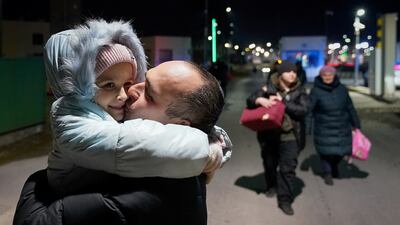
A father kisses his daughter after she, her mother and grandmother fled from the Russian invasion in Ukraine and crossed the border in Medyka, Poland. Reuters -
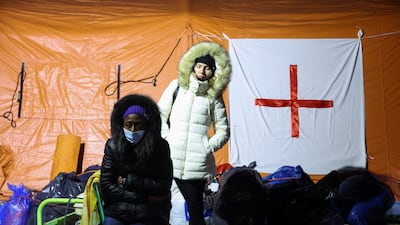
Refugees wait for help in Przemysl, Poland. Reuters -
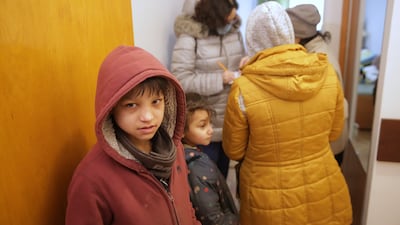
Ukrainian refugees in the town of Maroz near Olsztyn, Poland. EPA -

A Ukrainian refugee in the town of Maroz, Poland. EPA -

Ukrainian refugees in the town of Maroz, northern Poland. EPA -

Hospital employees and volunteers make hundreds of beds to prepare for an influx of Ukrainian refugees in Rzeszow, Poland. AP -
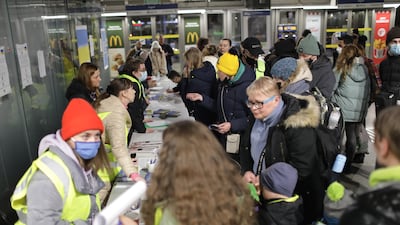
Ukrainian refugees who arrived by evening train from Kiev to Warsaw are helped at the Warszawa Wschodnia railway station in the Polish capital. EPA -
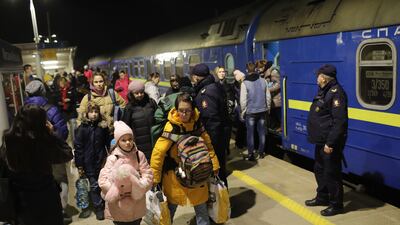
Ukrainian refugees arrive by train from Kiev at the Warszawa Wschodnia station in Warsaw. EPA -
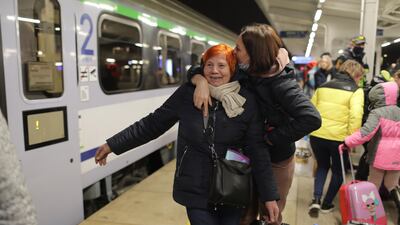
Ukrainian refugees arrive by train from Kiev to Warsaw, Poland. EPA -
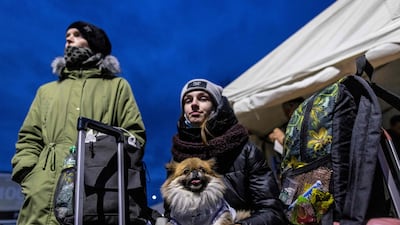
Ukrainian refugees arrive from the Medyka border crossing in eastern Poland. AFP -

A man hugs a child at the Polish-Ukrainian border crossing in Medyka, Poland. Getty


"Russia asked us if we would apply the Montreux Convention if necessary," Mr Cavusoglu said. "We told them we would apply it word for word."
He said Turkish experts had been studying the situation to assess "whether there is a state of war from a legal point of view".
Turkey is navigating its own narrow diplomatic passage between its ally Kiev, to which it has sold combat drones used against Russian tanks, and Moscow, on which it depends for its gas and grain supplies.
But Turkey on Sunday officially recognised Russia's attacks on Ukraine as a "state of war".
Mr Erdogan on Monday said he considered "Russia's attack on Ukrainian territory as unacceptable" and praised the struggle of the Ukrainian government and people.

