



Since the first time they met in 2017 in India, Afghan couple Sara Rahimi, 26, and Mohammad Haroon Rahimi, 27, were inseparable.
“We dated for a few years, and after returning to Afghanistan, we got engaged about a year ago. Initially, my family resisted because he is from a different tribe, but after meeting him and his family, we were able to convince them,” Ms Rahimi said.
Both of their first names have been changed but the couple are identified as Mr and Ms Rahimi, which is the name they had planned to engrave on their door after their wedding that they had planned for September last year.
As a young couple in a conservative society, they pushed cultural boundaries.
“Compared to India where we had a lot of freedom, dating in Kabul was a struggle,” Mr Rahimi said.
“The first thing we did was save money between us and purchased a car so we could travel together. We would drive around Kabul, go to cafes and restaurants. You name a restaurant in Kabul, and we have been there,” he said, smiling as he recalled the fond memories
But as fate would have it, the Taliban seized Kabul just weeks before their wedding.
As a development professional working with a USAID project on empowering women, Ms Rahimi’s life came under extreme threat from extremists.
“I come from a very conservative province and my family faced a lot of threats and opposition when I started work,” she says, referring to her struggle during the 20 years after the US-led invasion and subsequent Taliban insurgency.
“But because my family continued to support me I was able to continue my work,” she said, adding that now with the Taliban in power, threats against her were more real than before.
“They see me as an American puppet, and used to call us infidels.”
Afghan women defy the Taliban - in pictures
-

Zakia, an economics student who had to abandon her studies when the Taliban took control of Afghanistan in August, at her home in the capital Kabul, where women are coming together to stand against the hardline regime. All photos: AFP -
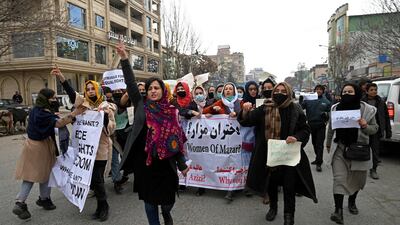
She is part of a growing group that started with 15 activists, mostly women in their 20s who already knew each other. Now a network of dozens of women work in secret to organise protests. -
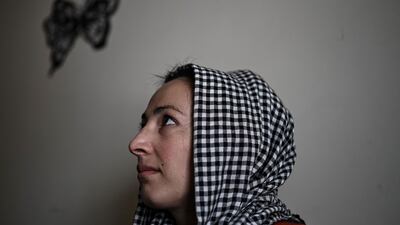
Hoda Khamosh, a published poet and former NGO worker who organised workshops to help empower women, vets newcomers to the group to ensure they can be trusted. -
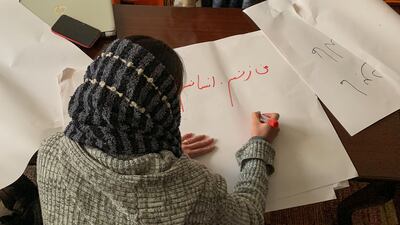
One test she sets is to ask them to prepare banners or slogans at short notice - she can sense passion for the cause from women who deliver quickly. -

Other tests yield even clearer results. Hoda says one potential recruit was given a fake date and time for a demonstration. The Taliban turned up ahead of the supposed protest, and all contact was cut with the woman suspected of tipping off officials. -

A core group of the activists use a dedicated phone number to co-ordinate on the day of a protest. That number is later disconnected to ensure it is not being tracked. -
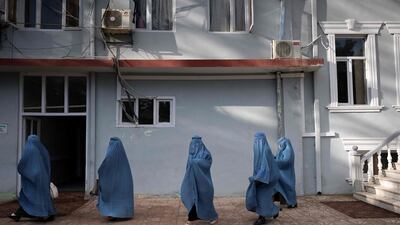
"We usually carry an extra scarf or an extra dress. When the demonstration is over, we change our clothes so we cannot be recognised," says Hoda. -

She has changed her phone number several times and her husband has received threats. "We could still be harmed, it's exhausting. But all we can do is persevere," she says.


After nine days under the Taliban regime, with Ms Rahimi staying in hiding, she received a call from her American employers advising her to get to the airport for evacuation.
However, as a single unmarried woman, she could not take Mr Rahimi with her since he was not her legal partner. Compounding the problem, as an NGO worker he was not directly employed by the US and was therefore not eligible to be flown out, despite the threats to his life.
“But he insisted that I leave and he will try to come after me. But it has been over five months and so far we’ve had no luck on getting him here,” she said, breaking down in tears.
“I miss my city. I miss its dusty roads. I miss the food. But most of all, I miss him so much. We have never been separated this long.”
In Kabul, Mr Rahimi finds himself connected with her in love and grief. “We loved the life we were building here. Kabul was our city of love but without her this city is meaningless. I am miserable, I lost everything overnight,” he said.
The Rahimis are not alone in their loss; in the chaos of the evacuations that followed the fall of Kabul, many Afghan families, particularly young couples, found themselves torn apart and strewn across the world.
The separation is now taking an emotional toll, Afghan mental health professionals say. “Long distance relationships are hard as it is, but mixed in with the trauma of dealing with the loss of their country, identity and loved ones, it’s bound to take a toll on relationships and individual mental health,” Dr Hadi Rasooli, an Afghan mental health expert, told The National.
Dr Rasooli has many years of experience in counselling vulnerable individuals to cope with trauma endured during conflict in Afghanistan. He stressed the long-term emotional damage separations could cause to a person already undergoing trauma.
“Particularly in the case of Afghans who are culturally conditioned to find comfort in large families, separation from someone they love can cause dissociation, where they struggle to fill the vacuum created by the sudden and unplanned loss,” he explained, adding that he was witnessing similar mental health issues arise among the recent groups of Afghans who were forced to flee.
Separation has been hard on the Rahimis.
“It is challenging; we cannot always talk because of the time difference. He is emotionally exhausted. He lost his job when the NGO he worked at shut down. Sometimes he cries over the phone and it breaks my heart,” Ms Rahimi said.
She is constantly worried the Taliban might hurt him for his work with foreigners. “I don’t know when we will be reunited. Sometimes I think I made a mistake by leaving him behind,” she said.
However, Mr Rahimi insists they made the right decision. “I am so happy she is out of this country. It is the worst place for a woman to be. It is not easy to live a life like this under the Taliban. But I am happy that at least she is out,” he said.
Dr Rasooli said that in recent years, younger Afghans such as the Rahimis had increasingly been exercising their own agency in choosing their partners, a previously rare practice.
“This was particularly empowering for women who felt they had a say in their lives and built stronger, healthier relationships,” he said.
The Taliban take over of Afghanistan - in pictures
-
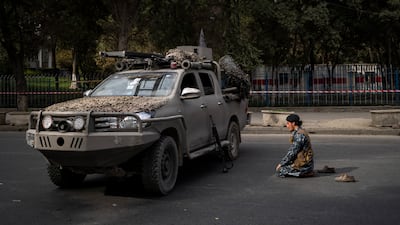
A Taliban fighter prays next to a demonstration organised by the Afghan Society of Muslim Youth, demanding the release of frozen international money in Kabul, Afghanistan. AP Photo -
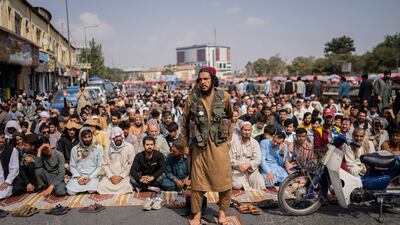
A Taliban fighter and a group of Afghan men attend Friday prayers in Kabul. AP Photo -
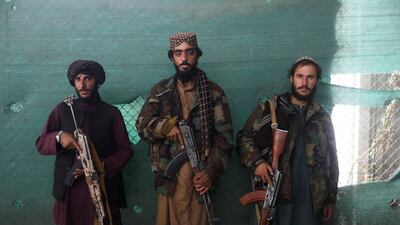
Taliban soldiers in Bagram Air Base in Parwan. Reuters -
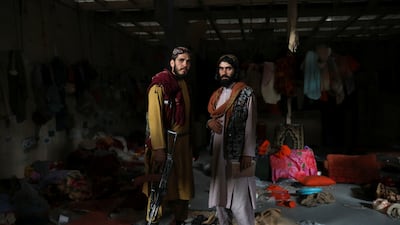
Taliban soldiers Seifatollah and Vasighollah stand in a prison in Bagram Air Base. Reuters -
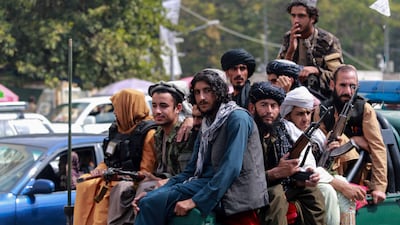
Taliban patrol Kabul. EPA -
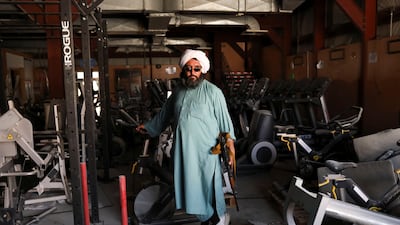
Vahdat, a Taliban soldier and former prisoner, stands next to exercise equipment in Bagram Air Base. Reuters -
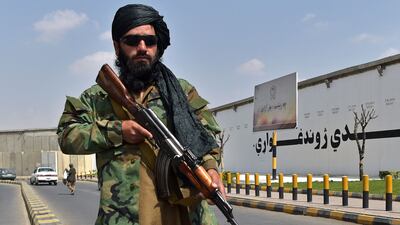
A Taliban fighter stands guard near Zanbaq Square in Kabul. AFP -
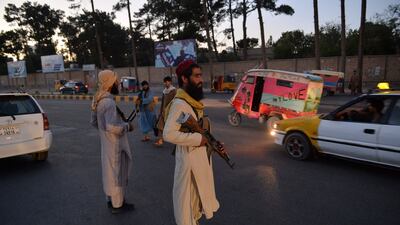
Taliban fighters police a road in Herat. AFP


Over the years, since the fall of the Taliban, the culture around dating in Afghanistan evolved, albeit at a very slow pace and largely restricted to the urban centres. It was not uncommon to find Valentine’s Day paraphernalia around the markets and restaurants in Kabul in the days preceding February 14.
The historical Koch-e-Gul-Faroushi (Flower Street) in the heart of Kabul would light up with decorations and thousands of innovative flower arrangements luring the young crowds, to celebrate the western-inspired day of love.
“During Valentine’s Day, we would both take days off and go out for a fancy lunch. And then we would go shopping, and I would shower her with gifts and she would do the same,” Mr Rahimi said.
However, the Taliban, known for their fundamentalist interpretation of Islam, are unlikely to allow an environment that fosters such companionship.
“It takes away the power from the youth, and women and I speculate that we will see many emotional divorces, if not actual divorces in the coming years,” Dr Rasooli said, explaining that emotional divorces are state of mental resignation from the relationship when a person feels hopelessness and lack of control over their lives.
The Rahimis are determined not to let that happen to them.
Ms Rahimi said that she was working to get her partner into the US. However, immigration bureaucracy and strict rules for Afghans had made it extremely difficult for the couple to reunite.
“It might take years before she receives her documents that will allow her to sponsor me, and even then she might not be able to seek a family reunification since legally we do not belong to each other. But emotionally, we are one soul,” Mr Rahimi said.

