


Astronomers believe they may have found a second giant exomoon 5,500 light years away, which is orbiting a planet the size of Jupiter.
Researchers spotted the giant exomoon – the term for moons orbiting planets outside our Solar System – candidate orbiting the planet Kepler 1708b, in the direction of the Cygna and Lyra constellations.
The team involved in the research is led by David Kipping and his Cool Worlds Lab at Columbia University, which reported the first exomoon candidate in 2017.
The new exomoon is about a third smaller than the Neptune-sized moon Mr Kipping and his colleagues found orbiting a similar Jupiter-sized planet, Kepler 1625b.
If the sighting is confirmed, it could mean exomoons are as common in the universe as exoplanets, and that the moons are a feature of planetary systems.
But the team’s initial sighting of an exomoon is yet to be confirmed, so it could take years before the second exomoon is established.
Observations from other space telescopes are needed to verify the discovery.
“Astronomers have found more than 10,000 exoplanet candidates so far, but exomoons are far more challenging,” said Mr Kipping, who has spent the last decade hunting for the astral bodies.
“They are terra incognita.”
In the current study, the researchers looked at the sample of the coldest gas giant planets captured by Nasa’s planet-hunting spacecraft, Kepler.
After scanning 70 planets in depth, they found only one candidate, Kepler 1708b, with a moon-like signal.
Mr Kipping said both of the exomoons are likely to be made of gas that piled up under the gravitational pull caused by their enormous size.
He said that if there were other moons out there, they would be harder to spot as they were likely to be smaller.
“The first detections in any survey will generally be the weirdos,” Mr Kipping said. “The big ones that are simply easiest to detect with our limited sensitivity.”
Should the exomoons be confirmed, they may have the potential to reveal how and where life emerged in the universe.
Other astronomers have mixed views about the findings.
Eric Agol, an astronomy professor at the University of Washington, said he is doubtful this latest signal would turn out to be real, as it could be a “fluctuation in the data, either due to the star or instrumental noise”.
Michael Hippke, an independent astronomer in Germany, said the candidate was “intriguing”.
The study has been published in the peer-reviewed journal Nature Astronomy.
In another study, scientists have said a “slushy” ocean of magma could be responsible for the composition of the crust of the Earth’s Moon.
Researchers from the University of Cambridge and the Ecole Normale Superieure de Lyon said the composition could be the result of crystallisation.
It is thought the moon formed when two protoplanets collided and the larger became the Earth while the smaller became the moon.
As a result of the crash, the moon was very hot and crystals, which were inside the liquid magma, solidified over hundreds of millions of years.
-

From launching the first Arab mission to the Moon to looking into the early universe using the world’s most powerful telescope – the new year is going to be a busy one for space exploration. The National looks at some of the most exciting missions scheduled for 2022. Photo: Nasa -
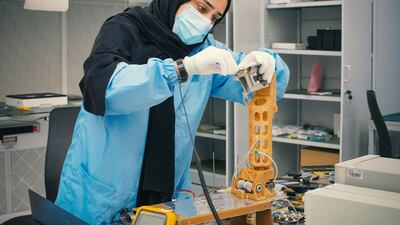
Engineers at the Mohammed bin Rashid Space Centre have been planning a Moon mission since 2017. They have built a 10-kilogram rover called Rashid that will study lunar soil and its properties. It is scheduled for a launch sometime between August to December 2022. Photo: Mohammed bin Rashid Space Centre -
The final prototype of the UAE's Rashid Moon rover. Photo: Mohammed bin Rashid Space Centre -

Two Emirati candidate astronauts are to begin training at Nasa’s Johnson Space Centre in Houston, Texas, in January. Mohammed Al Mulla, a Dubai Police helicopter pilot, and Nora Al Matrooshi, a mechanical engineer, will spend two years in training. Chris Whiteoak / The National -
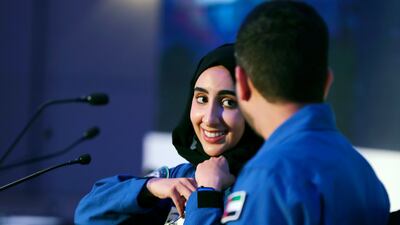
Nora Al Matrooshi and Mohammed Al Mulla will learn the systems of the International Space Station, the Russian language, robotics and how to perform spacewalks. Once they graduate, both astronauts would become eligible for space missions. AP -

Nora Al Matrooshi and Mohammed Al Mulla are the generation of astronauts that could go to the Moon one day. The UAE has its sights set on human missions to the lunar surface. Chris Whiteoak / The National -

US space agency Nasa is preparing the space launch system and Orion spacecraft for the Artemis 1 launch on March 12, which will involve a three-week, uncrewed test flight to the Moon. AFP / Nasa -
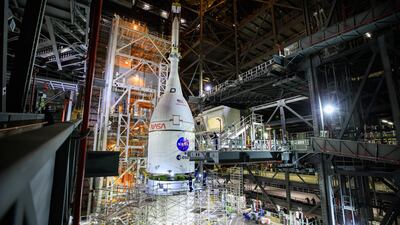
During the mission, the Orion spacecraft will fly 100 kilometres above the Moon’s surface and then use its gravitation force to become captured in an opposite orbit about 70,000 kilometres from the Moon. EPA / Nasa -
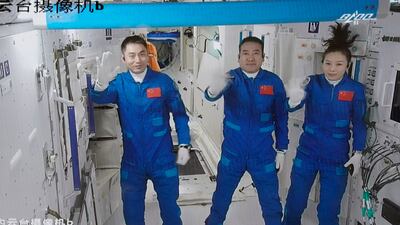
Completion of China’s space station is scheduled for the end of 2022. The Tiangong’s core module Tianhe is already in orbit and has been hosting astronauts, including Wang Yaping, its first female astronaut. Xinhua / AP -
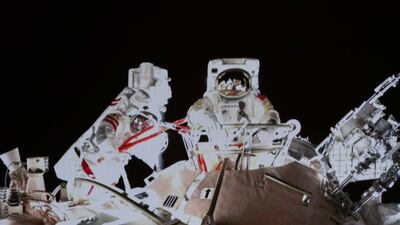
Wang Yaping was sent to the station earlier this year. On November 8, the 41-year-old also became the first Chinese female astronaut to perform a spacewalk. Xinhua / AP -
South Korea plans to launch its first lunar mission in 2022. The Korea Pathfinder orbiter will be launched on a SpaceX Falcon 9 rocket. Photo: Korea Aerospace Research Agency -
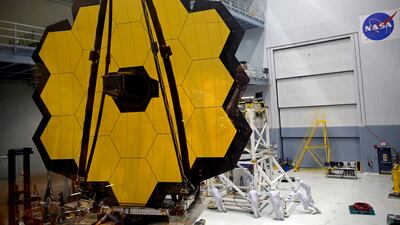
The James Webb Space Telescope will be capable of 'looking back' 13.5 billion years to see the first stars and galaxies of the universe and search for signs of life. It was launched on Saturday, December 25, 2021, and it is expected to make several discoveries when it becomes operational in 2022. Reuters


Samples collected by Apollo 11 astronauts from the lunar highlands contain light rocks called anorthosites, which formed in the early days of the moon.
They are similar to anorthosites which were formed through the crystallisation of magma on Earth.
“Since the Apollo era, it has been thought that the lunar crust was formed by light anorthite crystals floating at the surface of the liquid magma ocean, with heavier crystals solidifying at the ocean floor," said Chloe Michaut, from Ecole normale superieure de Lyon.
“This ‘flotation’ model explains how the lunar highlands may have formed.”
The peer-reviewed study has been reported in the Geophysical Review Letters journal.

