Kazakhstan soldiers wearing UN blue peacekeeping helmets select flash grenades as they prepare to stop protesters in Almaty, Kazakhstan on Thursday, January 6, 2022. NUR. KZ via AP

UN criticises Kazakhstan over unauthorised blue peacekeeper helmet use


James Reinl
  • English
  • Arabic

The United Nations has criticised Kazakhstan over photos showing armed personnel wearing the world body’s iconic blue helmets during last week’s violence and a crackdown on protests that left more than 160 people dead.

UN spokesman Stephane Dujarric on Monday said the UN had complained to Kazakhstan’s diplomatic outpost in New York about the apparent use of UN peacekeeping equipment and said the issue “had been addressed”.

Over the weekend, journalists posted photos on social media showing troops on Kazakhstan’s streets wearing UN blue helmets – which are only allowed to be worn by peacekeepers operating under a UN Security Council mandate.

A Kazakhstan soldier patrol a street after clashes in Almaty, Kazakhstan, Thursday, Jan. 6, 2022. Kazakhstan's president authorized security forces on Friday to shoot to kill those participating in unrest, opening the door for a dramatic escalation in a crackdown on anti-government protests that have turned violent. The Central Asian nation this week experienced its worst street protests since gaining independence from the Soviet Union three decades ago, and dozens have been killed in the tumult. (Vladimir Tretyakov/NUR. KZ via AP)

“Any UN troop and police contributing countries are to use UN insignia only when they are performing their mandated tasks as UN peacekeepers,” Mr Dujarric said in answer to a question from The National.

“We have conveyed our concern to the permanent mission of Kazakhstan directly on this issue, and we've received assurances from them that this issue had been addressed.”

Kazakhstan’s UN mission did not immediately respond to a request for comment.

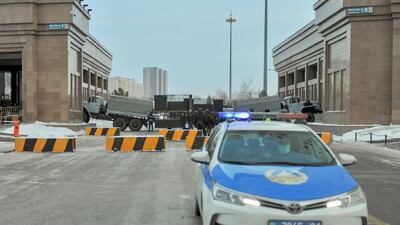
  • Police block a street leading to the official presidential residence in Kazakhstan's capital Nur-Sultan, after protests against the government. Reuters
    Police block a street leading to the official presidential residence in Kazakhstan's capital Nur-Sultan, after protests against the government. Reuters
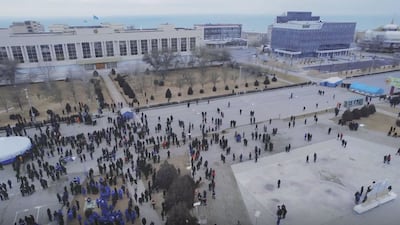
  • Protesters gather in a square outside an administration office in Aktau, capital of the resource-rich Mangistau region in Kazakhstan. AFP
    Protesters gather in a square outside an administration office in Aktau, capital of the resource-rich Mangistau region in Kazakhstan. AFP
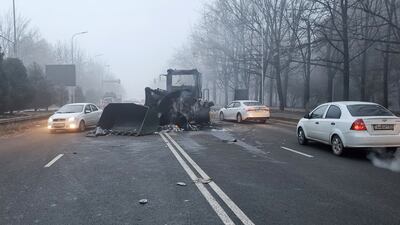
  • A burnt-out digger destroyed in protests triggered by fuel price increases, in Kazakhstan's trading and cultural hub Almaty. Reuters
    A burnt-out digger destroyed in protests triggered by fuel price increases, in Kazakhstan's trading and cultural hub Almaty. Reuters
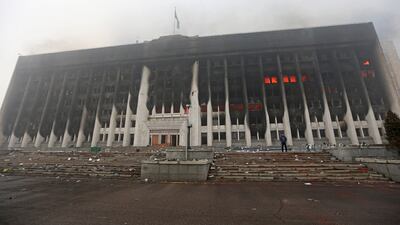
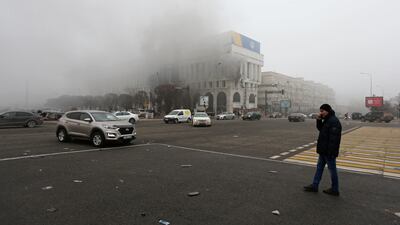
  • A man stands in front of the mayor's office building that was torched during protests in Almaty. Police there have reported killing dozens of rioters since Wednesday. Reuters
    A man stands in front of the mayor's office building that was torched during protests in Almaty. Police there have reported killing dozens of rioters since Wednesday. Reuters
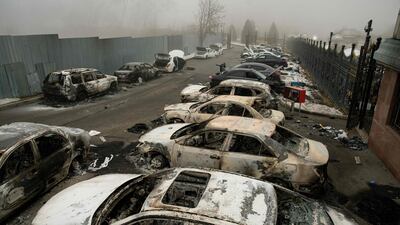
  • Burnt-out cars in central Almaty. Authorities said at least 18 members of the security forces have been killed in the violence in the city. AFP
    Burnt-out cars in central Almaty. Authorities said at least 18 members of the security forces have been killed in the violence in the city. AFP
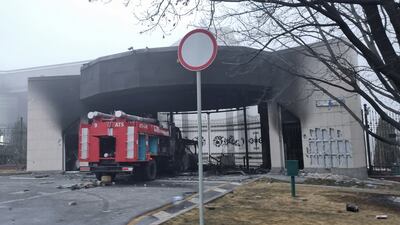
  • A fire truck destroyed in the protests, in front of the presidential residence in Almaty. Reuters
    A fire truck destroyed in the protests, in front of the presidential residence in Almaty. Reuters
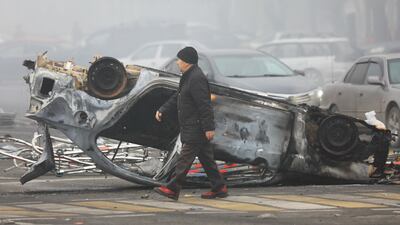
  • A man walks past a car that was overturned and destroyed during the protests in Almaty. Reuters
    A man walks past a car that was overturned and destroyed during the protests in Almaty. Reuters
  • Smoke billows from the Kazakhstan state TV channel building, which was torched during protests in Almaty. Reuters
    Smoke billows from the Kazakhstan state TV channel building, which was torched during protests in Almaty. Reuters
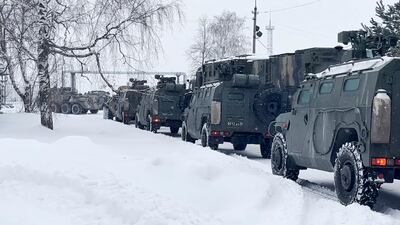
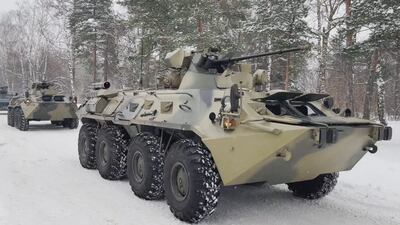
  • Russian military vehicles wait to be loaded on to military aircraft at an airfield outside Moscow, to fly to Kazakhstan. They are part of an alliance of former Soviet states being sent to control the uprising. AP
    Russian military vehicles wait to be loaded on to military aircraft at an airfield outside Moscow, to fly to Kazakhstan. They are part of an alliance of former Soviet states being sent to control the uprising. AP
  • Russian military vehicles wait to be loaded on to a military cargo plane Chkalovsky airbase, outside Moscow, as part of a force heading to Kazakhstan. AFP
    Russian military vehicles wait to be loaded on to a military cargo plane Chkalovsky airbase, outside Moscow, as part of a force heading to Kazakhstan. AFP
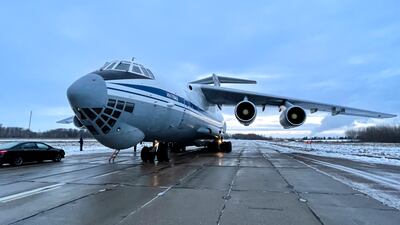
  • A Russian military plane with Belarusian troops on board waits to take off from an airfield outside Minsk, Belarus, to fly to Kazakhstan. AP
    A Russian military plane with Belarusian troops on board waits to take off from an airfield outside Minsk, Belarus, to fly to Kazakhstan. AP
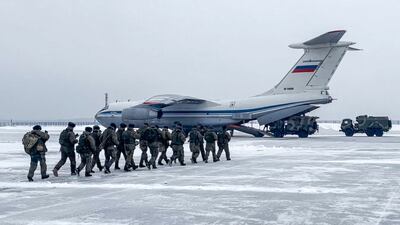
  • Russian paratroopers board a military plane at Chkalovsky airbase, headed for Kazakhstan. AFP
    Russian paratroopers board a military plane at Chkalovsky airbase, headed for Kazakhstan. AFP

The blue helmet worn by UN peacekeepers symbolises perhaps the best-known function of the world body. The UN has more than 86,000 personnel from 121 countries deployed in a dozen missions in the world’s hotspots.

According to UN data, Kazakhstan contributes to UN missions, with 16 service people deployed at the end of October. They are allowed to wear official UN peacekeeping gear only when operating under a UN mandate.

Protesters took the streets of Almaty and elsewhere in Kazakhstan on January 2 over fuel price hikes, but demonstrations quickly morphed into broader complaints about corruption and discontent with the authoritarian government.

The government revoked the fuel price increase and the ministerial cabinet resigned, but order was not restored until troops from Russia and other members of the Collective Security Treaty Organisation (CSTO) deployed to Kazakhstan.

Kazakhstan President Kassym-Jomart Tokayev blamed "terrorists" for the violence and authorised a shoot-to-kill order for police and the military to restore order.

Nearly 8,000 people were detained across the country, Kazakhstan's Interior Ministry said on Monday.


UAE squad

Rohan Mustafa (captain), Ashfaq Ahmed, Ghulam Shabber, Rameez Shahzad, Mohammed Boota, Mohammed Usman, Adnan Mufti, Shaiman Anwar, Ahmed Raza, Imran Haider, Qadeer Ahmed, Mohammed Naveed, Amir Hayat, Zahoor Khan

Bharatanatyam

A ancient classical dance from the southern Indian state of Tamil Nadu. Intricate footwork and expressions are used to denote spiritual stories and ideas.

HOW TO WATCH

Facebook: TheNationalNews  

Twitter: @thenationalnews  

Instagram: @thenationalnews.com  

TikTok: @thenationalnews 

NO OTHER LAND

Director: Basel Adra, Yuval Abraham, Rachel Szor, Hamdan Ballal

Stars: Basel Adra, Yuval Abraham

Rating: 3.5/5

Mercer, the investment consulting arm of US services company Marsh & McLennan, expects its wealth division to at least double its assets under management (AUM) in the Middle East as wealth in the region continues to grow despite economic headwinds, a company official said.

Mercer Wealth, which globally has $160 billion in AUM, plans to boost its AUM in the region to $2-$3bn in the next 2-3 years from the present $1bn, said Yasir AbuShaban, a Dubai-based principal with Mercer Wealth.

Within the next two to three years, we are looking at reaching $2 to $3 billion as a conservative estimate and we do see an opportunity to do so,” said Mr AbuShaban.

Mercer does not directly make investments, but allocates clients’ money they have discretion to, to professional asset managers. They also provide advice to clients.

“We have buying power. We can negotiate on their (client’s) behalf with asset managers to provide them lower fees than they otherwise would have to get on their own,” he added.

Mercer Wealth’s clients include sovereign wealth funds, family offices, and insurance companies among others.

From its office in Dubai, Mercer also looks after Africa, India and Turkey, where they also see opportunity for growth.

Wealth creation in Middle East and Africa (MEA) grew 8.5 per cent to $8.1 trillion last year from $7.5tn in 2015, higher than last year’s global average of 6 per cent and the second-highest growth in a region after Asia-Pacific which grew 9.9 per cent, according to consultancy Boston Consulting Group (BCG). In the region, where wealth grew just 1.9 per cent in 2015 compared with 2014, a pickup in oil prices has helped in wealth generation.

BCG is forecasting MEA wealth will rise to $12tn by 2021, growing at an annual average of 8 per cent.

Drivers of wealth generation in the region will be split evenly between new wealth creation and growth of performance of existing assets, according to BCG.

Another general trend in the region is clients’ looking for a comprehensive approach to investing, according to Mr AbuShaban.

“Institutional investors or some of the families are seeing a slowdown in the available capital they have to invest and in that sense they are looking at optimizing the way they manage their portfolios and making sure they are not investing haphazardly and different parts of their investment are working together,” said Mr AbuShaban.

Some clients also have a higher appetite for risk, given the low interest-rate environment that does not provide enough yield for some institutional investors. These clients are keen to invest in illiquid assets, such as private equity and infrastructure.

“What we have seen is a desire for higher returns in what has been a low-return environment specifically in various fixed income or bonds,” he said.

“In this environment, we have seen a de facto increase in the risk that clients are taking in things like illiquid investments, private equity investments, infrastructure and private debt, those kind of investments were higher illiquidity results in incrementally higher returns.”

The Abu Dhabi Investment Authority, one of the largest sovereign wealth funds, said in its 2016 report that has gradually increased its exposure in direct private equity and private credit transactions, mainly in Asian markets and especially in China and India. The authority’s private equity department focused on structured equities owing to “their defensive characteristics.”

Updated: January 11, 2022, 7:08 AM