
Fossil experts have found a perfectly preserved dinosaur embryo from at least 66 million years ago that was preparing to hatch from its egg just like a chicken.
The fossil was discovered in Ganzhou in southern China and belonged to a toothless theropod dinosaur, or oviraptorosaur, scientists announced on Tuesday. Researchers have dubbed the embryo “Baby Yingliang".
“It is one of the best dinosaur embryos ever found in history,” said University of Birmingham researcher Fion Waisum Ma, who co-authored a paper in the journal iScience.
Ms Ma and colleagues found Baby Yingliang's head lay below its body, with the feet on either side and back curled – a posture that was previously unseen in dinosaurs, but similar to modern birds.
In birds, the behaviour is controlled by the central nervous system and called “tucking”. Chicks preparing to hatch tuck their head under their right wing to stabilise the head while they crack the shell with their beak.
Embryos that fail to tuck have a higher chance of death from an unsuccessful hatching.
“This indicates that such behaviour in modern birds first evolved and originated among their dinosaur ancestors,” said Ms Ma.
An alternative to tucking might have been something closer to what is seen in modern crocodiles, which instead assume a sitting posture with the head bending upon the chest before hatching.
Oviraptorosaurs, or “egg thief lizards”, were feathered dinosaurs that lived in what is now Asia and North America during the Late Cretaceous period.
They had variable beak shapes and diets and ranged in size from modern turkeys at the lower end to massive gigantoraptors that were eight metres long.
Baby Yingliang measures around 27 centimetres from head to tail, and lies inside a 17cm egg at the Yingliang Stone Nature History Museum.
Researchers believe the fossil is between 72 and 66 million years old and was probably preserved by a sudden mudslide that buried the egg, protecting it from scavengers.
It would have grown two to three meters long if it had lived to be an adult and would have likely fed on plants.
The specimen was one of several egg fossils that were forgotten in storage for decades.
Two new species of dinosaur discovered on Isle of Wight – In Pictures
-
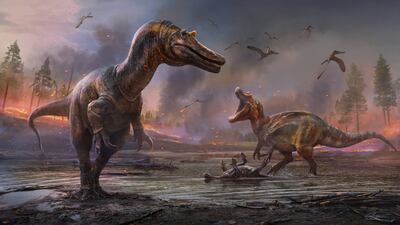
An artist's impression of 'Ceratosuchops inferodios', foreground, and 'Riparovenator milnerae'. These new species of dinosaur roamed what is now the Isle of Wight, off England's south coast, 125 million years ago. All photos: PA -
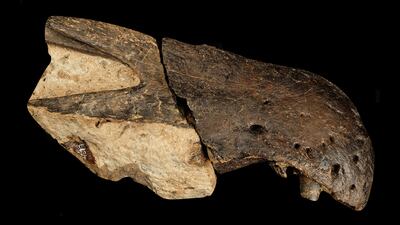
The snout of a 'Ceratosuchops inferodios'. The two carnivorous reptiles are thought to have been nine metres long, with skulls similar to those of crocodiles. -
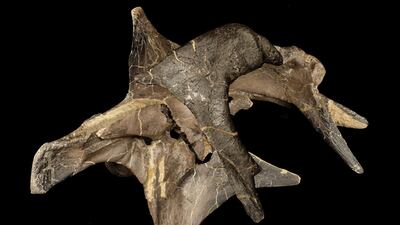
The braincase for a 'Ceratosuchops inferodios'. -
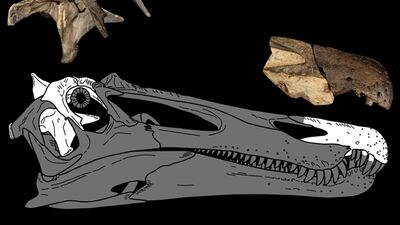
This graphic shows where the braincase and snout of a 'Ceratosuchops inferodios' would be located on its skull. -
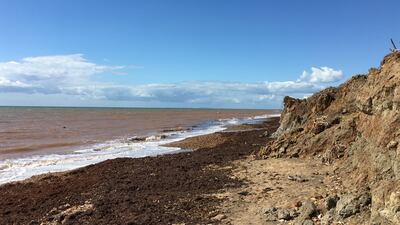
Early Cretaceous rocks on the Isle of Wight reveal the areas was once a floodplain with a Mediterranean-like climate. -

The braincase of a 'Riparovenator milnerae'. -
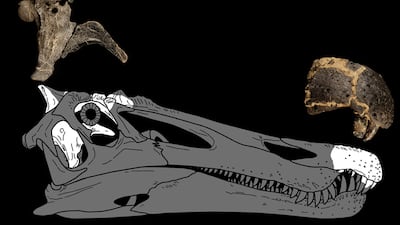
This graphic shows where the braincase and snout of a 'Riparovenator milnerae' would be located on its skull.


'One of the most beautiful fossils'
The research team suspected they might contain unborn dinosaurs. They scraped off part of Baby Yingliang's eggshell to uncover the embryo hidden within.
“This dinosaur embryo inside its egg is one of the most beautiful fossils I have ever seen,” said Prof Steve Brusatte of the University of Edinburgh, part of the research team.
“This little prenatal dinosaur looks just like a baby bird curled in its egg, which is yet more evidence that many features characteristic of today's birds first evolved in their dinosaur ancestors.”
The team hopes to study Baby Yingliang in greater detail using advanced scanning techniques to image its full skeleton, including its skull bones, because part of the body is still covered by rock.

