



The death toll in the Philippines from Typhoon Rai rose to 146 on Sunday after the governor of an island province said that at least 72 people had lost their lives in the strongest storm to hit the country this year.
Arthur Yap of Bohol province also said 10 people were missing and 13 had been injured. He suggested that the death toll may increase considerably because only 33 out of 48 provincial mayors had been able to report back to him.
Officials were trying to confirm a large number of deaths caused by landslides and extensive flooding elsewhere.
Mr Yap ordered mayors in his province of more than 1.2 million people to use their emergency powers to secure food packs for large numbers of people. He also said clean water was an urgent problem because water stations had been knocked out by power cuts.
After joining a military aerial survey of typhoon-ravaged towns, Mr Yap said it was clear "that the damage sustained by Bohol is great and all-encompassing".
He said the initial inspection did not cover four towns first hit by the typhoon as it blew in on Thursday and Friday through central island provinces. The government said about 780,000 people were affected, including more than 300,000 who had to flee their homes.
Rai was a super typhoon when it smashed into the popular tourist island of Siargao on Thursday, bringing sustained winds of 195 kilometres an hour.
Flights from Dubai to Mactan-Cebu – the second largest international airport in the Philippines – were cancelled on Saturday after it was damaged in the typhoon.
“This is indeed one of the most powerful storms that has hit the Philippines in the month of December in the last decade,” said Alberto Bocanegra, head of the International Federation of Red Cross and Red Crescent Societies in the Philippines.
“The information we are receiving and the pictures we are receiving are very alarming.”
At least 64 other typhoon deaths were reported by the disaster-response agency, the national police and local officials. Most were hit by falling trees and collapsed walls, drowned in flash floods or were buried in landslides. Officials on Dinagat Islands, one of the south-eastern provinces first pounded by the typhoon, separately reported 10 deaths only from a few towns, bringing the overall fatalities so far to 146.
President Rodrigo Duterte flew to the region Saturday and promised 2 billion pesos ($40 million) in aid. He met officials in Maasin City in Southern Leyte province where he was born. Mr Duterte’s family later relocated to the southern city of Davao, where he served as a longtime mayor before rising to the presidency.
“The moment I was born into this world, I told my mother, `Let’s not stay here because this place is really prone to typhoons,’” Mr Duterte told officials.
-
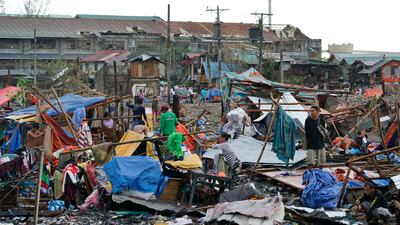
A powerful typhoon slammed into southeastern Philippines. AP Photo -
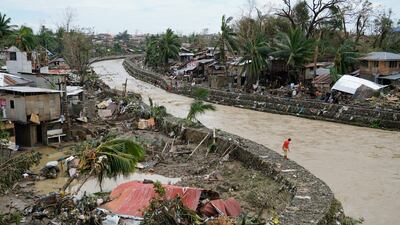
At least 21 people were killed, according to official reports on Saturday. AP Photo -
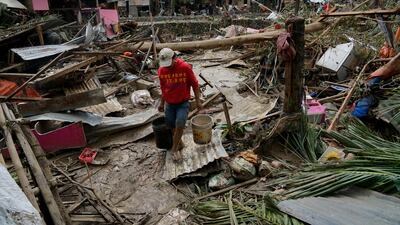
More than 300,000 people fled to safety before the storm made landfall. AP Photo -
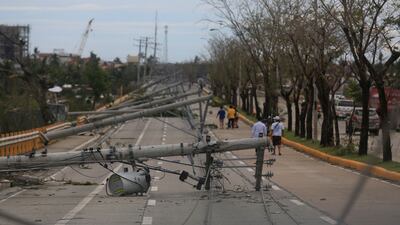
Witnesses described ferocious winds that ripped off roofs and forced down trees. AFP -
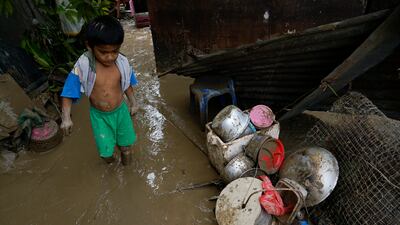
Others experienced severe flooding that trapped residents on their roofs. AP Photo -
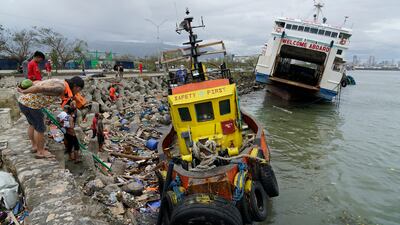
Ships run aground in Cebu city. AP Photo -
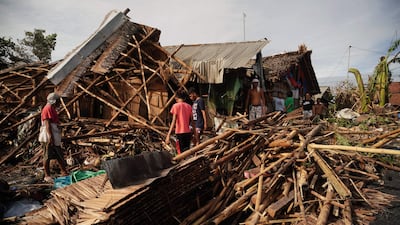
Residents salvage belongings from their destroyed homes in the coastal town of Dulag in Leyte province. AFP -

Residents walk past their destroyed homes in Hernani town, Eastern Samar. AFP -
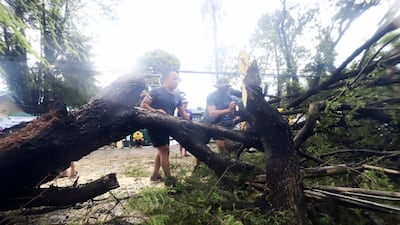
Government workers clear a fallen tree in Iloilo city. EPA


At its strongest, the typhoon blew gusts of up to 270kph, making it one of the most powerful storms in recent years to hit the disaster-prone archipelago, which lies between the Pacific Ocean and the South China Sea.
Floodwaters rose rapidly in Bohol’s riverside town of Loboc, where people were trapped on their roofs and in trees. They were rescued by the coastguard the following day. On Dinagat, an official said the roofs of nearly all the houses, including emergency shelters, had either been damaged or blown away.
At least 227 cities and towns lost electricity, which has since been restored in only 21 areas, officials said. Three regional airports were damaged, including two that remain closed.
More than 18,000 military, police, coastguard and firefighting personnel will join search and rescue efforts in the worst-affected regions, said Mark Timbal, spokesman for the national disaster agency.
There has been severe damage on Siargao Island and the northern tip of the southern island of Mindanao, Mr Timbal said, referring to areas that took the full force of the typhoon.
There are about 100,000 people living on Siargao, but the population swells with tourists drawn to its beaches and big waves.
The coastguard shared photos on social media showing widespread destruction around Surigao City on Mindanao.
About 20 storms and typhoons hit the Philippines each year. Scientists have long given warnings that typhoons are becoming more powerful and strengthening more rapidly as the world becomes warmer because of human-driven climate change.

