

Australia imposed restrictions on travel from southern Africa on Saturday after the discovery of a coronavirus variant called Omicron sparked global concern and a market sell-off.
Omicron, dubbed a “variant of concern” by the World Health Organisation, was discovered in South Africa and has since been detected in Belgium, Botswana, Israel and Hong Kong.
A minister in the German state of Hesse said the variant had very probably arrived in Germany in a traveller returning from South Africa.
Omicron is potentially more contagious than previous variants of the disease, although scientists have said it is too early to tell how it will affect the effectiveness of Covid-19 vaccines.
The WHO convened a global meeting on international measures to defeat the virus. Comprising all 194 members of the World Health Assembly, it was called to develop a new accord on the pandemic response.
On Saturday, the UAE issued restrictions for travellers departing from or transiting through Botswana, Eswatini, Lesotho, Mozambique, Namibia, South Africa and Zimbabwe. Those travellers will not be accepted for travel into Dubai until further notice.
“We will have more pandemics in the future. The question is not if, but when,” Jaouad Mahjour, the WHO assistant director general for emergency preparedness, told reporters.
WHO chief Dr Tedros Adhanom Ghebreyesus wants a treaty to end what he said was "neglect and panic”.
"The ongoing chaos of this pandemic only underlines why the world needs an iron-clad global agreement to set the rules,” he said.
Financial markets plunged on Friday, with stocks of airlines and others in the travel sector hit particularly hard.
Investors said they were worried the variant could cause another surge in the pandemic and stall a global recovery. Oil prices tumbled by about $10 a barrel.
-

An employee of the Red Cross checks the registrations for the PCR test at a Covid-19 testing station in Innsbruck, Austria. From today, people who are not vaccinated against the coronavirus are barred from entering restaurants, bars, hotel, gyms, hairdressers, ski lifts and other public places throughout the country. Getty -

People leave a river cruise ship that arrived from Passau, Germany, at a shipping pier along the Danube river in Vienna, Austria. At least 80 passengers on the ship tested positive for Covid-19. EPA -
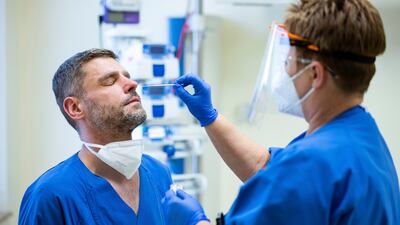
Rami Tahhan, a nursing assistant at Vivantes Clinic in Friedrichshain, Berlin, Germany, is tested for Covid-19. AP -
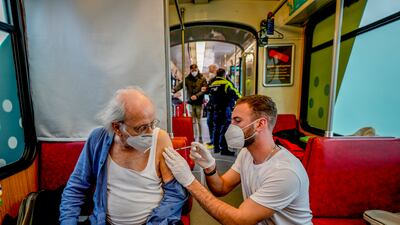
An 85-year-old man receives a booster vaccination aboard the ‘vaccination express’ tram in Frankfurt, Germany. AP -
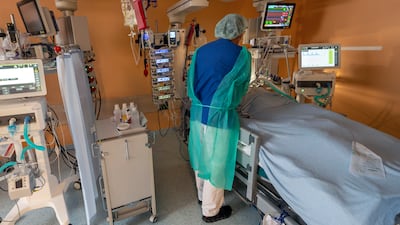
Head doctor Dr Lorenz Nowak treats a Covid-19 patient in the intensive care unit of Asklepios Clinic in Munich, Germany. AP -
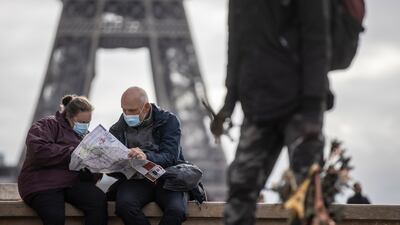
People wear protective face masks near the Eiffel Tower in Paris, France. EPA -

A man rides his mobility scooter along the promenade of Levante beach in Benidorm, Spain. The number of British tourists in the coastal resort has steadily risen since the UK government eased travel rules. Getty -

People take part in a ‘No Green Pass’ rally in Trieste, northern Italy. EPA -

AC Milan supporters display a banner in memory of Covid-19 victims during an Italian Serie A football match in the Italian city. EPA -

A QR code is displayed in a sports hall in Heerhugowaard, Netherlands. Owing to tightened coronavirus measures, indoor sports associations are obliged to check the smartphones of players and visitors. EPA -
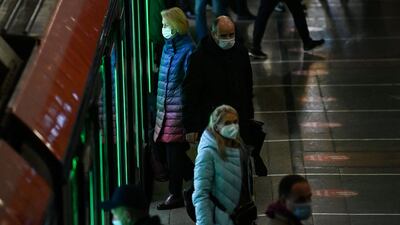
Passengers wear face masks on a metro train platform in Moscow, Russia. AFP


Travel restrictions
Epidemiologists say travel curbs may be too late to stop Omicron from circulating globally. But on Friday, a string of countries, including the US, Brazil, Canada and EU member states, announced travel bans or restrictions on arrivals from southern Africa.
On Saturday, Australia said it would bar entry of non-citizens who have been in one of nine southern African countries and would impose supervised 14-day quarantines for Australian citizens and their dependents returning from any of these nations.
Japan said it would extend its tightened border controls to three more African countries after imposing curbs on travel on Friday. Sri Lanka, Thailand and Oman also announced travel curbs on southern African nations.
Many countries in Europe are already battling a surge in Covid-19 infections. Some have reintroduced restrictions on social activity to curb the spread.
In Britain, the main opposition Labour Party called on Saturday for the vaccine booster programme to be accelerated. It said the gap between the second dose of a vaccination and the booster dose should be cut from six to five months.
“This new variant is a wake-up call,” Labour's junior health spokesman, Alex Norris, said. “The pandemic is not over. We need to urgently bolster our defences to keep the virus at bay.”
Some experts say it could be some time before the risk posed by the new variant becomes clear.
“I certainly thought [of] Delta as a peak variant, and probably it couldn’t get much worse than that. This looks potentially worse,” said Danny Altmann, professor of immunology at Imperial College London.
“On the other hand, there’s no reporting from South Africa yet that cases are more severe, and it looks like vaccines may still be doing something because we heard there yesterday that the people in hospital tended to be the unvaccinated people rather than the vaccinated.”

