Many developing countries are highly vulnerable to climate-related disasters such as floods, as seen here in India. AFP

Cop26: Rich countries fall short of $100bn aid target for poorer nations


Tim Stickings
  • English
  • Arabic

Rich countries have failed to meet a $100 billion promise to help developing nations tackle climate change — but there is hope that they could meet the target by 2023.

The announcement sets the stage for tricky negotiations at the Cop26 summit, at which leaders will be urged to open their wallets to support the global south.

Cop26 president Alok Sharma acknowledged "deep frustration" from poorer countries that the money had not been delivered, more than a decade after it was first promised in 2009.

Many developing nations are particularly vulnerable to climate-related disasters, such as floods and droughts, which will become far more frequent if global warming is not kept in check.

Leaders of developing countries say they need the money to help them grow their economies sustainably, without relying on fossil fuels.

But a report commissioned by Mr Sharma said the promised $100bn had not been raised by the 2020 deadline.

“Even though final figures for 2020 are not available yet, it is becoming clear that developed countries will not have mobilised US$100 billion jointly,” it said.

Total funds rose to $79.6bn by 2019, with most of the money coming from taxpayers rather than the private sector. The report welcomed a "significant effort by developed countries" but said there was still a shortfall.

"Understandably, this has been a source of deep frustration for developing countries," said Mr Sharma. "We can and must do more to get finance flowing to developing nations.

"Crucially, we must increase the sums available for climate adaptation, and we must also urgently improve access to finance. So our work continues."

Jochen Flasbarth, a state secretary in Germany's Environment Ministry, said developing countries were "rightfully disappointed" by the lack of funds.

The ministers set out what they called a Delivery Plan to get the money together by 2023, mainly relying on increased spending from governments.

"It is my strong hope that with this plan, we can show the international community that developed countries remain committed to deliver on their promises," Mr Flasbarth said.

  • An aerial view of the Scottish Events Centre in Glasgow, where the Cop26 Summit will take place from Sunday, October 31, until Friday, November 12. Getty Images
    An aerial view of the Scottish Events Centre in Glasgow, where the Cop26 Summit will take place from Sunday, October 31, until Friday, November 12. Getty Images
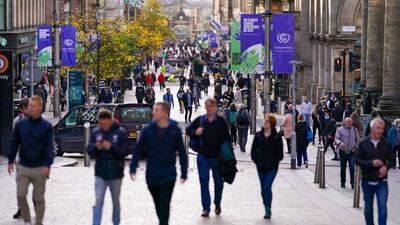
  • Banners advertising the upcoming Cop26 Summit line a street in Glasgow. Glasgow was chosen to host the summit in 2019. Ministers described it as one of the UK’s most sustainable cities and a showcase for “diverse culture and world-leading innovation”. Bloomberg
    Banners advertising the upcoming Cop26 Summit line a street in Glasgow. Glasgow was chosen to host the summit in 2019. Ministers described it as one of the UK’s most sustainable cities and a showcase for “diverse culture and world-leading innovation”. Bloomberg
  • Workers erect a fence at the Scottish Events Centre. Cop26 was initially due to take place in 2020 but was postponed by a year because of the pandemic. Getty Images
    Workers erect a fence at the Scottish Events Centre. Cop26 was initially due to take place in 2020 but was postponed by a year because of the pandemic. Getty Images
  • A pupil holds a poster at St Convals Primary School in Glasgow while learning about climate change ahead of Cop26. About 25,000 people are expected to attend the summit. Reuters
    A pupil holds a poster at St Convals Primary School in Glasgow while learning about climate change ahead of Cop26. About 25,000 people are expected to attend the summit. Reuters
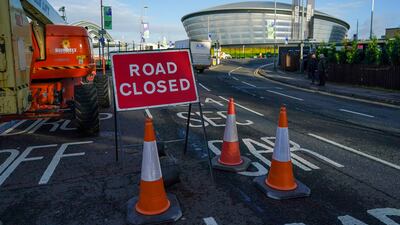
  • Road closures are in place around the SEC in Glasgow. There have been 25 Conference of the Parties (or 'Cop') summits so far, making this year's event 'Cop26'. Bloomberg
    Road closures are in place around the SEC in Glasgow. There have been 25 Conference of the Parties (or 'Cop') summits so far, making this year's event 'Cop26'. Bloomberg
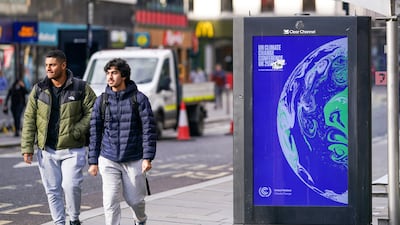
  • An electronic poster advertising the Cop26 summit. World leaders will kick off the summit by setting 'high-level ambition' for climate action, the UK government says. Bloomberg
    An electronic poster advertising the Cop26 summit. World leaders will kick off the summit by setting 'high-level ambition' for climate action, the UK government says. Bloomberg
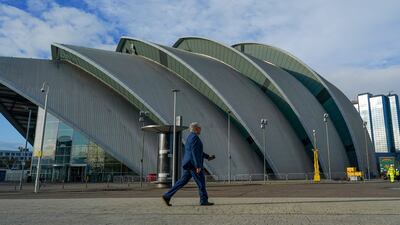
  • The Armadillo building forms part of the SEC, the location for the summit. Bloomberg
    The Armadillo building forms part of the SEC, the location for the summit. Bloomberg
  • Artists paint a mural on a a wall next to the Clydeside Expressway near the SEC. Getty Images
    Artists paint a mural on a a wall next to the Clydeside Expressway near the SEC. Getty Images
  • Police Scotland mounted officers patrol near the SSE Hydro venue in Glasgow. As part of the summit, world leaders are holding talks on November 1 and 2. Prime Minister Boris Johnson will represent Britain and US President Joe Biden will be there. AFP
    Police Scotland mounted officers patrol near the SSE Hydro venue in Glasgow. As part of the summit, world leaders are holding talks on November 1 and 2. Prime Minister Boris Johnson will represent Britain and US President Joe Biden will be there. AFP
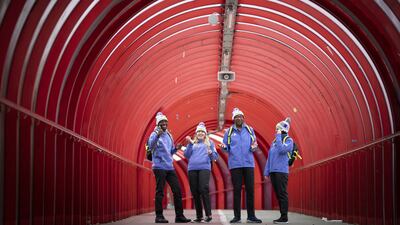
  • Volunteers model the official uniforms that will be worn by about 1,000 volunteers at Cop26. PA
    Volunteers model the official uniforms that will be worn by about 1,000 volunteers at Cop26. PA

Funding shortfall

The wealthy countries expected to stump up the money are mainly in Europe and North America, but also include Australia, Japan and New Zealand.

Monday's report was spearheaded by ministers from Germany and Canada, and did not point the finger at specific countries for failing to meet the target.

But experts and aid groups have criticised the US for donating too little money, given the size of its economy, population and carbon footprint.

President Joe Biden plans to double Washington’s contribution during his first term and the report said there were encouraging signs in a number of countries.

“The outlook to 2025 shows a positive trend,” it said, with rich countries “making significant progress towards the $100 billion goal in 2022”.

As a result, the study authors “express confidence that it would be met in 2023”. Mr Sharma said there could be $117bn by 2025.

Teresa Anderson, a climate lobbyist at the charity ActionAid, said the $100bn was a bare minimum needed to build trust in global talks.

"World leaders must recognise and address the glaring gap between the current 100 billion-a-year target and the trillions needed to tackle the scale and urgency of the crisis," she said.

People demonstrate on the sidelines of a meeting of environment ministers in Naples, Italy. AP

The funding promise agreed in Copenhagen more than a decade ago runs until 2025, when the UN expects a more ambitious target to be adopted.

This will be one of the topics discussed at Cop26, where Mr Sharma hopes to prepare the ground for a new target to be set.

Britain plans to spend £11.6bn ($16.0bn) on climate finance by 2026. The EU is urging other countries to find more money by cutting fossil fuel subsidies.

Private financing has proved disappointing, according to Monday’s report, which said it remained “more or less flat” from 2017 to 2019. Mr Biden’s administration has said it will try to raise more money from investors.

China and India, two of the world’s biggest polluters, are not considered developed countries and therefore not expected to contribute.

However, they will be key players in negotiations on fossil fuels, especially the future of coal power.

The UK wants coal to be “consigned to history” at Cop26, but India has evaded calls for a global agreement to phase it out.

Speaking to schoolchildren on Monday, UK Prime Minister Boris Johnson expressed concern on Monday that the Glasgow summit "might go wrong".

"It's very, very far from clear that we'll get the progress that we need," he said. "We might not get the agreements that we need and it's touch and go."


Why your domicile status is important

Your UK residence status is assessed using the statutory residence test. While your residence status – ie where you live - is assessed every year, your domicile status is assessed over your lifetime.

Your domicile of origin generally comes from your parents and if your parents were not married, then it is decided by your father. Your domicile is generally the country your father considered his permanent home when you were born. 

UK residents who have their permanent home ("domicile") outside the UK may not have to pay UK tax on foreign income. For example, they do not pay tax on foreign income or gains if they are less than £2,000 in the tax year and do not transfer that gain to a UK bank account.

A UK-domiciled person, however, is liable for UK tax on their worldwide income and gains when they are resident in the UK.

Things Heard & Seen

Directed by: Shari Springer Berman, Robert Pulcini

Starring: Amanda Seyfried, James Norton

2/5

Mercer, the investment consulting arm of US services company Marsh & McLennan, expects its wealth division to at least double its assets under management (AUM) in the Middle East as wealth in the region continues to grow despite economic headwinds, a company official said.

Mercer Wealth, which globally has $160 billion in AUM, plans to boost its AUM in the region to $2-$3bn in the next 2-3 years from the present $1bn, said Yasir AbuShaban, a Dubai-based principal with Mercer Wealth.

Within the next two to three years, we are looking at reaching $2 to $3 billion as a conservative estimate and we do see an opportunity to do so,” said Mr AbuShaban.

Mercer does not directly make investments, but allocates clients’ money they have discretion to, to professional asset managers. They also provide advice to clients.

“We have buying power. We can negotiate on their (client’s) behalf with asset managers to provide them lower fees than they otherwise would have to get on their own,” he added.

Mercer Wealth’s clients include sovereign wealth funds, family offices, and insurance companies among others.

From its office in Dubai, Mercer also looks after Africa, India and Turkey, where they also see opportunity for growth.

Wealth creation in Middle East and Africa (MEA) grew 8.5 per cent to $8.1 trillion last year from $7.5tn in 2015, higher than last year’s global average of 6 per cent and the second-highest growth in a region after Asia-Pacific which grew 9.9 per cent, according to consultancy Boston Consulting Group (BCG). In the region, where wealth grew just 1.9 per cent in 2015 compared with 2014, a pickup in oil prices has helped in wealth generation.

BCG is forecasting MEA wealth will rise to $12tn by 2021, growing at an annual average of 8 per cent.

Drivers of wealth generation in the region will be split evenly between new wealth creation and growth of performance of existing assets, according to BCG.

Another general trend in the region is clients’ looking for a comprehensive approach to investing, according to Mr AbuShaban.

“Institutional investors or some of the families are seeing a slowdown in the available capital they have to invest and in that sense they are looking at optimizing the way they manage their portfolios and making sure they are not investing haphazardly and different parts of their investment are working together,” said Mr AbuShaban.

Some clients also have a higher appetite for risk, given the low interest-rate environment that does not provide enough yield for some institutional investors. These clients are keen to invest in illiquid assets, such as private equity and infrastructure.

“What we have seen is a desire for higher returns in what has been a low-return environment specifically in various fixed income or bonds,” he said.

“In this environment, we have seen a de facto increase in the risk that clients are taking in things like illiquid investments, private equity investments, infrastructure and private debt, those kind of investments were higher illiquidity results in incrementally higher returns.”

The Abu Dhabi Investment Authority, one of the largest sovereign wealth funds, said in its 2016 report that has gradually increased its exposure in direct private equity and private credit transactions, mainly in Asian markets and especially in China and India. The authority’s private equity department focused on structured equities owing to “their defensive characteristics.”

Hili 2: Unesco World Heritage site

The site is part of the Hili archaeological park in Al Ain. Excavations there have proved the existence of the earliest known agricultural communities in modern-day UAE. Some date to the Bronze Age but Hili 2 is an Iron Age site. The Iron Age witnessed the development of the falaj, a network of channels that funnelled water from natural springs in the area. Wells allowed settlements to be established, but falaj meant they could grow and thrive. Unesco, the UN's cultural body, awarded Al Ain's sites - including Hili 2 - world heritage status in 2011. Now the most recent dig at the site has revealed even more about the skilled people that lived and worked there.

Updated: October 25, 2021, 1:34 PM