


The vaccine pioneers who led the fight against the pandemic were left empty-handed when a Nobel Prize jury gave the 2021 prize in physiology or medicine to biologists who shone a light on human senses.
But after scooping other awards sometimes regarded as precursors to the Nobel, the team behind the Pfizer-BioNTech shot could yet be honoured in the future.
Scientific breakthroughs are not like Oscar-nominated movies, with only one chance of recognition. Nobel prizes can be presented many years after the event.
The secrecy around the award means there is no official word on who else was in contention.
Winners are picked behind closed doors and nominations kept secret for 50 years.
But the pandemic is likely to remain high in the public mind, and the scientists who helped to turn the tide against Covid-19 have already been widely commended.
“It’s hard to think of any parallel here, a discovery that’s had such a huge impact,” said Dr Jason Sheltzer, a US biologist who has published research on the Nobel Prize. He spoke before this year’s winners were announced.
He said Nobel judges were generally conservative and looked for safe choices whose work had been widely embraced by the scientific community over time.
But the breakthrough vaccine technology has been in development for years. “You could say the initial discoveries aren’t recent, it’s just their application that’s taken the world by storm,” Dr Sheltzer said.
The Pfizer-BioNTech vaccine was the first to be approved by the World Health Organisation, and has helped prevent untold numbers of deaths and lift countries out of the monotony of lockdown. It was created in record time – earlier vaccines typically took a decade or more to develop.
The Ehrlich Prize, Germany’s top medical award, last month went to three scientists from BioNTech: founders Ugur Sahin and Ozlem Tureci, and biochemist Katalin Kariko.
Drs Sahin and Tureci, who are married, created the company in 2008. After the success of their Covid vaccine, the German-Turkish couple hope to use the same technology to take on malaria.
Dr Kariko also won the Lasker Award, a US prize, with her collaborator, Dr Drew Weissman. He worked on the development of the mRNA vaccines that have proved spectacularly successful against Covid-19.
Theirs are not the only names to watch in future Nobel ballots. Arthur Horwich and Franz-Ulrich Hartl have been widely honoured for their work on proteins and how they take their shape.
Recipients of the Canada Gairdner International Award in 2004, they more recently won the $3 million Breakthrough Prize in Life Sciences in 2019.
Another scientist with those two prizes, but no Nobel to his name, is American biologist Dr C David Allis, a pioneer in the field of epigenetics.
“I feel like there are dozens of [scientists] that would qualify for the Nobel, and if they won the Nobel, people would say that’s terrific, very well deserved,” Dr Sheltzer said.
“But with one prize in medicine and one prize in chemistry each year, there are so many deserving ones that haven’t been recognised.”
Every scientist relies on colleagues and collaborators to win awards. “To some extent, they’re a fiction,” Dr Sheltzer said of the Nobel Prizes.
“The idea that you can pick one or two or three people and say they did this discovery, they did this amazing thing – that’s not exactly how science works in 2021.”
-
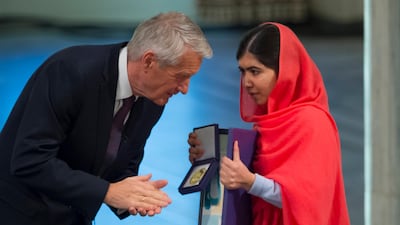
Malala Yousafzai became the youngest person to receive this prize in 2014. Getty Images -
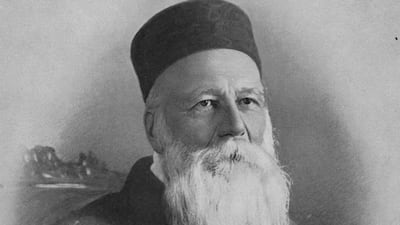
Swiss philanthropist Jean Henri Dunant was one of the first to receive the Nobel Peace Prize in 1901 for his role in the founding of the International Red Cross. Getty Images -
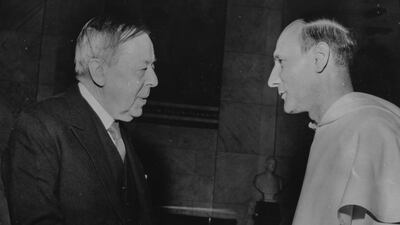
Belgian Dominican friar Dominique Pire's (right) work helping refugees in post-World War II Europe saw him receive the Nobel Peace Prize in 1958. Getty Images -
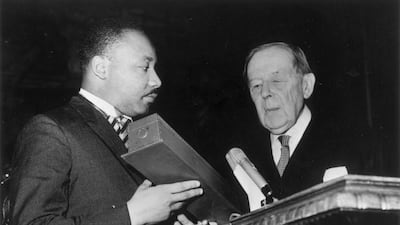
American civil rights leader Martin Luther King, Jr., left, announced that he would turn over the prize money to the furtherance of the civil rights movement. Getty Images -
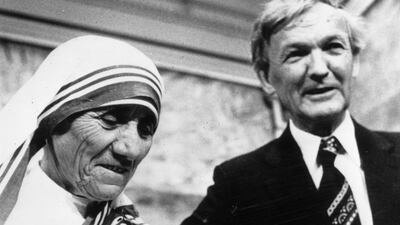
Mother Teresa was awarded the Nobel Peace Prize for her humanitarian work with the poor in 1979. Getty Images -
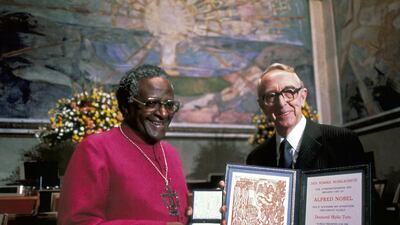
South African Archbishop Mgr Desmond Tutu, left, was honored with the Peace Prize for his opposition to apartheid. AFP -
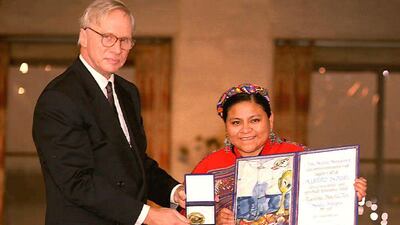
Guatemalan Indian activist Rigoberta Menchu, right, was the ninth woman to win the award. AFP -
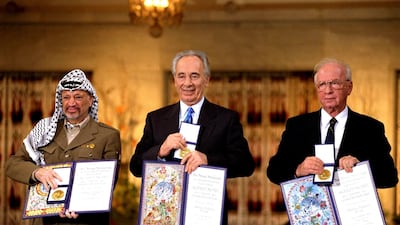
From left: Palestinian leader Yaser Arafat, Israeli Foreign Minister Shimon Peres and Israeli Prime Minister Yitzak Rabin are the joint Nobel Peace Prize winners for 1994 for their efforts to create peace in the Middle East. Getty Images -
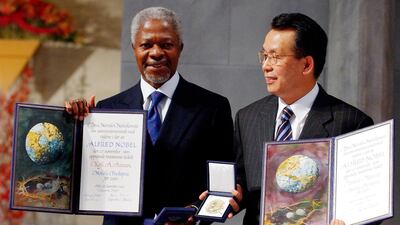
President of the UN General Assembly, South Korean Foreign Minister Han Seung-soo, right, looks at Secretary-General of the United Nations Kofi Annan at the Nobel Peace Awards in 2001. The prize was awarded to Annan for his work as secretary-general and the UN represented by Han Seung-soo. AFP -
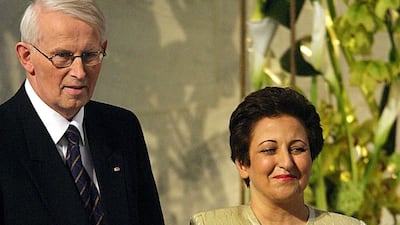
Iranian lawyer and human rights activist Shirin Ebadi, right, receives the 2003 Nobel Peace Prize for her democracy-building efforts and her work to improve human rights in Iran, making her the first Muslim woman to receive the award. AFP -

Mohamed ElBaradei, director general of the International Atomic Energy Agency, left, and Yukiya Amano, chairman of its board of governors, received the 2005 Nobel Peace Prize at a ceremony for their efforts to halt the spread of nuclear weapons. AFP -
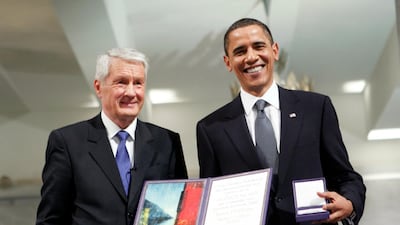
US President Barack Obama was awarded the 2009 Nobel Peace Prize "for his extraordinary efforts to strengthen international diplomacy and cooperation between peoples." AFP -

Dr. Denis Mukwege and Nadia Murad have been jointly awarded the 2018 Nobel peace prize in recognition for their efforts to end the use of sexual violence as a weapon in war. Getty Images


The medical winners are chosen by a 50-strong panel known as the Nobel Assembly. Based at the Karolinska Institute, an academy founded by Swedish royals in 1810, it typically meets in a private room with curtains drawn.
Selected scientists are invited to nominate their fellow researchers for the prize, but nobody is told whether they are under consideration.
The nominations are kept secret for 50 years, meaning runners-up may never know how close they came.
The jackpot is 10m Swedish kronor ($1.1m), although it is often shared. The winner also receives a medal from the King of Sweden.
Some winners, according to tongue-in-cheek legend, become afflicted by “Nobel Disease” – an outbreak of overconfidence that leads them to stray into fields they are not qualified to comment on.
But to be eligible for the prize, they must have made a discovery that benefits all of humankind. It sets a high bar for entry.
That was the wish of Alfred Nobel, the Swedish dynamite tycoon who left the prizes in his will when he died in 1896.
He said the winner should be “the person who made the most important discovery within the domain of physiology or medicine”.
Discoveries must “extend the horizon of human knowledge in profound ways,” the committee says, although this often does not become clear for many years. Judges can choose to give no award at all if there is no suitable candidate.
Dr Juleen Zierath, a jury member and biologist, said the significance of a scientific breakthrough was sometimes quite obscure at first.
In remarks published by prize organisers, she said scientists were sometimes blindsided by being given the award when they were tracked down by the committee.
“By the time we come to the decision, it is a big surprise to the individuals who have been selected,” she said. “And so, it’s generally unexpected and it changes their lives.
“What I would say is often it takes many years before the field recognises that the discovery you’ve made is of a distinction that should be considered for a Nobel Prize. So sometimes you have to be quite patient.”

