It was not until Hatem Salama Saleh left his Brooklyn neighbourhood in 2005 to join the US Marine Corps fighting in Iraq that he personally felt the impact of the terror attacks of September 11, 2001.
“That is when I felt the effects of anti-this and anti-that, as I was the only Muslim American in my whole battalion. That is where I faced reality,” he said.
“Your last name, your first name, you stand out with the Johnsons and the Smiths. But after a while, once you become one with everyone else, it kind of gets brushed aside - everyone is a service member.”
Mr Saleh, 32, is from the Bay Ridge neighbourhood of Brooklyn in New York, home to a community of Arab Americans from Egypt, Jordan, Palestine, Syria and other parts of the Middle East spread across a five-block radius.
Locals, a mix of foreign-born and first-generation immigrants, congregate daily to drink coffee thickened with condensed milk and to smoke slowly at street tables.
New York has the highest concentration of Arab Americans in the US.
Before 9/11, discrimination was already a part of life for Enas Salem, a 28-year-old Egyptian American who grew up on Staten Island.
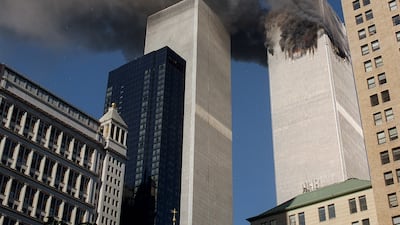
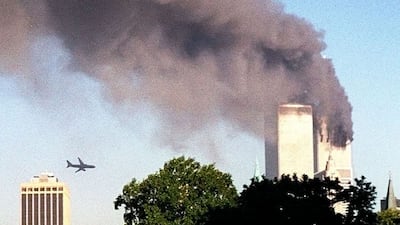
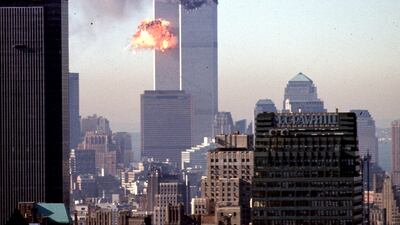
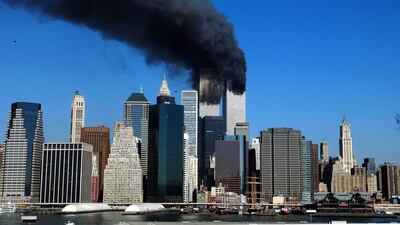
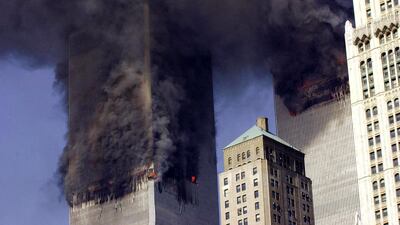
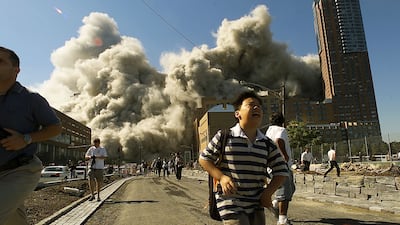
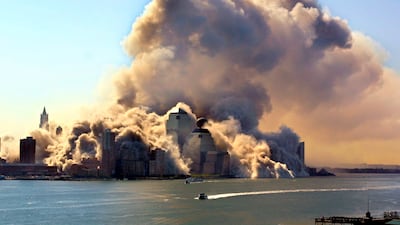
But watching the Twin Towers crumble on television, Ms Salem’s heart sank.
She said she “knew everything was going to change, because, one, my uncle was going to be called to duty to serve in the military in a war that targeted people that looked like us and two, we knew we were going to be targeted on American soil because of the way we looked.
“At the time, I was wearing the hijab and people would pull it off of you in the street or throw things at you or use any kind of racial slur they could think of,” she explained over a dish of koshari, the deliciously starchy Egyptian comfort food.
The backlash was indiscriminate, she said: “It wasn’t just Arabs and Muslims that were targeted, it was anyone who looked brown, anyone who looked different, anyone with an accent. The fear, especially in New York City, was so heightened that there was no room for nuance in any of it.”
A 2002 poll by the Arab American Institute found that more than two thirds of Arab Americans believed they had seen more profiling since 9/11, while one fifth had personally experienced discrimination after the attacks.
Many Arab Americans remember the discriminatory “Special Registration” policy (National Security Entry-Exit Registration System) rolled out in 2002, which required men in select visa categories from 25 predominantly Arab and Muslim countries to check in with US authorities.
Designed to catch terrorists, in reality it was often used to detain people unfairly, said Emira Habiby Browne, a Palestinian American and founder of the Arab American Family Support Centre, whose workload soared post-9/11 as families sought legal protection and emotional support.
But as the years passed, the backlash against Arab Americans and Muslims abated.
“The image smoothed out and there was no stigma anymore,” Mr Saleh said.
Then, as he came into office in 2017, former US president Donald Trump imposed an executive order banning travel from seven mostly Muslim countries, an action widely referred to as the “Muslim ban".
It was “a return to post-9/11”, said Ms Habiby Browne, who now runs an immigrant advocacy centre in New York.
“It was this bigotry that cropped up all over again when things were beginning to get better.
“I came as an immigrant and this country was a wonderful place to be. And then everything turned upside down for immigrants. Because of all this misinformation, all these things that people are hearing, and listening to and being fed, it infuriates me. This is not the America I came to,” she said.
Still, the advent of social media has also helped educate people about their communities, Arab Americans say.
“People didn’t understand what a Muslim was, what an Arab is,” said Ms Habiby Browne. “I didn’t realise how little Americans generally knew about the community.”
Today, “people have better sources of information about Islam,” said Wally, a 44-year-old Algerian and now New Yorker who declined to give his last name.
Ms Salem said she agreed: “There is still so much of that discrimination and racism that is 100 per cent there but … there is more of a spread of information that people have access to that we didn’t at the time of 9/11.”
Twenty years after the attacks, the shared devastation over 9/11 remains.
“When the anniversary comes up, a lot of people in the community memorialise it as a loss for our country and our loved ones,” said Hizam Wahib, a 43-year-old Yemeni American and senior director of legal services and expansion strategy at the Arab American Family Support Centre.
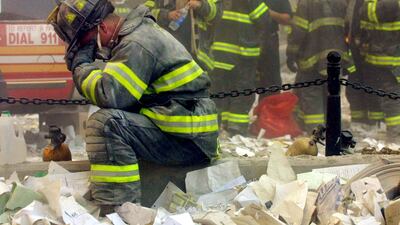
“It affected everyone - Muslims, non-Muslims. If you didn’t lose any family members, it feels like you did.”
For Mr Saleh, the former marine, when you are born and raised in the US, "the ground that you walk on is yours. For our parents and grandparents, they are basically long-term visitors. Someone like me, this is my home and my country".

Abandon
Sangeeta Bandyopadhyay
Translated by Arunava Sinha
Tilted Axis Press
THE BIO
Born: Mukalla, Yemen, 1979
Education: UAE University, Al Ain
Family: Married with two daughters: Asayel, 7, and Sara, 6
Favourite piece of music: Horse Dance by Naseer Shamma
Favourite book: Science and geology
Favourite place to travel to: Washington DC
Best advice you’ve ever been given: If you have a dream, you have to believe it, then you will see it.
Results
5pm: Maiden (PA) Dh80,000 (Turf) 1,600m; Winner: Rawat Al Reef, Adrie de Vries (jockey), Abdallah Al Hammadi (trainer)
5.30pm: Wathba Stallions Cup Handicap (PA) Dh70,000 (T) 1,400m; Winner: Noof KB, Richard Mullen, Ernst Oertel
6pm: Handicap (PA) Dh80,000 (T) 1,200m; Winner: AF Seven Skies, Bernardo Pinheiro, Qaiss Aboud
6.30pm: Handicap (PA) Dh80,000 (T) 2,200m; Winner: Jabalini, Szczepan Mazur, Ibrahim Al Hadhrami
7pm: UAE Arabian Derby – Prestige (PA) Dh150,000 (T) 2,200m; Winner: Dergham Athbah, Richard Mullen, Mohamed Daggash
7.30pm: Emirates Championship – Group 1 (PA) Dh1,000,000 (T) 2,200m; Winner: Somoud, Richard Mullen, Jean de Roualle
8pm: Abu Dhabi Championship – Group 3 (TB) Dh380,000 (T) 2,200m; Winner: Irish Freedom, Antonio Fresu, Satish Seemar
Defending champions
World Series: South Africa
Women’s World Series: Australia
Gulf Men’s League: Dubai Exiles
Gulf Men’s Social: Mediclinic Barrelhouse Warriors
Gulf Vets: Jebel Ali Dragons Veterans
Gulf Women: Dubai Sports City Eagles
Gulf Under 19: British School Al Khubairat
Gulf Under 19 Girls: Dubai Exiles
UAE National Schools: Al Safa School
International Invitational: Speranza 22
International Vets: Joining Jack
Honeymoonish
%3Cp%3E%3Cstrong%3EDirector%3A%3C%2Fstrong%3E%20Elie%20El%20Samaan%3C%2Fp%3E%0A%3Cp%3E%3Cstrong%3EStarring%3A%20%3C%2Fstrong%3ENour%20Al%20Ghandour%2C%20Mahmoud%20Boushahri%3C%2Fp%3E%0A%3Cp%3E%3Cstrong%3ERating%3A%3C%2Fstrong%3E%203%2F5%3C%2Fp%3E%0A
Desert Warrior
Starring: Anthony Mackie, Aiysha Hart, Ben Kingsley
Director: Rupert Wyatt
Rating: 3/5
Mercer, the investment consulting arm of US services company Marsh & McLennan, expects its wealth division to at least double its assets under management (AUM) in the Middle East as wealth in the region continues to grow despite economic headwinds, a company official said.
Mercer Wealth, which globally has $160 billion in AUM, plans to boost its AUM in the region to $2-$3bn in the next 2-3 years from the present $1bn, said Yasir AbuShaban, a Dubai-based principal with Mercer Wealth.
“Within the next two to three years, we are looking at reaching $2 to $3 billion as a conservative estimate and we do see an opportunity to do so,” said Mr AbuShaban.
Mercer does not directly make investments, but allocates clients’ money they have discretion to, to professional asset managers. They also provide advice to clients.
“We have buying power. We can negotiate on their (client’s) behalf with asset managers to provide them lower fees than they otherwise would have to get on their own,” he added.
Mercer Wealth’s clients include sovereign wealth funds, family offices, and insurance companies among others.
From its office in Dubai, Mercer also looks after Africa, India and Turkey, where they also see opportunity for growth.
Wealth creation in Middle East and Africa (MEA) grew 8.5 per cent to $8.1 trillion last year from $7.5tn in 2015, higher than last year’s global average of 6 per cent and the second-highest growth in a region after Asia-Pacific which grew 9.9 per cent, according to consultancy Boston Consulting Group (BCG). In the region, where wealth grew just 1.9 per cent in 2015 compared with 2014, a pickup in oil prices has helped in wealth generation.
BCG is forecasting MEA wealth will rise to $12tn by 2021, growing at an annual average of 8 per cent.
Drivers of wealth generation in the region will be split evenly between new wealth creation and growth of performance of existing assets, according to BCG.
Another general trend in the region is clients’ looking for a comprehensive approach to investing, according to Mr AbuShaban.
“Institutional investors or some of the families are seeing a slowdown in the available capital they have to invest and in that sense they are looking at optimizing the way they manage their portfolios and making sure they are not investing haphazardly and different parts of their investment are working together,” said Mr AbuShaban.
Some clients also have a higher appetite for risk, given the low interest-rate environment that does not provide enough yield for some institutional investors. These clients are keen to invest in illiquid assets, such as private equity and infrastructure.
“What we have seen is a desire for higher returns in what has been a low-return environment specifically in various fixed income or bonds,” he said.
“In this environment, we have seen a de facto increase in the risk that clients are taking in things like illiquid investments, private equity investments, infrastructure and private debt, those kind of investments were higher illiquidity results in incrementally higher returns.”
The Abu Dhabi Investment Authority, one of the largest sovereign wealth funds, said in its 2016 report that has gradually increased its exposure in direct private equity and private credit transactions, mainly in Asian markets and especially in China and India. The authority’s private equity department focused on structured equities owing to “their defensive characteristics.”
Killing of Qassem Suleimani
The burning issue
The internal combustion engine is facing a watershed moment – major manufacturer Volvo is to stop producing petroleum-powered vehicles by 2021 and countries in Europe, including the UK, have vowed to ban their sale before 2040. The National takes a look at the story of one of the most successful technologies of the last 100 years and how it has impacted life in the UAE.
Read part four: an affection for classic cars lives on
Read part three: the age of the electric vehicle begins
Read part one: how cars came to the UAE
Jawan
%3Cp%3E%3Cstrong%3EDirector%3A%20%3C%2Fstrong%3EAtlee%3C%2Fp%3E%0A%3Cp%3E%3Cstrong%3EStars%3A%3C%2Fstrong%3E%20Shah%20Rukh%20Khan%2C%20Nayanthara%2C%20Vijay%20Sethupathi%26nbsp%3B%3C%2Fp%3E%0A%3Cp%3E%3Cstrong%3ERating%3A%20%3C%2Fstrong%3E4%2F5%3C%2Fp%3E%0A
The biog
Job: Fitness entrepreneur, body-builder and trainer
Favourite superhero: Batman
Favourite quote: We must become the change we want to see, by Mahatma Gandhi.
Favourite car: Lamborghini
What is graphene?
Graphene is extracted from graphite and is made up of pure carbon.
It is 200 times more resistant than steel and five times lighter than aluminum.
It conducts electricity better than any other material at room temperature.
It is thought that graphene could boost the useful life of batteries by 10 per cent.
Graphene can also detect cancer cells in the early stages of the disease.
The material was first discovered when Andre Geim and Konstantin Novoselov were 'playing' with graphite at the University of Manchester in 2004.
Countries offering golden visas
UK
Innovator Founder Visa is aimed at those who can demonstrate relevant experience in business and sufficient investment funds to set up and scale up a new business in the UK. It offers permanent residence after three years.
Germany
Investing or establishing a business in Germany offers you a residence permit, which eventually leads to citizenship. The investment must meet an economic need and you have to have lived in Germany for five years to become a citizen.
Italy
The scheme is designed for foreign investors committed to making a significant contribution to the economy. Requires a minimum investment of €250,000 which can rise to €2 million.
Switzerland
Residence Programme offers residence to applicants and their families through economic contributions. The applicant must agree to pay an annual lump sum in tax.
Canada
Start-Up Visa Programme allows foreign entrepreneurs the opportunity to create a business in Canada and apply for permanent residence.