US Marines, seen here placing barbed wire around the US embassy in Kabul on January 11, 2002, are returning to Afghanistan's capital to help embassy workers and Afghans leave the country. AFP

Marine vanguard lands in Afghan capital Kabul as US speeds up evacuations


  • English
  • Arabic

The first forces of a Marine battalion have arrived in Kabul to stand guard as the US speeds up evacuation flights for some American diplomats and thousands of Afghans, spurred by a lightning Taliban offensive that increasingly is isolating Afghanistan's capital.

Pentagon spokesman John Kirby said on Friday that “elements” of a battalion were now in Kabul, the vanguard of three Marine and Army battalions that the US was sending to the city by the end of the weekend to help more Americans and their Afghan colleagues get out quickly.

The Taliban, emboldened by the imminent end of the US combat mission in the country, took four more provincial capitals on Friday, heightening fears they would move soon on the capital, which is home to millions of Afghans. “Clearly from their actions, it appears as if they are trying to get Kabul isolated,” Mr Kirby said at a Pentagon briefing.

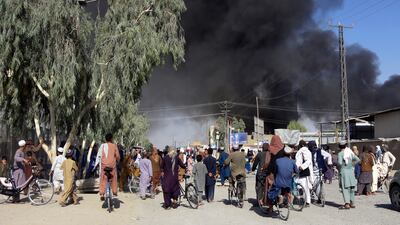
  • Smoke plumes as the Taliban and Afghan government forces fight for control of key southern city Kandahar.
    Smoke plumes as the Taliban and Afghan government forces fight for control of key southern city Kandahar.
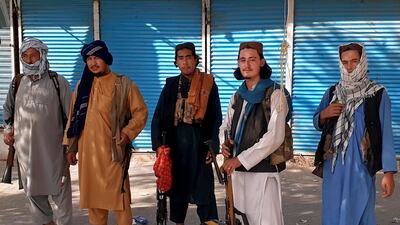
  • Taliban fighters stand guard in Kunduz city, northern Afghanistan. The militants have ramped up their push across much of the country in recent weeks.
    Taliban fighters stand guard in Kunduz city, northern Afghanistan. The militants have ramped up their push across much of the country in recent weeks.
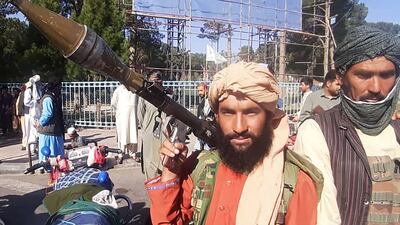
  • A Taliban fighter brandishes a rocket-propelled grenade launcher in Herat, Afghanistan's third-biggest city, after besieged government forces pulled out.
    A Taliban fighter brandishes a rocket-propelled grenade launcher in Herat, Afghanistan's third-biggest city, after besieged government forces pulled out.
  • Taliban fighters in Herat. The US and UK have told their citizens to leave Afghanistan. The insurgents have also taken Pul-e-Alam in Logar province, just 50km south of Kabul.
    Taliban fighters in Herat. The US and UK have told their citizens to leave Afghanistan. The insurgents have also taken Pul-e-Alam in Logar province, just 50km south of Kabul.
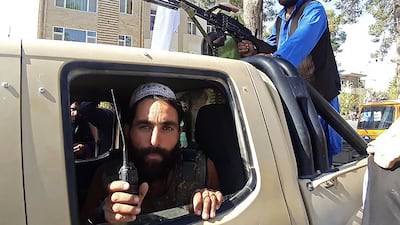
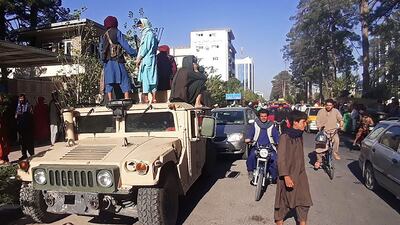
  • Taliban fighters stand on an abandoned military vehicle in Herat, on the same day insurgents also took Kandahar, Afghanistan's second-biggest city.
    Taliban fighters stand on an abandoned military vehicle in Herat, on the same day insurgents also took Kandahar, Afghanistan's second-biggest city.
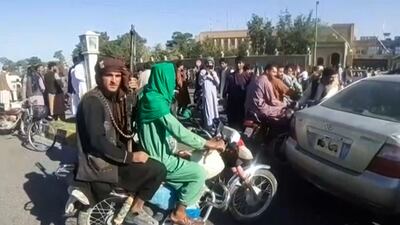
  • A Taliban fighter on the back of a motorcycle after the extremist group entered Herat.
    A Taliban fighter on the back of a motorcycle after the extremist group entered Herat.
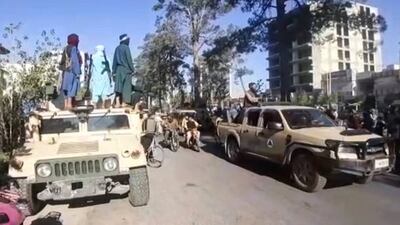
  • A Taliban convoy enters Herat. The group has also taken Lashkar Gah, capital of southern province Helmand.
    A Taliban convoy enters Herat. The group has also taken Lashkar Gah, capital of southern province Helmand.
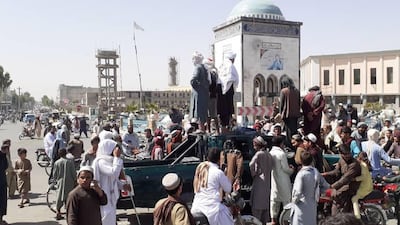
  • Taliban extremists gather in the main square after taking control of Kandahar.
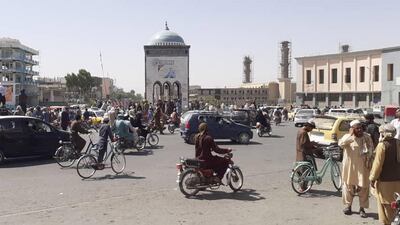
    Taliban extremists gather in the main square after taking control of Kandahar.
  • Despite the major setback of losing Kandahar, the government still holds Kabul and says it is determined to resist the Taliban advance.
    Despite the major setback of losing Kandahar, the government still holds Kabul and says it is determined to resist the Taliban advance.

The Pentagon is also moving an additional 4,500 to 5,000 troops to bases in Qatar and Kuwait, including 1,000 to Qatar to speed up visa processing for Afghan translators and others who fear retribution from the Taliban for their past work with Americans, and their family members.

The remainder – 3,500 to 4,000 troops from a combat brigade of the 82nd Airborne Division – were bound for Kuwait. Mr Kirby said the combat troops would be a reserve force on standby “in case we need even more” than the 3,000 going to Kabul.

The temporary build-up of troops for US evacuations highlights the stunning pace of the Taliban takeover of much of the country, less than three weeks before the US is set to officially end nearly 20 years of combat in Afghanistan.

President Joe Biden has remained adamant about ending the US mission on August 31, insisting the American and Nato mission that launched on October 7, 2001, had done what it could to build up a Kabul-based Afghan government and military that could withstand the Taliban when western troops finally withdrew.

The latest significant blow by the Taliban was the capture on Friday of the capital of Helmand province, where American, British and other allied Nato forces fought some of the bloodiest battles in the past 20 years. Hundreds of western troops died there during the course of the war, in fighting that often succeeded in knocking back Taliban fighters locally, only to have the militants move back in when a western unit rotated out.

The State Department said the embassy in Kabul would remain partially staffed and functioning, but Thursday's decision to evacuate a significant number of embassy staff and bring in the thousands of additional US troops is a sign of waning confidence in the Afghan government's ability to hold off the Taliban surge. The Biden administration has not ruled out a full embassy evacuation.

The US had already withdrawn most of its troops, but had kept about 650 troops in Afghanistan to support US diplomatic security, including at the airport.

The Biden administration told Taliban officials directly the US would respond if the Taliban attacked Americans during the evacuations.

Americans are preparing a military base abroad to receive and house large numbers of Afghan translators and others as their visa applications are processed. The Biden administration has not identified the base, but was in talks with both Kuwait and Qatar about using US bases there for the temporary relocations.

As of Thursday, the US had flown 1,200 Afghans – former American employees and their families whose visas are farthest along in the approval process — to Fort Lee, Virginia.

State Department spokesman Ned Price said on Thursday the US would soon have evacuation planes flying out daily for Afghan translators and others who manage to reach the Kabul airport despite the fighting.

The number of Afghans flown out under the special visa programme is going to ”grow very quickly in the coming days”, he said.

The viability of the US-trained Afghan army was looking increasingly dim. A new military assessment says Kabul could come under Taliban pressure as soon as September and, if current trends hold, the country could fall to the Taliban within a few months.

Shortly before Mr Price's announcement of the evacuation, the embassy urged US citizens to leave immediately – reiterating a warning it first issued last Saturday.

The latest drawdown will further limit the ability of the embassy to conduct business, although Mr Price maintained it would still be able to function. Nonessential personal had already been withdrawn from the embassy in April after Mr Biden’s withdrawal announcement that same month, and it was not immediately clear how many staffers would remain in the heavily fortified compound. As of Thursday, there were roughly 4,200 staff at the embassy, most of them Afghan nationals, according to the State Department.

Apart from a complete evacuation and shuttering of the embassy, Mr Price said other contingency plans were being weighed, including possibly relocating its operations to the airport.

Britain is also sending 600 troops to Afghanistan to help its nationals leave the country.

Canada is sending special forces to help Canadian staff leave Kabul, a source familiar with the plan told Associated Press.


UAE squad

Esha Oza (captain), Al Maseera Jahangir, Emily Thomas, Heena Hotchandani, Indhuja Nandakumar, Katie Thompson, Lavanya Keny, Mehak Thakur, Michelle Botha, Rinitha Rajith, Samaira Dharnidharka, Siya Gokhale, Sashikala Silva, Suraksha Kotte, Theertha Satish (wicketkeeper) Udeni Kuruppuarachchige, Vaishnave Mahesh.

UAE tour of Zimbabwe

All matches in Bulawayo
Friday, Sept 26 – First ODI
Sunday, Sept 28 – Second ODI
Tuesday, Sept 30 – Third ODI
Thursday, Oct 2 – Fourth ODI
Sunday, Oct 5 – First T20I
Monday, Oct 6 – Second T20I

What is Genes in Space?

Genes in Space is an annual competition first launched by the UAE Space Agency, The National and Boeing in 2015.

It challenges school pupils to design experiments to be conducted in space and it aims to encourage future talent for the UAE’s fledgling space industry. It is the first of its kind in the UAE and, as well as encouraging talent, it also aims to raise interest and awareness among the general population about space exploration. 

Mercer, the investment consulting arm of US services company Marsh & McLennan, expects its wealth division to at least double its assets under management (AUM) in the Middle East as wealth in the region continues to grow despite economic headwinds, a company official said.

Mercer Wealth, which globally has $160 billion in AUM, plans to boost its AUM in the region to $2-$3bn in the next 2-3 years from the present $1bn, said Yasir AbuShaban, a Dubai-based principal with Mercer Wealth.

Within the next two to three years, we are looking at reaching $2 to $3 billion as a conservative estimate and we do see an opportunity to do so,” said Mr AbuShaban.

Mercer does not directly make investments, but allocates clients’ money they have discretion to, to professional asset managers. They also provide advice to clients.

“We have buying power. We can negotiate on their (client’s) behalf with asset managers to provide them lower fees than they otherwise would have to get on their own,” he added.

Mercer Wealth’s clients include sovereign wealth funds, family offices, and insurance companies among others.

From its office in Dubai, Mercer also looks after Africa, India and Turkey, where they also see opportunity for growth.

Wealth creation in Middle East and Africa (MEA) grew 8.5 per cent to $8.1 trillion last year from $7.5tn in 2015, higher than last year’s global average of 6 per cent and the second-highest growth in a region after Asia-Pacific which grew 9.9 per cent, according to consultancy Boston Consulting Group (BCG). In the region, where wealth grew just 1.9 per cent in 2015 compared with 2014, a pickup in oil prices has helped in wealth generation.

BCG is forecasting MEA wealth will rise to $12tn by 2021, growing at an annual average of 8 per cent.

Drivers of wealth generation in the region will be split evenly between new wealth creation and growth of performance of existing assets, according to BCG.

Another general trend in the region is clients’ looking for a comprehensive approach to investing, according to Mr AbuShaban.

“Institutional investors or some of the families are seeing a slowdown in the available capital they have to invest and in that sense they are looking at optimizing the way they manage their portfolios and making sure they are not investing haphazardly and different parts of their investment are working together,” said Mr AbuShaban.

Some clients also have a higher appetite for risk, given the low interest-rate environment that does not provide enough yield for some institutional investors. These clients are keen to invest in illiquid assets, such as private equity and infrastructure.

“What we have seen is a desire for higher returns in what has been a low-return environment specifically in various fixed income or bonds,” he said.

“In this environment, we have seen a de facto increase in the risk that clients are taking in things like illiquid investments, private equity investments, infrastructure and private debt, those kind of investments were higher illiquidity results in incrementally higher returns.”

The Abu Dhabi Investment Authority, one of the largest sovereign wealth funds, said in its 2016 report that has gradually increased its exposure in direct private equity and private credit transactions, mainly in Asian markets and especially in China and India. The authority’s private equity department focused on structured equities owing to “their defensive characteristics.”

Living in...

This article is part of a guide on where to live in the UAE. Our reporters will profile some of the country’s most desirable districts, provide an estimate of rental prices and introduce you to some of the residents who call each area home.

How much do leading UAE’s UK curriculum schools charge for Year 6?
  1. Nord Anglia International School (Dubai) – Dh85,032
  2. Kings School Al Barsha (Dubai) – Dh71,905
  3. Brighton College Abu Dhabi - Dh68,560
  4. Jumeirah English Speaking School (Dubai) – Dh59,728
  5. Gems Wellington International School – Dubai Branch – Dh58,488
  6. The British School Al Khubairat (Abu Dhabi) - Dh54,170
  7. Dubai English Speaking School – Dh51,269

*Annual tuition fees covering the 2024/2025 academic year

Who's who in Yemen conflict

Houthis: Iran-backed rebels who occupy Sanaa and run unrecognised government

Yemeni government: Exiled government in Aden led by eight-member Presidential Leadership Council

Southern Transitional Council: Faction in Yemeni government that seeks autonomy for the south

Habrish 'rebels': Tribal-backed forces feuding with STC over control of oil in government territory

'The Woman in the House Across the Street from the Girl in the Window'

Director:Michael Lehmann

Stars:Kristen Bell

Rating: 1/5

Milestones on the road to union

1970

October 26: Bahrain withdraws from a proposal to create a federation of nine with the seven Trucial States and Qatar. 

December: Ahmed Al Suwaidi visits New York to discuss potential UN membership.

1971

March 1:  Alex Douglas Hume, Conservative foreign secretary confirms that Britain will leave the Gulf and “strongly supports” the creation of a Union of Arab Emirates.

July 12: Historic meeting at which Sheikh Zayed and Sheikh Rashid make a binding agreement to create what will become the UAE.

July 18: It is announced that the UAE will be formed from six emirates, with a proposed constitution signed. RAK is not yet part of the agreement.

August 6:  The fifth anniversary of Sheikh Zayed becoming Ruler of Abu Dhabi, with official celebrations deferred until later in the year.

August 15: Bahrain becomes independent.

September 3: Qatar becomes independent.

November 23-25: Meeting with Sheikh Zayed and Sheikh Rashid and senior British officials to fix December 2 as date of creation of the UAE.

November 29:  At 5.30pm Iranian forces seize the Greater and Lesser Tunbs by force.

November 30: Despite  a power sharing agreement, Tehran takes full control of Abu Musa. 

November 31: UK officials visit all six participating Emirates to formally end the Trucial States treaties

December 2: 11am, Dubai. New Supreme Council formally elects Sheikh Zayed as President. Treaty of Friendship signed with the UK. 11.30am. Flag raising ceremony at Union House and Al Manhal Palace in Abu Dhabi witnessed by Sheikh Khalifa, then Crown Prince of Abu Dhabi.

December 6: Arab League formally admits the UAE. The first British Ambassador presents his credentials to Sheikh Zayed.

December 9: UAE joins the United Nations.

The specs
Engine: 77.4kW all-wheel-drive dual motor
Power: 320bhp
Torque: 605Nm
Transmission: Single-speed automatic
Price: From Dh219,000
On sale: Now
Updated: August 14, 2021, 6:13 AM