



A government Humvee billows thick black smoke in a residential street of Afghanistan’s third-largest city and cultural capital Herat, marking the site of an inner-city front line.
Gun shots are fired intermittently and A-29 attack aircraft rumble through the sky overhead, as the city faces its first real threat from the Taliban since the US invasion two decades ago.
At this front line in Bulqa Hay Darqara, only six kilometres south of Herat’s city centre, local fighters and government troops shout at the residents in the area: “Get inside! Get inside!”
A colourfully-dressed band of onlookers watch from a safer distance further up the street, cheering for the men defending the city against the insurgents.
“We are here to protect the people of Herat,” says local fighter Mohammadullah, 20.
“There is no way we will let the Taliban take the city and we are here to support the government forces to make sure that doesn’t happen.
“The Afghan government has provided us with weapons.”
The Taliban insurgent group took control of the Guzara district, where the city’s international airport is located, for a few hours on Friday afternoon.
The same day, fighting spilt on to the main motorway towards the airfield and rocket-propelled grenades and gunfire targeted the entrance to the UN compound in the area.
At least one police guard was killed, while several others were injured, according to an official statement. However, an internal memo seen by The National said a further four Department for Protection and Security guards stationed at a UNHCR warehouse about 500 metres away were also killed. The compound was targeted again on Saturday, but no casualties were reported.
Commercial flights were suspended at Herat’s international airport on Thursday morning, leaving residents with no escape amid mounting fears over the city’s fate. Commercial airlines were expected to resume flights on Sunday afternoon.
-
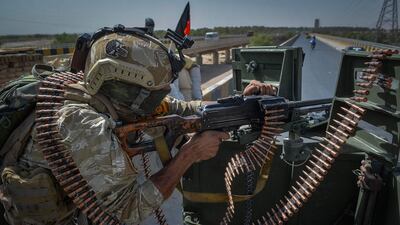
A man on top of a vehicle guards the UN office compound in the Guzara district of Herat province. -
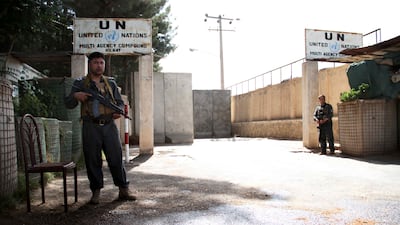
Afghan security officials stand guard outside the UN office in Herat. -
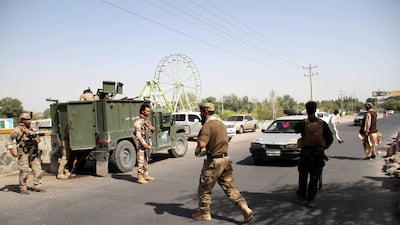
Afghan security officials stand guard at a roadside checkpoint. -
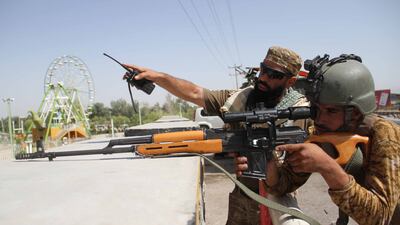
Afghan security officials stand guard at a roadside checkpoint. -

An Afghan security official stands guard at a roadside checkpoint. -
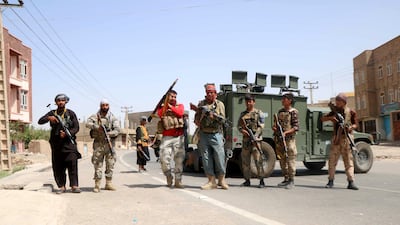
Armed Afghan security officials stand guard at a checkpoint in Pul-e Malan, Guzara. -

A market that was closed over security fears as the Taliban attacked parts of Herat. -

A market that was closed over security fears as the Taliban attacked parts of Herat.


The elderly and somewhat frail politician-warlord Ismail Khan – famed for helping US forces topple the Taliban in 2001 – has attempted to send out a message of strength by leading his fighters to the front lines in the past few days.
“Herat will never fall, but war with the Taliban is different now compared to the 1990s – the US has legitimised the Taliban through the Doha agreement and many other countries are now supporting the group,” he said.
Khan, 75, said he had 3,000 men fighting in Herat and casualties had been low – he claimed no more than a handful.
Herat governor Saboor Qani said there was a strategic plan in place to push the Taliban out of the city within the next three days.
“The situation is changing right across the country and Taliban attacks are intensifying. Our plan is to first secure the city and then we will retake the lost districts,” he said.
Taliban splinter group fighters loyal to the powerful Niazi clan are also supporting the government’s efforts to repel the Taliban.
“The motorway is reasonably stable, we have special forces deployed to keep the Pashtun Bridge safe,” said an Afghan security official.
“The tactic of the Taliban is to keep us busy by surrounding the city. We’re giving up on the idea of taking back districts for the moment. We're focusing on securing the city.”
The Pashtun Bridge is located 11 kilometres from the city centre and is where the fighting migrated to on Friday. It is a part of the main highway that leads to the airport and is approximately one kilometre away from the UN compound.
The official said Kabul had offered significant support, but he indicated concern over the deteriorating situation.
On Friday night, three air strikes were carried out by the Afghan Air Force and seven by the coalition, according to the official. A US official confirmed at least two were carried out by the US.
“The Taliban are not alone, they have a huge amount of volunteer fighters from Pakistan,” said the Afghan official.
“Since the air strikes that were conducted last night we are seeing a shift in our favour.”
Hundreds more government troops were deployed in Herat on Sunday.
Despite the continuing violence, families have still been going out for ice cream together, balloon sellers continue to make sales, a decorated wedding car indicated one couple were determined not to let their big day be ruined, and sports games have continued in the parks around the centre, with a good turnout of spectators.
Tariq Mohandeszada, 35, was watching a volleyball match.
“There has been war since I was born – this is normal for us. But it’s had a big impact for me lately. I lost my job at the Islam Qala Customs Office after the Taliban took control of the area this month,” he said.
“We are worried both about the prospect of war in the city and of the possibility of the Taliban taking control here. We believe there is a chance that Herat could fall to the Taliban – they have taken the districts and the border towns and they are gaining ground here.”

