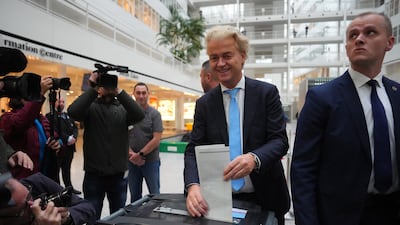
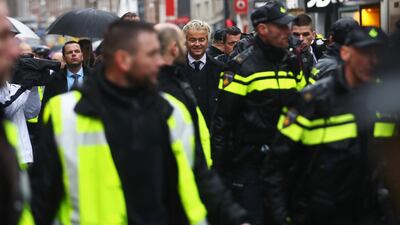
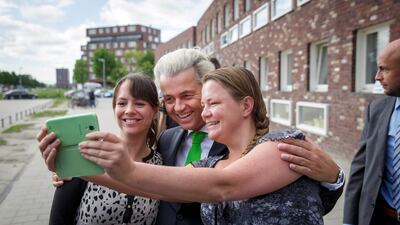
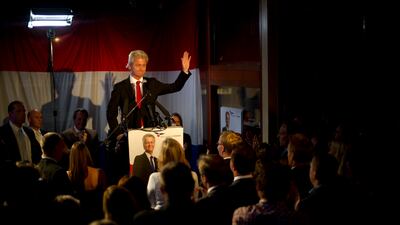
In the bitter wind blowing off the North Sea, supporters crowded in on the unmistakeable figurehead of the Netherlands’ hard right, Geert Wilders, during a victory lap visit to a suburb on the outskirts of The Hague.
“We love you Geert,” a shaven-head man shouted. “You will make the Dutch great again.”
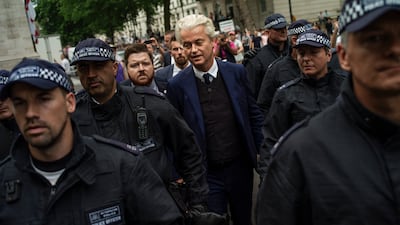
Uniformed police surrounded Mr Wilders as he was mobbed by supporters and a media scrum packed around him.
In the chill darkness 100m away, watching through the windows of the Hotel Atlantic, were 120 Syrian asylum seekers who had been given emergency accommodation.
Their presence – which had not gone down well among the well-heeled burghers of the town – summed up the shift in the make-up of the country and the uncertain future for those of a different background to the cheering crowd of Wilders supporters.
Wilders the victor
Mr Wilders's stunning election win was confirmed officially on Friday, heralding a potentially dangerous passage for the Netherlands, Europe and their Muslim citizens.
However, the far-right Dutch leader faces an uphill battle to forge a coalition with other parties uncomfortable with his anti-Islam views.
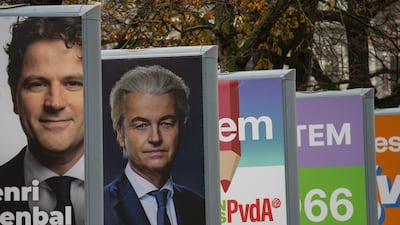
The election committee said Mr Wilders and his PVV Freedom Party had won 37 seats in the 150-seat parliament, an unexpected surge for the far-right that sent shockwaves through Europe and beyond.
All eyes are now on whether he can build a governing coalition and become the country's first far-right prime minister.
Banning the Quran, outlawing the hijab and closing mosques have been the Freedom Party leader’s demands, although he promised during the election to keep his anti-Islamic policies on ice.
“Wilders said he wants to put them in the refrigerator, but they belong in the garbage,” influential Muslim community leader Nourdin El Ouali, 42, told The National, explaining that refrigerated items can always be used later at a suitable moment.
He said that economic challenges or an extremist atrocity could be that opportunity, “because then hearts and minds will be more open to his policies”.
With a population of 18 million, including a million Muslims, the Dutch are a small nation but one with wealth and influence.
The concern is that Mr Wilders’s victory brings the drumbeat of right-wing anti-immigrant policies further into the mainstream, following the success of hardliners in Sweden, Hungary, Slovakia and Italy.
It will take only the European giants of France and Germany to vote in hard-right politicians for the continent to become an even more uncomfortable place for Muslims.
“France and Germany are the guide countries for Europe,” said Mr El Ouali, director of Spior, an umbrella organisation for 100 Muslim groups. “So this election is a game changer because it is further normalising Wilders’s views and our concerns are that we are being treated as second-class citizens.”
What just happened?
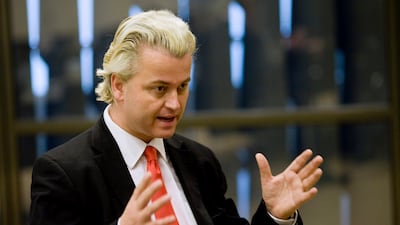
Like many populists, Mr Wilders has a unique appearance, from his highly identifiable coiffured, peroxide-blond hair to his anti-Islamic invective.
But the latter he carefully fogged out in the election earning the nickname “Milders” by using a softer tone of voice and less radical language.
His approach was simplistic – the lack of jobs and houses is down to the influx of migrants. The argument resonated.
This apparent metamorphosis disguises a past in which he had equated the Quran to Adolf Hitler’s Mein Kampf, stirring such ire that for the past 20 years he has required armed police protection.
Geert (pronounced “Hurt”) Wilders, 60, is a veteran of Dutch politics with the cunning to realise that when the conservative-liberal VVD-led government coalition collapsed largely over the migration issue he had a platform from which he could trumpet loudly.
A crucial mistake was made by the VVD when its leader admitted that it would go into coalition government with the PVV, legitimising them.
“Wilders out-foxed them all,” said Caroline de Gruyter, a European affairs journalist and a member of the European Council on Foreign Relations. “For the first time he saw the door ajar, he pushed it open, saying, ‘I am willing to compromise and put my most unconstitutional proposals aside’ and becomes apparently nice and stops being an extremist.”
Clearly it worked, shocking many Dutch and beyond.
To gain power Mr Wilders will need a coalition of three or four parties, but that could be problematic because few want to be tainted in sharing power with the extremists.
However, their hand might well be forced as the people have spoken and will view it as anti-democratic if the PVV were denied power.
“My best guess would be that we have a minority government or the PVV in coalition with someone else as prime minister from another party so that the stain of the radical right is less clear,” said Dr Marcel Hanegraaff, a political lecturer at the University of Amsterdam.
In 2022, 200,000 migrants entered the Netherlands, the highest number since the Syrian crisis a decade earlier, with the average usually 60,000 a year.
The VVD government of Mark Rutte had closed refugee centres to save money but is now being forced to put them up in hotels such as the Atlantic as winter arrives.
Coalition quandary
Before the election earthquake the VVD said it would govern with the PVV in the mistaken belief it would remain the senior party, but now the people have voted.
“The worst thing that can happen is that Wilders is not prime minister or is not part of a coalition as the protests will become even more angry,” said Lucas van Houtert, a local newspaper journalist in Eindhoven. “We are still working within the borders of democracy, which some want to step out of and be more revolutionary.”
Even a Syrian taxi driver in Rotterdam who fled Aleppo nine years ago told The National that “we of course have to respect the vote”, although Muslims are afraid of what Mr Wilders might do once in power.
Mr El Ouali agreed. “The best thing is to honour the elections, but it is very hard, maybe impossible, for someone like Geert Wilders to unify society,” he said at his office in Rotterdam.
Brexit moment?
“The impact on us is like Brexit on Britain,” said Denny van der Vlist, of the Institute of Political Science at Leiden University. “It’s a shock that the PVV have become the largest party in the Netherlands and are potentially providing the next prime minister.”
While Mr Wilders said “I will be a prime minister for all”, his programme clearly indicated “rather extreme options”. Mr Van der Vlist added: “I would not necessarily argue that he has become mild in any way.”
The other issue is that Mr Wilders appears to have no vision for the Dutch, bar his migrant policy.
“He doesn't have a story for the future except that everything was better in the past,” Mr El Ouali said. “He has also previously said it would be a good idea to have 16 million fewer Muslims in Europe.”
“Wilders would feel very comfortable in the right wing of the Conservative party where many share his views,” said former Dutch navy officer Martinus Berkien, originally from Delft.
“This is very much the result of years of bungling by Rutte cabinets, including the notion that the market will solve problems such as housing,” he added.
Assimilate, deport, ethnic cleanse
The worry for Muslims – and with good reason – is that the constitution will not protect their rights. The Dutch security services have conducted covert surveillance of people entering certain mosques, a practice not within the law.
Muslims with dual citizenship have also fallen foul of tax benefit laws for children after they were blacklisted for allegedly misusing the break.
There is also a concern that Mr Wilders is no longer referred to as an extremist in Dutch media, who are “doing everything to say that we don’t have a problem”, Mr El Ouali said.
The reality of Mr Wilders’s success is that the Muslim community sees itself confronted with three unpleasant outcomes, Mr El Ouali said.
One is forced assimilation, in which Muslim culture is lost, the second is deportation of those convicted of crimes requiring 10 years incarceration being “denaturalised and sent to a country that they might never have been to”.
It might sound far-fetched within the legal structures of the European Union, but the third outcome could be ethnic cleansing, with the Muslims in Bosnia the most recent example.
“When you see a majority not happy, or worse, disgusted with the minority, then history teaches us there are three main choices that societies may take,” he said.
“This is going on in Europe and that's very scary. I don't even see the start to a solution or a different approach as we’ve had two decades of normalised extreme thoughts and beliefs since 9/11.”
Gaza impact
The war may have had some effect on the vote, with Mr Wilders, who displays the Israeli flag in his office, being an unapologetic supporter.
“His message that Israel has the right to defend itself was attractive to conservative voters because they tend to buy the Israel argument,” Dr Hanegraaff said.
Mr El Ouali added that since the Israel-Gaza war broke out there had been a “huge increase” in Islamophobia with mosques being graffitied and Muslims losing their jobs over comments made on social media.
Gaza also demonstrated to Muslims that the US and Europe were largely prepared to ignore international law, he said.
"On the other hand, public opinion is shifting with pro-Palestine demonstrations being organised and attended by people from all walks of life," he added.
Hard-right Europe
The message the Dutch election sends is that the past decade of migration has made Europeans less tolerant.
But political analysts believe that rather than the entanglement of a Brexit, the European powers could gather to change it from within.
“They don’t want to step out of the European Union because then nobody will protect your name, they want to change Europe from the inside,” Ms de Gruyter said.
There is a suggestion that Mr Wilders may head to Florence this weekend for a migration summit with other like-minded hard-right leaders such as Victor Orban of Hungary and Italy’s Giorgia Meloni.
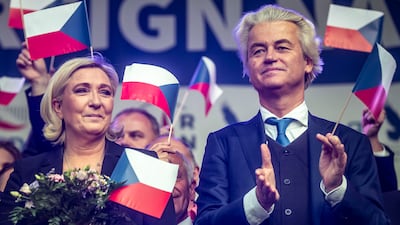
The strong power base of Marine Le Pen in France and the rising support for the similarly extremist AfD in Germany is another serious cause for concern.
Meanwhile the political centre in Europe is moving further to the right to keep out the extremists while in the process legitimising their arguments.
“We simply need a better asylum and immigration system in Europe because it’s not functioning, with member states disagreeing.” Ms de Gruyter said.
The irony remains that Europe’s population is getting older and declining without enough young people to fill vacant jobs, something that migrants could do.
Geert Wilders through the years - in pictures
Tough choices
The uncomfortable feeling that Mr Wilders and his policies are being given mainstream legitimacy gathered pace in the chill outside the Atlantic Hotel on Tuesday night.
Shielded by state-provided bodyguards he was quickly surrounded by the press, in a manner redolent of a Donald Trump rally.
“If the PVV gains influence on the national government, reducing the influx of asylum seekers will be number one on the agenda,” Mr Wilders said, indicating no change in his stance.
His supporters were in lock-step. “He is a very brave man, not afraid to say something difficult and that makes me happy,” said local resident Aida Paglarini, originally from Italy. “We have too many asylum seekers.”
The joy of seeing his idol close up impelled the shaven-headed man to proclaim “I love you Geert” as he snapped pictures on his phone.
“We must fight for our country," he added. "The refugee situation is crazy. We are hard workers living in cold houses and they are up there in a warm hotel.”
A more sombre message came from Senna, 21, a student standing near by who agreed that refugees needed “a roof over their heads” but that “we are coming to a point in the Netherlands where we genuinely are having trouble with resources in giving good care to asylum seekers”.
“I have a hard time supporting Wilders because of what he’s said in the past and a lot of Dutch people are with me on that, but everybody wants this situation resolved.”

Maestro
%3Cp%3E%3Cstrong%3EDirector%3A%20%3C%2Fstrong%3EBradley%20Cooper%3C%2Fp%3E%0A%3Cp%3E%3Cstrong%3EStarring%3A%20%3C%2Fstrong%3EBradley%20Cooper%2C%20Carey%20Mulligan%2C%20Maya%20Hawke%3C%2Fp%3E%0A%3Cp%3E%3Cstrong%3ERating%3A%3C%2Fstrong%3E%203%2F5%3C%2Fp%3E%0A
Nancy 9 (Hassa Beek)
Nancy Ajram
(In2Musica)
THE LIGHT
Director: Tom Tykwer
Starring: Tala Al Deen, Nicolette Krebitz, Lars Eidinger
Rating: 3/5
Red flags
- Promises of high, fixed or 'guaranteed' returns.
- Unregulated structured products or complex investments often used to bypass traditional safeguards.
- Lack of clear information, vague language, no access to audited financials.
- Overseas companies targeting investors in other jurisdictions - this can make legal recovery difficult.
- Hard-selling tactics - creating urgency, offering 'exclusive' deals.
Courtesy: Carol Glynn, founder of Conscious Finance Coaching
Women%E2%80%99s%20T20%20World%20Cup%20Qualifier
%3Cp%3E%3Cstrong%3EUAE%20fixtures%3C%2Fstrong%3E%3C%2Fp%3E%0A%3Cp%3E25%20April%20%E2%80%93%20Ireland%20v%20UAE*%3Cbr%3E27%20April%20%E2%80%93%20UAE%20v%20Zimbabwe**%3Cbr%3E29%20April%20%E2%80%93%20Netherlands%20v%20UAE*%3Cbr%3E3%20May%20%E2%80%93%20UAE%20v%20Vanuatu*%3Cbr%3E5%20May%20%E2%80%93%20Semi-finals%3Cbr%3E7%20May%20%E2%80%93%20Final%3Cbr%3E%3Cstrong%3EUAE%20squad%3A%20%3C%2Fstrong%3EEsha%20Oza%20(captain)%2C%20Al%20Maseera%20Jahangir%2C%20Avanee%20Patel%2C%20Heena%20Hotchandani%2C%20Indhuja%20Nandakumar%2C%20Kavisha%20Kumari%2C%20Khushi%20Sharma%2C%20Lavanya%20Keny%2C%20Mehak%20Thakur%2C%20Rinitha%20Rajith%2C%20Samaira%20Dharnidharka%2C%20Siya%20Gokhale%2C%20Suraksha%20Kotte%2C%20Theertha%20Satish%2C%20Vaishnave%20Mahesh.%3C%2Fp%3E%0A%3Cp%3E*Zayed%20Cricket%20Stadium%3C%2Fp%3E%0A%3Cp%3E**Tolerance%20Oval%3C%2Fp%3E%0A
RESULTS
2pm: Handicap (PA) Dh40,000 (Dirt) 1,000m
Winner: AF Mozhell, Saif Al Balushi (jockey), Khalifa Al Neyadi (trainer)
2.30pm: Maiden (PA) Dh40,000 (D) 2,000m
Winner: Majdi, Szczepan Mazur, Abdallah Al Hammadi.
3pm: Handicap (PA) Dh40,000 (D) 1,700m
Winner: AF Athabeh, Tadhg O’Shea, Ernst Oertel.
3.30pm: Handicap (PA) Dh40,000 (D) 1,700m
Winner: AF Eshaar, Bernardo Pinheiro, Khalifa Al Neyadi
4pm: Gulf Cup presented by Longines Prestige (PA) Dh150,000 (D) 1,700m
Winner: Al Roba’a Al Khali, Al Moatasem Al Balushi, Younis Al Kalbani
4.30pm: Handicap (TB) Dh40,000 (D) 1,200m
Winner: Apolo Kid, Antonio Fresu, Musabah Al Muahiri
Dhadak 2
Director: Shazia Iqbal
Starring: Siddhant Chaturvedi, Triptii Dimri
Rating: 1/5
More from Neighbourhood Watch
Company%20profile
%3Cp%3E%3Cstrong%3ECompany%20name%3A%20%3C%2Fstrong%3EXare%C2%A0%3C%2Fp%3E%0A%3Cp%3E%3Cstrong%3EStarted%3A%20%3C%2Fstrong%3EJanuary%2018%2C%202021%C2%A0%3C%2Fp%3E%0A%3Cp%3E%3Cstrong%3EFounders%3A%20%3C%2Fstrong%3EPadmini%20Gupta%2C%20Milind%20Singh%2C%20Mandeep%20Singh%C2%A0%3C%2Fp%3E%0A%3Cp%3E%3Cstrong%3EBased%3A%20%3C%2Fstrong%3EDubai%C2%A0%3C%2Fp%3E%0A%3Cp%3E%3Cstrong%3ESector%3A%20%3C%2Fstrong%3EFinTech%C2%A0%3C%2Fp%3E%0A%3Cp%3E%3Cstrong%3EFunds%20Raised%3A%20%3C%2Fstrong%3E%2410%20million%C2%A0%3C%2Fp%3E%0A%3Cp%3E%3Cstrong%3ECurrent%20number%20of%20staff%3A%20%3C%2Fstrong%3E28%C2%A0%3C%2Fp%3E%0A%3Cp%3E%3Cstrong%3EInvestment%20stage%3A%20%3C%2Fstrong%3Eundisclosed%3C%2Fp%3E%0A%3Cp%3E%3Cstrong%3EInvestors%3A%20%3C%2Fstrong%3EMS%26amp%3BAD%20Ventures%2C%20Middle%20East%20Venture%20Partners%2C%20Astra%20Amco%2C%20the%20Dubai%20International%20Financial%20Centre%2C%20Fintech%20Fund%2C%20500%20Startups%2C%20Khwarizmi%20Ventures%2C%20and%20Phoenician%20Funds%3C%2Fp%3E%0A
THE BIO
Born: Mukalla, Yemen, 1979
Education: UAE University, Al Ain
Family: Married with two daughters: Asayel, 7, and Sara, 6
Favourite piece of music: Horse Dance by Naseer Shamma
Favourite book: Science and geology
Favourite place to travel to: Washington DC
Best advice you’ve ever been given: If you have a dream, you have to believe it, then you will see it.
Ten tax points to be aware of in 2026
1. Domestic VAT refund amendments: request your refund within five years
If a business does not apply for the refund on time, they lose their credit.
2. E-invoicing in the UAE
Businesses should continue preparing for the implementation of e-invoicing in the UAE, with 2026 a preparation and transition period ahead of phased mandatory adoption.
3. More tax audits
Tax authorities are increasingly using data already available across multiple filings to identify audit risks.
4. More beneficial VAT and excise tax penalty regime
Tax disputes are expected to become more frequent and more structured, with clearer administrative objection and appeal processes. The UAE has adopted a new penalty regime for VAT and excise disputes, which now mirrors the penalty regime for corporate tax.
5. Greater emphasis on statutory audit
There is a greater need for the accuracy of financial statements. The International Financial Reporting Standards standards need to be strictly adhered to and, as a result, the quality of the audits will need to increase.
6. Further transfer pricing enforcement
Transfer pricing enforcement, which refers to the practice of establishing prices for internal transactions between related entities, is expected to broaden in scope. The UAE will shortly open the possibility to negotiate advance pricing agreements, or essentially rulings for transfer pricing purposes.
7. Limited time periods for audits
Recent amendments also introduce a default five-year limitation period for tax audits and assessments, subject to specific statutory exceptions. While the standard audit and assessment period is five years, this may be extended to up to 15 years in cases involving fraud or tax evasion.
8. Pillar 2 implementation
Many multinational groups will begin to feel the practical effect of the Domestic Minimum Top-Up Tax (DMTT), the UAE's implementation of the OECD’s global minimum tax under Pillar 2. While the rules apply for financial years starting on or after January 1, 2025, it is 2026 that marks the transition to an operational phase.
9. Reduced compliance obligations for imported goods and services
Businesses that apply the reverse-charge mechanism for VAT purposes in the UAE may benefit from reduced compliance obligations.
10. Substance and CbC reporting focus
Tax authorities are expected to continue strengthening the enforcement of economic substance and Country-by-Country (CbC) reporting frameworks. In the UAE, these regimes are increasingly being used as risk-assessment tools, providing tax authorities with a comprehensive view of multinational groups’ global footprints and enabling them to assess whether profits are aligned with real economic activity.
Contributed by Thomas Vanhee and Hend Rashwan, Aurifer
The specs
Engine: 2.0-litre 4cyl turbo
Power: 261hp at 5,500rpm
Torque: 405Nm at 1,750-3,500rpm
Transmission: 9-speed auto
Fuel consumption: 6.9L/100km
On sale: Now
Price: From Dh117,059
Disposing of non-recycleable masks
- Use your ‘black bag’ bin at home
- Do not put them in a recycling bin
- Take them home with you if there is no litter bin
- No need to bag the mask
Mercer, the investment consulting arm of US services company Marsh & McLennan, expects its wealth division to at least double its assets under management (AUM) in the Middle East as wealth in the region continues to grow despite economic headwinds, a company official said.
Mercer Wealth, which globally has $160 billion in AUM, plans to boost its AUM in the region to $2-$3bn in the next 2-3 years from the present $1bn, said Yasir AbuShaban, a Dubai-based principal with Mercer Wealth.
“Within the next two to three years, we are looking at reaching $2 to $3 billion as a conservative estimate and we do see an opportunity to do so,” said Mr AbuShaban.
Mercer does not directly make investments, but allocates clients’ money they have discretion to, to professional asset managers. They also provide advice to clients.
“We have buying power. We can negotiate on their (client’s) behalf with asset managers to provide them lower fees than they otherwise would have to get on their own,” he added.
Mercer Wealth’s clients include sovereign wealth funds, family offices, and insurance companies among others.
From its office in Dubai, Mercer also looks after Africa, India and Turkey, where they also see opportunity for growth.
Wealth creation in Middle East and Africa (MEA) grew 8.5 per cent to $8.1 trillion last year from $7.5tn in 2015, higher than last year’s global average of 6 per cent and the second-highest growth in a region after Asia-Pacific which grew 9.9 per cent, according to consultancy Boston Consulting Group (BCG). In the region, where wealth grew just 1.9 per cent in 2015 compared with 2014, a pickup in oil prices has helped in wealth generation.
BCG is forecasting MEA wealth will rise to $12tn by 2021, growing at an annual average of 8 per cent.
Drivers of wealth generation in the region will be split evenly between new wealth creation and growth of performance of existing assets, according to BCG.
Another general trend in the region is clients’ looking for a comprehensive approach to investing, according to Mr AbuShaban.
“Institutional investors or some of the families are seeing a slowdown in the available capital they have to invest and in that sense they are looking at optimizing the way they manage their portfolios and making sure they are not investing haphazardly and different parts of their investment are working together,” said Mr AbuShaban.
Some clients also have a higher appetite for risk, given the low interest-rate environment that does not provide enough yield for some institutional investors. These clients are keen to invest in illiquid assets, such as private equity and infrastructure.
“What we have seen is a desire for higher returns in what has been a low-return environment specifically in various fixed income or bonds,” he said.
“In this environment, we have seen a de facto increase in the risk that clients are taking in things like illiquid investments, private equity investments, infrastructure and private debt, those kind of investments were higher illiquidity results in incrementally higher returns.”
The Abu Dhabi Investment Authority, one of the largest sovereign wealth funds, said in its 2016 report that has gradually increased its exposure in direct private equity and private credit transactions, mainly in Asian markets and especially in China and India. The authority’s private equity department focused on structured equities owing to “their defensive characteristics.”
RIVER%20SPIRIT
%3Cp%3E%3Cstrong%3EAuthor%3A%20%3C%2Fstrong%3ELeila%20Aboulela%C2%A0%3C%2Fp%3E%0A%3Cp%3E%3Cstrong%3EPublisher%3A%3C%2Fstrong%3E%20Saqi%20Books%3C%2Fp%3E%0A%3Cp%3E%3Cstrong%3EPages%3A%3C%2Fstrong%3E%20320%3C%2Fp%3E%0A%3Cp%3E%3Cstrong%3EAvailable%3A%3C%2Fstrong%3E%20Now%3C%2Fp%3E%0A
Zayed Sustainability Prize
What are NFTs?
Are non-fungible tokens a currency, asset, or a licensing instrument? Arnab Das, global market strategist EMEA at Invesco, says they are mix of all of three.
You can buy, hold and use NFTs just like US dollars and Bitcoins. “They can appreciate in value and even produce cash flows.”
However, while money is fungible, NFTs are not. “One Bitcoin, dollar, euro or dirham is largely indistinguishable from the next. Nothing ties a dollar bill to a particular owner, for example. Nor does it tie you to to any goods, services or assets you bought with that currency. In contrast, NFTs confer specific ownership,” Mr Das says.
This makes NFTs closer to a piece of intellectual property such as a work of art or licence, as you can claim royalties or profit by exchanging it at a higher value later, Mr Das says. “They could provide a sustainable income stream.”
This income will depend on future demand and use, which makes NFTs difficult to value. “However, there is a credible use case for many forms of intellectual property, notably art, songs, videos,” Mr Das says.
Benefits of first-time home buyers' scheme
- Priority access to new homes from participating developers
- Discounts on sales price of off-plan units
- Flexible payment plans from developers
- Mortgages with better interest rates, faster approval times and reduced fees
- DLD registration fee can be paid through banks or credit cards at zero interest rates
The biog
Name: Abeer Al Shahi
Emirate: Sharjah – Khor Fakkan
Education: Master’s degree in special education, preparing for a PhD in philosophy.
Favourite activities: Bungee jumping
Favourite quote: “My people and I will not settle for anything less than first place” – Sheikh Mohammed bin Rashid.
Kanguva
Director: Siva
Stars: Suriya, Bobby Deol, Disha Patani, Yogi Babu, Redin Kingsley
Diriyah%20project%20at%20a%20glance
%3Cp%3E-%20Diriyah%E2%80%99s%201.9km%20King%20Salman%20Boulevard%2C%20a%20Parisian%20Champs-Elysees-inspired%20avenue%2C%20is%20scheduled%20for%20completion%20in%202028%0D%3Cbr%3E-%20The%20Royal%20Diriyah%20Opera%20House%20is%20expected%20to%20be%20completed%20in%20four%20years%0D%3Cbr%3E-%20Diriyah%E2%80%99s%20first%20of%2042%20hotels%2C%20the%20Bab%20Samhan%20hotel%2C%20will%20open%20in%20the%20first%20quarter%20of%202024%0D%3Cbr%3E-%20On%20completion%20in%202030%2C%20the%20Diriyah%20project%20is%20forecast%20to%20accommodate%20more%20than%20100%2C000%20people%0D%3Cbr%3E-%20The%20%2463.2%20billion%20Diriyah%20project%20will%20contribute%20%247.2%20billion%20to%20the%20kingdom%E2%80%99s%20GDP%0D%3Cbr%3E-%20It%20will%20create%20more%20than%20178%2C000%20jobs%20and%20aims%20to%20attract%20more%20than%2050%20million%20visits%20a%20year%0D%3Cbr%3E-%20About%202%2C000%20people%20work%20for%20the%20Diriyah%20Company%2C%20with%20more%20than%2086%20per%20cent%20being%20Saudi%20citizens%0D%3C%2Fp%3E%0A
The rules of the road keeping cyclists safe
Cyclists must wear a helmet, arm and knee pads
Have a white front-light and a back red-light on their bike
They must place a number plate with reflective light to the back of the bike to alert road-users
Avoid carrying weights that could cause the bike to lose balance
They must cycle on designated lanes and areas and ride safe on pavements to avoid bumping into pedestrians
The specs: 2019 Subaru Forester
Price, base: Dh105,900 (Premium); Dh115,900 (Sport)
Engine: 2.5-litre four-cylinder
Transmission: Continuously variable transmission
Power: 182hp @ 5,800rpm
Torque: 239Nm @ 4,400rpm
Fuel economy, combined: 8.1L / 100km (estimated)
Learn more about Qasr Al Hosn
In 2013, The National's History Project went beyond the walls to see what life was like living in Abu Dhabi's fabled fort:
The specs
Engine: 3.0-litre twin-turbo flat-six
Power: 480hp at 6,500rpm
Torque: 570Nm from 2,300-5,000rpm
Transmission: 8-speed dual-clutch auto
Fuel consumption: 10.4L/100km
Price: from Dh547,600
On sale: now
Tips to avoid getting scammed
1) Beware of cheques presented late on Thursday
2) Visit an RTA centre to change registration only after receiving payment
3) Be aware of people asking to test drive the car alone
4) Try not to close the sale at night
5) Don't be rushed into a sale
6) Call 901 if you see any suspicious behaviour
Earth under attack: Cosmic impacts throughout history
- 4.5 billion years ago: Mars-sized object smashes into the newly-formed Earth, creating debris that coalesces to form the Moon
- 66 million years ago: 10km-wide asteroid crashes into the Gulf of Mexico, wiping out over 70 per cent of living species – including the dinosaurs.
- 50,000 years ago: 50m-wide iron meteor crashes in Arizona with the violence of 10 megatonne hydrogen bomb, creating the famous 1.2km-wide Barringer Crater
- 1490: Meteor storm over Shansi Province, north-east China when large stones “fell like rain”, reportedly leading to thousands of deaths.
- 1908: 100-metre meteor from the Taurid Complex explodes near the Tunguska river in Siberia with the force of 1,000 Hiroshima-type bombs, devastating 2,000 square kilometres of forest.
- 1998: Comet Shoemaker-Levy 9 breaks apart and crashes into Jupiter in series of impacts that would have annihilated life on Earth.
-2013: 10,000-tonne meteor burns up over the southern Urals region of Russia, releasing a pressure blast and flash that left over 1600 people injured.
Living in...
This article is part of a guide on where to live in the UAE. Our reporters will profile some of the country’s most desirable districts, provide an estimate of rental prices and introduce you to some of the residents who call each area home.
Gulf Under 19s final
Dubai College A 50-12 Dubai College B
MATCH INFO
What: 2006 World Cup quarter-final
When: July 1
Where: Gelsenkirchen Stadium, Gelsenkirchen, Germany
Result:
England 0 Portugal 0
(Portugal win 3-1 on penalties)
Women’s T20 World Cup Asia Qualifier
ICC Academy, November 22-28
UAE fixtures
Nov 22, v Malaysia
Nov 23, v Hong Kong
Nov 25, v Bhutan
Nov 26, v Kuwait
Nov 28, v Nepal
ICC T20I rankings
14. Nepal
17. UAE
25. Hong Kong
34. Kuwait
35. Malaysia
44. Bhutan
UAE squad
Chaya Mughal (captain), Natasha Cherriath, Samaira Dharnidharka, Kavisha Egodage, Mahika Gaur, Priyanjali Jain, Suraksha Kotte, Vaishnave Mahesh, Judit Peter, Esha Rohit, Theertha Satish, Chamani Seneviratne, Khushi Sharma, Subha Venkataraman
The five pillars of Islam