


On July 26, 2024, in the capital of France, an unprecedented migration of sporting talent takes to the water. Over 10,000 athletes from a range of disciplines will leave dry land and travel around four miles by barge to a destination close to the foot of the Eiffel Tower. Around half-a-million spectators will line the route, along the banks of Paris’s greatest natural asset, the river Seine.
Thus the novel concept for the Opening Ceremony for the next Olympic Games, the 33rd edition of what likes to call itself the greatest show on earth. These Games, the 2024 Olympics and Paralympics, boast that, above all, they care about the earth. The ambitious plan to concentrate the Opening Ceremony, traditionally focused on an iconic, bespoke stadium, not on asphalt or within concrete grandstands but on water is a statement. It reminds that the great juggernaut of international sport, with its notoriously extravagant carbon footprint, is obliged to pause, to clean up its act. Paris intends to show how it can be done.
And to really clean it up, the Olympics hosts promise: They want Parisiens to be swimming in the Seine each summer after the Games have packed up their – much-reduced, mostly re-usable – luggage and left town. It’s an aspiration with huge challenges and, in the past 12 months, several setbacks. Episodes of unusually heavy rainfall this summer thwarted attempts to reduce pollution in the city’s main river artery to safe enough levels that some of the world’s leading triathletes could compete in the Seine in a pilot event for the Games. The hope remains that, come July, the Olympic triathletes and swimmers will take to the river’s purer water in pursuit of medals.
-

Floodwaters overflow the banks of the Seine river near the Eiffel Tower in Paris. Etienne Laurent / EPA -
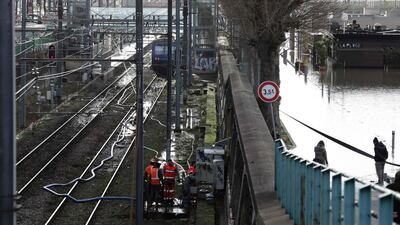
Workers pump water from the Javel railway station, flooded due to the high level of the Seine River in Paris. Ludovic Marin / AFP -
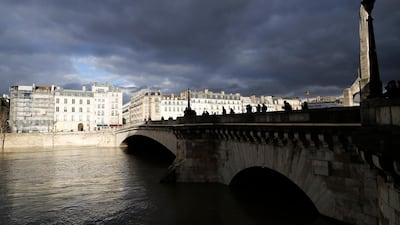
Floodwaters overflow the banks of the Seine river near Notre Dame in Paris. Etienne Laurent / EPA -
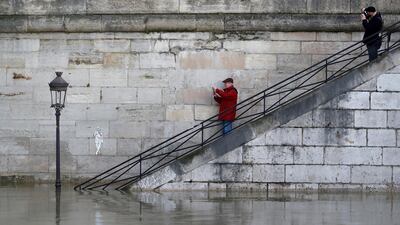
Men take pictures of a street lamp on the flooded banks of the River Seine in Paris, France, after days of almost non-stop rain caused flooding in the country. Christian Hartmann / Reuters -
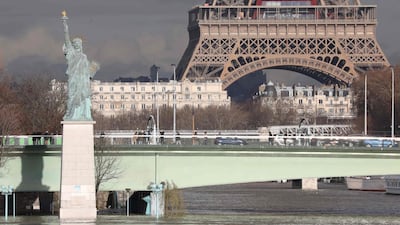
The flooded Ile aux Cygnes and banks of the river Seine with a model of the Statue of Liberty and the Eiffel Tower in the backround in Paris. Leaks were starting to appear on January 26 in the basements of Paris buildings as the Seine inched higher, with forecasters warning that the river could stay high throughout next wee. Ludovic Marin / AFP -
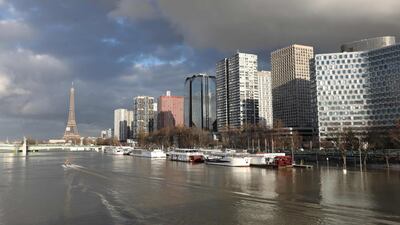
The flooded banks of the river Seine and the Beaugrenelle area and Eiffel Tower in the backround in Paris. Ludovic Marin / AFP -

A man looks at the flooded banks of the river Seine and the Beaugrenelle area and Eiffel Tower in the backround in Paris. Ludovic Marin / AFP -
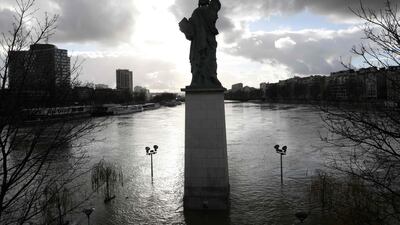
The flooded Ile aux Cygnes and banks of the river Seine with a model of the Statue of Liberty in Paris. Ludovic Marin / AFP


The environmental targets of Paris 2024 were set high from the moment it bid to stage the event. The city which gives its name to the most cited global agreement on tackling climate change could barely seem indifferent – the Paris Climate Accords were signed in 2016, a year before the French capital was approved by the International Olympic Committee – to the impact of events that gather vast numbers of globe-trotting participants and spectators and, typically, demand large-scale construction projects.
On the latter, Paris bucks a modern trend. The Seine will be the star of the Opening Ceremony rather than a brand new or thoroughly renovated arena because, unlike in Beijing in 2008 or London in 2012 there is no new stadium as centrepiece for these Games. The existing Stade de France, built in Saint-Denis for the 1998 men’s football World Cup, is the principal venue and there are far fewer competition sites than in previous Olympics being built from scratch. An Aquatic Centre, close to the Stade, is the only permanent new venue. The downscaling of construction is stark. Rio Games of 2016 featured nine new arenas; Tokyo 2020 – delayed for a year because of the Covid-19 pandemic – had nine, and London 2012 six.
As for the organisation and accommodation hubs, these premises advertise their sustainability. To visit the striking Pulse building, Paris 2024’s administrative headquarters constructed predominantly of wood and glass, is to tread carpets that all had previous homes, sit on chairs re-fashioned from discarded furniture and, from Pulse’s rooftop, to survey the Paris skyline from in between planters where rainfall nourishes vegetables. Some may even make their way to the official restaurants where the Game’s athletes and spectators will choose from menus on which, organisers pledge, 33 per cent of the protein offering comes from plant-based food.
An estimated 13 million meals will be consumed during the event and there is a commitment to limit produce to what can be sourced locally, from within a restricted radius of Paris to reduce transport by lorry. Thirteen million meals need not mean bins overflowing with packaging and bottles. The aim of the catering operation is to cut single-use plastics by half compared with London 2012.
Paris 2024's director of environmental excellence
“That’s a target we believe we can meet,” Georgina Grenon, Paris 2024’s director of environmental excellence tells The National, assured that core IOC sponsors like Coca-Cola are on board. “The resolve cannot come just from the organising committee but has to be shared by suppliers and partners. We don't claim to be perfect, but by acting collectively, we can do things differently."
Grenon acknowledges that in some areas, the drive to make Paris a Games that aspire not only, as the Olympic slogan has it, to be Higher, Faster and Stronger but also Greener, meets a degree of scepticism. While an individual athlete may be committed to changing their daily habits to protect the future of the planet, once you ask them to, say, review the materials used in producing their state-of-the-art javelin or the pole they have set their personal bests using in the pole vault, they confront difficult choices.
Conditions in the Athletes Village, accommodation constructed with minimal use of concrete across three main areas of the city and with their re-use as future housing prioritised, have also come under scrutiny. The intention was to make the units, with capacity to house 14,000 athletes and staff, comfortable through the hot summer period of the Games without conventional air-conditioning. Natural cooling systems in the design would, say organisers, guarantee temperatures indoors are no less than six degrees lower than outside.

But there has been disagreement. In February, the mayor of Paris, Anne Hidalgo whose tenure has been characterised by environmental initiatives, said of installing air-conditioning for athletes: “There will be no need. I have great respect for athletes’ comfort, but I have greater concern about the survival of humanity.” Eight months later, organisers revealed that, after talks with several athletes’ delegations, an option of temporary air-conditioning would be available in the village.
The red line target is that Paris 2024’s total carbon emissions amount to no more than half of London’s or Rio’s, calculated at around 3.5m tonnes each. Comparisons with Tokyo are not like-for-like because those Games took place under severe Covid-driven restrictions on spectators. The carbon footprint left by transport and travel to Japan was atypical.
And that’s the area that Paris, for all its endeavours and imaginative solutions for a cleaner, greener Games, can only exert a finite control. Within the city, fans may be moving from venue to venue by bicycle, by low-emission trains, on electric busses – or even by boat on a river whose water is clearer of pollutants than it has been in perhaps half a century – but a sizeable proportion will have come to the Olympics on long-haul flights. How many will be clearer once ticket sales have closed at the end of this year, but, typically, high numbers of spectators at the Games come from the United States and from east Asia.

Billions will meanwhile watch on television, the images beamed to them in a broadcasting operation so valuable to the IOC and to networks that huge emergency diesel-powered generators have traditionally been part of the vast Olympic caravan of hardware, in case of failures in the local electricity supply. Paris 2024, drawing extensively on solar power, wants to minimise the need for fossil-fuel-intensive back-up, to persuade those delivering the greatest show to all corners of the planet that its electricity supply can bear the demands.
Grenon is optimistic the emphasis on re-use – “that everything, as much as possible, has a ‘second life’,” – that has shaped the wider infrastructure planning and smaller details will leave important legacies, both for the host city and for mega events, in sport and entertainment, in the long term.
“We have learned a lot from previous hosts,” she says, “and we believe we can pass on an example of what can be achieved. The ambition is to show another model is possible.”

