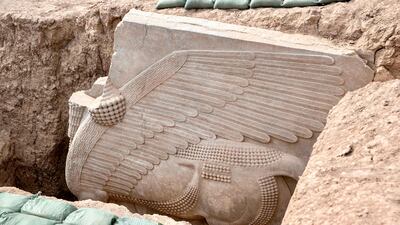
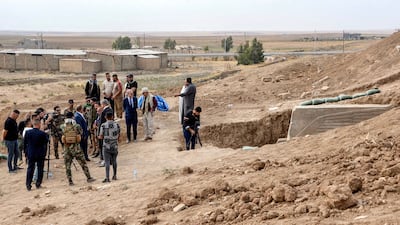
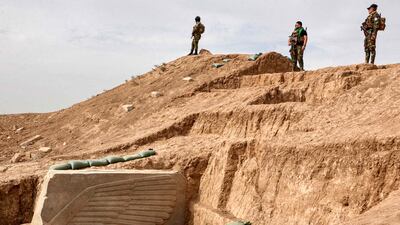
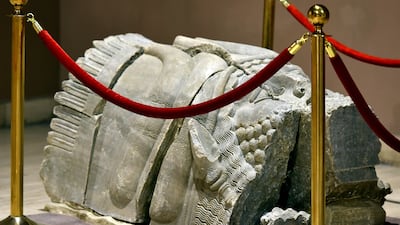
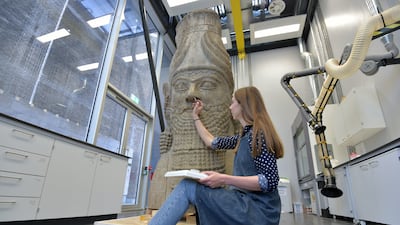
A team of French archaeologists last month unearthed a long-buried Assyrian winged bull, otherwise known as a lamassu, in Mosul, north Iraq, that dates back to the reign of King Sargon II from 722-705BC.
The priceless carving now exposed to the atmosphere and at risk of erosion won’t have to contend with the weather for too long because the Louvre has promptly, much to the chagrin of many Iraqis, vacated a spot to accommodate the piece.
As an Assyrian, the relationship I have with my ancient heritage can be conflicting. Growing up in the UK, the British Museum is like a second home. I have lost count of the number of times I’ve traipsed down the Assyrian galleries, with their depictions of war, lion hunts and eagle-headed winged genies. The contents are as close as I can physically get to my homeland.
Each visit would fill me with a combination of awe, and amusement at the uncanny similarity of the alabaster faces to that of my grandad's. Underlying these emotions is the sorrow of how they got there in the first place. Many miles from where they were found, ancient Assyrian heritage mirrors the modern Assyrian diaspora, scattered predominantly in the western world, and severed from their native land.
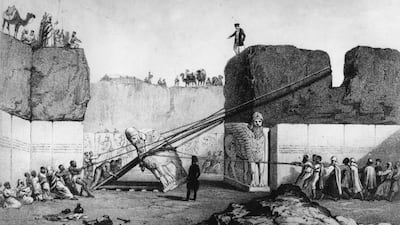
The official line is that the British Museum obtained its collection legitimately. Austen Henry Layard, a diplomat, was the first to excavate Nineveh and Nimrud in what was Mesopotamia in the mid-19th century. He swiftly received sponsorship and then embarked on a mammoth journey by ship, transporting the huge carved stone reliefs to England. Layard’s visit inspired other Europeans to follow and swell their public – as well as private – collections of treasures.
The region, under Ottoman rule, granted permission for removal of the antiquities although there is scant information about the nature of the transactions, and it appears highly improbable that locals were consulted in the process.
While I ultimately believe that these items belong in the land where they originated, I have several reservations about repatriation. Circumstances over the past few decades have made it challenging for Iraq to manage its antiquities. My mother recalls a trip to the aqueduct of Sennacherib in Jerwan in the late 1960s. The site, dating back to the seventh-century BC, was crawling with security guards, one of whom scolded her for attempting to reach out to touch a pebble.
Now it is unattended, which is sadly an all-too-common observation at similar archaeological sites. Last year, Chatham House published research detailing the extent to which Iraqi institutions lacked the funding to deliver the security and conservation gravely needed for these areas.
The recently found winged-bull sculpture in Mosul is, in fact, incomplete. The head was stolen during a previous excavation that was abandoned at the start of the Gulf War. The conflict and subsequent sanctions shattered the country economically and prompted an illegal trade in the trafficking of ancient goods.
This continued during the 2003 invasion when occupying troops setting up bases at historically significant grounds inflicted considerable damage, and peaked with the horrendous looting of the museum in Baghdad. Some of the artefacts found their way on to eBay; an example that stood out was an invaluable cuneiform slab being sold for $10 as a “coaster”.
It is thought that, in all, Iraq has lost hundreds of thousands of cultural objects. While some have been recovered, the occasional glimpse of others in private collections has sparked controversy. Perhaps most notable was a 3,000-year-old panel of gypsum depicting a deity called Apkallu sold at auction by Christie's New York in 2018. It had been acquired by an American Episcopal seminary in 1859 through Dr Henri Byron Haskell, a US missionary who was intrigued by artefacts with biblical relevance.
The auction provoked restitution claims from the Iraqi ministry of culture, with officials petitioning Unesco and Interpol to intervene, but to no avail. Christie's addressed Iraq's position, putting out proof of provenance of the item. It added it had contacted law enforcement authorities before publishing details of the sale to ensure the documentation for the alabaster relief met “applicable laws governing its sale”.
That piece went under the hammer to an anonymous buyer for $31 million – three times the estimated value – arguably because of ISIS taking a pneumatic drill to monuments of a similar era at the palace of Ashurnasirpal II in Nimrud a few years earlier.
What ISIS did not destroy they traded on the black market, generating millions of dollars. Little coverage was given to the fact that, at the same time the statues were being demolished, the descendants of those who built them were being systematically massacred by the very same terrorist organisation.
That disconnect between modern and ancient Assyrians within the narrative about Iraq is not coincidental. At no stage in Iraq’s history has the constitution acknowledged us as an ethnic group, still less our indigeneity. Our direct lineage to ancient Assyrians, despite linguistic, cultural, geographic and genetic evidence, is often questioned.
The Arab nationalist policies of Baathism reclassified Assyrians as “Arab Christians”, but that didn’t stop Saddam Hussein fashioning himself as king Nebuchadnezzar in murals across the country nor his somewhat problematic restoration of Babylon, where he ensured his name was inscribed on every brick.
In May, Iraq's president requested the return of approximately 6,000 artefacts that were “borrowed” in 1923 for “academic purposes”. Given the British Museum’s track record of declining previous calls to repatriate items, it is interesting that this request was granted unchallenged.
In Baghdad, a lavish ceremony took place to mark the occasion with President Abdul Latif Rashid at the helm, a man who has been an instrumental member of the Patriotic Union of Kurdistan party. The party’s core ideology is establishing a state with a singular Kurdish identity.
With that in mind, seeing a politician salivate over our cultural heritage, proclaiming the goods as symbolic of national unity, was stomach turning. More so if you are aware of the role the party has had in marginalising Assyrian communities.
Dig a few inches down in Iraq and you will more than likely stumble upon something a few thousand years old. That’s exactly what happened to journalist Hormuz Mushi in the town of Fayda in 2019. After alerting the relevant authorities of his accidental find, Mushi was assaulted and detained by Kurdish security forces.
The bizarre response makes sense when understanding the objectives of the Kurdish Regional Government (KRG) which presides over that part of Iraq. Such discoveries are viewed as a threat to the pursuit for Kurdish independence that has partially relied on discrediting Assyrian indigeneity.
The KRG are famed for co-option of Assyrian material heritage, adopting historical revisionism as a key tactic. A report by the Assyrian Policy Institute described disturbing examples, such as incorrect labelling of museum exhibits, frequent vandalisation of archaeological sites as well as tangible heritage being torn down altogether – or, as was the case with the Khinnis rock reliefs, being renovated into an outdoor swimming pool.
I can’t help but feel that Assyrian history is the one aspect of Mesopotamia’s back story that appears to belong to everyone but Assyrians. I laughed when my grandad first snorted “I could do with my portrait back” before a trip I made to the British Museum as a child. Now, as I remember those words, there is a poignancy to them that emphasises the lack of ownership we possess over our own past.
Michael Rakowitz, an American artist, wrote a letter to the British Museum in January requesting repatriation of a lamassu to Iraq. In exchange, he offered the Tate a contemporary version of the sculpture he had created.
To many Assyrians, this seemed like nothing more than a gimmick. If he succeeded, he would have achieved what no one else had done before, as well as immortalise himself with an artwork in a world-renowned gallery.
The recent thefts at the British Museum have been an unexpected twist in the timeline of the institution. In August, the museum reported that a number of items, including gold jewellery and precious stones, appeared to be missing or damaged. The incident, under investigation by police, led to the museum director Hartwig Fischer resigning. It emerged that concerns about possible thefts first raised by an art historian more than two years ago had gone unheeded. It has been suggested that inadequate cataloguing and lapses in security may have contributed to the losses. Fischer quit after accepting responsibility for the museum's failure to properly respond to warnings about the suspected thefts of thousands of objects as far back as 2021.
Until this point, I had always maintained that Assyrian artefacts were best placed where they are, in the British Museum. Iraqi authorities, on the other hand, have repeatedly failed to guard our physical heritage and are yet to realise the need to protect our modern communities, the numbers of which are continually dwindling. Until they can prove otherwise, I can’t help but feel that these relics are far safer underground.
Jenan Younis is a comedian and BBC New Voices Winner based in London. Her next show IRAQNOPHOBIA is at the Harrison Theatre, Bloomsbury, on Saturday, December 16.

What vitamins do we know are beneficial for living in the UAE
Vitamin D: Highly relevant in the UAE due to limited sun exposure; supports bone health, immunity and mood.
Vitamin B12: Important for nerve health and energy production, especially for vegetarians, vegans and individuals with absorption issues.
Iron: Useful only when deficiency or anaemia is confirmed; helps reduce fatigue and support immunity.
Omega-3 (EPA/DHA): Supports heart health and reduces inflammation, especially for those who consume little fish.
Navdeep Suri, India's Ambassador to the UAE
There has been a longstanding need from the Indian community to have a religious premises where they can practise their beliefs. Currently there is a very, very small temple in Bur Dubai and the community has outgrown this. So this will be a major temple and open to all denominations and a place should reflect India’s diversity.
It fits so well into the UAE’s own commitment to tolerance and pluralism and coming in the year of tolerance gives it that extra dimension.
What we will see on April 20 is the foundation ceremony and we expect a pretty broad cross section of the Indian community to be present, both from the UAE and abroad. The Hindu group that is building the temple will have their holiest leader attending – and we expect very senior representation from the leadership of the UAE.
When the designs were taken to the leadership, there were two clear options. There was a New Jersey model with a rectangular structure with the temple recessed inside so it was not too visible from the outside and another was the Neasden temple in London with the spires in its classical shape. And they said: look we said we wanted a temple so it should look like a temple. So this should be a classical style temple in all its glory.
It is beautifully located - 30 minutes outside of Abu Dhabi and barely 45 minutes to Dubai so it serves the needs of both communities.
This is going to be the big temple where I expect people to come from across the country at major festivals and occasions.
It is hugely important – it will take a couple of years to complete given the scale. It is going to be remarkable and will contribute something not just to the landscape in terms of visual architecture but also to the ethos. Here will be a real representation of UAE’s pluralism.
Director: Laxman Utekar
Cast: Vicky Kaushal, Akshaye Khanna, Diana Penty, Vineet Kumar Singh, Rashmika Mandanna
Rating: 1/5
Mercer, the investment consulting arm of US services company Marsh & McLennan, expects its wealth division to at least double its assets under management (AUM) in the Middle East as wealth in the region continues to grow despite economic headwinds, a company official said.
Mercer Wealth, which globally has $160 billion in AUM, plans to boost its AUM in the region to $2-$3bn in the next 2-3 years from the present $1bn, said Yasir AbuShaban, a Dubai-based principal with Mercer Wealth.
“Within the next two to three years, we are looking at reaching $2 to $3 billion as a conservative estimate and we do see an opportunity to do so,” said Mr AbuShaban.
Mercer does not directly make investments, but allocates clients’ money they have discretion to, to professional asset managers. They also provide advice to clients.
“We have buying power. We can negotiate on their (client’s) behalf with asset managers to provide them lower fees than they otherwise would have to get on their own,” he added.
Mercer Wealth’s clients include sovereign wealth funds, family offices, and insurance companies among others.
From its office in Dubai, Mercer also looks after Africa, India and Turkey, where they also see opportunity for growth.
Wealth creation in Middle East and Africa (MEA) grew 8.5 per cent to $8.1 trillion last year from $7.5tn in 2015, higher than last year’s global average of 6 per cent and the second-highest growth in a region after Asia-Pacific which grew 9.9 per cent, according to consultancy Boston Consulting Group (BCG). In the region, where wealth grew just 1.9 per cent in 2015 compared with 2014, a pickup in oil prices has helped in wealth generation.
BCG is forecasting MEA wealth will rise to $12tn by 2021, growing at an annual average of 8 per cent.
Drivers of wealth generation in the region will be split evenly between new wealth creation and growth of performance of existing assets, according to BCG.
Another general trend in the region is clients’ looking for a comprehensive approach to investing, according to Mr AbuShaban.
“Institutional investors or some of the families are seeing a slowdown in the available capital they have to invest and in that sense they are looking at optimizing the way they manage their portfolios and making sure they are not investing haphazardly and different parts of their investment are working together,” said Mr AbuShaban.
Some clients also have a higher appetite for risk, given the low interest-rate environment that does not provide enough yield for some institutional investors. These clients are keen to invest in illiquid assets, such as private equity and infrastructure.
“What we have seen is a desire for higher returns in what has been a low-return environment specifically in various fixed income or bonds,” he said.
“In this environment, we have seen a de facto increase in the risk that clients are taking in things like illiquid investments, private equity investments, infrastructure and private debt, those kind of investments were higher illiquidity results in incrementally higher returns.”
The Abu Dhabi Investment Authority, one of the largest sovereign wealth funds, said in its 2016 report that has gradually increased its exposure in direct private equity and private credit transactions, mainly in Asian markets and especially in China and India. The authority’s private equity department focused on structured equities owing to “their defensive characteristics.”
KILLING OF QASSEM SULEIMANI
The specs
Engine: 6.2-litre V8
Transmission: ten-speed
Power: 420bhp
Torque: 624Nm
Price: Dh325,125
On sale: Now
In numbers: PKK’s money network in Europe
Germany: PKK collectors typically bring in $18 million in cash a year – amount has trebled since 2010
Revolutionary tax: Investigators say about $2 million a year raised from ‘tax collection’ around Marseille
Extortion: Gunman convicted in 2023 of demanding $10,000 from Kurdish businessman in Stockholm
Drug trade: PKK income claimed by Turkish anti-drugs force in 2024 to be as high as $500 million a year
Denmark: PKK one of two terrorist groups along with Iranian separatists ASMLA to raise “two-digit million amounts”
Contributions: Hundreds of euros expected from typical Kurdish families and thousands from business owners
TV channel: Kurdish Roj TV accounts frozen and went bankrupt after Denmark fined it more than $1 million over PKK links in 2013
RESULTS
Catchweight 82kg
Piotr Kuberski (POL) beat Ahmed Saeb (IRQ) by decision.
Women’s bantamweight
Corinne Laframboise (CAN) beat Cornelia Holm (SWE) by unanimous decision.
Welterweight
Omar Hussein (PAL) beat Vitalii Stoian (UKR) by unanimous decision.
Welterweight
Josh Togo (LEB) beat Ali Dyusenov (UZB) by unanimous decision.
Flyweight
Isaac Pimentel (BRA) beat Delfin Nawen (PHI) TKO round-3.
Catchweight 80kg
Seb Eubank (GBR) beat Emad Hanbali (SYR) KO round 1.
Lightweight
Mohammad Yahya (UAE) beat Ramadan Noaman (EGY) TKO round 2.
Lightweight
Alan Omer (GER) beat Reydon Romero (PHI) submission 1.
Welterweight
Juho Valamaa (FIN) beat Ahmed Labban (LEB) by unanimous decision.
Featherweight
Elias Boudegzdame (ALG) beat Austin Arnett (USA) by unanimous decision.
Super heavyweight
Maciej Sosnowski (POL) beat Ibrahim El Sawi (EGY) by submission round 1.
Iraq negotiating over Iran sanctions impact
- US sanctions on Iran’s energy industry and exports took effect on Monday, November 5.
- Washington issued formal waivers to eight buyers of Iranian oil, allowing them to continue limited imports. Iraq did not receive a waiver.
- Iraq’s government is cooperating with the US to contain Iranian influence in the country, and increased Iraqi oil production is helping to make up for Iranian crude that sanctions are blocking from markets, US officials say.
- Iraq, the second-biggest producer in the Organization of Petroleum Exporting Countries, pumped last month at a record 4.78 million barrels a day, former Oil Minister Jabbar Al-Luaibi said on Oct. 20. Iraq exported 3.83 million barrels a day last month, according to tanker tracking and data from port agents.
- Iraq has been working to restore production at its northern Kirkuk oil field. Kirkuk could add 200,000 barrels a day of oil to Iraq’s total output, Hook said.
- The country stopped trucking Kirkuk oil to Iran about three weeks ago, in line with U.S. sanctions, according to four people with knowledge of the matter who asked not to be identified because they aren’t allowed to speak to media.
- Oil exports from Iran, OPEC’s third-largest supplier, have slumped since President Donald Trump announced in May that he’d reimpose sanctions. Iran shipped about 1.76 million barrels a day in October out of 3.42 million in total production, data compiled by Bloomberg show.
- Benchmark Brent crude fell 47 cents to $72.70 a barrel in London trading at 7:26 a.m. local time. U.S. West Texas Intermediate was 25 cents lower at $62.85 a barrel in New York. WTI held near the lowest level in seven months as concerns of a tightening market eased after the U.S. granted its waivers to buyers of Iranian crude.
Bert van Marwijk factfile
Born: May 19 1952
Place of birth: Deventer, Netherlands
Playing position: Midfielder
Teams managed:
1998-2000 Fortuna Sittard
2000-2004 Feyenoord
2004-2006 Borussia Dortmund
2007-2008 Feyenoord
2008-2012 Netherlands
2013-2014 Hamburg
2015-2017 Saudi Arabia
2018 Australia
Major honours (manager):
2001/02 Uefa Cup, Feyenoord
2007/08 KNVB Cup, Feyenoord
World Cup runner-up, Netherlands
SPEC%20SHEET%3A%20APPLE%20M3%20MACBOOK%20AIR%20(13%22)
%3Cp%3E%3Cstrong%3EProcessor%3A%3C%2Fstrong%3E%20Apple%20M3%2C%208-core%20CPU%2C%20up%20to%2010-core%20CPU%2C%2016-core%20Neural%20Engine%3C%2Fp%3E%0A%3Cp%3E%3Cstrong%3EDisplay%3A%3C%2Fstrong%3E%2013.6-inch%20Liquid%20Retina%2C%202560%20x%201664%2C%20224ppi%2C%20500%20nits%2C%20True%20Tone%2C%20wide%20colour%3C%2Fp%3E%0A%3Cp%3E%3Cstrong%3EMemory%3A%3C%2Fstrong%3E%208%2F16%2F24GB%3C%2Fp%3E%0A%3Cp%3E%3Cstrong%3EStorage%3A%3C%2Fstrong%3E%20256%2F512GB%20%2F%201%2F2TB%3C%2Fp%3E%0A%3Cp%3E%3Cstrong%3EI%2FO%3A%3C%2Fstrong%3E%20Thunderbolt%203%2FUSB-4%20(2)%2C%203.5mm%20audio%2C%20Touch%20ID%3C%2Fp%3E%0A%3Cp%3E%3Cstrong%3EConnectivity%3A%3C%2Fstrong%3E%20Wi-Fi%206E%2C%20Bluetooth%205.3%3C%2Fp%3E%0A%3Cp%3E%3Cstrong%3EBattery%3A%3C%2Fstrong%3E%2052.6Wh%20lithium-polymer%2C%20up%20to%2018%20hours%2C%20MagSafe%20charging%3C%2Fp%3E%0A%3Cp%3E%3Cstrong%3ECamera%3A%3C%2Fstrong%3E%201080p%20FaceTime%20HD%3C%2Fp%3E%0A%3Cp%3E%3Cstrong%3EVideo%3A%3C%2Fstrong%3E%20Support%20for%20Apple%20ProRes%2C%20HDR%20with%20Dolby%20Vision%2C%20HDR10%3C%2Fp%3E%0A%3Cp%3E%3Cstrong%3EAudio%3A%3C%2Fstrong%3E%204-speaker%20system%2C%20wide%20stereo%2C%20support%20for%20Dolby%20Atmos%2C%20Spatial%20Audio%20and%20dynamic%20head%20tracking%20(with%20AirPods)%3C%2Fp%3E%0A%3Cp%3E%3Cstrong%3EColours%3A%3C%2Fstrong%3E%20Midnight%2C%20silver%2C%20space%20grey%2C%20starlight%3C%2Fp%3E%0A%3Cp%3E%3Cstrong%3EIn%20the%20box%3A%3C%2Fstrong%3E%20MacBook%20Air%2C%2030W%2F35W%20dual-port%2F70w%20power%20adapter%2C%20USB-C-to-MagSafe%20cable%2C%202%20Apple%20stickers%3C%2Fp%3E%0A%3Cp%3E%3Cstrong%3EPrice%3A%3C%2Fstrong%3E%20From%20Dh4%2C599%3C%2Fp%3E%0A
Packages which the US Secret Service said contained possible explosive devices were sent to:
- Former first lady Hillary Clinton
- Former US president Barack Obama
- Philanthropist and businessman George Soros
- Former CIA director John Brennan at CNN's New York bureau
- Former Attorney General Eric Holder (delivered to former DNC chair Debbie Wasserman Schultz)
- California Congresswoman Maxine Waters (two devices)
How Beautiful this world is!
Zimbabwe v UAE, ODI series
All matches at the Harare Sports Club:
1st ODI, Wednesday, April 10
2nd ODI, Friday, April 12
3rd ODI, Sunday, April 14
4th ODI, Tuesday, April 16
UAE squad: Mohammed Naveed (captain), Rohan Mustafa, Ashfaq Ahmed, Shaiman Anwar, Mohammed Usman, CP Rizwan, Chirag Suri, Mohammed Boota, Ghulam Shabber, Sultan Ahmed, Imran Haider, Amir Hayat, Zahoor Khan, Qadeer Ahmed
Our family matters legal consultant
Name: Hassan Mohsen Elhais
Position: legal consultant with Al Rowaad Advocates and Legal Consultants.
Sunday:
GP3 race: 12:10pm
Formula 2 race: 1:35pm
Formula 1 race: 5:10pm
Performance: Guns N' Roses
Brief scores:
Everton 2
Walcott 21', Sigurdsson 51'
Tottenham 6
Son 27', 61', Alli 35', Kane 42', 74', Eriksen 48'
Man of the Match: Son Heung-min (Tottenham Hotspur)
White hydrogen: Naturally occurring hydrogen
Chromite: Hard, metallic mineral containing iron oxide and chromium oxide
Ultramafic rocks: Dark-coloured rocks rich in magnesium or iron with very low silica content
Ophiolite: A section of the earth’s crust, which is oceanic in nature that has since been uplifted and exposed on land
Olivine: A commonly occurring magnesium iron silicate mineral that derives its name for its olive-green yellow-green colour
BMW M5 specs
Engine: 4.4-litre twin-turbo V-8 petrol enging with additional electric motor
Power: 727hp
Torque: 1,000Nm
Transmission: 8-speed auto
Fuel consumption: 10.6L/100km
On sale: Now
Price: From Dh650,000
Du Football Champions
The fourth season of du Football Champions was launched at Gitex on Wednesday alongside the Middle East’s first sports-tech scouting platform.“du Talents”, which enables aspiring footballers to upload their profiles and highlights reels and communicate directly with coaches, is designed to extend the reach of the programme, which has already attracted more than 21,500 players in its first three years.
Benefits of first-time home buyers' scheme
- Priority access to new homes from participating developers
- Discounts on sales price of off-plan units
- Flexible payment plans from developers
- Mortgages with better interest rates, faster approval times and reduced fees
- DLD registration fee can be paid through banks or credit cards at zero interest rates
SERIES INFO
Schedule:
All matches at the Harare Sports Club
1st ODI, Wed Apr 10
2nd ODI, Fri Apr 12
3rd ODI, Sun Apr 14
4th ODI, Sun Apr 16
UAE squad
Mohammed Naveed (captain), Rohan Mustafa, Ashfaq Ahmed, Shaiman Anwar, Mohammed Usman, CP Rizwan, Chirag Suri, Mohammed Boota, Ghulam Shabber, Sultan Ahmed, Imran Haider, Amir Hayat, Zahoor Khan, Qadeer Ahmed
Zimbabwe squad
Peter Moor (captain), Solomon Mire, Brian Chari, Regis Chakabva, Sean Williams, Timycen Maruma, Sikandar Raza, Donald Tiripano, Kyle Jarvis, Tendai Chatara, Chris Mpofu, Craig Ervine, Brandon Mavuta, Ainsley Ndlovu, Tony Munyonga, Elton Chigumbura
The biog
Marital status: Separated with two young daughters
Education: Master's degree from American Univeristy of Cairo
Favourite book: That Is How They Defeat Despair by Salwa Aladian
Favourite Motto: Their happiness is your happiness
Goal: For Nefsy to become his legacy long after he is gon
Who's who in Yemen conflict
Houthis: Iran-backed rebels who occupy Sanaa and run unrecognised government
Yemeni government: Exiled government in Aden led by eight-member Presidential Leadership Council
Southern Transitional Council: Faction in Yemeni government that seeks autonomy for the south
Habrish 'rebels': Tribal-backed forces feuding with STC over control of oil in government territory
SPAIN SQUAD
Goalkeepers Simon (Athletic Bilbao), De Gea (Manchester United), Sanchez (Brighton)
Defenders Gaya (Valencia), Alba (Barcelona), P Torres (Villarreal), Laporte (Manchester City), Garcia (Manchester City), D Llorente (Leeds), Azpilicueta (Chelsea)
Midfielders Busquets (Barcelona), Rodri (Manchester City), Pedri (Barcelona), Thiago (Liverpool), Koke (Atletico Madrid), Ruiz (Napoli), M Llorente (Atletico Madrid)
Forwards: Olmo (RB Leipzig), Oyarzabal (Real Sociedad), Morata (Juventus), Moreno (Villarreal), F Torres (Manchester City), Traore (Wolves), Sarabia (PSG)
Labour dispute
The insured employee may still file an ILOE claim even if a labour dispute is ongoing post termination, but the insurer may suspend or reject payment, until the courts resolve the dispute, especially if the reason for termination is contested. The outcome of the labour court proceedings can directly affect eligibility.
- Abdullah Ishnaneh, Partner, BSA Law
The biog
Name: Sarah Al Senaani
Age: 35
Martial status: Married with three children - aged 8, 6 and 2
Education: Masters of arts in cultural communication and tourism
Favourite movie: Captain Corelli’s Mandolin
Favourite hobbies: Art and horseback ridding
Occupation: Communication specialist at a government agency and the owner of Atelier
Favourite cuisine: Definitely Emirati - harees is my favourite dish
Living in...
This article is part of a guide on where to live in the UAE. Our reporters will profile some of the country’s most desirable districts, provide an estimate of rental prices and introduce you to some of the residents who call each area home.
Israel Palestine on Swedish TV 1958-1989
Director: Goran Hugo Olsson
Rating: 5/5
Sri Lanka World Cup squad
Dimuth Karunaratne (c), Lasith Malinga, Angelo Mathews, Thisara Perera, Kusal Perera, Dhananjaya de Silva, Kusal Mendis, Isuru Udana, Milinda Siriwardana, Avishka Fernando, Jeevan Mendis, Lahiru Thirimanne, Jeffrey Vandersay, Nuwan Pradeep, Suranga Lakmal.
Defined benefit and defined contribution schemes explained
Defined Benefit Plan (DB)
A defined benefit plan is where the benefit is defined by a formula, typically length of service to and salary at date of leaving.
Defined Contribution Plan (DC)
A defined contribution plan is where the benefit depends on the amount of money put into the plan for an employee, and how much investment return is earned on those contributions.
Draw:
Group A: Egypt, DR Congo, Uganda, Zimbabwe
Group B: Nigeria, Guinea, Madagascar, Burundi
Group C: Senegal, Algeria, Kenya, Tanzania
Group D: Morocco, Ivory Coast, South Africa, Namibia
Group E: Tunisia, Mali, Mauritania, Angola
Group F: Cameroon, Ghana, Benin, Guinea-Bissau
MATCH INFO
Liverpool 0
Stoke City 0
Man of the Match: Erik Pieters (Stoke)