


For historian Katherine Pangonis, this summer’s heatwave is a reminder of the natural catastrophies that caused the decline of some of the Mediterranean’s greatest cities.
“Natural disaster, changing geographies, changing trade routes and intentional annihilation all played a part in the rise and fall of cities, changing the fortunes of empires,” she said.
She spoke to The National from the blistering heat of Syracuse, where she launched her latest history of the Mediterranean, Twilight Cities. The city is known for having reached Europe’s highest yet recorded temperature – 48.8ºC – in 2021.

Yet heatwaves this month threatened to reach or break that record.
The Mediterranean has always been hot, says Pangonis, who was inspired to write her book while on summer holiday in the Sicilian city as a student. “When you go into the annals you read about the scorching summers, poor harvests and the harsh conditions of the Mediterranean,” she said.
As she travelled along the coastline to write her book she could not help but notice its shifting geographies.
While diving to see the archaeological ruins of Tyre, the city in southern Lebanon that was once a major port for the seafaring Phoenicians, she discovered the impact of rising sea levels. “So much of the ancient city of Tyre is under the sea,” she said, recalling a diving trip to the Lebanese city’s Roman ruins which she writes of in her book. “I’m seeing with my own eyes the sea levels rising.”
Ravenna, another city in Pangonis’s book, met the opposite fate. “It was a city of canals and waterways on the coast. Now it isn’t” she said of the Italian city that was once the capital of the Western Roman Empire.
Twilight Cities tells the story of five Mediterranean cities that which were once the capitals of mighty empires. Today, many of them are “sleepy backwaters”, remembered only for their past greatness.
What remains of these cities are traces of their history, in the form of ruins and archaeological sites that attract millions of tourists every year.
“I wanted to tell an alternative history of the Mediterranean through the lens of less celebrated cities,” she says. “I wanted to capture glimpses of what has been left behind in their journeys from greatness to obscurity.”

Perhaps the most poignant decline among them is Carthage in Tunisia – the city founded by the powerful Queen Dido in Virgil’s epic – which was sacked by the Romans and is today a hilly suburb of the capital Tunis.
Phoenician lore records how Queen Elissar – another name for Dido – fled her native coastal city of Tyre, and used an oxhide to carve out a piece of land on a hill, which then expanded to the major trading capital of Carthage.
These histories are interspersed with Pangonis’s own accounts of daily, contemporary life in these cities. “I don’t like dusty history,” she said.
Throughout, residents reveal their local attachment to their cities’ ancient histories, which informs their identity and sometimes their politics. In Tyre, local tour guide Bachir tells her that he took part in a DNA test that revealed a 30 per cent match with the ancient Phoenicians.
She also walked through the ruined streets of Antakya in Turkey, a city devastated by earthquakes earlier this year. “My book was just about to go to press when the earthquake happened,” she said.
After a wrangle with her publishers to postpone printing, she flew in to the city to witness the devastation first hand. “I spent a while looking for the historic Yeni Hammam, and then realised I was standing in front of it, it was just rubble,” she said. “It was just very sad having to re-write that chapter from the point of view of destruction."
The remains of the Byzantine wall surrounding the ancient city of Antioch had sustained some damage. Yet she was brought to tears on her visit to the cave of the Church of St Peter. “That was miraculously completely untouched, there’s no damage at all,” she says.
-

A building destroyed by a wildfire in Mandra, north-west of Athens. Bloomberg -

A helicopter sprays water to douse a fire in Dervenochoria, Greece. AFP -

People try to escape the heat by swimming at Poetto beach in Sardinia, Italy. Bloomberg -

A fireman tries to control a wildfire in New Peramos, near Athens, Greece. AFP -

A man cools off at a fountain near the Pantheon in Rome, Italy. Reuters -

A resident inspects his home, which was completely destroyed by fire in Dervenochoria. EPA -

Lemurs try to reach iced fruit at the Rome Zoo in Italy. AFP -
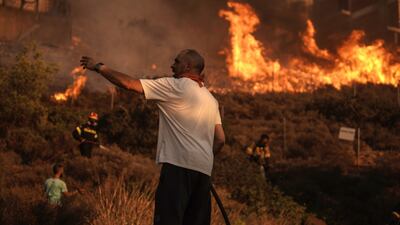
Firefighters and volunteers work to extinguish a burning field during a wildfire in Saronida, south of Athens. Bloomberg -
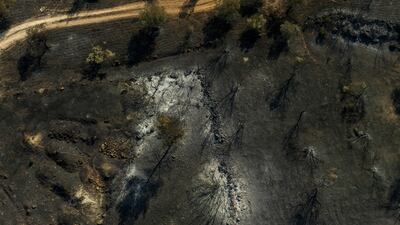
Burnt trees after a wildfire in Kouvaras, near Athens. Reuters -
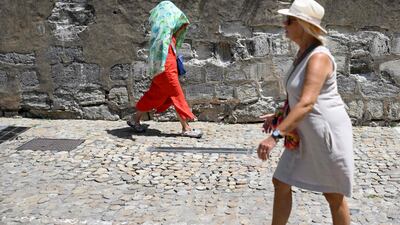
A woman covers herself with a scarf in Avignon, southern France. AFP -

A boy cools down at the Barcaccia fountain in Rome. AFP -
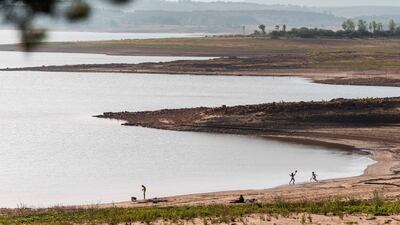
People play in the shore of the Aguilar de Campoo reservoir in Spain. AFP -
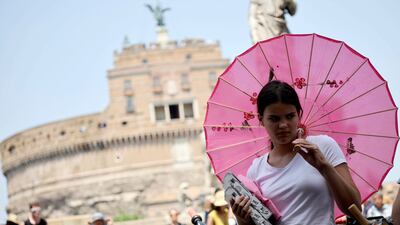
An umbrella provides shade during a heatwave in Rome. The Italian Health Ministry has put out a red alert. EPA -
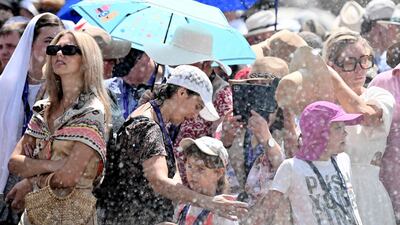
Cooling off in a fountain in St Peter's square, Vatican City. AFP -
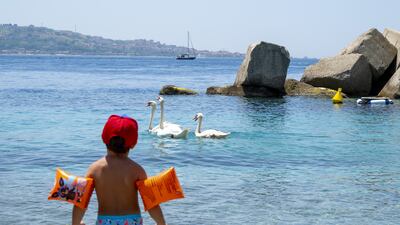
Swanning about in the sun is child's play, near Messina in Sicily. AFP -
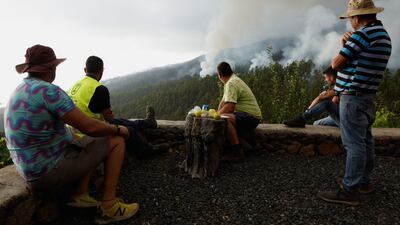
The Tijarafe wildfire advances on the Canary Island of La Palma, Spain. Reuters -
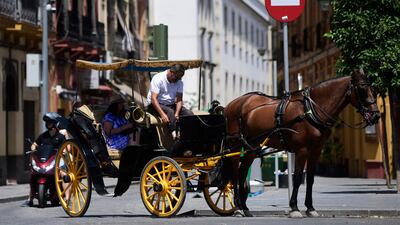
Tourists are hot to trot in a horse-drawn carriage in Seville, Spain. AFP -
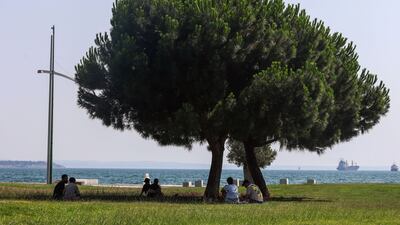
A tree provides shelter from the sun in Thessaloniki, Greece, where a four-day heatwave has led to temperatures of up to 44°C. EPA -

A father and daughter are shrouded by mist from a public fountain in Bucharest, Romania. AP


The book reveals how the geography of these cities played a role in their identity.
In Syracuse, a city at the heart of the Mediterranean that was the battleground of empires for millenia, Pangonis discovered how the practice of keeping prisoners in its caves may have inspired the ancient Greek philosopher Plato’s Allegory of the Cave – a text that has been seminal to western and Islamic civilisations.
Twilight Cities is part of a trilogy of medieval and ancient histories of the Mediterranean by Pangonis. Her first book, Queens of Jerusalem: Women Who Dared to Rule, tells the story of the queens of Christendom in the Levant, the daughters of Crusaders who became powerful rulers in their own right. Her next book will be a history of Damascus.
"Being a young woman doing medieval history can be challenging, some people don't take you seriously or think you're doing real research. But in some contexts it plays to your advantage as people want to help you even more," she said.
For the project the author divides her time between Lebanon, France and the UK. “Nowhere do you see [the region’s] potential crises more clearly than Lebanon. The country is collapsing,” she said.
“Smaller countries and less stable countries are often used as sort of a battleground for the arguments or the politics of bigger, richer countries. That has always been the case in Mediterranean history,” she adds.
Today, what remains of these deep histories is also at risk, Pangonis says.
“Climate change will have an impact on the preservation of culture and history in the Mediterranean,” she says, “and the ease with which people can visit.”
She hopes Twilight Cities will give people an incentive to keep visiting the region, despite the uncomfortable weather. “This book is meant to be as enjoyable and interesting to read as it was to write and I hope that it inspires people to travel to these places.”

