How the finest Darjeeling tea is losing its steam due to climate change


Taniya Dutta
  • English
  • Arabic

For the past two centuries, hand-picked brews from the rolling hills of India’s Darjeeling area have been tantalising tea connoisseurs around the world, but the aromatic “champagne of teas” is slowly losing its steam as it faces the brunt of climate change.

At an elevation ranging between 600m and 2,000m near the third tallest mountain in the world, Kangchenjunga, India grows the world’s most premium tea in the steep hills of Darjeeling, in the eastern state of West Bengal.

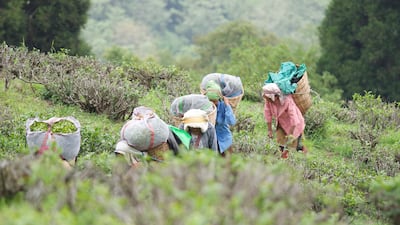
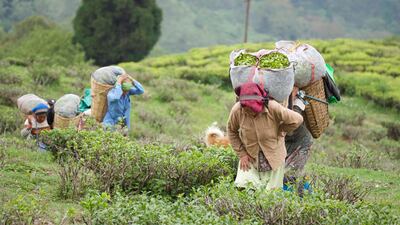
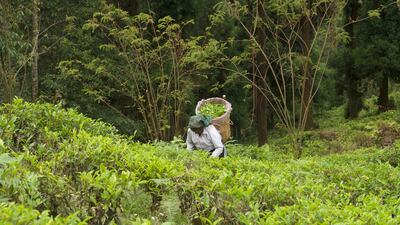
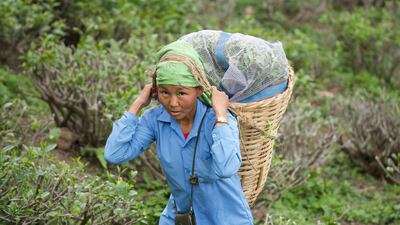
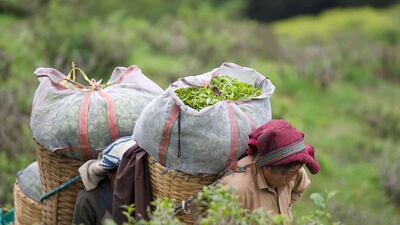
The panoramic view is dotted with cotton clouds, pine trees and hordes of tea workers – mostly women, carrying huge cane baskets on their backs, meticulously hand-picking tender shoots – just two leaves and a bud.

These painstakingly picked tender shoots give Darjeeling tea its distinctive champagne-like colour, pleasant aroma and delicate flavour, which in 2004 earned the brew a Geographical Identification tag – unique protected status under the World Trade Organisation.

But in recent years, erratic climatic conditions have been affecting production of teas in the region, leading to challenges for tea owners. Tea is a rain-fed crop that requires a distinct temperature range, between 15ºC and 23ºC, relative humidity, well-dispersed rainfall and sunshine hours to work in harmony for a good product, experts say.

But of late the region has recorded increased temperatures, drought and hailstorms. Water sources are limited and the heat means trees wilt quickly.

Just two carefully picked leaves and a bud give Darjeeling tea its unique taste and aroma. Taniya Dutta / The National

Darjeeling thrives between 18ºC and 29ºC and with annual rainfall of between 150cm and 500cm. But in May the average temperature was hovering at 39ºC – more than 10ºC to 15ºC higher than usual in the month.

“In the summer season, we are seeing hailstorms, during the monsoon season, we are seeing too much sunlight. The drought seasons have become longer," says Sparsh Agarwal, co-founder of Dorje Teas, adding that the changing traditional weather patterns are affecting "our yield and quality of harvest”.

“Since growing tea is a symphony of the sun and the soil, it requires certain conditions to grow, a certain amount of sunshine, a certain amount of rainfall and winds, but no longer is that in a uniform quantity throughout the year.”

Dorje Teas grows organic green teas, special moonlight harvest white tea and a range of Japanese-inspired teas at a nearly 150 year old estate in Darjeeling and sells them through www.dorjeteas.com.

Old trees and organic cultivation

Darjeeling was a tiny hamlet used by British officials and their families as a summer resort when stationed in Kolkata, until 1841.

As an experiment to source tea outside China, Archibald Campbell, a doctor and botanist, sowed a few seeds of tea around his bungalow in Darjeeling, about 2,100m above sea level.

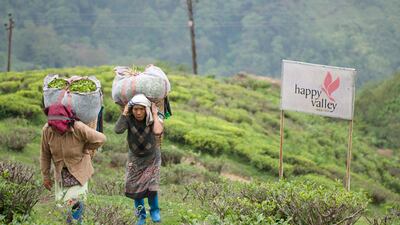
Workers hand-picking tea leaves at the Happy Valley Tea Estate in Darjeeling, West Bengal, India. Taniya Dutta / The National

The original planting succeeded and in 1846 the first commercial tea gardens were established. Within two decades there were 39 tea gardens nestled in Darjeeling, together producing a total of 21,000 kilograms of tea.

The region at one point was producing more than 10 million kilograms of tea a year, but the changing climatic patterns along with factors such as shifting to organic harvesting have adversely affected the quantity and quality of tea production.

The yield reduced to 6.87 million kilograms in 2021, according to the Indian Tea Association, the apex chamber of the tea industry in India.

Darjeeling produces teas throughout the year.

The first flush, or the spring tea, is the premium tea. It is pale and light and is harvested in March. The second flush is more oxidised – exposed to air after picking – which strengthens flavour. The leaves are bright and are harvested in summer three weeks after the first flush. The third flush is the monsoon harvest in June and the last flush is autumn, done by mid-November.

Rajat Thapa, manager of the Happy Valley Tea Estate, Darjeeling’s second oldest tea plantation, said that rising temperatures and longer hot spells causes plants to be less productive.

Workers at Happy Valley Tea Estate in Darjeeling, West Bengal. Taniya Dutta / The National

“More sunshine causes plants to close down stomata and hampers the process of photosynthesis,” Mr Thapa told The National.

He said that the high temperatures increase the chances of pest infestation, which is exacerbated by organic farming, where the plantation owners don’t use pesticides and depend on cow manure.

Mr Thapa also pointed out that most of the plants are more than 100 years old and were planted by the British.

“Over the past few years, the bushes are dying. They are more than 110 years old. The plants have become older; they don’t get nourishment and nutrients.

“We shifted to organic farming in 2007. We use cow manure, but it is not sufficient for these trees. This has drastically brought down the quality and quantity,” he said.

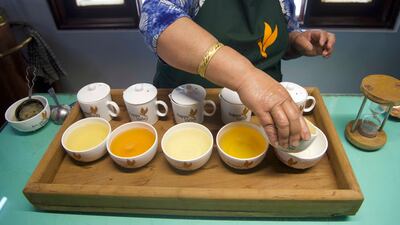
Rajat Thapa, manager of the Happy Valley Tea Estate, Darjeeling’s second oldest tea plantation, showing the types of teas produced at the estate. Taniya Dutta / The National

Drought-resistant clones

Industry experts say that the decline in production is due to several factors, but concur that climate has a bearing on declining tea yields and changes in flavour.

“We are noticing a marginal increase in the mean temperature. The duration of the hot spells has increased. The rainfall pattern has gone awry and the quantum of rainfall has been reduced,” Arijit Raha, chief executive of the Indian Tea Association, told The National.

Mr Raha emphasised that while there is no immediate threat to the production of tea, because the product is not perishing, steps such as collaboration on projects that can bring modern techniques, more efficient irrigation, including drip irrigation, are being looked at.

“It is extremely important to set up a robust, workable irrigation infrastructure which is a big challenge given the terrain and the availability of water. People are exploring steps for rainwater harvesting so some kind of nourishment can be given to the tea bushes and restoring the loss of biodiversity by planting trees,” he said.

Darjeeling in West Bengal, India, is recording increased temperatures, drought and hailstorms as a result of climate change. Taniya Dutta / The National

He also said that the scientists are working on "drought-resistant clones", but that planting them will be a challenge given the mountainous terrain.

“This is at a work-in-progress research state, where we are looking at drought-resistant clones. But it will take time because it takes about six to seven years for a new plant to come to bear.

“The option of refurbishing the estate is not practical as there would be a huge income and revenue gap if production is stopped. Darjeeling has not been able to replant because of its terrain.”

  • In the past, Darjeeling, in north-east India, has produced more than 10,000 tonnes of tea a year. All photos: Taniya Dutta / The National
    In the past, Darjeeling, in north-east India, has produced more than 10,000 tonnes of tea a year. All photos: Taniya Dutta / The National
  • Workers at Happy Valley Tea Estate in Darjeeling, West Bengal, India
    Workers at Happy Valley Tea Estate in Darjeeling, West Bengal, India
  • But changing climatic patterns, plus a shift to organic harvesting has affected the quantity and quality of tea produced
    But changing climatic patterns, plus a shift to organic harvesting has affected the quantity and quality of tea produced
  • The panoramic view of a Darjeeling tea garden
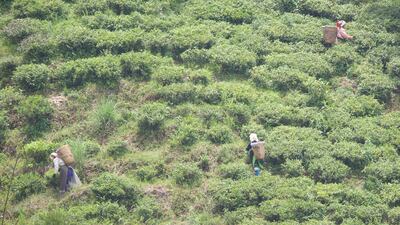
    The panoramic view of a Darjeeling tea garden
  • At an elevation ranging between 600 metres to 2,000 metres near the third tallest mountain in the world, Kangchenjunga, Darjeeling provides some of the world's premium tea
    At an elevation ranging between 600 metres to 2,000 metres near the third tallest mountain in the world, Kangchenjunga, Darjeeling provides some of the world's premium tea
  • Workers carrying fresh tea leaves for processing at Happy Valley Tea Estate
    Workers carrying fresh tea leaves for processing at Happy Valley Tea Estate
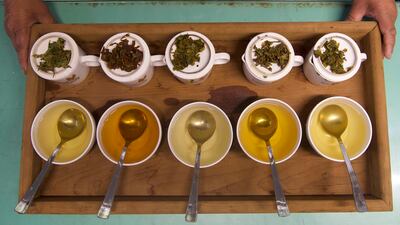
  • A tea-tasting activity at Happy Valley Tea Estate. Darjeeling tea is renowned for its pleasant aroma and delicate flavour
    A tea-tasting activity at Happy Valley Tea Estate. Darjeeling tea is renowned for its pleasant aroma and delicate flavour
  • Darjeeling produces teas throughout the year. The first flush or the spring tea is the premium tea. It is pale and light and is harvested in March
    Darjeeling produces teas throughout the year. The first flush or the spring tea is the premium tea. It is pale and light and is harvested in March
  • The second flush, which is brighter, is harvested three weeks later. The third flush is the monsoon harvest in June, followed by and the last flush by mid-November
    The second flush, which is brighter, is harvested three weeks later. The third flush is the monsoon harvest in June, followed by and the last flush by mid-November
  • Picking leaves in the lush landscape of Happy Valley Tea Estate
    Picking leaves in the lush landscape of Happy Valley Tea Estate
  • A worker carrying a basket of tea at Happy Valley Tea Estate
    A worker carrying a basket of tea at Happy Valley Tea Estate
  • Workers at Happy Valley Tea Estate
    Workers at Happy Valley Tea Estate
  • Happy Valley Tea Estate is one of highest tea plantations in the world
    Happy Valley Tea Estate is one of highest tea plantations in the world

Springtime in a Broken Mirror,
Mario Benedetti, Penguin Modern Classics


Profile

Company name: Jaib

Started: January 2018

Co-founders: Fouad Jeryes and Sinan Taifour

Based: Jordan

Sector: FinTech

Total transactions: over $800,000 since January, 2018

Investors in Jaib's mother company Alpha Apps: Aramex and 500 Startups

The five pillars of Islam

1. Fasting

2. Prayer

3. Hajj

4. Shahada

5. Zakat 

The bio

Favourite food: Japanese

Favourite car: Lamborghini

Favourite hobby: Football

Favourite quote: If your dreams don’t scare you, they are not big enough

Favourite country: UAE

Winners

Best Men's Player of the Year: Kylian Mbappe (PSG)

Maradona Award for Best Goal Scorer of the Year: Robert Lewandowski (Bayern Munich)

TikTok Fans’ Player of the Year: Robert Lewandowski

Top Goal Scorer of All Time: Cristiano Ronaldo (Manchester United)

Best Women's Player of the Year: Alexia Putellas (Barcelona)

Best Men's Club of the Year: Chelsea

Best Women's Club of the Year: Barcelona

Best Defender of the Year: Leonardo Bonucci (Juventus/Italy)

Best Goalkeeper of the Year: Gianluigi Donnarumma (PSG/Italy)

Best Coach of the Year: Roberto Mancini (Italy)

Best National Team of the Year: Italy 

Best Agent of the Year: Federico Pastorello

Best Sporting Director of the Year: Txiki Begiristain (Manchester City)

Player Career Award: Ronaldinho

THE SPECS

Engine: six-litre W12 twin-turbo

Transmission: eight-speed dual clutch auto

Power: 626bhp

Torque: 900Nm

Price: Dh940,160 (plus VAT)

On sale: Q1 2020

Our legal columnist

Name: Yousef Al Bahar

Advocate at Al Bahar & Associate Advocates and Legal Consultants, established in 1994

Education: Mr Al Bahar was born in 1979 and graduated in 2008 from the Judicial Institute. He took after his father, who was one of the first Emirati lawyers

Mercer, the investment consulting arm of US services company Marsh & McLennan, expects its wealth division to at least double its assets under management (AUM) in the Middle East as wealth in the region continues to grow despite economic headwinds, a company official said.

Mercer Wealth, which globally has $160 billion in AUM, plans to boost its AUM in the region to $2-$3bn in the next 2-3 years from the present $1bn, said Yasir AbuShaban, a Dubai-based principal with Mercer Wealth.

Within the next two to three years, we are looking at reaching $2 to $3 billion as a conservative estimate and we do see an opportunity to do so,” said Mr AbuShaban.

Mercer does not directly make investments, but allocates clients’ money they have discretion to, to professional asset managers. They also provide advice to clients.

“We have buying power. We can negotiate on their (client’s) behalf with asset managers to provide them lower fees than they otherwise would have to get on their own,” he added.

Mercer Wealth’s clients include sovereign wealth funds, family offices, and insurance companies among others.

From its office in Dubai, Mercer also looks after Africa, India and Turkey, where they also see opportunity for growth.

Wealth creation in Middle East and Africa (MEA) grew 8.5 per cent to $8.1 trillion last year from $7.5tn in 2015, higher than last year’s global average of 6 per cent and the second-highest growth in a region after Asia-Pacific which grew 9.9 per cent, according to consultancy Boston Consulting Group (BCG). In the region, where wealth grew just 1.9 per cent in 2015 compared with 2014, a pickup in oil prices has helped in wealth generation.

BCG is forecasting MEA wealth will rise to $12tn by 2021, growing at an annual average of 8 per cent.

Drivers of wealth generation in the region will be split evenly between new wealth creation and growth of performance of existing assets, according to BCG.

Another general trend in the region is clients’ looking for a comprehensive approach to investing, according to Mr AbuShaban.

“Institutional investors or some of the families are seeing a slowdown in the available capital they have to invest and in that sense they are looking at optimizing the way they manage their portfolios and making sure they are not investing haphazardly and different parts of their investment are working together,” said Mr AbuShaban.

Some clients also have a higher appetite for risk, given the low interest-rate environment that does not provide enough yield for some institutional investors. These clients are keen to invest in illiquid assets, such as private equity and infrastructure.

“What we have seen is a desire for higher returns in what has been a low-return environment specifically in various fixed income or bonds,” he said.

“In this environment, we have seen a de facto increase in the risk that clients are taking in things like illiquid investments, private equity investments, infrastructure and private debt, those kind of investments were higher illiquidity results in incrementally higher returns.”

The Abu Dhabi Investment Authority, one of the largest sovereign wealth funds, said in its 2016 report that has gradually increased its exposure in direct private equity and private credit transactions, mainly in Asian markets and especially in China and India. The authority’s private equity department focused on structured equities owing to “their defensive characteristics.”

Results

Female 49kg: Mayssa Bastos (BRA) bt Thamires Aquino (BRA); points 0-0 (advantage points points 1-0).

Female 55kg: Bianca Basilio (BRA) bt Amal Amjahid (BEL); points 4-2.

Female 62kg: Beatriz Mesquita (BRA) v Ffion Davies (GBR); 10-2.

Female 70kg: Thamara Silva (BRA) bt Alessandra Moss (AUS); submission.

Female 90kg: Gabreili Passanha (BRA) bt Claire-France Thevenon (FRA); submission.

Male 56kg: Hiago George (BRA) bt Carlos Alberto da Silva (BRA); 2-2 (2-0)

Male 62kg: Gabriel de Sousa (BRA) bt Joao Miyao (BRA); 2-2 (2-1)

Male 69kg: Paulo Miyao (BRA) bt Isaac Doederlein (USA); 2-2 (2-2) Ref decision.

Male 77kg: Tommy Langarkar (NOR) by Oliver Lovell (GBR); submission.

Male 85kg: Rudson Mateus Teles (BRA) bt Faisal Al Ketbi (UAE); 2-2 (1-1) Ref decision.

Male 94kg: Kaynan Duarte (BRA) bt Adam Wardzinski (POL); submission.

Male 110kg: Joao Rocha (BRA) bt Yahia Mansoor Al Hammadi (UAE); submission.

Brief scores:

QPR 0

Watford 1

Capoue 45' 1

Indika
%3Cp%3E%3Cstrong%3EDeveloper%3A%3C%2Fstrong%3E%2011%20Bit%20Studios%3Cbr%3E%3Cstrong%3EPublisher%3A%3C%2Fstrong%3E%20Odd%20Meter%3Cbr%3E%3Cstrong%3EConsole%3A%3C%2Fstrong%3E%20PlayStation%205%2C%20PC%20and%20Xbox%20series%20X%2FS%3Cbr%3E%3Cstrong%3ERating%3A%3C%2Fstrong%3E%204%2F5%3C%2Fp%3E%0A
Who's who in Yemen conflict

Houthis: Iran-backed rebels who occupy Sanaa and run unrecognised government

Yemeni government: Exiled government in Aden led by eight-member Presidential Leadership Council

Southern Transitional Council: Faction in Yemeni government that seeks autonomy for the south

Habrish 'rebels': Tribal-backed forces feuding with STC over control of oil in government territory

Company Profile

Name: JustClean

Based: Kuwait with offices in other GCC countries

Launch year: 2016

Number of employees: 130

Sector: online laundry service

Funding: $12.9m from Kuwait-based Faith Capital Holding

Real estate tokenisation project

Dubai launched the pilot phase of its real estate tokenisation project last month.

The initiative focuses on converting real estate assets into digital tokens recorded on blockchain technology and helps in streamlining the process of buying, selling and investing, the Dubai Land Department said.

Dubai’s real estate tokenisation market is projected to reach Dh60 billion ($16.33 billion) by 2033, representing 7 per cent of the emirate’s total property transactions, according to the DLD.

'Outclassed in Kuwait'
Taleb Alrefai, 
HBKU Press 

Coffee: black death or elixir of life?

It is among the greatest health debates of our time; splashed across newspapers with contradicting headlines - is coffee good for you or not?

Depending on what you read, it is either a cancer-causing, sleep-depriving, stomach ulcer-inducing black death or the secret to long life, cutting the chance of stroke, diabetes and cancer.

The latest research - a study of 8,412 people across the UK who each underwent an MRI heart scan - is intended to put to bed (caffeine allowing) conflicting reports of the pros and cons of consumption.

The study, funded by the British Heart Foundation, contradicted previous findings that it stiffens arteries, putting pressure on the heart and increasing the likelihood of a heart attack or stroke, leading to warnings to cut down.

Numerous studies have recognised the benefits of coffee in cutting oral and esophageal cancer, the risk of a stroke and cirrhosis of the liver. 

The benefits are often linked to biologically active compounds including caffeine, flavonoids, lignans, and other polyphenols, which benefit the body. These and othetr coffee compounds regulate genes involved in DNA repair, have anti-inflammatory properties and are associated with lower risk of insulin resistance, which is linked to type-2 diabetes.

But as doctors warn, too much of anything is inadvisable. The British Heart Foundation found the heaviest coffee drinkers in the study were most likely to be men who smoked and drank alcohol regularly.

Excessive amounts of coffee also unsettle the stomach causing or contributing to stomach ulcers. It also stains the teeth over time, hampers absorption of minerals and vitamins like zinc and iron.

It also raises blood pressure, which is largely problematic for people with existing conditions.

So the heaviest drinkers of the black stuff - some in the study had up to 25 cups per day - may want to rein it in.

Rory Reynolds

Updated: July 01, 2023, 8:22 AM