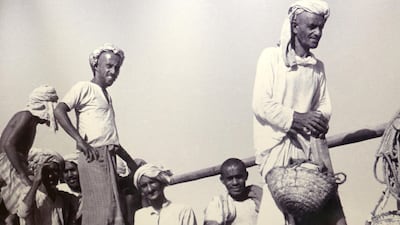
An old photograph of pearl divers on display at the Pearl Museum at the National Bank of Dubai building in Dubai. Pawan Singh / The National

Timeframe: June once signalled the start of the Big Dive for UAE pearl divers


Razmig Bedirian
  • English
  • Arabic

June isn’t a very popular month in the UAE.

The last of the refreshing breezes of spring have ebbed and temperatures have begun creeping past the 40°C mark. Save for beachside afternoons or the errant zephyrs that circle you as you walk in the shade, being outside doesn’t seem that appealing any more.

This timidity over braving the outdoors is commonplace today, but there was a time in the UAE when summer was one of the most consequential times of the year, as it determined how many would fare for the rest of the year.

Pearl divers preferred the window of time from June to September that became known as Ghous Al Kabir, or the Big Dive, because waters were warmer, meaning they could gain access to lower depths in their search for pearls.

The divers’ departure would be marked with a seaside ceremony called “hiraat”, or oyster bed. As the sailors departed from the beach, their families would wave and wish them well from the shoreline. It was usually a bittersweet moment as it meant that the men would be away from their families for months.

The captain of the crew would then officially announce the start of the pearling season.

The end of Ghous Al Kabir was marked with more fervour. A cannon was fired from the shoreline to greet the divers’ arrival. Family members took this as a cue to prepare for the festivities. Cloth flags would be hung from houses and special meals were prepared.

As they approached the shoreline, the divers would begin hearing their families singing in welcome.

  • A photograph of the pearl divers on display at the Pearl Museum at Emirates NBD head office in Deira, Dubai. Pawan Singh / The National
    A photograph of the pearl divers on display at the Pearl Museum at Emirates NBD head office in Deira, Dubai. Pawan Singh / The National
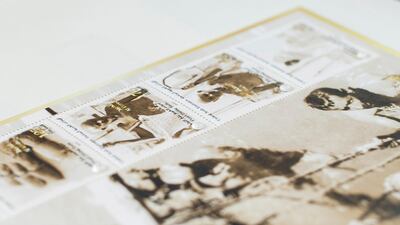
  • Stamps picturing pearl-diving tools, with a half piece of pearl placed at the corner of each stamp. These were issued in 2005. Reem Mohammed / The National
    Stamps picturing pearl-diving tools, with a half piece of pearl placed at the corner of each stamp. These were issued in 2005. Reem Mohammed / The National
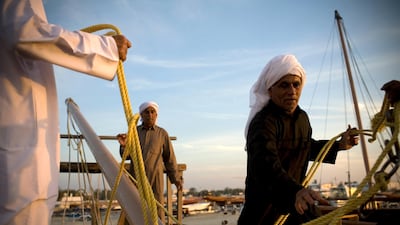
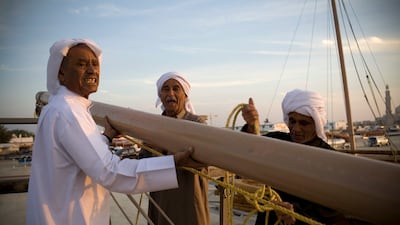
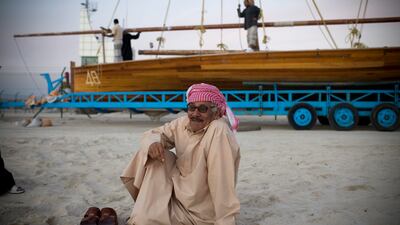
  • Men who once worked as crew on pearl-diving ships help out on their friend's racing dhow. Many still gather with other pearl divers in Umm Sequim 1, a fishing port near Burj Al Arab. Nicole Hill / The National
    Men who once worked as crew on pearl-diving ships help out on their friend's racing dhow. Many still gather with other pearl divers in Umm Sequim 1, a fishing port near Burj Al Arab. Nicole Hill / The National
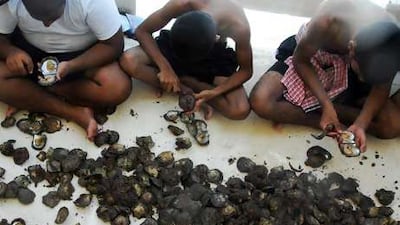
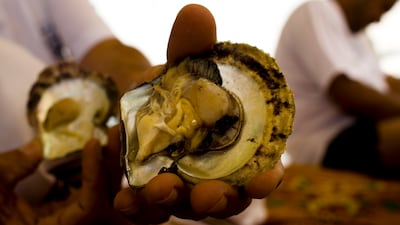
  • Young men hunt for pearls in the oysters they harvest while participating in the Kuwait Sea Sports Club's Pearl Diving Heritage Revival Festival in 2010.
    Young men hunt for pearls in the oysters they harvest while participating in the Kuwait Sea Sports Club's Pearl Diving Heritage Revival Festival in 2010.
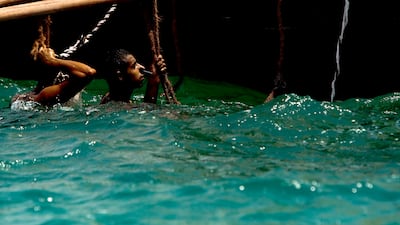
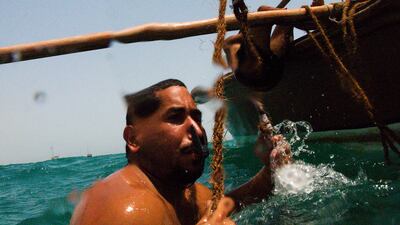
  • Jossem Al Ameni, 19, and Mashal Al Dhiferi, 24, dive for pearls in the Arabian Sea in 2009. Andrew Henderson / The National
    Jossem Al Ameni, 19, and Mashal Al Dhiferi, 24, dive for pearls in the Arabian Sea in 2009. Andrew Henderson / The National
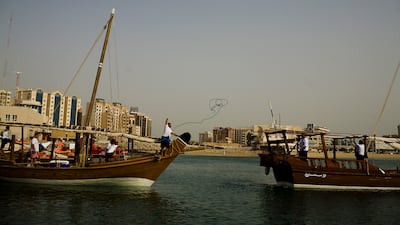
  • Kuwaitis sail in traditional dhows during preparations for the annual pearl diving expedition in 2009. Andrew Henderson / The National
    Kuwaitis sail in traditional dhows during preparations for the annual pearl diving expedition in 2009. Andrew Henderson / The National
  • Attiq Khalfan, left, and Ahmed Majed, back right, once worked as crew on pearl-diving ships. Nicole Hill / The National
    Attiq Khalfan, left, and Ahmed Majed, back right, once worked as crew on pearl-diving ships. Nicole Hill / The National
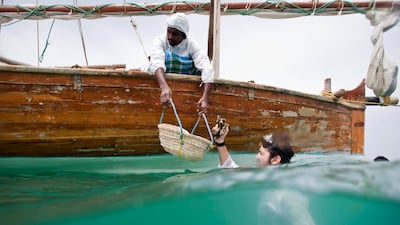
  • A traditional pearl-diving experience is recreated for tourists as part of an EMAG and Jumeirah-run event in Dubai in 2012. Antonie Robertson / The National
    A traditional pearl-diving experience is recreated for tourists as part of an EMAG and Jumeirah-run event in Dubai in 2012. Antonie Robertson / The National
  • Boats sail into the Arabian Sea off the coast of Khairan, Kuwait, the traditional site for the Al Ghous Festival, to undertake in the 23rd pearl diving expedition in 2009. Andrew Henderson / The National
    Boats sail into the Arabian Sea off the coast of Khairan, Kuwait, the traditional site for the Al Ghous Festival, to undertake in the 23rd pearl diving expedition in 2009. Andrew Henderson / The National
  • Bakeet Bin Safan, pictured in 2008, used to work on a pearl diving ship. Nicole Hill / The National
    Bakeet Bin Safan, pictured in 2008, used to work on a pearl diving ship. Nicole Hill / The National
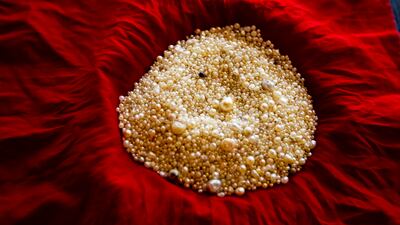
  • A photograph of pearl diver Faraj Al Muhairbi's souvenir pearls, collected over a lifetime of diving. Sarah Dea / The National
    A photograph of pearl diver Faraj Al Muhairbi's souvenir pearls, collected over a lifetime of diving. Sarah Dea / The National
  • An organiser holds pearls that young sailors found in oysters on August 4, 2009 during the Al Ghous Festival in Kuwait. Andrew Henderson / The National
    An organiser holds pearls that young sailors found in oysters on August 4, 2009 during the Al Ghous Festival in Kuwait. Andrew Henderson / The National
  • The divers would use a fettam, a clip made of turtle shell or sheep's bone, to keep their nostrils closed while underwater. Andrew Henderson / The National
    The divers would use a fettam, a clip made of turtle shell or sheep's bone, to keep their nostrils closed while underwater. Andrew Henderson / The National

A dhow could hold as many as 30 crew, usually made up of men, though children did sometimes accompany them on shorter voyages. Besides its millennia-long sense of tradition, pearl diving was one of the primary sources of income for the region up until the 1920s, after which a global industry-wide collapse occurred due to the advent of artificial pearls.

However, pearl diving has flourished in the region as a trade and tradition. Although it's much harder to meet a pearl diver today, heritage festivals across the UAE have recreated aspects of the trade and culture.

So while today it seems intuitive to groan and grumble as we scurry from one air-conditioned space to another, it’s remarkable to think that a century ago, local divers were braving the scorching weather, going out to sea for pearls and singing songs to keep their spirits afloat.

That knowledge might do little to cool you as you’re striding steadfast towards your car in an open-air parking spot at noon, but it might help in your resolve – or at least inspire a visit to the beach.


How to invest in gold

Investors can tap into the gold price by purchasing physical jewellery, coins and even gold bars, but these need to be stored safely and possibly insured.

A cheaper and more straightforward way to benefit from gold price growth is to buy an exchange-traded fund (ETF).

Most advisers suggest sticking to “physical” ETFs. These hold actual gold bullion, bars and coins in a vault on investors’ behalf. Others do not hold gold but use derivatives to track the price instead, adding an extra layer of risk. The two biggest physical gold ETFs are SPDR Gold Trust and iShares Gold Trust.

Another way to invest in gold’s success is to buy gold mining stocks, but Mr Gravier says this brings added risks and can be more volatile. “They have a serious downside potential should the price consolidate.”

Mr Kyprianou says gold and gold miners are two different asset classes. “One is a commodity and the other is a company stock, which means they behave differently.”

Mining companies are a business, susceptible to other market forces, such as worker availability, health and safety, strikes, debt levels, and so on. “These have nothing to do with gold at all. It means that some companies will survive, others won’t.”

By contrast, when gold is mined, it just sits in a vault. “It doesn’t even rust, which means it retains its value,” Mr Kyprianou says.

You may already have exposure to gold miners in your portfolio, say, through an international ETF or actively managed mutual fund.

You could spread this risk with an actively managed fund that invests in a spread of gold miners, with the best known being BlackRock Gold & General. It is up an incredible 55 per cent over the past year, and 240 per cent over five years. As always, past performance is no guide to the future.

Specs
Engine: Electric motor generating 54.2kWh (Cooper SE and Aceman SE), 64.6kW (Countryman All4 SE)
Power: 218hp (Cooper and Aceman), 313hp (Countryman)
Torque: 330Nm (Cooper and Aceman), 494Nm (Countryman)
On sale: Now
Price: From Dh158,000 (Cooper), Dh168,000 (Aceman), Dh190,000 (Countryman)
Yahya Al Ghassani's bio

Date of birth: April 18, 1998

Playing position: Winger

Clubs: 2015-2017 – Al Ahli Dubai; March-June 2018 – Paris FC; August – Al Wahda

Why it pays to compare

A comparison of sending Dh20,000 from the UAE using two different routes at the same time - the first direct from a UAE bank to a bank in Germany, and the second from the same UAE bank via an online platform to Germany - found key differences in cost and speed. The transfers were both initiated on January 30.

Route 1: bank transfer

The UAE bank charged Dh152.25 for the Dh20,000 transfer. On top of that, their exchange rate margin added a difference of around Dh415, compared with the mid-market rate.

Total cost: Dh567.25 - around 2.9 per cent of the total amount

Total received: €4,670.30 

Route 2: online platform

The UAE bank’s charge for sending Dh20,000 to a UK dirham-denominated account was Dh2.10. The exchange rate margin cost was Dh60, plus a Dh12 fee.

Total cost: Dh74.10, around 0.4 per cent of the transaction

Total received: €4,756

The UAE bank transfer was far quicker – around two to three working days, while the online platform took around four to five days, but was considerably cheaper. In the online platform transfer, the funds were also exposed to currency risk during the period it took for them to arrive.

Formula Middle East Calendar (Formula Regional and Formula 4)
Round 1: January 17-19, Yas Marina Circuit – Abu Dhabi
 
Round 2: January 22-23, Yas Marina Circuit – Abu Dhabi
 
Round 3: February 7-9, Dubai Autodrome – Dubai
 
Round 4: February 14-16, Yas Marina Circuit – Abu Dhabi
 
Round 5: February 25-27, Jeddah Corniche Circuit – Saudi Arabia
UAE tour of the Netherlands

UAE squad: Rohan Mustafa (captain), Shaiman Anwar, Ghulam Shabber, Mohammed Qasim, Rameez Shahzad, Mohammed Usman, Adnan Mufti, Chirag Suri, Ahmed Raza, Imran Haider, Mohammed Naveed, Amjad Javed, Zahoor Khan, Qadeer Ahmed
Fixtures and results:
Monday, UAE won by three wickets
Wednesday, 2nd 50-over match
Thursday, 3rd 50-over match

COMPANY PROFILE
Name: Almnssa
Started: August 2020
Founder: Areej Selmi
Based: Gaza
Sectors: Internet, e-commerce
Investments: Grants/private funding
if you go

The flights
Flydubai offers three daily direct flights to Sarajevo and, from June, a daily flight from Thessaloniki from Dubai. A return flight costs from Dhs1,905 including taxes.
The trip 
The Travel Scientists are the organisers of the Balkan Ride and several other rallies around the world. The 2018 running of this particular adventure will take place from August 3-11, once again starting in Sarajevo and ending a week later in Thessaloniki. If you’re driving your own vehicle, then entry start from €880 (Dhs 3,900) per person including all accommodation along the route. Contact the Travel Scientists if you wish to hire one of their vehicles. 

Bert van Marwijk factfile

Born: May 19 1952
Place of birth: Deventer, Netherlands
Playing position: Midfielder

Teams managed:
1998-2000 Fortuna Sittard
2000-2004 Feyenoord
2004-2006 Borussia Dortmund
2007-2008 Feyenoord
2008-2012 Netherlands
2013-2014 Hamburg
2015-2017 Saudi Arabia
2018 Australia

Major honours (manager):
2001/02 Uefa Cup, Feyenoord
2007/08 KNVB Cup, Feyenoord
World Cup runner-up, Netherlands

Star%20Wars%3A%20Episode%20I%20%E2%80%93%20The%20Phantom%20Menace
%3Cp%3E%3Cstrong%3EDeveloper%3A%3C%2Fstrong%3E%20Big%20Ape%20Productions%3Cbr%3E%3Cstrong%3EPublisher%3A%3C%2Fstrong%3E%20LucasArts%3Cbr%3E%3Cstrong%3EConsoles%3A%3C%2Fstrong%3E%20PC%2C%20PlayStation%3Cbr%3E%3Cstrong%3ERating%3A%3C%2Fstrong%3E%202%2F5%3C%2Fp%3E%0A
CHATGPT%20ENTERPRISE%20FEATURES
%3Cp%3E%E2%80%A2%20Enterprise-grade%20security%20and%20privacy%3C%2Fp%3E%0A%3Cp%3E%E2%80%A2%20Unlimited%20higher-speed%20GPT-4%20access%20with%20no%20caps%3C%2Fp%3E%0A%3Cp%3E%E2%80%A2%20Longer%20context%20windows%20for%20processing%20longer%20inputs%3C%2Fp%3E%0A%3Cp%3E%E2%80%A2%20Advanced%20data%20analysis%20capabilities%3C%2Fp%3E%0A%3Cp%3E%E2%80%A2%20Customisation%20options%3C%2Fp%3E%0A%3Cp%3E%E2%80%A2%20Shareable%20chat%20templates%20that%20companies%20can%20use%20to%20collaborate%20and%20build%20common%20workflows%3C%2Fp%3E%0A%3Cp%3E%E2%80%A2%20Analytics%20dashboard%20for%20usage%20insights%3C%2Fp%3E%0A%3Cp%3E%E2%80%A2%20Free%20credits%20to%20use%20OpenAI%20APIs%20to%20extend%20OpenAI%20into%20a%20fully-custom%20solution%20for%20enterprises%3C%2Fp%3E%0A
Updated: June 13, 2023, 3:08 AM