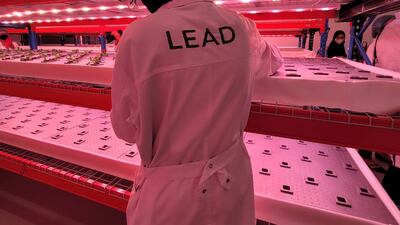
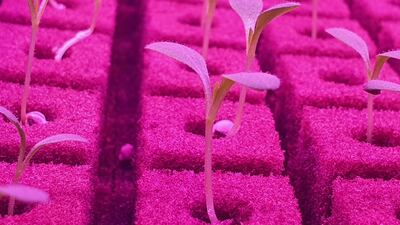
Starlab aims to eventually grow crops on its own space station. Getty Images

Space-age seeds — the Abu Dhabi company looking to the stars to grow better crops


Daniel Bardsley
  • English
  • Arabic

It was about 10,000 years ago in the Fertile Crescent of ancient Mesopotamia that people began to domesticate plants, changing the course of history for ever.

Probably soon after the first cereals were domesticated, between the Tigris and Euphrates rivers in and around what is now Iraq, people started to select types that were more suitable as crops.

Given the region’s links to the earliest efforts at plant breeding, it is perhaps appropriate that a company in Abu Dhabi is taking this discipline into the space age.

To boldly grow

StarLab Oasis is planning to send seeds into space in the hope that conditions there could throw up new mutations that could improve agriculture here on Earth.

From developing crops that are resistant to climate change to helping them cope with salinity, the work could be of particular importance to agriculture in the Gulf region.

Seeds could be kept in space for months at a time and then germinated, with the resulting plants assessed for potentially useful novel traits.

StarLab Oasis also says that its ambitious programme could highlight the best ways to grow crops in space, which may prove important as humankind considers missions where people stay away from Earth for longer periods.

The company is poised to benefit from the growth of the commercial space sector and the planned creation of additional space stations where research could be carried out.

Ben Greaves, a researcher with StarLab Oasis. Photo: StarLab Oasis

“Because of the drop in launch costs, it’s become cost-effective to look at off-Earth breeding,” said Ben Greaves, a researcher at StarLab Oasis, which was founded in 2021 by a US company, Nanoracks.

“Through mutation breeding … we’re able to introduce new traits we don’t have on Earth.”

Evolution of agriculture

While genetic engineering has allowed researchers to, for example, insert fish genes into the genetic material of tomatoes, Mr Greaves said it was still important for new mutations to be created so that these could be incorporated into crops through conventional breeding.

On Earth, people have created mutations by exposing plants to, for example, chemicals, extreme temperatures and rays of charged particles called ion beams.

Mutations could be induced in space in a wide range of plants, including grains such as rice, wheat and barley, and fruit or tuber crops, such as cassava.

Ecologically important plants like mangroves could also be included, as could fungi, such as mushrooms, and bacteria.

“How can this improve food security on Earth?” Mr Greaves said. “How can we use this as an opportunity to look at underinvested crops as well? There’s no shortage of crops that could help in fighting against climate change.

“It allows us to be more prepared for a future that’s hotter, drier and saltier.”

Among the other crops that could be mutated in space is coffee, new forms of which may be needed to cope with climate change.

Scientists have found that with Arabica coffee, yields are best at high altitudes in tropical areas where annual average temperatures are between 18°C and 23°C.

If temperatures increase or rainfall decreases because of climate change, yields may fall, putting a premium on coffee varieties that grow well in conditions that are warmer or drier.

Growing crops in space may highlight issues that would become important if people were to attempt to produce food in space.

“A lot of this is understanding how do these crops grow in space in microgravity,” Mr Greaves. “What if we find wheat crops end up growing twice as tall or three times as tall?”

Ensuring seeds survive the trek to space

Allen Herbert, co-founder and general manager of StarLab Oasis, said the work could provide insights into taking seeds much further away than space stations, which exist in low Earth orbit. The International Space Station, for example, is just over 400km from Earth.

“As we get out into space, to Mars and other places, we have to make sure some of these seeds can survive the trip,” he said.

He said Nasa and other space organisations were interested in how seeds could best be packaged to help them survive the rigours of space.

StarLab Oasis is keen to investigate how, for example, seeds could be packaged so that radiation did not affect them.

The company aims to send seeds into space this year through partnerships with research institutions, universities or private sector companies.

StarLab Oasis is looking to send seeds to the International Space Station, which could host the George Washington Carver Science Park created by a sister company, Starlab. Photo: StarLab Oasis

Initially, seeds could be sent to the International Space Station, which may host the George Washington Carver Science Park created by a sister company, Starlab.

Starlab, whose partners also include Airbus and Voyager Space, ultimately aims to create its own space stations in the late 2020s at different orbits, meaning that plant, fungal or other materials could be exposed to different levels of radiation.

“StarLab Oasis will be coordinating all of the agricultural technology and plant science research,” Mr Greaves said. “There will be multiple Starlabs with different purposes.”

While StarLab Oasis has huge agricultural ambitions that stretch far beyond planet Earth, Mr Herbert said the company was firmly rooted in the Emirates.

“This is not a company that was transplanted from the US to the UAE. It was grown in the UAE, developed in the UAE” he said.

“We live in a harsh environment and these technologies and techniques … have real-world applications where we live.”

This high-tech work is a far cry from growing crops in the Fertile Crescent millennia ago, but it may be just as important in ensuring people have enough food into the future.

Hi-tech agriculture — in pictures

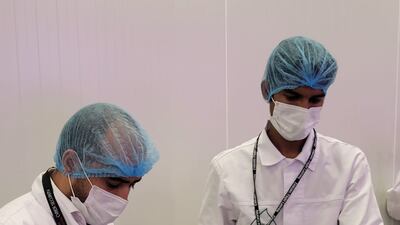
  • Agronomy experts inspect the seeds at Bustanica in Dubai. The 330,000-square-foot farm near Al Maktoum International Airport is a joint venture between Emirates Flight Catering and Crop One, a firm specialising in technology-driven indoor vertical farming. All photos: Bustanica
    Agronomy experts inspect the seeds at Bustanica in Dubai. The 330,000-square-foot farm near Al Maktoum International Airport is a joint venture between Emirates Flight Catering and Crop One, a firm specialising in technology-driven indoor vertical farming. All photos: Bustanica
  • There are 27 rooms in Bustanica where plants are grown before being harvested.
    There are 27 rooms in Bustanica where plants are grown before being harvested.
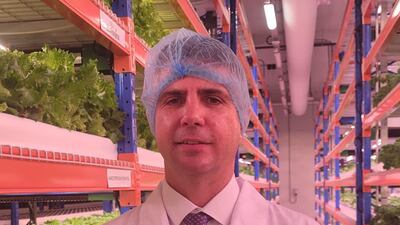
  • Robert Fellows, production director with Emirates Crop One.
    Robert Fellows, production director with Emirates Crop One.
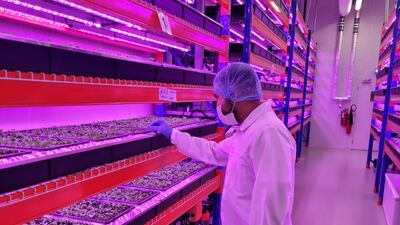
  • Inspecting the plants inside the Bustanica vertical farm.
    Inspecting the plants inside the Bustanica vertical farm.
  • Seeds are planted in membranes without using soil at Bustanica.
    Seeds are planted in membranes without using soil at Bustanica.
  • Teams of experts carefully care for the plants in confined conditions to optimise quality.
    Teams of experts carefully care for the plants in confined conditions to optimise quality.
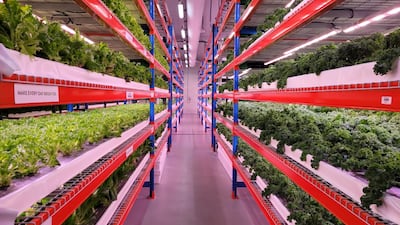
  • Lettuce, kale and spinach are being produced at the vertical farm.
    Lettuce, kale and spinach are being produced at the vertical farm.
  • The plants take root at Bustanica vertical farm. It is estimated it is able to produce more than one million kilograms of leafy greens each year, or more than three tonnes per day.
    The plants take root at Bustanica vertical farm. It is estimated it is able to produce more than one million kilograms of leafy greens each year, or more than three tonnes per day.
FIXTURES

Nov 04-05: v Western Australia XI, Perth
Nov 08-11: v Cricket Australia XI, Adelaide
Nov 15-18 v Cricket Australia XI, Townsville (d/n)
Nov 23-27: 1ST TEST v AUSTRALIA, Brisbane
Dec 02-06: 2ND TEST v AUSTRALIA, Adelaide (d/n)
Dec 09-10: v Cricket Australia XI, Perth
Dec 14-18: 3RD TEST v AUSTRALIA, Perth
Dec 26-30 4TH TEST v AUSTRALIA, Melbourne
Jan 04-08: 5TH TEST v AUSTRALIA, Sydney

Note: d/n = day/night

Tips for used car buyers
  • Choose cars with GCC specifications
  • Get a service history for cars less than five years old
  • Don’t go cheap on the inspection
  • Check for oil leaks
  • Do a Google search on the standard problems for your car model
  • Do your due diligence. Get a transfer of ownership done at an official RTA centre
  • Check the vehicle’s condition. You don’t want to buy a car that’s a good deal but ends up costing you Dh10,000 in repairs every month
  • Validate warranty and service contracts with the relevant agency and and make sure they are valid when ownership is transferred
  • If you are planning to sell the car soon, buy one with a good resale value. The two most popular cars in the UAE are black or white in colour and other colours are harder to sell

Tarek Kabrit, chief executive of Seez, and Imad Hammad, chief executive and co-founder of CarSwitch.com

Avatar: Fire and Ash

Director: James Cameron

Starring: Sam Worthington, Sigourney Weaver, Zoe Saldana

Rating: 4.5/5

The five pillars of Islam
What can you do?

Document everything immediately; including dates, times, locations and witnesses

Seek professional advice from a legal expert

You can report an incident to HR or an immediate supervisor

You can use the Ministry of Human Resources and Emiratisation’s dedicated hotline

In criminal cases, you can contact the police for additional support

MOUNTAINHEAD REVIEW

Starring: Ramy Youssef, Steve Carell, Jason Schwartzman

Director: Jesse Armstrong

Rating: 3.5/5

Company Profile

Name: JustClean

Based: Kuwait with offices in other GCC countries

Launch year: 2016

Number of employees: 130

Sector: online laundry service

Funding: $12.9m from Kuwait-based Faith Capital Holding

Dengue%20fever%20symptoms
%3Cp%3EHigh%20fever%20(40%C2%B0C%2F104%C2%B0F)%3Cbr%3ESevere%20headache%3Cbr%3EPain%20behind%20the%20eyes%3Cbr%3EMuscle%20and%20joint%20pains%3Cbr%3ENausea%3Cbr%3EVomiting%3Cbr%3ESwollen%20glands%3Cbr%3ERash%26nbsp%3B%3C%2Fp%3E%0A
The President's Cake

Director: Hasan Hadi

Starring: Baneen Ahmad Nayyef, Waheed Thabet Khreibat, Sajad Mohamad Qasem 

Rating: 4/5

The specs

Engine: 2.0-litre 4-cylturbo

Transmission: seven-speed DSG automatic

Power: 242bhp

Torque: 370Nm

Price: Dh136,814

Kill%20
%3Cp%3E%3Cstrong%3EDirector%3A%3C%2Fstrong%3E%20Nikhil%20Nagesh%20Bhat%3C%2Fp%3E%0A%3Cp%3E%3Cstrong%3EStarring%3C%2Fstrong%3E%3A%20Lakshya%2C%20Tanya%20Maniktala%2C%20Ashish%20Vidyarthi%2C%20Harsh%20Chhaya%2C%20Raghav%20Juyal%3C%2Fp%3E%0A%3Cp%3E%3Cstrong%3ERating%3A%3C%2Fstrong%3E%204.5%2F5%3Cbr%3E%3C%2Fp%3E%0A
How much do leading UAE’s UK curriculum schools charge for Year 6?
  1. Nord Anglia International School (Dubai) – Dh85,032
  2. Kings School Al Barsha (Dubai) – Dh71,905
  3. Brighton College Abu Dhabi - Dh68,560
  4. Jumeirah English Speaking School (Dubai) – Dh59,728
  5. Gems Wellington International School – Dubai Branch – Dh58,488
  6. The British School Al Khubairat (Abu Dhabi) - Dh54,170
  7. Dubai English Speaking School – Dh51,269

*Annual tuition fees covering the 2024/2025 academic year

In numbers

Number of Chinese tourists coming to UAE in 2017 was... 1.3m

Alibaba’s new ‘Tech Town’  in Dubai is worth... $600m

China’s investment in the MIddle East in 2016 was... $29.5bn

The world’s most valuable start-up in 2018, TikTok, is valued at... $75bn

Boost to the UAE economy of 5G connectivity will be... $269bn 

COMPANY%20PROFILE
%3Cp%3E%3Cstrong%3EName%3A%20%3C%2Fstrong%3EEjari%3Cbr%3E%3Cstrong%3EBased%3A%20%3C%2Fstrong%3ERiyadh%2C%20Saudi%20Arabia%3Cbr%3E%3Cstrong%3EFounders%3A%20%3C%2Fstrong%3EYazeed%20Al%20Shamsi%2C%20Fahad%20Albedah%2C%20Mohammed%20Alkhelewy%20and%20Khalid%20Almunif%3Cbr%3E%3Cstrong%3ESector%3A%20%3C%2Fstrong%3EPropTech%3Cbr%3E%3Cstrong%3ETotal%20funding%3A%20%3C%2Fstrong%3E%241%20million%3Cbr%3E%3Cstrong%3EInvestors%3A%20%3C%2Fstrong%3ESanabil%20500%20Mena%2C%20Hambro%20Perks'%20Oryx%20Fund%20and%20angel%20investors%3Cbr%3E%3Cstrong%3ENumber%20of%20employees%3A%20%3C%2Fstrong%3E8%3C%2Fp%3E%0A
Benefits of first-time home buyers' scheme
  • Priority access to new homes from participating developers
  • Discounts on sales price of off-plan units
  • Flexible payment plans from developers
  • Mortgages with better interest rates, faster approval times and reduced fees
  • DLD registration fee can be paid through banks or credit cards at zero interest rates
Updated: March 12, 2023, 7:06 AM