


A biting cold nips at Hadi Pir as he stares across a snow-covered expanse a few kilometres from his home in Lincoln, Nebraska.
The 43-year-old father of two smiles as his daughters — Ayana, 13, and Yara, 8 — chase each other through the snow, laughing and giggling.
“Nebraska is home now,” said Mr Pir, sounding amazed, despite having lived here for years.
The vast, flat plains that make up this Midwestern state could not be farther from his native Sinjar in north-western Iraq, where a spiny mountain range dominates the landscape.
As a child growing up in Saddam Hussein’s Iraq, Mr Pir, a member of the Yazidi community — a religious minority that has lived in northern Iraq and Syria for millennia — often felt out of place.
“Life under Saddam's regime was not just difficult, but people had no future at all, especially people like me,” said Mr Pir.
The Baathist leader sought to “Arabise” the Yazidis, displacing communities and forcing many into hiding their religion and identity.

Mr Pir would often escape to the mountains, where he could relax, think and, for a brief moment, not feel the prying eyes of the regime.
“The only place I felt like was home in Iraq was when I was in the mountains, sometimes by myself,” Mr Pir recounted. “It was like I'm outside every government, every ideology, everything.”
In the immediate aftermath of the US invasion of Iraq in March 2003, Mr Pir, who was in his last term of studying English at the University of Mosul, returned home to Sinjar and began working with the American military, providing crucial linguistic and cultural knowledge.
It was an easy decision: he hated Saddam and, like many minorities, was eager for change.
“Most of us wanted the Americans to invade,” he said. “Not thinking about the consequences.”
What he thought would be a couple of weeks' work turned into seven years of harrowing service with the US military, four of which he joined up with special operations units in northern Iraq.
Equipped with a rifle and pistol, and dressed in US military fatigues, Mr Pir was often the second person through the door during operations.

“We used to get shot at every single day,” he recalled.
Dodging bullets with the US military was not what he had envisioned for his life — but it was work he was good at.
“I was never like a military man. I was skinny when I started, very skinny. I never worked out,” Mr Pir told The National. “And I always liked other things like philosophy, history and literature.”
With piercing eyes and an enchanting smile, Mr Pir quickly made friends with the US soldiers he worked shoulder to shoulder with.
“You could just tell he was a smart guy,” said Aaron Libby, a staff sergeant at the time, who served with Mr Pir in Iraq in 2007.
The two bonded during downtime on the US base near Sinjar.
When asked, Mr Pir rattles off a long list of close calls during his seven years as an interpreter, including the time his armoured Stryker fighting vehicle was hit by a car bomber on the road from Sinjar to Tal Afar.
“Our vehicle just became like ash,” he said. “We jumped out of the top and I couldn’t hear for three months.”
Then there was the time in Mosul, when, as opposing forces were firing from several different directions and with nowhere to take cover, he dove into a nearby pit that had been dug for a new house.
But the images of dead and wounded children still haunt Mr Pir.
“One of the first scenes I saw when I went to the town was that two kids were hanging from the top of a bulldozer,” he said as he described a military operation in a small Yazidi village near Sinjar.

By 2010, the war was winding down and the US was preparing a full withdrawal from Iraq. Mr Pir decided that the time had come to leave as well.
His years of service made him eligible for a Special Immigrant Visa, more commonly known as SIVs, a fast-tracked immigration programme aimed at getting Iraqi and Afghan interpreters out of danger and into the US.
To date, the US has issued only 2,272 SIVs out of the 2,500 allocated to Iraqis by the National Defence Authorisation Act.
But in all, more than 21,000 Iraqis have been helped by the visas, mostly family members of the applicants.
Mr Pir gathered his wife, baby daughter, his siblings, his father and stepmother and drove to Jordan.
In total, 21 family members followed the US Army out of Iraq. They lived for two years in Amman, before Mr Pir’s visa finally came through.
His years in Jordan, where he was stuck between a past he couldn’t forget and a future on hold. were difficult.
He credits his eldest daughter Ayana for getting him out of “a dark place”.

With dangerous thoughts swirling in his mind, Ayana tethered him to the present and made him hopeful for the future.
“Looking at her, she was so tiny, sweet and smiling,” he reminisced, with a proud father’s twinkle in his eye.
In 2012, the Pirs finally moved to the US. At first they wanted to settle in Colorado Springs, where an old army buddy of Mr Pir’s lived. The mountains, so similar to the ones he grew up around, were a plus, too.
Instead, at the urging of his large extended family, they settled in Lincoln, where a small Yazidi community already existed.
While it was a rough adjustment for Mr Pir and his wife, his young daughter took to it immediately and soon another daughter, Yara, arrived, the first member of the family to be American.
Mr Pir, always interested in helping others, became a teacher at a local public school. After five years, he decided to pursue a doctorate in education. He is one year away from completing his degree at the University of Nebraska.
His dissertation examines the education system in Iraq from 1920 to the present and why it has failed.
-
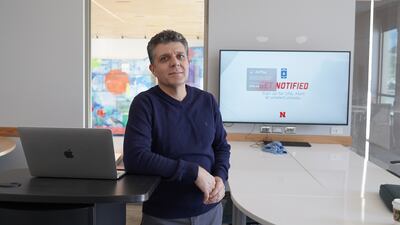
Hadi Pir stands at a lectern at the University of Nebraska, where he is pursuing a doctorate in education. All photos: Willy Lowry / The National -
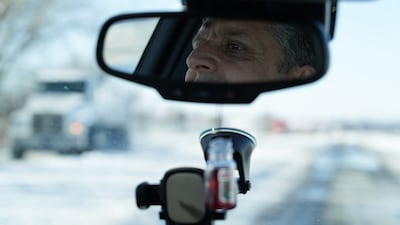
Hadi navigates the wintry roads near his home in Lincoln, Nebraska -
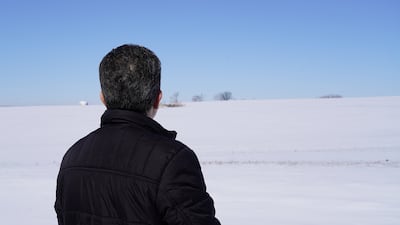
A snow-covered cornfield in Lincoln -

A khalat, which contains earth from a sacred Yazidi shrine in Lalish, Iraq, is one of the only mementos from home that hangs in Hadi's house -
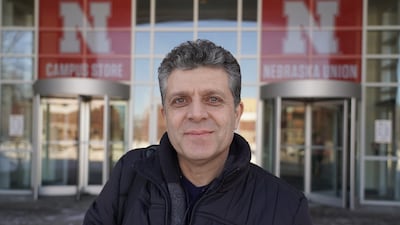
On the campus of the University of Nebraska -
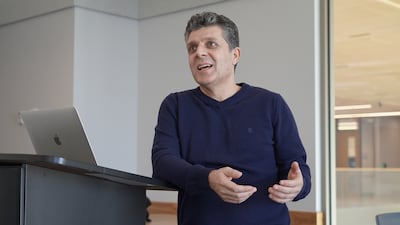
Hadi speaking in a classroom at the University of Nebraska -
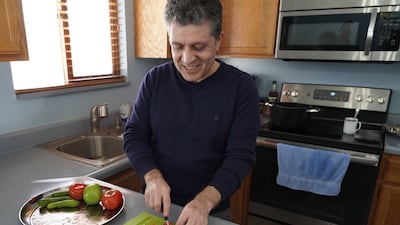
Hadi chops vegetables in his kitchen as he and his wife prepare a traditional Iraqi lunch -
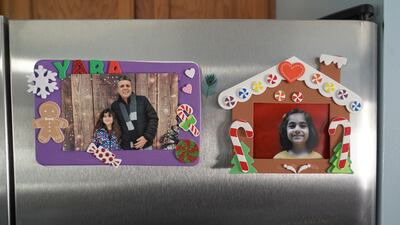
Photos of Hadi and his daughter Yara hang on the fridge -

Hadi's wife, Adula, and daughter, Ayana, pose for selfie -

Hadi and Adula prepare lunch -
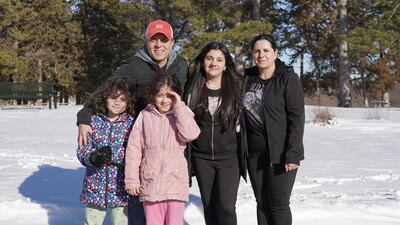
Hadi poses for a picture with his wife, Adula, two daughters, Ayana and Yara, and his niece -
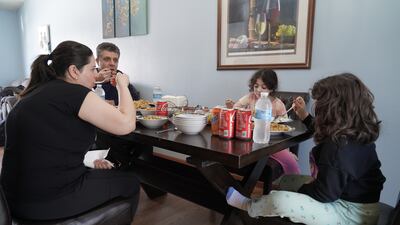
Hadi and his wife eat lunch with their youngest daughter and their niece -
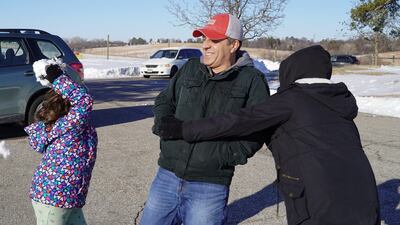
Hadi's daughters Yara, left, and Ayana throw snowballs at him -
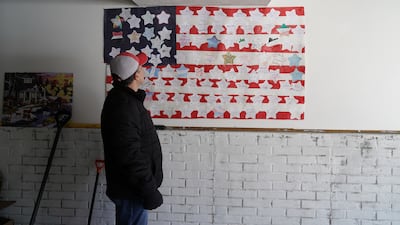
Hadi looks at a card given to him by his students on the day he received his US citizenship -
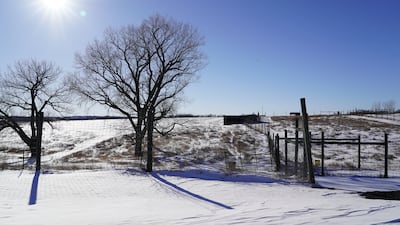
Pioneer Park in Lincoln, a sprawling piece of land where Hadi goes to think -
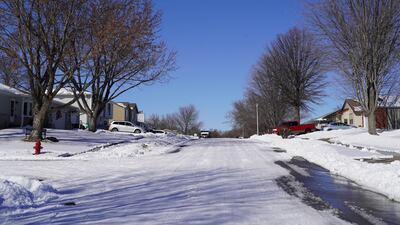
Hadi's treelined street in Lincoln


While he is now a proud American citizen, his mind is never far from Iraq and the Yazidi community.
In 2014, he was instrumental in lobbying the US military to launch air strikes against ISIS near Mount Sinjar, as the terrorist organisation was committing harrowing acts against stranded community members.
Following the Yazidi genocide, Mr Pir, along with several other community members founded Yazda, an international organisation that seeks to protect religious and ethnic minorities in the Middle East.
The organisation’s headquarters, which is in a small strip mall on the outskirts of Lincoln, has become a gathering point for the city’s growing Yazidi community.
With deep roots now in Nebraska and children whose Midwestern accents belie their Middle Eastern origins, Mr Pir is content.
But every now and then, the images from nearly a decade of war come swarming back. He’s tried therapy but prefers to write away his emotions.
He is currently on the last chapter of a novel inspired by what he lived through.
Mr Libby, who wrote a letter on behalf of Mr Pir during his visa application process, is thrilled to see the life that his old friend has built.
“He'd be great wherever he was but it's a good thing he’s in the US,” said Mr Libby.
Mr Pir feels the same way, even as a cold wind kicks up and his daughters’ angelic laughter quickly turns mischievous.
Snow in their hands, they quickly descend on Mr Pir and suddenly he’s swatting snow out of his greying hair, laughing to himself over how this wintry wonderland is now home.

