



As Mike Lutmer examines ears of soon-to-be-harvested corn on his farm in south-west Ohio, his face turns increasingly grim.
“They are very light. They should be much wider and longer,” says Mr Lutmer, who, along with his brother, farms about 1,500 acres of soybeans, corn and hay in the rolling hills of picturesque Warren County.
The kernels on one ear of corn he holds are anything but the uniform size and shape he normally expects to see.
“It was just too dry.”
Large parts of Ohio, an important crop-producing state, have seen little substantial rainfall since July, with parts of the state experiencing “moderate drought conditions”, according to the National Integrated Drought Information System.
With food and animal feed grown by Mr Lutmer and others like him ultimately destined for export to places such as Saudi Arabia and other Gulf nations, the drought currently hitting America's breadbasket could have global consequences.
Heavy rains in late spring this year, followed by an extended dry period that stretched through the summer to early winter, have put pay to any hopes of high harvest yields for Mr Lutmer.
“We like to have a minimum of 150 to 200 bushels of corn per acre,” he says. “If we average a little over 100 this year, we’ll probably be lucky.”
And the situation in Ohio is just the tip of the iceberg.
Politico quoted analysts as saying 80 per cent of the contiguous US is currently either in a drought or facing “unusually dry conditions”.
This is the most widespread dry spell since the National Oceanic and Atmospheric Administration began tracking drought 20 years ago.
The western US, reports suggest, is now the driest it’s been for 1,200 years.
And that has had a significant knock-on effect on food yields, not only in the US, but in the Middle East and other regions as well.
On average, the US grows about 90 million acres of corn – an area larger than Germany – every year. The USDA reports that corn yields this year in Texas, Oklahoma and Kentucky are down 27, 19 and 20 per cent, respectively, compared to 2021.
But Kansas, which borders Oklahoma, is perhaps the state worst affected by drought this year.
Record-breaking dry conditions have parched the central US state where one quarter of all US winter wheat - a crop used for producing bread and other essential foodstuffs, and which is particular important in developing countries - is harvested.
Drought in Kenya affects wildlife - in pictures
-
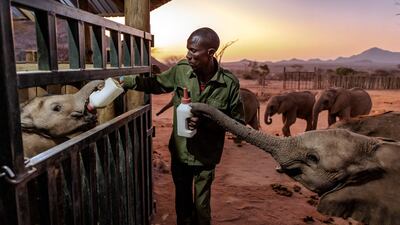
An elephant calf is given enriched bottle milk at the sanctuary. AFP -
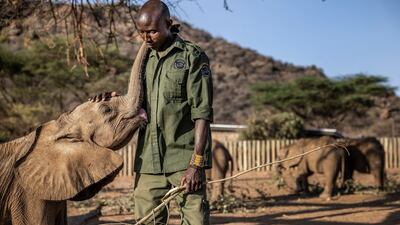
An elephant keeper with a calf at Reteti Elephant Sanctuary in Namunyak Wildlife Conservancy, Samburu, Kenya. The sanctuary has been overwhelmed with rescue operations and the influx of orphaned and abandoned calves because of the drought in the conservancy. AFP -

A gamekeeper with an orphaned generuk calf at Reteti Elephant Sanctuary in Samburu, Kenya. East Africa’s worst drought in 40 years is starving Kenya’s wildlife of its usual food and water sources while increasing human-wildlife conflict. AFP -
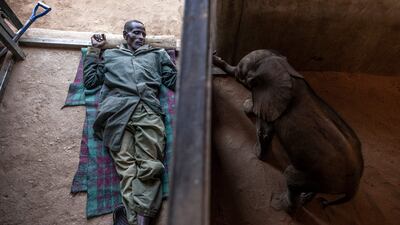
Elephant keeper Kiapi Lakupanai rests next to orphaned calf Naesemare in the quarantine area at Reteti Elephant Sanctuary. AFP -
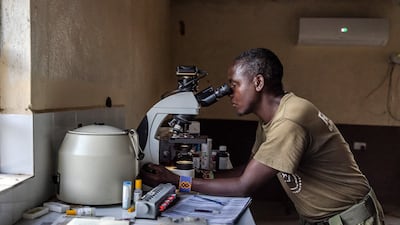
A veterinary worker analyses samples from elephant calves in Samburu, Kenya. AFP -

Naesemare, who is a month old, was recently rescued after her herd abandoned her when she became stuck in a dry well. AFP -
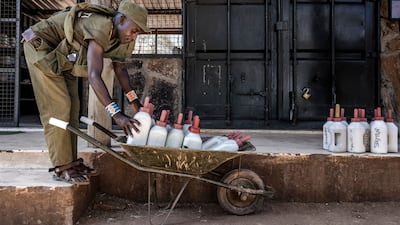
A keeper prepares feeding bottles containing enriched milk to feed elephant calves at the sanctuary. AFP -

The carcass of an adult elephant that died during the drought in Namunyak Wildlife Conservancy. AFP -

Elephant keeper Kiapi Lakupanai and resident veterinarian Isaiah Alolo check on a calf at the sanctuary in Namunyak Wildlife Conservancy. AFP -

An elephant calf at Reteti Elephant Sanctuary, Samburu, Kenya, where severe drought has not only put millions of people on the brink of starvation, but is also threatening the rich biodiversity in the region. AFP -

A gamekeeper with a rescued generuk calf at the Reteti Elephant Sanctuary, in Samburu, Kenya. EPA -
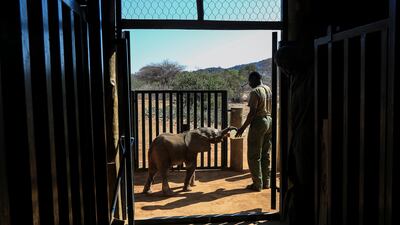
Naesemare plays with a keeper at the sanctuary. EPA -
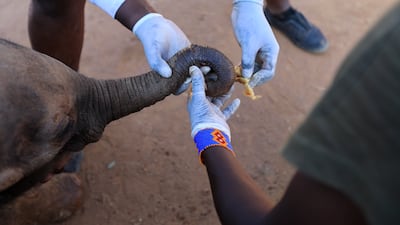
Carers treat a wound on Naesemare's trunk. EPA -
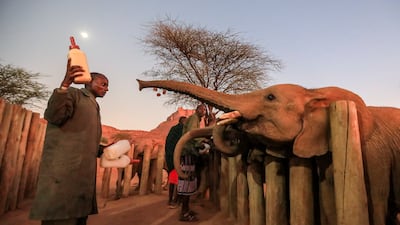
Keepers feed rescued elephant calves at Reteti Elephant Sanctuary. EPA -
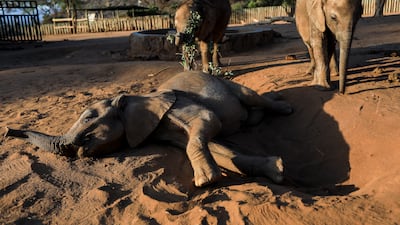
Rescued elephant calves play in the sand at the sanctuary. EPA -
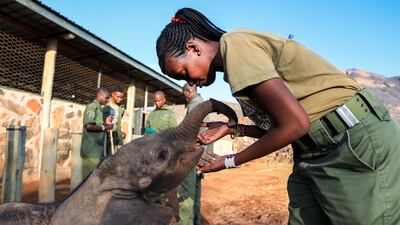
Orphaned calf Naesemare plays with a keeper at the Reteti Elephant Sanctuary. EPA -
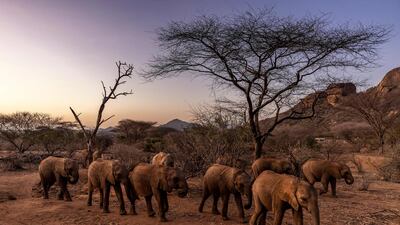
Elephant calves walk after a feeding routine early in the morning at Reteti Elephant Sanctuary. AFP


Half of Kansas’s wheat supplies are exported.
Kansas neighbour Nebraska ranks third and fourth in corn and soybean production, respectively – the two biggest agricultural food exports to Saudi Arabia, which buys more than $1 billion in US agricultural products every year. Half the state is facing either “severe” or “extreme” drought conditions.
Last year, nearly $200 million worth of Nebraska soybeans – used to feed animals and make cooking oils – were exported to Egypt, the Midwestern state’s third-biggest importer of the crop behind China and Mexico.
About $24 million worth of Nebraska corn was exported to Saudi Arabia, and $16 million exported to Egypt and Morocco, respectively.
It’s not just grain and bean markets that have been affected.
Saudi Arabia and other Gulf states are home to huge dairy operations that supply milk and other dairy products to countries across the Middle East and North Africa. Many of those farms rely on large volumes of hay and other animal feed from the US.
In 2019, Saudi Arabia and the UAE imported more than 750,000 metric tonnes of American alfalfa and hay. Combined, that accounted for about 20 per cent of all US exports of those products.
This year, from the months of January to August, that figure had fallen to 5 per cent, according to the Gombos Company, a California-based forage exporter.
“GCC countries face a shortage of hay and forage not only this year, but also into the future,” says Shohei Takimoto, analyst at the Japanese company Mitsui, a major trader of international grain.
A river runs dry: drought on the Colorado - video
This year, demand for forage in the US has ramped up due to poor yields fuelled by a brutal drought in Texas, the country’s largest hay producer, last summer.
And reports suggest dry conditions in the Midwest are set to continue for the coming months, in large part due to the La Nina climate event, with the 2022-23 crop of wheat estimated to be among the lowest in the past 20 years.
This could lead to shortages in countries such as Yemen, the tenth-largest importer of US wheat and a country in the midst of a civil war.
“We are seeing some of the worst drought conditions,” says Dennis Todey of the Midwest Climate Hub, an agency of the US Department of Agriculture.
Mr Todey compared the current situation to the 1930s Dust Bowl phenomenon, when severe dust storms greatly damaged agriculture in the American prairies, destroying the lives and livelihoods of millions.
“If you look at the 1930s drought, we are probably similar to a couple of those years, though we are not to the length of those droughts.”
He says that what has made this year particularly bad for crop farming is that most of the Plains and the Midwest regions have faced some degree of drought throughout most of this year.
Revealed by drought - in pictures
-
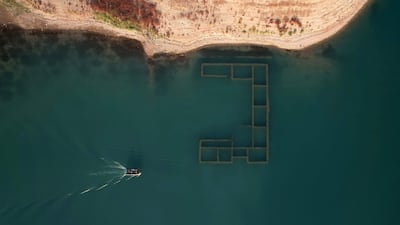
The remains of the submerged Gary Qasruka village abandoned 36 years ago, which have resurfaced after falling water levels at the Dohuk Dam due to drought, in the autonomous Kurdish region of Iraq. AFP -
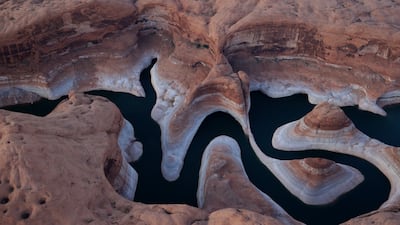
The tall bleached 'bathtub ring' is visible on the rocky banks of Lake Powell at Reflection Canyon in Utah, as severe drought grips parts of the western US. Getty Images -
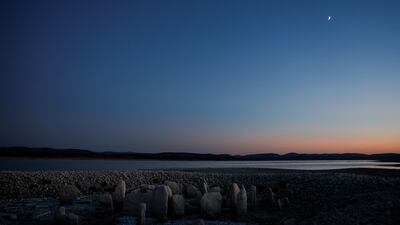
The dolmen of Guadalperal, also known as the Spanish Stonehenge, is seen due to the receding water of the Valdecanas reservoir near El Gordo, Spain. Reuters -

A shopping cart rusts on a sandbank in the Rhine, exposed by the low tide in Bonn, Germany. Reuters -
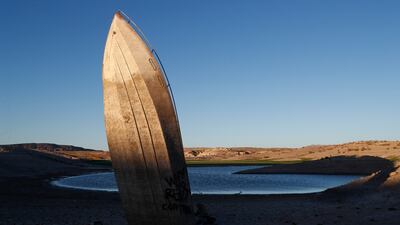
A formerly sunken boat sits upright along the shoreline at the Lake Mead National Recreation Area in Boulder City, Nevada. EPA -

The Kloental lake's low water level in Glarus, Switzerland. EPA -
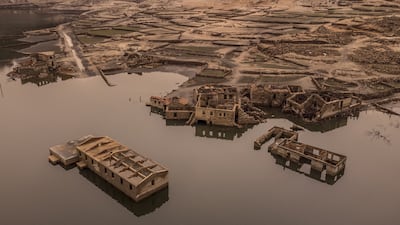
Houses of the former village of Aceredo, in Galicia, Spain. The village was buried under water due to the construction of a reservoir in 1992, yet in 2021 the village resurfaced due to a drought. EPA -

The wreck of a ship that sank during the Second World War is revealed by the unusually low water level of the River Danube near Vamosszabadi, in north-western Hungary. EPA -
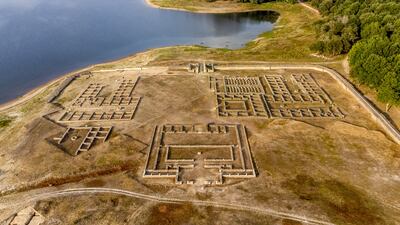
A view of the Roman camp Aquis Querquennis, located on the banks of the Limia river in the As Conchas reservoir, in Ourense, Spain. The camp is usually underwater but can now be seen due to the low level of the reservoir. EPA -
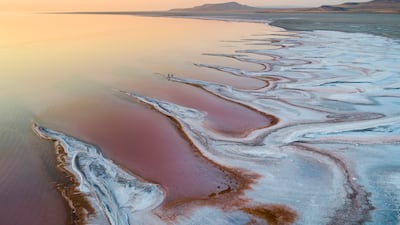
Visitors on the salt flats watching the sunset over the Great Salt Lake, Utah. The lake has lost 50 per cent of its volume since the arrival of Mormon pioneers in 1847. EPA -

A buoy sits high and dry on cracked earth previously under the waters of Lake Mead at the Lake Mead National Recreation Area near Boulder City, Nevada. AP Photo -
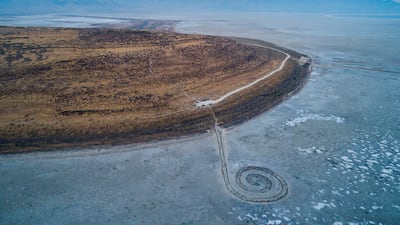
Robert Smithson's earthwork 'Spiral Jetty' on the shore of Great Salt Lake, Utah. Constructed in 1970, the work remained submerged until 2002, when a mega-drought began to afflict the region. EPA -
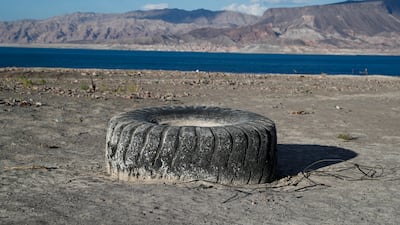
A tire sits on dried land that was once under water at the Lake Mead National Recreation Area in Boulder City, Nevada. EPA -

The Virgen de los Dolores (Our lady of Sorrows) Temple in Guanajuato state, Mexico. The temple, built in 1898, was flooded 40 years ago to build a dam. Heavy drought in the region has exposed its structure again. EPA


Back in Ohio, Mike Lutmer says he has felt those effects. He typically harvests about 500 acres of high-quality hay each year, much of which is bought by local famers right out of the field.
This year has been a little different.
“We’ve actually shipped hundreds of tonnes of hay out to Texas and Oklahoma,” he says. “I’ve got some friends out there - it’s really bad right now.”
Although corn and soybean yields in many traditionally high-producing states are way down this year, that has partly been offset by higher yield returns in other states.
And while the drought’s effects on many agricultural regions continues to be a concern, experts say that, in the short term, China’s grappling with its Covid-19 response is currently of greater concern to international markets than any fallout from the US drought.
Still, the ongoing lack of rain in the US heartland, combined with drought in Argentina – the second-largest wheat producer in the southern hemisphere – and the war in Ukraine, another major global grain producer, means that the outlook for next year is far from ideal.
“Now the issue becomes how much rainfall do we get ahead of production next year,” says Todey.
“We have some very dry soils and winter wheat conditions are very poor going into the winter.”

