When winter tidings are grim in British politics, a prime minister will eye the countdown to Christmas as eagerly as a child anticipates a chocolate advent calendar.
When the holiday arrives in Downing Street next week, Rishi Sunak will take solace in the traditional fortnight of political silence that will descend.
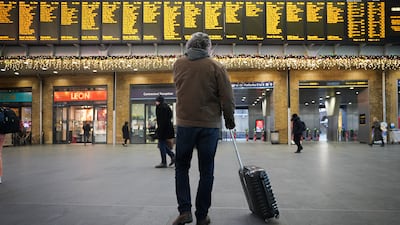
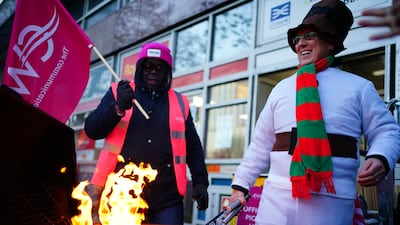
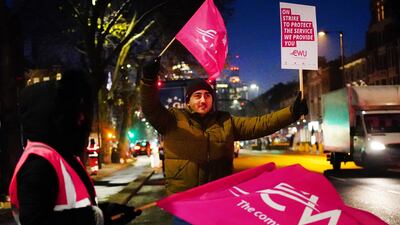
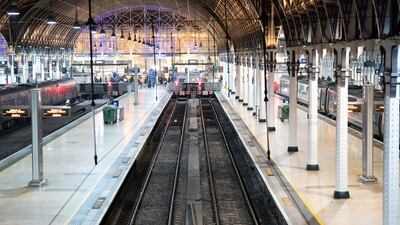
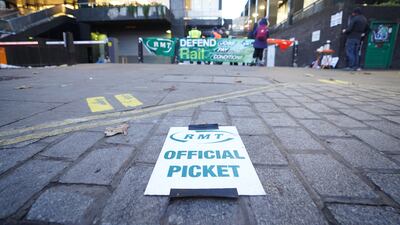
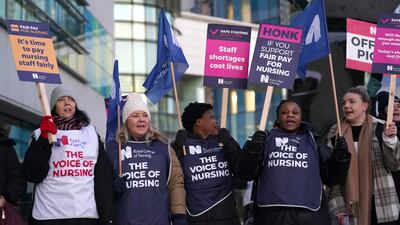
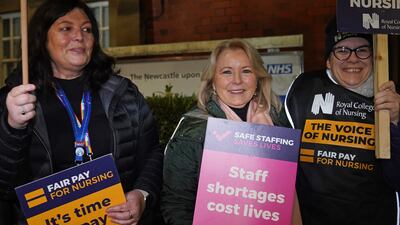
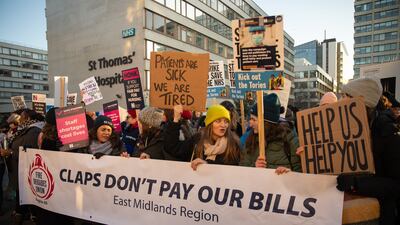
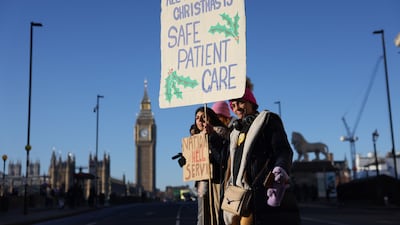
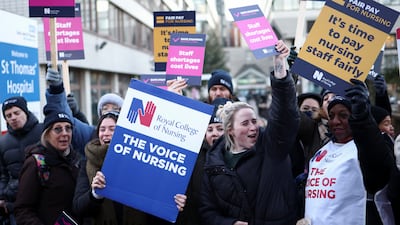
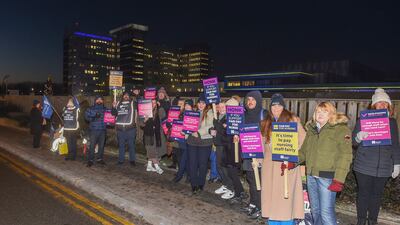
But ringing in his ears will be the cries from the picket lines from nurses, postal workers, train drivers and immigration staff demanding more pay, with Britain on the precipice of a general strike.
Mr Sunak will take some heart that he has survived longer than the 50 days of his predecessor Liz Truss, but the new year will raise questions over the wave of strike action that could jeopardise his own political survival.
Tottering economy
Resolving the financial mess inherited from Ms Truss’s curtailed leadership was a challenge Mr Sunak competently surmounted in last month’s autumn statement.
But the strict financial parameters that steadied Britain’s tottering economy are being challenged by the unions, presenting Mr Sunak with his first real leadership test.
Affable, gracious and witty, the first British-Asian leader appears a gentle soul. We will soon find out if he possesses the inner steel to resist the demands of Britain’s nurses, held several planes higher in public esteem than the political class.
That has been enhanced by the National Health Service’s achievements during the Covid-19 pandemic and a public awareness that nurses are poorly paid relative to their workload and the emotional stresses that come with it.
Mr Sunak, 42, has yet to demonstrate that he has a plan, but government insiders believe the demand for a 19 per cent pay rise might soon appear unreasonable.
“The problem is that nurses are seen as angels and instantly get sympathy from the public, but they have to moderate their demands,” a Conservative source said. “It's very hard not to feel sympathy for them, but any pay settlement has got to be affordable and reasonable.”
Mr Sunak’s political skills will need to be sharp if the strike endures and patients suffer while hospital waiting lists get longer.
For now, political insiders say, his position is to observe, keeping a lofty prime-ministerial distance between the picket line and the seat of British power.
Inflation peril
With autumn’s financial overhaul addressing the £50 billion ($60.9 billion) shortfall in finances somewhat, there is very little room to concede.
There is also a question of playing patience to see if the economy can produce some positives and inflation is already inching away from its double-digit high.
Downing Street believes that could lead to more realistic wage demands. Mr Sunak, a former chancellor, knows that if he concedes on pay, that could unleash other demands, further fuelling inflation and crippling the economy.
Political decisions have again become a high-wire act, said Dr Alan Mendoza, of the centre-right Henry Jackson think tank.
“This is a very tough situation, given that the Prime Minister is trying to maintain financial stability, while fully aware that giving in to the demands of the strikers will place a burden not simply on the economy but on individual families struggling to deal with the cost-of-living rises,” he said.
“The reality is that everyone recognises there must be a deal because everyone will need a pay rise. But it's at what level can we do this and surely it’s in everyone's interests that we get inflation under control as quickly as possible?”
The graft to prevent rising inflation underpins all Mr Sunak’s economic management and any hope that he might have of winning the next general election.
Indeed, that may well reinforce his resilience in refusing to yield to the strikers’ demands. If he loses against inflation, he loses office.
“The reality is that we need to hold firm and say, ‘we're all in this together’,” said another Conservative insider. “The nurses' 19 per cent demand is well off where the public is on this. Rishi is right to hold his ground, there is room for a sensible deal but we can't sacrifice inflation for what trade unions feel their members deserve.”
Clever policy?
Other Tories believe a clever policy of conceding to one side and remaining robust to the other will break the strikers’ collective unity.
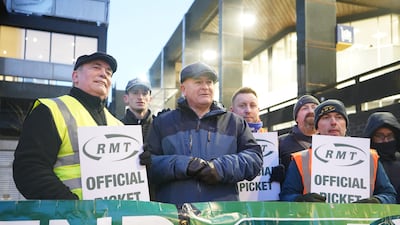
The rail unions have been picketing for years, in part over pay but also against having trains without guards. Public sympathy is low, especially when action involves Christmas disruption.
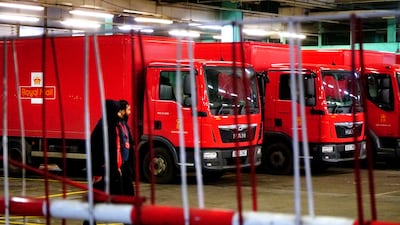
Once a citadel of the British high street, the Post Office is being subsumed by the technological age and the galaxy of delivery drivers.
UK strikes – in pictures
Border Force staff are trickier, especially at a time of high immigration, yet they are an essential government service, therefore soldiers are being trained to do their job — for much less pay, it is pointed out.
Similarly, the army is stepping in to drive ambulances and, sadly, the population has become used to having to wait for hours for assistance.
Which leaves the nurses and their pay request, which would cost the Treasury an estimated further £10 billion ($12.19 billion).
However, there is an argument that generously increasing their pay may induce a virtuous circle, retaining and attracting staff that will help bring down the list of those awaiting operations.
Holding nerve
The public sector wage bill already accounts for almost a quarter of government expenditure and every 1 per cent increase in public sector pay would increase state spending by £2 billion.
The hope would appear to be that after months of protest action from nurses and others, momentum, as well as earnings, are lost from the mounting number of strike days.
The coming weeks will “be a test of his nerve and to a certain extent a test of the prime minister’s authority”, said former minister David Jones.
“At the moment he is playing it correctly,” the MP for Clwyd West said. “For the nurses there will be negotiations, but it's a question of seeing how that develops as it is still early days. There can be a resolution but while inflation is dropping, we don’t want it stoked up again with high pay settlements that ultimately will devalue any settlement that they get.”
Shut for Christmas
For now, Mr Sunak is relying on an independent pay review body’s offer that recommends an annual £1,400 pay increase for nurses. He will also look to Scotland where nurses have accepted a pay settlement of 7.5 per cent and cancelled strikes.
The Conservative leader knows that for now he has to keep his nerve and in a few days he can shut up shop for two weeks and see what appetite there is for public sector strikes next year.
Nurses strike in the UK - in pictures
In his most recent interview the Prime Minister insisted union bosses should not be fooled by his gentle demeanour.
“I am not afraid to be tough to achieve what I think is right for the country, people shouldn’t mistake the politeness for that,” he told The Spectator magazine. This apparent robustness was enhanced with the threat of “tough new strike laws”.
The problem is that after the pandemic, energy crisis and financial instability, the public sector is in a fragile state. If it crumbles, a general election could well follow and Mr Sunak’s tenure in No 10 may prove almost as fleeting as his predecessor’s.

UAE%20athletes%20heading%20to%20Paris%202024
%3Cp%3E%3Cstrong%3EEquestrian%3C%2Fstrong%3E%3Cbr%3EAbdullah%20Humaid%20Al%20Muhairi%2C%20Abdullah%20Al%20Marri%2C%20Omar%20Al%20Marzooqi%2C%20Salem%20Al%20Suwaidi%2C%20and%20Ali%20Al%20Karbi%20(four%20to%20be%20selected).%3Cbr%3E%3Cstrong%3EJudo%3C%2Fstrong%3E%3Cbr%3EMen%3A%20Narmandakh%20Bayanmunkh%20(66kg)%2C%20Nugzari%20Tatalashvili%20(81kg)%2C%20Aram%20Grigorian%20(90kg)%2C%20Dzhafar%20Kostoev%20(100kg)%2C%20Magomedomar%20Magomedomarov%20(%2B100kg)%3B%20women's%20Khorloodoi%20Bishrelt%20(52kg).%3Cbr%3E%3Cbr%3E%3Cstrong%3ECycling%3C%2Fstrong%3E%3Cbr%3ESafia%20Al%20Sayegh%20(women's%20road%20race).%3Cbr%3E%3Cbr%3E%3Cstrong%3ESwimming%3C%2Fstrong%3E%3Cbr%3EMen%3A%20Yousef%20Rashid%20Al%20Matroushi%20(100m%20freestyle)%3B%20women%3A%20Maha%20Abdullah%20Al%20Shehi%20(200m%20freestyle).%3Cbr%3E%3Cbr%3E%3Cstrong%3EAthletics%3C%2Fstrong%3E%3Cbr%3EMaryam%20Mohammed%20Al%20Farsi%20(women's%20100%20metres).%3C%2Fp%3E%0A
Getting%20there%20and%20where%20to%20stay
%3Cp%3EFly%20with%20Etihad%20Airways%20from%20Abu%20Dhabi%20to%20New%20York%E2%80%99s%20JFK.%20There's%2011%20flights%20a%20week%20and%20economy%20fares%20start%20at%20around%20Dh5%2C000.%3Cbr%3EStay%20at%20The%20Mark%20Hotel%20on%20the%20city%E2%80%99s%20Upper%20East%20Side.%20Overnight%20stays%20start%20from%20%241395%20per%20night.%3Cbr%3EVisit%20NYC%20Go%2C%20the%20official%20destination%20resource%20for%20New%20York%20City%20for%20all%20the%20latest%20events%2C%20activites%20and%20openings.%3Cbr%3E%3C%2Fp%3E%0A
Killing of Qassem Suleimani
Match info
Manchester City 3 (Jesus 22', 50', Sterling 69')
Everton 1 (Calvert-Lewin 65')
The biog
Favourite book: Men are from Mars Women are from Venus
Favourite travel destination: Ooty, a hill station in South India
Hobbies: Cooking. Biryani, pepper crab are her signature dishes
Favourite place in UAE: Marjan Island
Mina Cup winners
Under 12 – Minerva Academy
Under 14 – Unam Pumas
Under 16 – Fursan Hispania
Under 18 – Madenat
Ten tax points to be aware of in 2026
1. Domestic VAT refund amendments: request your refund within five years
If a business does not apply for the refund on time, they lose their credit.
2. E-invoicing in the UAE
Businesses should continue preparing for the implementation of e-invoicing in the UAE, with 2026 a preparation and transition period ahead of phased mandatory adoption.
3. More tax audits
Tax authorities are increasingly using data already available across multiple filings to identify audit risks.
4. More beneficial VAT and excise tax penalty regime
Tax disputes are expected to become more frequent and more structured, with clearer administrative objection and appeal processes. The UAE has adopted a new penalty regime for VAT and excise disputes, which now mirrors the penalty regime for corporate tax.
5. Greater emphasis on statutory audit
There is a greater need for the accuracy of financial statements. The International Financial Reporting Standards standards need to be strictly adhered to and, as a result, the quality of the audits will need to increase.
6. Further transfer pricing enforcement
Transfer pricing enforcement, which refers to the practice of establishing prices for internal transactions between related entities, is expected to broaden in scope. The UAE will shortly open the possibility to negotiate advance pricing agreements, or essentially rulings for transfer pricing purposes.
7. Limited time periods for audits
Recent amendments also introduce a default five-year limitation period for tax audits and assessments, subject to specific statutory exceptions. While the standard audit and assessment period is five years, this may be extended to up to 15 years in cases involving fraud or tax evasion.
8. Pillar 2 implementation
Many multinational groups will begin to feel the practical effect of the Domestic Minimum Top-Up Tax (DMTT), the UAE's implementation of the OECD’s global minimum tax under Pillar 2. While the rules apply for financial years starting on or after January 1, 2025, it is 2026 that marks the transition to an operational phase.
9. Reduced compliance obligations for imported goods and services
Businesses that apply the reverse-charge mechanism for VAT purposes in the UAE may benefit from reduced compliance obligations.
10. Substance and CbC reporting focus
Tax authorities are expected to continue strengthening the enforcement of economic substance and Country-by-Country (CbC) reporting frameworks. In the UAE, these regimes are increasingly being used as risk-assessment tools, providing tax authorities with a comprehensive view of multinational groups’ global footprints and enabling them to assess whether profits are aligned with real economic activity.
Contributed by Thomas Vanhee and Hend Rashwan, Aurifer
How England have scored their set-piece goals in Russia
Three Penalties
v Panama, Group Stage (Harry Kane)
v Panama, Group Stage (Kane)
v Colombia, Last 16 (Kane)
Four Corners
v Tunisia, Group Stage (Kane, via John Stones header, from Ashley Young corner)
v Tunisia, Group Stage (Kane, via Harry Maguire header, from Kieran Trippier corner)
v Panama, Group Stage (Stones, header, from Trippier corner)
v Sweden, Quarter-Final (Maguire, header, from Young corner)
One Free-Kick
v Panama, Group Stage (Stones, via Jordan Henderson, Kane header, and Raheem Sterling, from Tripper free-kick)
UPI facts
More than 2.2 million Indian tourists arrived in UAE in 2023
More than 3.5 million Indians reside in UAE
Indian tourists can make purchases in UAE using rupee accounts in India through QR-code-based UPI real-time payment systems
Indian residents in UAE can use their non-resident NRO and NRE accounts held in Indian banks linked to a UAE mobile number for UPI transactions
FIXTURES
All times UAE ( 4 GMT)
Friday
Saint-Etienne v Montpellier (10.45pm)
Saturday
Monaco v Caen (7pm)
Amiens v Bordeaux (10pm)
Angers v Toulouse (10pm)
Metz v Dijon (10pm)
Nantes v Guingamp (10pm)
Rennes v Lille (10pm)
Sunday
Nice v Strasbourg (5pm)
Troyes v Lyon (7pm)
Marseille v Paris Saint-Germain (11pm)
The language of diplomacy in 1853
Treaty of Peace in Perpetuity Agreed Upon by the Chiefs of the Arabian Coast on Behalf of Themselves, Their Heirs and Successors Under the Mediation of the Resident of the Persian Gulf, 1853
(This treaty gave the region the name “Trucial States”.)
We, whose seals are hereunto affixed, Sheikh Sultan bin Suggar, Chief of Rassool-Kheimah, Sheikh Saeed bin Tahnoon, Chief of Aboo Dhebbee, Sheikh Saeed bin Buyte, Chief of Debay, Sheikh Hamid bin Rashed, Chief of Ejman, Sheikh Abdoola bin Rashed, Chief of Umm-ool-Keiweyn, having experienced for a series of years the benefits and advantages resulting from a maritime truce contracted amongst ourselves under the mediation of the Resident in the Persian Gulf and renewed from time to time up to the present period, and being fully impressed, therefore, with a sense of evil consequence formerly arising, from the prosecution of our feuds at sea, whereby our subjects and dependants were prevented from carrying on the pearl fishery in security, and were exposed to interruption and molestation when passing on their lawful occasions, accordingly, we, as aforesaid have determined, for ourselves, our heirs and successors, to conclude together a lasting and inviolable peace from this time forth in perpetuity.
Taken from Britain and Saudi Arabia, 1925-1939: the Imperial Oasis, by Clive Leatherdale
Try out the test yourself
Q1 Suppose you had $100 in a savings account and the interest rate was 2 per cent per year. After five years, how much do you think you would have in the account if you left the money to grow?
a) More than $102
b) Exactly $102
c) Less than $102
d) Do not know
e) Refuse to answer
Q2 Imagine that the interest rate on your savings account was 1 per cent per year and inflation was 2 per cent per year. After one year, how much would you be able to buy with the money in this account?
a) More than today
b) Exactly the same as today
c) Less than today
d) Do not know
e) Refuse to answer
Q4 Do you think that the following statement is true or false? “Buying a single company stock usually provides a safer return than a stock mutual fund.”
a) True
b) False
d) Do not know
e) Refuse to answer
The “Big Three” financial literacy questions were created by Professors Annamaria Lusardi of the George Washington School of Business and Olivia Mitchell, of the Wharton School of the University of Pennsylvania.
Answers: Q1 More than $102 (compound interest). Q2 Less than today (inflation). Q3 False (diversification).
Mercer, the investment consulting arm of US services company Marsh & McLennan, expects its wealth division to at least double its assets under management (AUM) in the Middle East as wealth in the region continues to grow despite economic headwinds, a company official said.
Mercer Wealth, which globally has $160 billion in AUM, plans to boost its AUM in the region to $2-$3bn in the next 2-3 years from the present $1bn, said Yasir AbuShaban, a Dubai-based principal with Mercer Wealth.
“Within the next two to three years, we are looking at reaching $2 to $3 billion as a conservative estimate and we do see an opportunity to do so,” said Mr AbuShaban.
Mercer does not directly make investments, but allocates clients’ money they have discretion to, to professional asset managers. They also provide advice to clients.
“We have buying power. We can negotiate on their (client’s) behalf with asset managers to provide them lower fees than they otherwise would have to get on their own,” he added.
Mercer Wealth’s clients include sovereign wealth funds, family offices, and insurance companies among others.
From its office in Dubai, Mercer also looks after Africa, India and Turkey, where they also see opportunity for growth.
Wealth creation in Middle East and Africa (MEA) grew 8.5 per cent to $8.1 trillion last year from $7.5tn in 2015, higher than last year’s global average of 6 per cent and the second-highest growth in a region after Asia-Pacific which grew 9.9 per cent, according to consultancy Boston Consulting Group (BCG). In the region, where wealth grew just 1.9 per cent in 2015 compared with 2014, a pickup in oil prices has helped in wealth generation.
BCG is forecasting MEA wealth will rise to $12tn by 2021, growing at an annual average of 8 per cent.
Drivers of wealth generation in the region will be split evenly between new wealth creation and growth of performance of existing assets, according to BCG.
Another general trend in the region is clients’ looking for a comprehensive approach to investing, according to Mr AbuShaban.
“Institutional investors or some of the families are seeing a slowdown in the available capital they have to invest and in that sense they are looking at optimizing the way they manage their portfolios and making sure they are not investing haphazardly and different parts of their investment are working together,” said Mr AbuShaban.
Some clients also have a higher appetite for risk, given the low interest-rate environment that does not provide enough yield for some institutional investors. These clients are keen to invest in illiquid assets, such as private equity and infrastructure.
“What we have seen is a desire for higher returns in what has been a low-return environment specifically in various fixed income or bonds,” he said.
“In this environment, we have seen a de facto increase in the risk that clients are taking in things like illiquid investments, private equity investments, infrastructure and private debt, those kind of investments were higher illiquidity results in incrementally higher returns.”
The Abu Dhabi Investment Authority, one of the largest sovereign wealth funds, said in its 2016 report that has gradually increased its exposure in direct private equity and private credit transactions, mainly in Asian markets and especially in China and India. The authority’s private equity department focused on structured equities owing to “their defensive characteristics.”