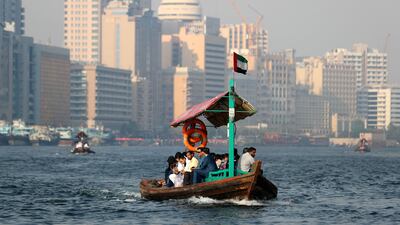
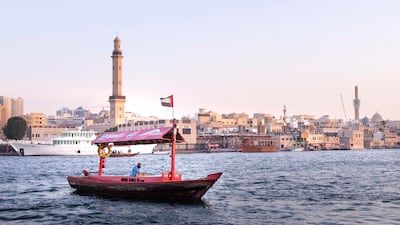
• Abras transport people and materials between the two shores of Dubai Creek. All photos: Antonie Robertson / The National
    Abras transport people and materials between the two shores of Dubai Creek. All photos: Antonie Robertson / The National
  • The little boats, run by the RTA, ferry everything, from tourists and traders to goods between the two shores of the waterway
    The little boats, run by the RTA, ferry everything, from tourists and traders to goods between the two shores of the waterway
  • The cost of a ticket is Dh1 per person, per trip
    The cost of a ticket is Dh1 per person, per trip
  • The ride across the creek takes about five minutes
    The ride across the creek takes about five minutes
  • Tourists can book a private abra for Dh60 to do a half-hour tour along Dubai's main waterway
    Tourists can book a private abra for Dh60 to do a half-hour tour along Dubai's main waterway
  • It can be booked for an hour for Dh120
    It can be booked for an hour for Dh120
  • Each abra has capacity for about 20 people
    Each abra has capacity for about 20 people
  • The new generation of wooden abras are made from African teak
    The new generation of wooden abras are made from African teak
  • The word abra comes from the Arabic verb abara, which means 'to cross'
    The word abra comes from the Arabic verb abara, which means 'to cross'
  • About 150 boats work the routes between Deira and Bur Dubai
    About 150 boats work the routes between Deira and Bur Dubai
  • Abra services start from 6am every day
    Abra services start from 6am every day
  • There are four stations along the creek – the first route is from Deira Old Souq to Bur Dubai and the second, which is the busiest, is from Al Sabkha to Dubai Old Souq
    There are four stations along the creek – the first route is from Deira Old Souq to Bur Dubai and the second, which is the busiest, is from Al Sabkha to Dubai Old Souq
  • The abras provide a unique, traditional and affordable way to cross Dubai's busy water thoroughfare
    The abras provide a unique, traditional and affordable way to cross Dubai's busy water thoroughfare
  • Tourists enjoy using the abras for alternative views of the city
    Tourists enjoy using the abras for alternative views of the city
  • The new abras are part of a plan developed by the Roads and Transport Authority to overhaul Dubai's marine transport systems
    The new abras are part of a plan developed by the Roads and Transport Authority to overhaul Dubai's marine transport systems

Abras on Dubai Creek hark back to a simpler past


Katy Gillett
  • English
  • Arabic

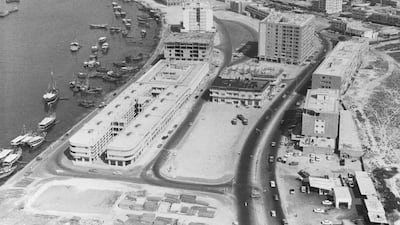
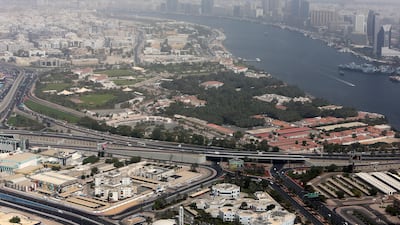
For decades the main artery of Dubai was the Creek, where early inhabitants first settled and where the city's first port and pearling industry thrived.

While the emirate has expanded far beyond Old Dubai's borders since then, the waterway has remained, offering a slice of the city's history to fishermen and visitors alike.

In particular, the traditional ferry-like boats known as abras plough relentlessly across Dubai Creek to this day.

One of Dubai's oldest forms of public transport, the abra, or water taxi, is still in use today. Antonie Robertson / The National

The word abra comes from the Arabic verb abara, which means "to cross", and that's exactly what these little water taxis do — take people from one side of the creek to the other every few minutes at a nominal cost (Dh1 per person, per trip).

Each abra has capacity for about 20 people and 150 boats work the routes between Deira and Bur Dubai from 6am every day. There are four stations along the creek, with the first route going from Deira Old Souq to Bur Dubai and a second, which is the busiest, going from Al Sabkha to Dubai Old Souq.

There are four abra stations along Dubai Creek. Antonie Robertson / The National

It's a unique way to get from A to B while trying to cross the emirate, without navigating the busy roads of Old Dubai, but it's also a wonderful experience for visitors, providing an alternative picture of a city that's today best known for its futuristic outlook.

The time-honoured design of these popular boats has changed little over the years, although they were overhauled to improve safety and accessibility in 2020.

Now run by the RTA, these abras are hand made from wood and powered by diesel engines. Antonie Robertson / The National

Some of the changes included adding designated spaces for wheelchairs, placing life jackets under the seats and the use of GPS technology, cameras and nol card payment systems, which is also used on the Dubai Metro.

The new generation of abras are made out of African teak and measure 10.6 metres in length and about three metres wide, with a 78 horsepower diesel engine rather than the 30hp engines of yesteryear.

The journey costs Dh1 per person, per trip and the boats can accommodate up to 20 people. Antonie Robertson / The National

The new abras were part of a master plan developed by the Roads and Transport Authority to overhaul Dubai's marine transport systems, which includes boosting the number of stations in the city to 59 by 2025 and to manufacture 26 transport modes that are not just the humble abra.

Onlookers watching the hustle and bustle on Dubai Creek. Antonie Robertson / The National

"Marine transport modes have the potential to become the ideal choice of many citizens, residents and tourists who will enjoy picturesque scenes of urban and tourist facilities on both banks of the canal and along the skyline of the Arabian Gulf shores," Mattar Al Tayer, director general of the RTA, said at the time.

Tourists can also book a private abra for Dh120 an hour to tour along Dubai's main waterway. Antonie Robertson / The National

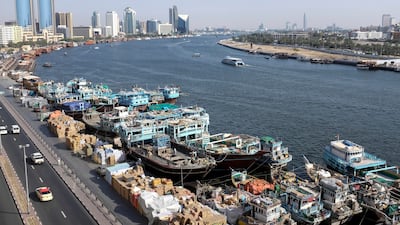
Dubai Creek has been a well-travelled trade network since the early 19th century, kept alive by hawkers, businessmen and artisans.

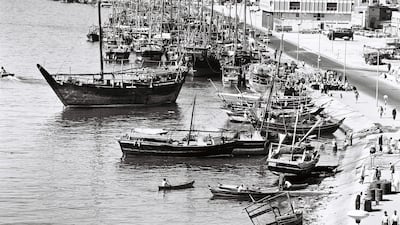
Back in the 1950s, life centred around it. Back then, Dubai was merely a town, with a population of about 20,000, with people living around Bur Dubai, Deira and Shindagha.

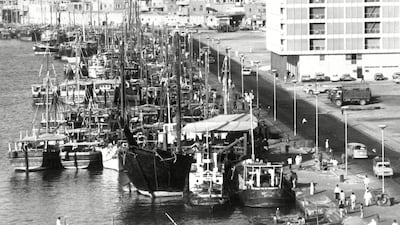
Vessels ploughed the Silk Route, trading goods such as wood and spices with East Africa and India, while pearling fleets left and returned from the spot during the diving season.

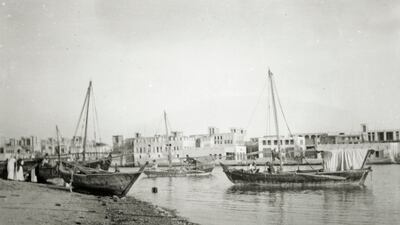
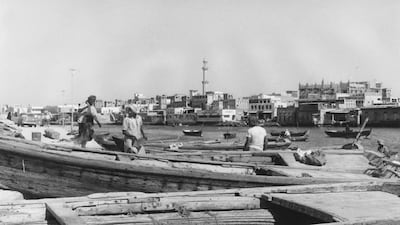
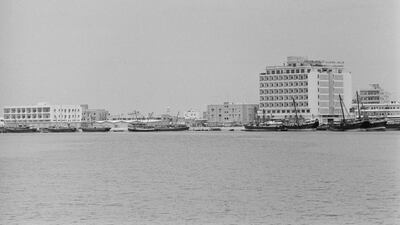
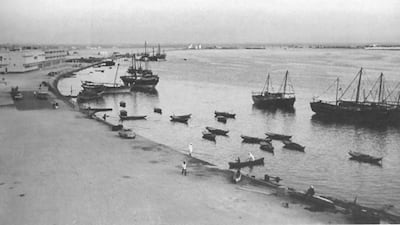
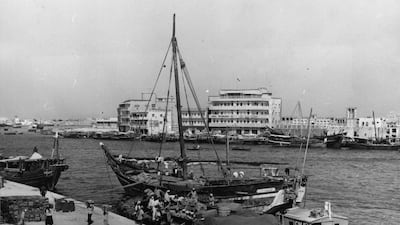
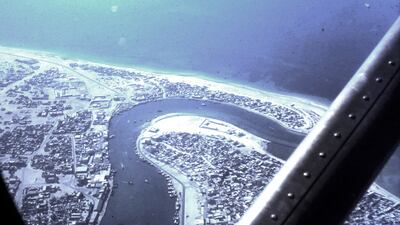
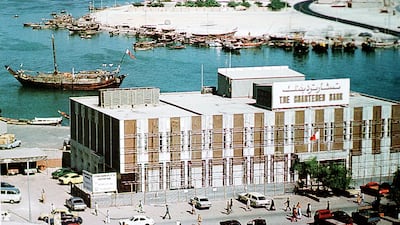
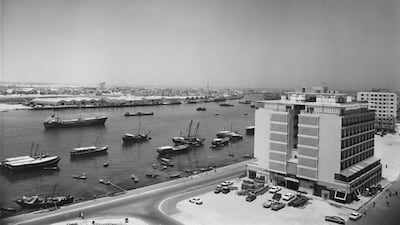
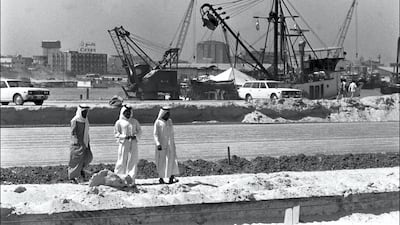
How Dubai Creek has (and hasn't) changed in 55 years — in pictures

  • The creek in Dubai circa 1937. Getty Images
    The creek in Dubai circa 1937. Getty Images
  • Boats on the Creek in Dubai, with the Customs House in the background, 1967. Getty Images
    Boats on the Creek in Dubai, with the Customs House in the background, 1967. Getty Images
  • A view across Dubai Creek in 1967. Getty Images
    A view across Dubai Creek in 1967. Getty Images
  • Dubai Creek in 1964. Photo: Alamy
    Dubai Creek in 1964. Photo: Alamy
  • Ships in 1967 unloading goods on the creek for the Customs Department in Dubai. Getty Images
    Ships in 1967 unloading goods on the creek for the Customs Department in Dubai. Getty Images
  • Dubai Creek, April 1968, taken from a Beaver flying to Sir Bani Yas Island. Photo: Nevile Ryton
    Dubai Creek, April 1968, taken from a Beaver flying to Sir Bani Yas Island. Photo: Nevile Ryton
  • Dubai Creek in 1976. Photo: Wam / AFP
    Dubai Creek in 1976. Photo: Wam / AFP
  • The Carlton Hotel on the banks of the Creek in Dubai, circa 1978. The property was later rebuilt as the Carlton Tower Hotel. Getty Images
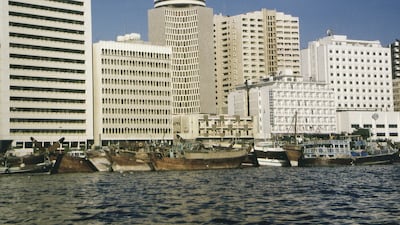
    The Carlton Hotel on the banks of the Creek in Dubai, circa 1978. The property was later rebuilt as the Carlton Tower Hotel. Getty Images
  • The mouth of the Creek, circa 1978. Getty Images
    The mouth of the Creek, circa 1978. Getty Images
  • Dubai Creek in October, 1977. Getty Images
    Dubai Creek in October, 1977. Getty Images
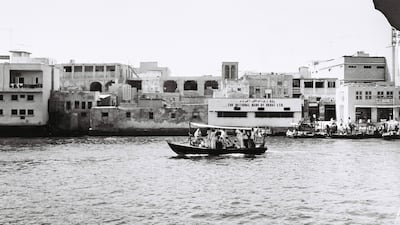
  • The building on the right is the National Bank of Dubai.
    The building on the right is the National Bank of Dubai.
  • The National Bank of Dubai building on the edge of Dubai Creek. Photo: Al Ittihad
    The National Bank of Dubai building on the edge of Dubai Creek. Photo: Al Ittihad
  • Dhows on the Creek in the 1970s. Photo: Al Ittihad
    Dhows on the Creek in the 1970s. Photo: Al Ittihad
  • Racing driver Juan Manuel Fangio in Dubai on December 11, 1981. Getty Images
    Racing driver Juan Manuel Fangio in Dubai on December 11, 1981. Getty Images
  • An aerial view of the opening of the Dubai Creek Golf and Marina Yacht Club golf course on January 1, 1993 in Dubai. Getty Images
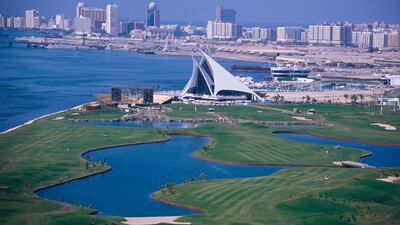
    An aerial view of the opening of the Dubai Creek Golf and Marina Yacht Club golf course on January 1, 1993 in Dubai. Getty Images
  • The Creek in 1993. Alamy
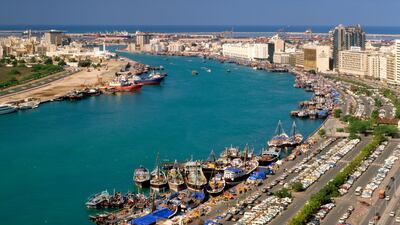
    The Creek in 1993. Alamy
  • The Creek in 1996. Getty Images
    The Creek in 1996. Getty Images
  • View of Bur Dubai and the Creek in 2015. Pawan Singh / The National
    View of Bur Dubai and the Creek in 2015. Pawan Singh / The National
  • Water taxis, known as abras, on Dubai Creek in 2019 take people from Bur Dubai to Deira and back again at sunset. Chris Whiteoak / The National
    Water taxis, known as abras, on Dubai Creek in 2019 take people from Bur Dubai to Deira and back again at sunset. Chris Whiteoak / The National
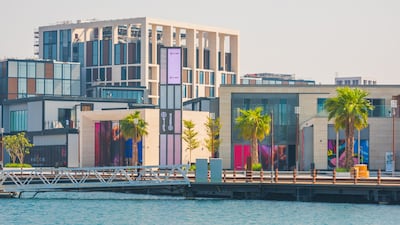
  • Al Seef waterfront dining destination opens on Dubai Creek in 2017.
    Al Seef waterfront dining destination opens on Dubai Creek in 2017.
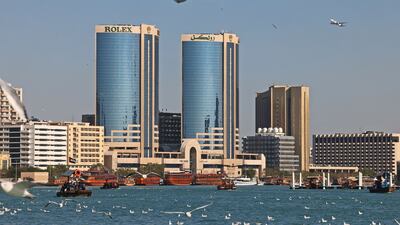
  • Dubai Creek from the Deira side of the city in 2015. Antonie Robertson / The National
    Dubai Creek from the Deira side of the city in 2015. Antonie Robertson / The National
  • Traditional ferry boats, known as abras, cross the Creek that separates Bur Dubai from Deira on January 6, 2022. AFP
    Traditional ferry boats, known as abras, cross the Creek that separates Bur Dubai from Deira on January 6, 2022. AFP
  • A dhow crosses the Creek near the spice souq in 2022. Reem Mohammed / The National
    A dhow crosses the Creek near the spice souq in 2022. Reem Mohammed / The National
  • Dubai Creek in May 2022. Chris Whiteoak / The National
    Dubai Creek in May 2022. Chris Whiteoak / The National
Results

5pm: Maiden (PA) Dh 80,000 (Turf) 1,400m. Winner: Al Ajeeb W’Rsan, Pat Dobbs (jockey), Jaci Wickham (trainer).

5.30pm: Maiden (PA) Dh 80,000 (T) 1,400m racing. Winner: Mujeeb, Fabrice Veron, Eric Lemartinel.

6pm: Handicap (PA) Dh 90,000 (T) 2,200m. Winner: Onward, Connor Beasley, Abdallah Al Hammadi.

6.30pm: Sheikh Zayed bin Sultan Al Nahyan Jewel Crown Prep Rated Conditions (PA) Dh 125,000 (T) 2,200m. Winner: Somoud, Richard Mullen, Jean de Roualle.

7pm: Wathba Stallions Cup Handicap (PA) Dh 70,000 (T) 1,600m. Winner: AF Arrab, Tadhg O’Shea, Ernst Oertel.

7.30pm: Handicap (TB) Dh 90,000 (T) 1,400m. Winner: Irish Freedom, Richard Mullen, Satish Seemar.

A new relationship with the old country

Treaty of Friendship between the United Kingdom of Great Britain and Northern Ireland and the United Arab Emirates

The United kingdom of Great Britain and Northern Ireland and the United Arab Emirates; Considering that the United Arab Emirates has assumed full responsibility as a sovereign and independent State; Determined that the long-standing and traditional relations of close friendship and cooperation between their peoples shall continue; Desiring to give expression to this intention in the form of a Treaty Friendship; Have agreed as follows:

ARTICLE 1 The relations between the United Kingdom of Great Britain and Northern Ireland and the United Arab Emirates shall be governed by a spirit of close friendship. In recognition of this, the Contracting Parties, conscious of their common interest in the peace and stability of the region, shall: (a) consult together on matters of mutual concern in time of need; (b) settle all their disputes by peaceful means in conformity with the provisions of the Charter of the United Nations.

ARTICLE 2 The Contracting Parties shall encourage education, scientific and cultural cooperation between the two States in accordance with arrangements to be agreed. Such arrangements shall cover among other things: (a) the promotion of mutual understanding of their respective cultures, civilisations and languages, the promotion of contacts among professional bodies, universities and cultural institutions; (c) the encouragement of technical, scientific and cultural exchanges.

ARTICLE 3 The Contracting Parties shall maintain the close relationship already existing between them in the field of trade and commerce. Representatives of the Contracting Parties shall meet from time to time to consider means by which such relations can be further developed and strengthened, including the possibility of concluding treaties or agreements on matters of mutual concern.

ARTICLE 4 This Treaty shall enter into force on today’s date and shall remain in force for a period of ten years. Unless twelve months before the expiry of the said period of ten years either Contracting Party shall have given notice to the other of its intention to terminate the Treaty, this Treaty shall remain in force thereafter until the expiry of twelve months from the date on which notice of such intention is given.

IN WITNESS WHEREOF the undersigned have signed this Treaty.

DONE in duplicate at Dubai the second day of December 1971AD, corresponding to the fifteenth day of Shawwal 1391H, in the English and Arabic languages, both texts being equally authoritative.

Signed

Geoffrey Arthur  Sheikh Zayed

Jetour T1 specs

Engine: 2-litre turbocharged

Power: 254hp

Torque: 390Nm

Price: From Dh126,000

Available: Now

Museum of the Future in numbers
  •  78 metres is the height of the museum
  •  30,000 square metres is its total area
  •  17,000 square metres is the length of the stainless steel facade
  •  14 kilometres is the length of LED lights used on the facade
  •  1,024 individual pieces make up the exterior 
  •  7 floors in all, with one for administrative offices
  •  2,400 diagonally intersecting steel members frame the torus shape
  •  100 species of trees and plants dot the gardens
  •  Dh145 is the price of a ticket
Updated: December 02, 2022, 2:01 PM