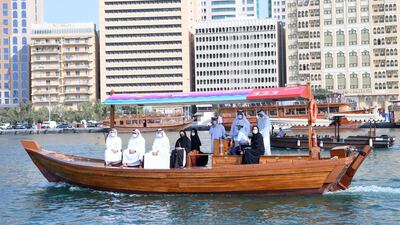
Dubai has unveiled a next generation fleet of abras. Courtesy: RTA

Dubai unveils 'next generation' fleet of abras complete with GPS and cameras


  • English
  • Arabic

Transport chiefs in Dubai unveiled a next generation fleet of high-powered wooden abras as part of a major drive to boost the emirate's marine transport sector.

The time-honoured design of the popular boats - a familiar sight cruising the waters of Dubai Creek - has been overhauled in order to bolster safety standards and improve access for people with disabilities.

Mattar Al Tayer, director-general of the Roads and Transport Authority (RTA) was briefed on the enhanced technical features of the vessels during a trial tour at Dubai Creek.

The raft of changes include designated spaces for two wheelchairs, life jackets placed under its seats and the use of GPS technology, cameras and nol card payment systems.

The engines in the enhanced abras operate at more than double the horse power of their predecessors and are linked with the remote monitoring system, and advanced sound and lighting systems onboard.

The driver seat has also been relocated to offer them a better view when ferrying passengers across the waters.

The new-look abra is made out of African teak wood, measures 10.6 metres in length and is roughly 3 metres wide.

The boat can accommodate 20 passengers, is powered by a 78 horse power diesel engine, compared to the 30 hp diesel engine of the old Abras.

RTA has also improved the position of the engine by placing it in a closed chamber equipped with soundproof and firefighting systems.

The Abra is equipped with hydraulic steering to improve driving and manoeuvring. The engine room is fitted with soundproofing and anti-vibration systems to reduce noise pollution.

Accordingly, the noise is decreased in the new Abra to less than 65 decibels, the universally permissible limit.

The abra remains one of the most scenic and affordable ways to travel through Dubai, with fares at just Dh1.

“Operating the new Abra is part of a master plan developed by RTA to overhaul Dubai’s marine transport systems which are used by 14 million riders per annum," said Mr Al Tayer.

"RTA plans to increase the number of marine transport stations to 59 stations by 2025 and manufacture 26 marine transport modes.

"It also plans to open new lines on Dubai Creek and the coastal strip along the Jumeirah beaches as well as new lines to serve the new islands and others along the Dubai Water Canal.

The transport boss said Dubai's marine transport sector has experienced encouraging growth in recent years and is set t make further waves in the future.

“The marine transport sector is experiencing a steady growth in the number of modes, stations and passengers since the launch of the Dubai Water Canal that links Dubai Creek with the Arabian Gulf beaches," he said.

"This sector is poised to see bigger growth upon the completion of the urban and tourist facilities on both sides of the canal and the building of more stations along the canal.

"Marine transport modes have the potential to become the ideal choice of many citizens, residents and tourists who will enjoy picturesque sceneries of urban and tourist facilities on both banks of the canal and along the skyline of the Arabian Gulf shores."


Tailors and retailers miss out on back-to-school rush

Tailors and retailers across the city said it was an ominous start to what is usually a busy season for sales.
With many parents opting to continue home learning for their children, the usual rush to buy school uniforms was muted this year.
“So far we have taken about 70 to 80 orders for items like shirts and trousers,” said Vikram Attrai, manager at Stallion Bespoke Tailors in Dubai.
“Last year in the same period we had about 200 orders and lots of demand.
“We custom fit uniform pieces and use materials such as cotton, wool and cashmere.
“Depending on size, a white shirt with logo is priced at about Dh100 to Dh150 and shorts, trousers, skirts and dresses cost between Dh150 to Dh250 a piece.”

A spokesman for Threads, a uniform shop based in Times Square Centre Dubai, said customer footfall had slowed down dramatically over the past few months.

“Now parents have the option to keep children doing online learning they don’t need uniforms so it has quietened down.”

Timeline

1947
Ferrari’s road-car company is formed and its first badged car, the 125 S, rolls off the assembly line

1962
250 GTO is unveiled

1969
Fiat becomes a Ferrari shareholder, acquiring 50 per cent of the company

1972
The Fiorano circuit, Ferrari’s racetrack for development and testing, opens

1976
First automatic Ferrari, the 400 Automatic, is made

1987
F40 launched

1988
Enzo Ferrari dies; Fiat expands its stake in the company to 90 per cent

2002
The Enzo model is announced

2010
Ferrari World opens in Abu Dhabi

2011
First four-wheel drive Ferrari, the FF, is unveiled

2013
LaFerrari, the first Ferrari hybrid, arrives

2014
Fiat Chrysler announces the split of Ferrari from the parent company

2015
Ferrari launches on Wall Street

2017
812 Superfast unveiled; Ferrari celebrates its 70th anniversary

Groom and Two Brides

Director: Elie Semaan

Starring: Abdullah Boushehri, Laila Abdallah, Lulwa Almulla

Rating: 3/5

About RuPay

A homegrown card payment scheme launched by the National Payments Corporation of India and backed by the Reserve Bank of India, the country’s central bank

RuPay process payments between banks and merchants for purchases made with credit or debit cards

It has grown rapidly in India and competes with global payment network firms like MasterCard and Visa.

In India, it can be used at ATMs, for online payments and variations of the card can be used to pay for bus, metro charges, road toll payments

The name blends two words rupee and payment

Some advantages of the network include lower processing fees and transaction costs

The bio

Favourite book: Peter Rabbit. I used to read it to my three children and still read it myself. If I am feeling down it brings back good memories.

Best thing about your job: Getting to help people. My mum always told me never to pass up an opportunity to do a good deed.

Best part of life in the UAE: The weather. The constant sunshine is amazing and there is always something to do, you have so many options when it comes to how to spend your day.

Favourite holiday destination: Malaysia. I went there for my honeymoon and ended up volunteering to teach local children for a few hours each day. It is such a special place and I plan to retire there one day.

Global state-owned investor ranking by size

1.

United States

2.

China

3.

UAE

4.

Japan

5

Norway

6.

Canada

7.

Singapore

8.

Australia

9.

Saudi Arabia

10.

South Korea