


Late on Wednesday night, Sotheby’s sent out an email announcing its year-to-date global total for contemporary art sales as $1.8 billion, its second highest, after last year.
Over at Christie's New York, last week the auction of Microsoft co-founder Paul Allen’s estate topped $1.5 billion, becoming the first 10-figure auction.
This breathtaking flash of cash follows three fairs within the space of two months, in Paris as well as the Macklowe auction this spring, which brought in $922 million at Sotheby’s.
Yet this comes at a time when global headlines are being dominated by inflation and looming recession, tech companies are laying off staff en masse, one of the world's largest crypto exchanges has collapsed, the war in Ukraine continues and families in Europe are rationing heating.
What is going on?
The answer in some senses is simple: the cost-of-living crisis has simply not hit the billionaires. Mark Zuckerberg is not suddenly scaling back; Jack Ma isn’t flying economy.
And because of the economic policies of the past 20 years, there are more billionaires than ever. Quantitative easing has put a lot of money into the system, and art has benefitted from low interest rates that inflate the value of long-duration assets.

“Low interest rates have meant people [are] buying things they didn’t buy before,” says Dirk Boll, Christie’s president in Europe, Middle East, Russia and India. “In the old days, people said 'my money has to work', but art as an asset class became a safe form of value storage.”
This group of collectors has been relatively untouched by the current economic crisis, Boll adds. “And canonised art continues to deliver lasting value, culturally and financially.”
The pool of people able to buy art at these prices has also widened geographically: China is the next big hope for the art world, as well as countries of South-East Asia, such as Singapore, which is hosting a new fair in January next year. While Christie’s did not disclose the buyers for all the works at the Allen sale, about a quarter of the lots by value went to Asian buyers.
Ultimately, the current art market landscape is a reflection of the widening income gap and, in the US, low tax environment that has produced billionaires, on the one hand, while the vast majority of the world experiences stagnating wages and quality of life. The latter are watching their bills; the former are bidding at auction.
Five paintings went over the $100 million mark at the Allen sale: Georges Seurat’s Les Poseuses, Ensemble (Petite version) sold for $149 million, Paul Cezanne’s La Montagne Sainte-Victoire for $138 million, Vincent Van Gogh’s Verger avec cyprès for $117 million, and Gustav Klimt’s Birch Forest for $105 million. And many of the lots attracted numerous bidders.
-
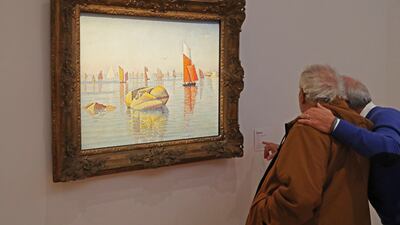
'Concarneau, calme du matin (Opus no. 219, larghetto)' by French artist Paul Signac. EPA -

'La Montagne Sainte-Victoire' by French artist Paul Cezanne. EPA -
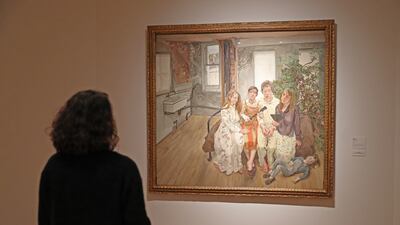
'Large Interior W11 (after Watteau)' by British artist Lucian Freud. EPA -
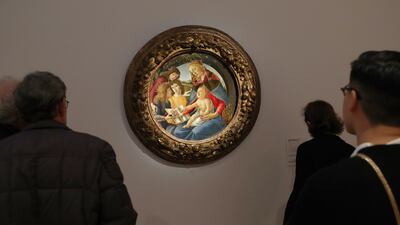
'Madonna of the Magnificat' by Sandro Botticelli. EPA -

'Le Grand Canal a Venise' by French painter Edouard Manet. EPA -

'The King Playing with the Queen (Le Roi jouant avec la Reine)' by German artist Max Ernst. EPA -
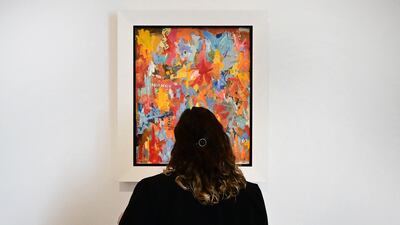
'Small False Start' by Jasper Johns. AFP -
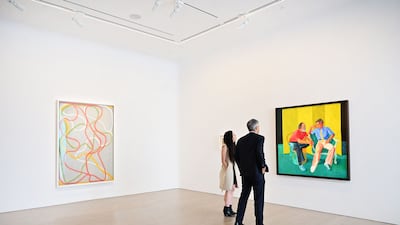
'The Conversation' by David Hockney, right, displayed beside 'The Attended' by Brice Marden. AFP -
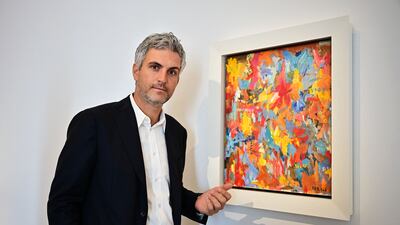
Christies senior specialist and senior vice president Alex Marshall next to Jasper Johns's 'Small False Start'. AFP -
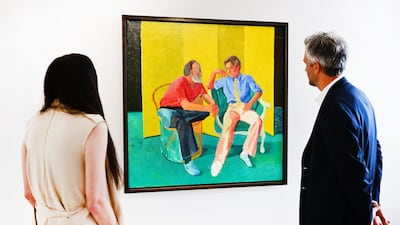
'The Conversation' by David Hockney, part of the Christie's auction of Paul Allen's collection. AFP


A bigger question than how this happened is how long can this last? A general rule of thumb is that the art market lags behind the stock market by about a year. Some experts see signs of weakness already.
“All the Allen works were guaranteed by Christie’s,” says Melanie Gerlis, author of two books on the art market. “When I see guarantees, that tells me that the market is iffy.”
A guarantee — either by the auction house or by a third party — means the consignor will make a minimum price even if the work fails to sell at auction. They used to be rare but are becoming more and more common.
Gerlis notes that not all the Allen works demonstrate great returns. Allen bought a painting by the French surrealist Yves Tanguy in 1999 for $1.5 million, an artist's record at the time. It sold last week for $3.4 million with fees ― $2.8 million without. Not bad, but not an exceptional investment over a 20-year period.
“I would say that the art market has not been touched ― yet,” she says.
There’s also a question of how exemplary the Allen and Macklowe auctions really are. Both of those broke headlines because they presented exceptional, museum-quality works that might not come up again for sale in collectors’ lifetimes. In the case of Allen, this was Impressionists and Modernists that Boll says are particularly attractive to Asian buyers.
Allen, who wrote the code for Microsoft, began collecting in the 1990s. Even then, the paintings were expensive by any objective measure, and Allen paid in the tens of millions for works by major Impressionists such as Monet. The Macklowes, who put their work up for auction this spring during a bitter divorce, started buying Abstract Expressionism very early, well before most of their contemporaries.
The works included in both these sales ― and future collections that might well be coming up for auctions ― are seen as safe bets even in an uncertain economic environment.
-
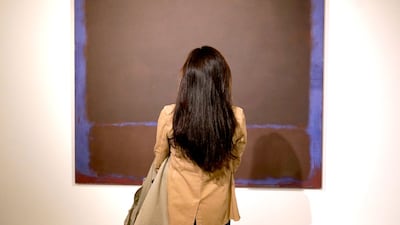
A person poses in front of Mark Rothko’s 'Untitled' during the New York press preview on May 6, 2022 for the Macklowe Collection at Sotheby's. AFP -
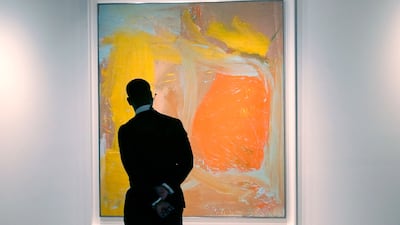
A person walks in front of Willem De Kooning's 'Untitled' during the New York press preview. AFP -
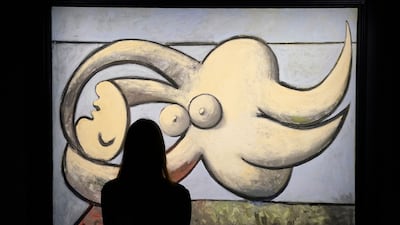
A woman poses in front of Pablo Picasso’s 'Femme nue couchée'. AFP -
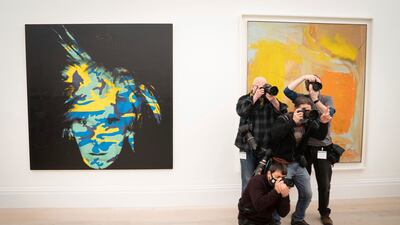
Photographers capture the art collection ahead of the auction on May 16 in New York. PA via AP -

A woman poses in front of Gerhard Richter's 'Seestuck (Seascape)'. AFP -
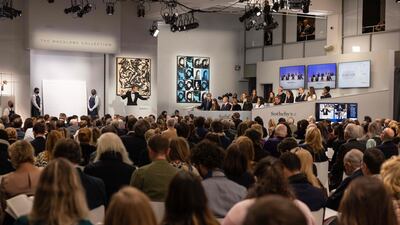
Sotheby's auctioneer Oliver Barker leads an auction of The Macklowe Collection, alongside Andy Warhol's 'Sixteen Jackies', centre, at Sotheby's on November 15, 2021 in New York City. AFP -

Andy Warhol's 'Nine Marylins', which sold for $47,373,000 at Sotheby's on November 15, 2021 in New York City. AFP -

Sotheby's staff take calls for off-site bids during an auction of The Macklowe Collection, at Sotheby's on November 15, 2021 in New York City. AFP


“We were nervous going in,” Boll says. “But we underestimated provenance. Allen was a self-made man, and the industry he co-founded is of utmost importance in 2022, not only in America or Europe but in places like India or Pakistan, and there are plenty of entrepreneurs who followed his path and identified with him as a person.”
“It was also a charity auction,” he says. “There was a good feeling in the room.”
Auction houses have done remarkably well out of the pandemic. During lockdown, their online format suited a population at home with disposable income, and they capitalised on users from new markets such as tech and Asia. Auctions, unlike galleries, are an easy entry point: there are no months of schmoozing to get on the list of people who would be lucky enough to spend $1 million on a painting.
There is more concern about the middle market, which is roughly defined as $200,000 to $1 million. Boll points out that, in auction prices, works that used to take years to climb in value are now surpassing the $1 million mark in a matter of one or two years. That has the effect of hollowing out the middle market offerings at auction, as works of high quality ― or those of high speculation ― quickly move out of reach of collectors.
It’s worth pointing out that the art market sustained three fairs over the past two months ― Frieze Seoul, Frieze London and Paris Plus, run by Art Basel ― with most gallerists returning home happy, either having sold work there or in sales conducted around the event. Fairs tend to be more mid-market and offer a wider span of artworks, potentially countering the idea that it is only the blue-chip, museum-quality art works that are holding their appeal.
Martin Klosterfelde, director of the Skarstedt gallery in London and an industry veteran, underlines that the art world is now so globalised that depressed purchasing power in one area is quickly offset by buyers elsewhere.
“It's a global market,” he says. “The US is very strong right now, but there's no more buying from Russians. Within the crisis, there's always opportunity.”
Even so, experts are keenly watching the modern and contemporary sales that are being conducted this week in New York, looking for guarantees, conservative pricing and works selling in the middle of their estimates. The figures so far are rosy, but the sentiment of incredulity is unmistakable.

