



From his nods and winks during formal proceedings to his outburst over a faulty pen, King Charles III is an expressive man who fails to live up the Queen Elizabeth II maxim: “Never complain, never explain.”
It will not be long before his instincts start to drive change in a royal family establishment that is ripe for it.
The new king has considerable power over royal appointments for his immediate family and will also inherit an immense fortune with too many homes for a slimmed down list of working royals.
Having pledged to step back from some of the causes with which he was most closely identified, there is also a calculation to be made about his future interventions in speeches and appearances.
The climate emergency is likely to be one of the few political areas that the king may choose to enter, having warned about environmental damage for the past four decades.
Religion could be another area of divergence from the queen’s strict adherence to the Anglican Church, with the king keen to promote diversity.
Popularity polls
As Prince of Wales, Charles at times found himself the subject controversy. His turbulent marriage and divorce from Princess Diana severely dented his standing, as did his comments on architecture and industrial farming.
He was also not helped by the leaking of his “black spider” memos in 2015, letters written to politicians in his distinctive handwriting.
-
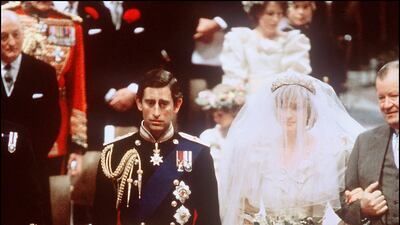
Lady Diana, Princess of Wales, and Charles, Prince of Wales, at their wedding in London at St Paul Cathedral, July 29, 1981 -

Prince Charles and Lady Diana Spencer at the Buckingham Palace after the announcement of their engagement on February 24, 1981 -
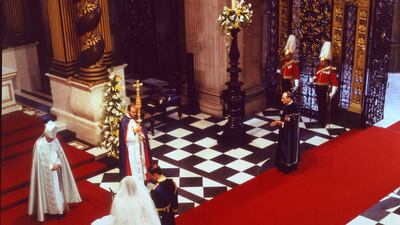
Lady Diana, Princess of Wales, and Charles, Prince of Wales, at their wedding in London at St Paul Cathedral, July 29, 1981 -

Prince Charles and Princess Diana stand on the balcony of Buckingham Palace in London, following their wedding at St. Pauls Cathedral, June 29, 1981 -

An official family photo taken on the wedding day of Prince Charles and Lady Diana, the Princess of Wales. Back Row, from left to right: Mark Phillips, Prince Andrew, Viscount Linley, the Duke of Edinburgh, Prince Edward, the Princely Couple, Ruth, Lady Fermoy (the bride's grandmother), Lady Jane Fellowes (the bride's sister), Viscount Althorp (Diana's brother) and Robert Fellowes. Centre row, from left to right: Princess Anne, Princess Margaret, the Queen Mother, Queen Elizabeth II, India Hicks, Lady Sarah Armstrong-Jones, Mrs Shand Kydd (Diana's mother) Count Spencer, Lady Sarah McCorquodale (Diana's sister), Neil McCorquodale. Front row: ushers and bridesmaids -

The Prince and Princess of Wales in a merry mood aboard the Royal Yacht Britannia as they sail away on their honeymoon -

Princess Diana and Prince Charles hold hands on their honeymoon at Balmoral in Scotland, in August 1981 -

Prince Charles and Princess Diana on the steps of the Lindo Wing at St. Mary's Hospital with their son, Prince William, as they left for Kensington Palace, June 1982 -

The Prince and Princess of Wales with baby Prince William in Kensington Palace in 1983 -
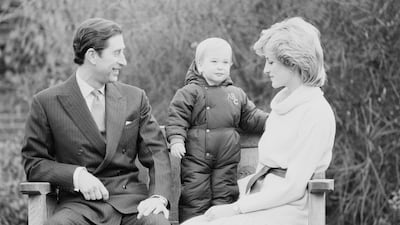
Charles, Prince of Wales, and Diana, Princess of Wales with their son Prince William, Duke of Cambridge, December 14, 1983 -
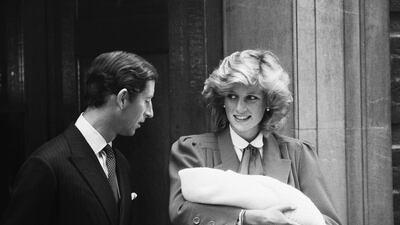
Charles, Prince of Wales and Diana, Princess of Wales leave the Lindo Wing of St Mary's Hospital with their son Prince Harry, in Paddington, London, on September 16, 1984 -

Princess Diana and Prince Charles meet Pope John Paul II during a private audience a the Vatican on April 25, 1985 -

Prince Charles, Prince of Wales and Diana, Princess of Wales with Prince William and Prince Harry on the Royal Yacht Britannia on May 6, 1985 in Venice, Italy -

Prince Charles, Prince of Wales and Diana, Princess of Wales in Al Ain during a visit to the UAE in March 1989 -

The Prince and Princess of Wales with sons Prince William, right, and Prince Harry prepare for a cycling trip in Tresco during their holiday in the Sicily Isles, June 1, 1989 -

The Queen Mother poses outside her London Clarence House residence for photographers with Queen Elizabeth II and other members of the Royal Family on her 89th birthday, August 4, 1989. Left to right: Prince Andrew, Sarah Duchess of York, Lord Linley, Prince Edward, Prince Charles and Diana, Princess of Wales -

Prince Charles looks towards Princess Diana as they await their carriage to depart the Order of the Garter ceremony at Windsor Castle, June 15, 1992 -

The Prince and Princess of Wales, and Prince Harry smile to photographers with Prince William on his first day of term at the Eton College on September 6, 1995 -

The Prince of Wales, Prince William, Princess Diana and Prince Harry attend the Heads of State ceremony in Hyde Park to commemorate the 50th Anniversary of VE Day in London on May 7, 1995


A poll in May showed his popularity rating at 54 per cent while the queen’s stood at 81 per cent and Prince William’s at 75.
But the heartfelt speech he made the day after his mother’s death appears to have moved the dial, suggesting he would continue the queen’s conscientious manner of ruling and know his constitutional place.
That has already had an effect, with a recent YouGov poll showing that people who thought he was doing a good job had increased from 32 per cent in May to 63 per cent after the queen died.
Sibling and son
At 8am on Monday, flags that have been half-mast at royal residences since September 8 will be raised and black armbands removed.
Before then, the king will consider what to do with Prince Andrew, who caused great harm to the family with the US court case that involved allegations of an under-age liaison with Virginia Giuffre and an alleged £12 million ($13.5m) settlement.
Prince Andrew was stripped of many titles and positions but is understood to be eager for a return to a royal role, particularly having suffered the humiliation of not being allowed to wear a military uniform over the past week.
But his brother will know the damage to his and the family’s standing if Andrew is rehabilitated, so for now is likely to retain his mother’s sanctions.

Since the queen’s death it is not known how deep the reconciliation might have been between Prince Harry and his father after the damaging Oprah Winfrey interview last year, including Meghan’s allegations of racism in the palace.
King Charles may well decide to “take a view” when Harry’s book expose of royal life is published at some point next year.
The National also understands that the king is not greatly enamoured with living in Buckingham Palace and would rather it became a museum and an “office” where he can greet dignitaries, host dinners and carry out investitures.
King Charles is said to be far more comfortable in Clarence House but understands the importance of the monarch’s main location being Buckingham Palace.
Slimmer monarchy
With Prince Andrew and Prince Harry no longer functioning as “working royals”, the job may already have been done to fulfil the king’s desire the reduce their number and save on the public purse.
Expenditures include an estimated £100m bill for police protection alone.
-

Masterpieces from Buckingham Palace at The Queen's Gallery will open to the public on 04 December. EPA -
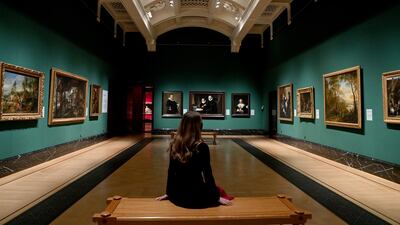
The exhibition brings together 65 of the most treasured paintings and includes works by Titian, Rembrandt, Rubens, Vermeer, Van Dyck and Canaletto am others. EPA -
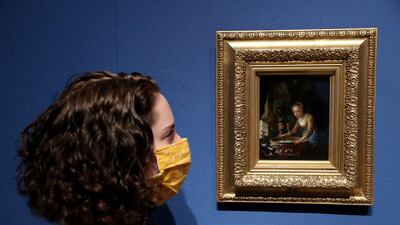
A lady looks at the Gerrit Dou painting "A Girl Chopping Onions". Getty Images -
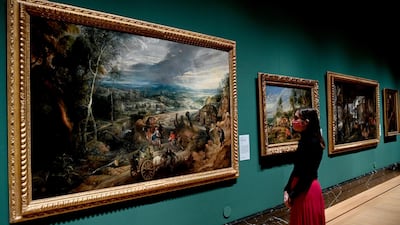
"Summer: Peasants Going to Market" by Flemish master Sir Peter Paul Rubens. EPA -
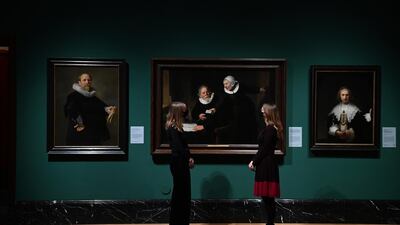
"The Shipbuilder and his Wife" by Dutch master Rembrandt. EPA -
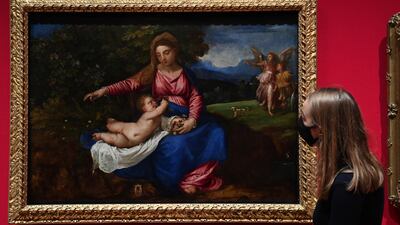
"Madonna and Child in a Landscape with Tobias and the Angel" by Italian master, Titian. EPA -
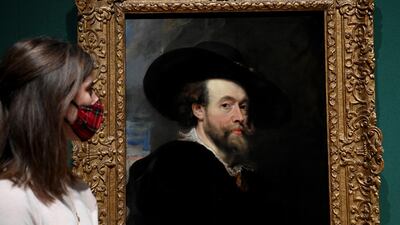
A self -portrait by Dutch master by Sir Peter Paul Rubens. EPA -
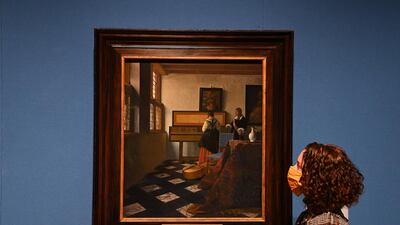
"At Lady at the Virginals with a Gentleman (The Music Lesson)" by Dutch master Johannes Vermeer. EPA -
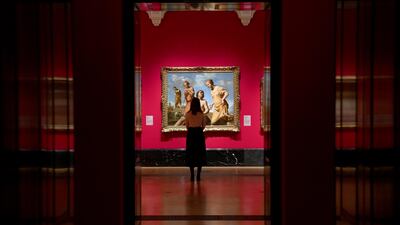
"Jacob Peeling the Rods" by Italian master Guido Cagnacci. EPA -
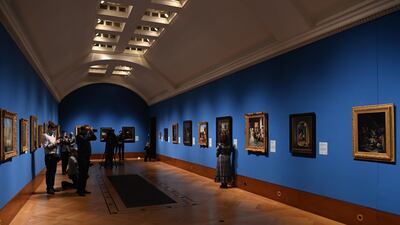
One of the exhibition rooms at The Queen's Gallery . EPA


There are now only seven main royals who carry out official duties, such as opening hospitals or schools and representing Britain on overseas trips, which gives the country a degree of influence.
And the remaining working royals are all regarded as “safe hands” who will not expose the family to negative publicity.
-
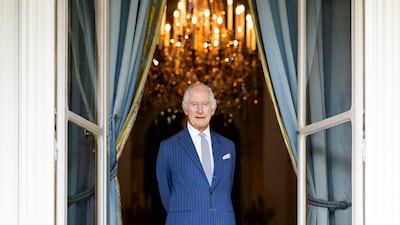
A photo released by Buckingham Palace as they announced that King Charles III had been diagnosed with cancer. All Photos: Getty Images unless stated -

King Charles attends the Sunday service at the Church of St Mary Magdalene on the Sandringham estate in January -
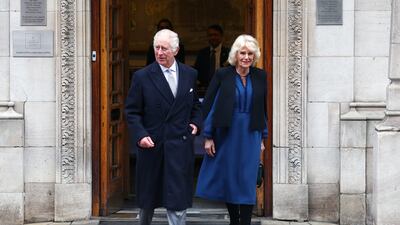
King Charles and Queen Camilla leaving The London Clinic in January. The King had been receiving treatment for an enlarged prostate. -
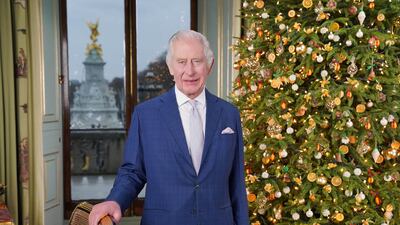
King Charles delivers his Christmas message at Buckingham Palace in December 2023 -
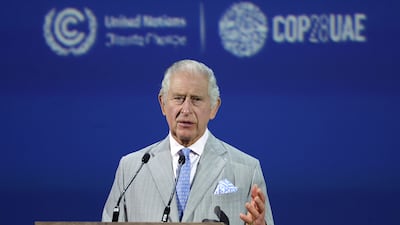
King Charles delivers an address at the opening ceremony of the Cop28 Summit in December 2023 in Dubai -
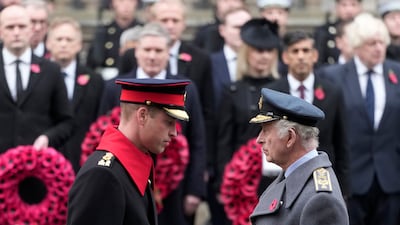
King Charles and Prince William attend the National Service of Remembrance at The Cenotaph in November 2023 in London -
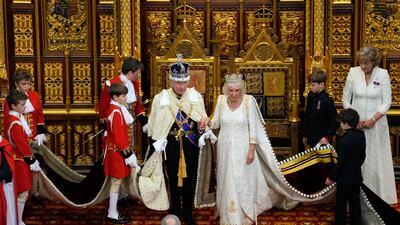
King Charles and Queen Camilla at the State Opening of Parliament in November 2023 -
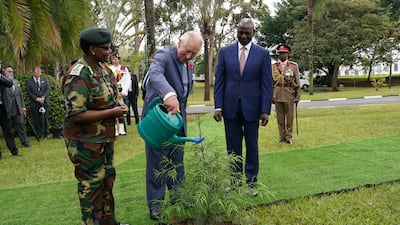
King Charles waters and plants a tree watched by President of Kenya, William Ruto in October 2023 in Nairobi -

King Charles and US President Joe Biden review a guard of honour at Windsor Castle in July 2023 -

Catherine, Princess of Wales, Prince William, King Charles and Queen Camilla during the National Service of Thanksgiving and Dedication at St Giles' Cathedral in Edinburgh, in July 2023 -
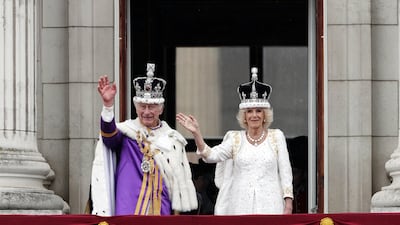
King Charles and Queen Camilla on the balcony of Buckingham Palace, after his coronation. PA -
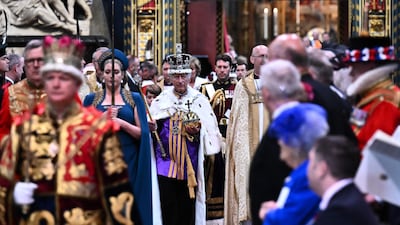
King Charles, carrying the Sovereign's Orb and Sceptre, leaves Westminster Abbey after the Coronation in May 2023. AFP -
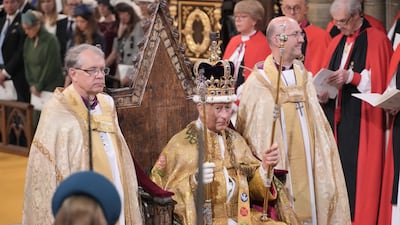
King Charles III is crowned with St Edward's Crown by The Archbishop of Canterbury Justin Welby during his coronation ceremony in Westminster Abbey in May 2023. PA -
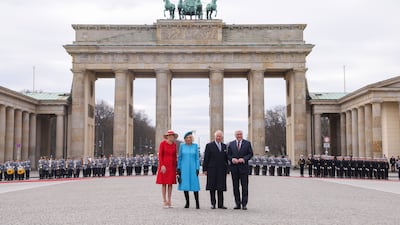
King Charles and Queen Consort Camilla, centre, with German President Frank-Walter Steinmeier and his wife Elke Buedenbender during the king's state visit in March 2023 -
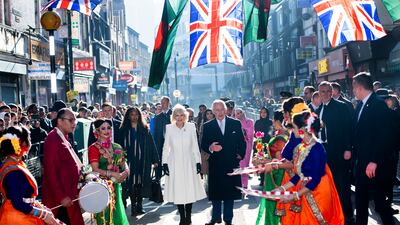
King Charles and Camilla during a visit to the Bangladeshi community of Brick Lane, London, in February 2023 -
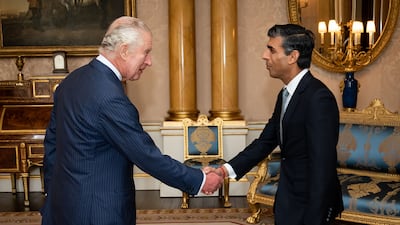
King Charles welcomes Rishi Sunak during an audience at Buckingham Palace, where he invited the leader of the Conservative Party to form a new government in October 2022 -
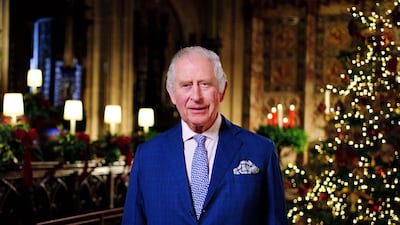
King Charles during the recording of his first Christmas broadcast at Windsor Castle in December 2022 -
King Charles follows the coffin of Queen Elizabeth as it is carried from Westminster Abbey after her state funeral. AP -
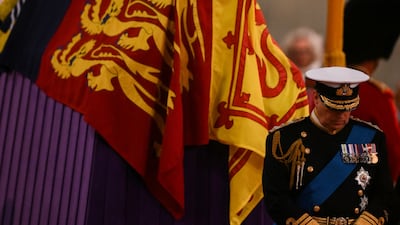
King Charles holds a vigil beside the coffin of his mother, Queen Elizabeth, as it lies in state on the catafalque in Westminster Hall. PA -
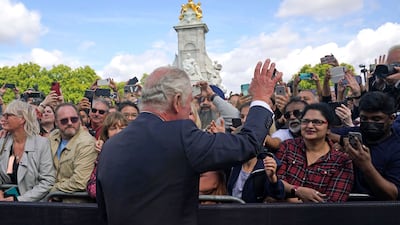
King Charles greets members of the public as he walks by the gates of Buckingham Palace after the death of Queen Elizabeth. AP -
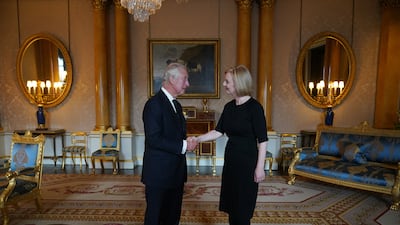
King Charles shakes hands with British Prime Minister Liz Truss during their first audience at Buckingham Palace -

King Charles III delivers his address to the nation and the Commonwealth from Buckingham Palace after the death of Queen Elizabeth II in September 2022 -
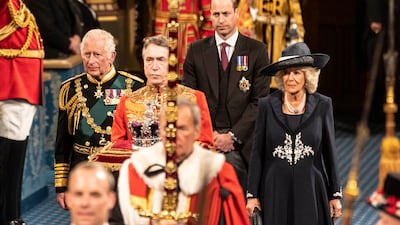
Prince Charles with Camilla and Prince William during the ceremonial state opening of parliament at the Palace of Westminster in 2022 -
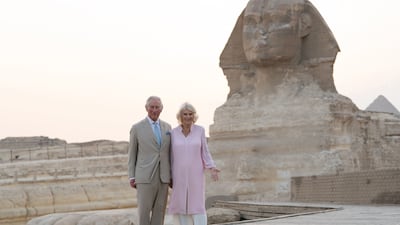
Prince Charles and Camilla on a visit to Giza in Egypt in 2021 -

Prince Charles joined members of the British Asian Trust for a short bicycle ride as they launched the charity's Palaces on Wheels cycling event at Highgrove in 2021 -
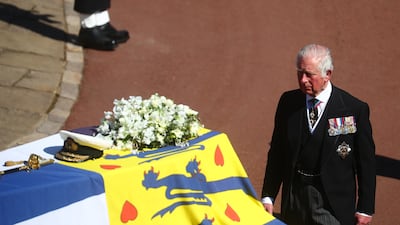
Prince Charles walks behind the Duke of Edinburgh’s coffin during the funeral of Prince Philip in 2021 -
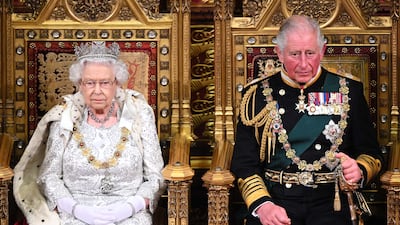
Queen Elizabeth and Prince Charles during the state opening of parliament at the Palace of Westminster, London, in 2019 -
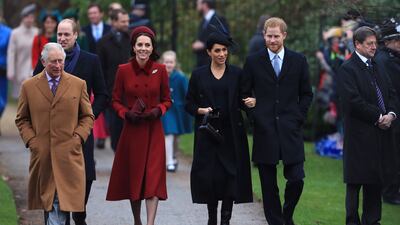
Prince Charles, Prince William, Catherine, Duchess of Cambridge, Meghan, Duchess of Sussex and Prince Harry arrive for a Christmas Day church service on the Sandringham estate in December 2018 -
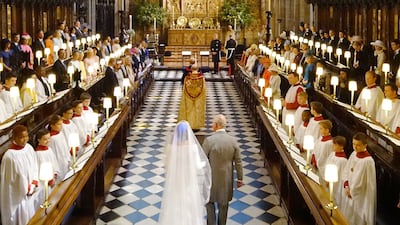
Prince Charles leads Meghan Markle up the aisle during her wedding to Prince Harry in St George's Chapel at Windsor Castle in 2018 -
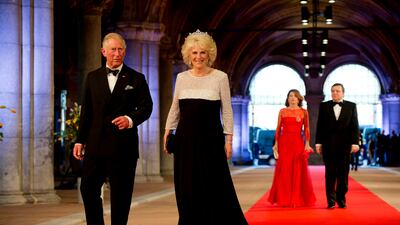
Prince Charles and Camilla attend a dinner hosted by Queen Beatrix of the Netherlands, in Amsterdam in 2013 -
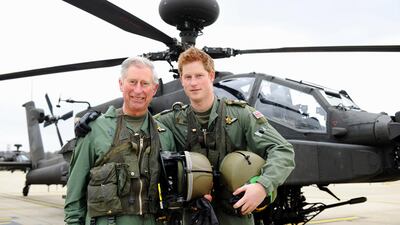
Prince Charles and Harry in front of an Apache helicopter at the Army Aviation Centre in Middle Wallop, 2011 -
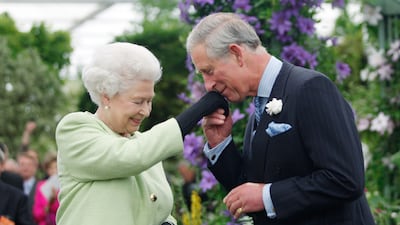
Queen Elizabeth presents Prince Charles with the Royal Horticultural Society's Victoria Medal of Honour at the Chelsea Flower Show, west London, in 2009 -
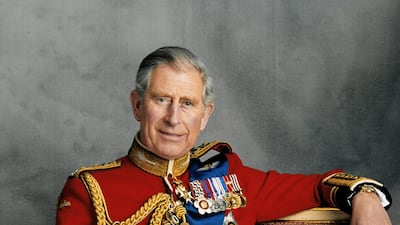
An official portrait to mark Prince Charles's 60th birthday in 2008 -
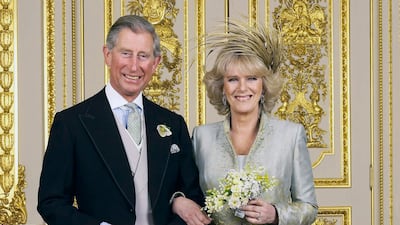
Prince Charles and his new bride Camilla, Duchess of Cornwall, in the White Drawing Room at Windsor Castle after their wedding in April 2005 -
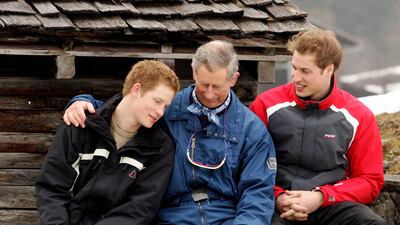
Charles with his sons William and Harry on a ski break at Klosters in Switzerland in 2005 -

Queen Elizabeth and Prince Charles in Avignon during a state visit to France in 1972 -

Prince Charles learns a soul dance routine at St George's Secondary School in Maida Vale, west London, in 1978 -
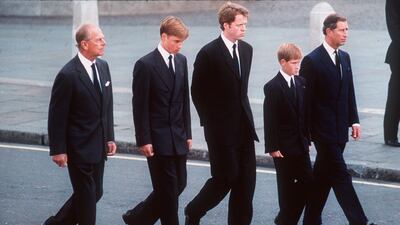
Prince Philip, Prince William, Earl Spencer, Prince Harry and Prince Charles follow the coffin of Princess Diana at her funeral in London in September 1997 -
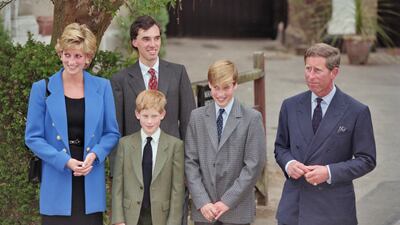
Diana and Prince Charles pose with their sons, Princes William and Harry, on Prince William's first day at Eton College in 1995 -
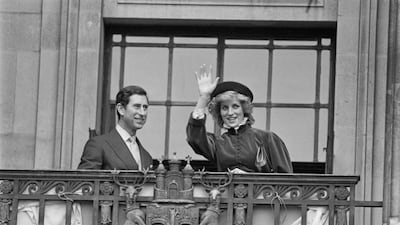
Prince Charles and Diana on a visit to Nottingham in 1985 -
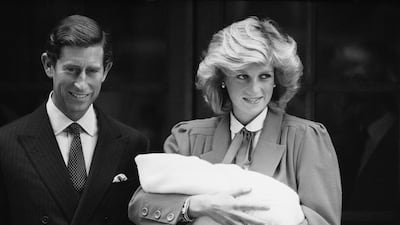
Diana and Prince Charles with Prince Harry leave St Mary's Hospital in Paddington, west London, in 1984 -
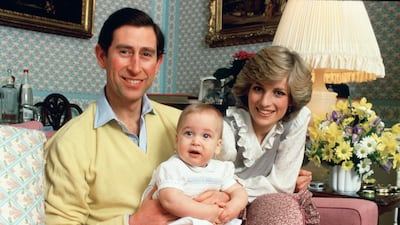
Prince Charles and his wife Diana with their baby son, Prince William, at home in Kensington Palace in 1983 -

Prince Charles and Diana with son William in 1983 -
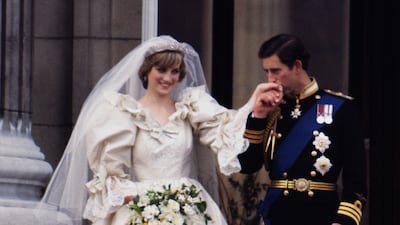
Prince Charles and Diana on the balcony of Buckingham Palace on their wedding day in 1981 -
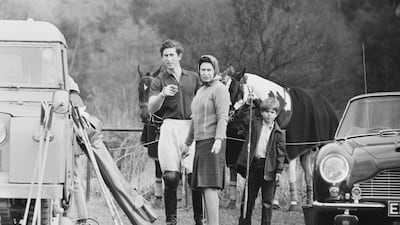
Prince Charles at a polo event in Windsor Great Park, accompanied by the queen and Prince Edward, in 1971 -
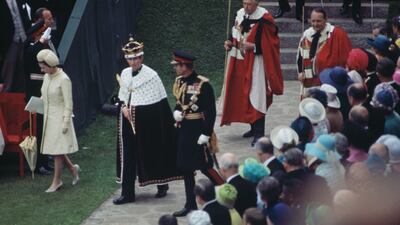
Prince Charles leaving Caernarfon Castle after his investiture as Prince of Wales, in Gwynedd, 1969 -
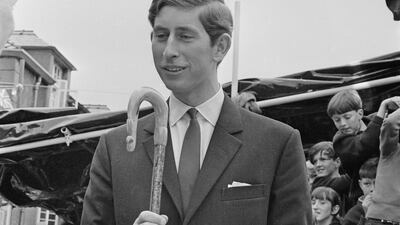
Prince Charles during a tour of Wales in 1969 -
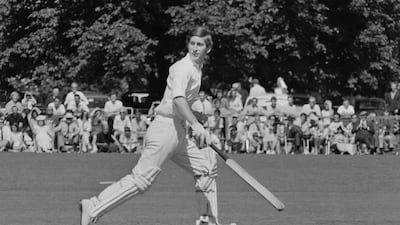
Prince Charles playing cricket in 1968. He was playing for Lord Brabourne against a team of Grand Prix racing drivers. -
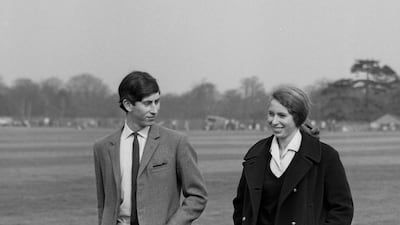
Prince Charles and Princess Anne at Windsor Great Park in 1968 -
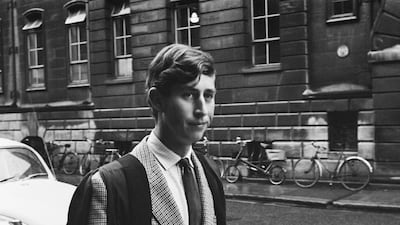
Prince Charles at the University of Cambridge in 1967, where he was beginning his term at Trinity College -
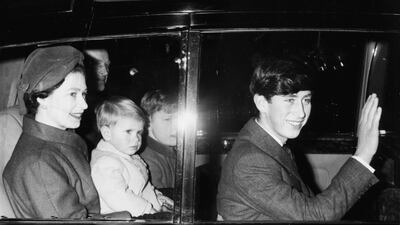
Queen Elizabeth and her family travel to Sandringham in 1966. Prince Andrew is on her lap, the Duke of Edinburgh to her left with Princess Anne on his lap, and Prince Charles, right -
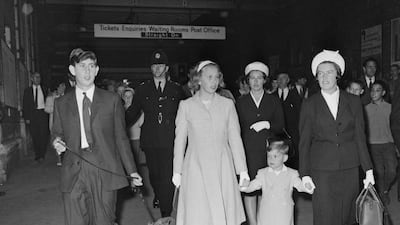
Prince Charles, walking a Corgi, Princess Anne, Prince Andrew and their nanny Mabel Anderson at Euston Station, London, in 1963 -
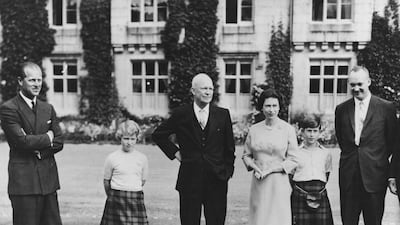
US President Dwight D Eisenhower, centre, with the British royal family, left to right, Prince Philip, Princess Anne, Queen Elizabeth and Prince Charles, at Balmoral Castle in 1959 -
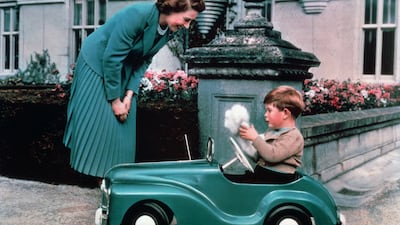
Queen Elizabeth watches her son Prince Charles driving a toy car in the grounds of Balmoral Castle in 1952 -
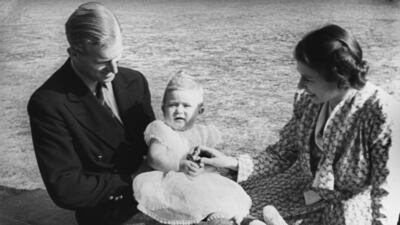
A young Prince Charles is perched on the lap of his father the Duke of Edinburgh, while his mother Queen Elizabeth II looks on in the grounds of Windlesham Moor in 1949


Sophie, the Countess of Wessex, has recently had very positive press after her close friendship with the late queen has become more widely known.
Her husband Prince Edward and his sister Princess Anne are regarded as hard-working royals who avoid controversy.
Prince William and his wife Kate generate positive publicity and will continue to embark on even more prestigious events after becoming the Prince and Princess of Wales.
With her steadying influence on King Charles over the past week, the Queen Consort Camilla could well grow in popularity and demand.
Indeed, some in the household argue that there are not enough working royals, possibly allowing some in the younger generation to step up.
King’s gold
In return for the work in burnishing Britain’s image, King Charles is given a “sovereign grant” that covers staff costs, travel and upkeep of palaces.
This amounted to £86m in the past year, calculated as a share of the treasury’s revenue from the crown estate that covers a large amount of central London, the seabed around the UK, Ascot racecourse and land and assets.
And the family has land, assets and property from the duchies of Lancaster and Cornwall that combined are worth £1.7bn and made of profit of £47m last year.
It will be King Charles’s decision on whether he continues to bankroll his immediate family as his mother did. Changes will inevitably lead to friction.
Defender of Faiths
On accession the king immediately becomes supreme governor of the Church of England, a role that his mother saw as a sacred duty.
This is enshrined in the accession promise that he would become the “defender of the faith” when it had been speculated he would replace it with “faiths”.

King Charles has shown an interest in other religions and wants to be an interfaith monarch, hence the idea of defending “faiths”.
He is interested in Greek Orthodoxy, Buddhism — with supporting for the Dalai Lama — and has studied Islam.
“Like other sacred texts, the Quran offers some profound and perceptive understanding of human and economic development — concepts that do not calculate well-being in merely financial terms,” he once said.
His multi-faith support could well make him stand out from his mother in a manner that it would be hoped does not attract controversy.
Climate prophesy
Another area in which King Charles might increase his popularity, particularly among younger people, is his continued promotion of the environment.
When he began preaching about mankind’s damage to the planet and climate catastrophe he was considered a touch eccentric.
Given today’s environmental emergency, it appears more prophetic and he could well, with government permission, continue giving speeches at international climate events.

He was also an early proponent of returning areas to the wild, something now conducted across Britain, and his promotion of organic food in the 1990s has seen it become a market worth nearly £3bn.
Stability
Queen Elizabeth’s reign was a constant in stability and her heir will seek to continue this, albeit asserting some positive influence in terms of religion and the environment.
Aides say the king works extremely hard but one slight issue is a tendency to public displays of irritation, twice witnessed in his issues with ink pens in the past 10 days.
After the decades of preparation and the support from his loving wife, it is hoped that King Charles will not be experiencing the emotions of his great-uncle Edward VIII, who after his father’s funeral felt the “uneasy sensation of being left alone on a vast stage”.
Queen Elizabeth II's funeral: extraordinary images from an extraordinary day — in pictures
-
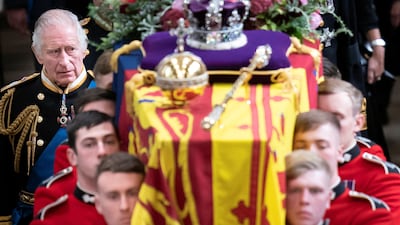
King Charles III follows behind the coffin of Queen Elizabeth II, draped in the Royal Standard with the Imperial State Crown and the Sovereign's orb and sceptre on top, as it is carried out of Westminster Abbey after her state funeral. Reuters -
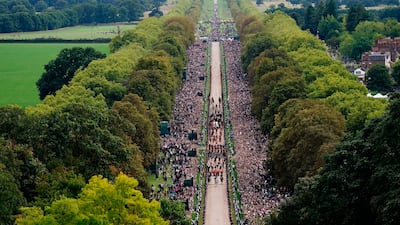
The ceremonial procession of the coffin of Queen Elizabeth travels down the Long Walk as it arrives at Windsor Castle for the Committal Service at St George's Chapel. AP -
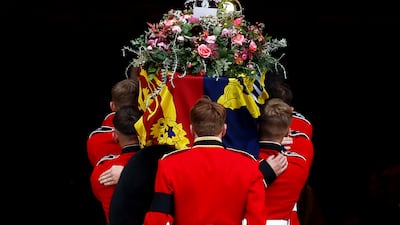
Pall bearers carry the coffin into St. George's Chapel, in Windsor. AP -
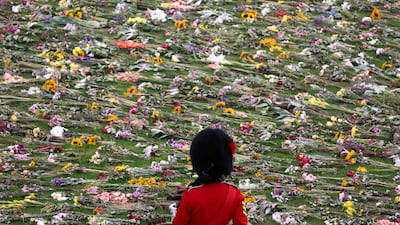
A Royal Guard stands by floral tributes at Windsor Castle. AFP -

The coffin of Queen Elizabeth is pulled on a gun carriage by Royal Navy sailors to Westminster Abbey. Getty Images -
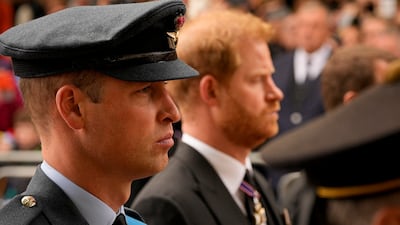
Prince William and Prince Harry follow the coffin of the queen after her state funeral in Westminster Abbey. AP -

Emma, the monarch's fell pony, stands as Queen Elizabeth's coffin passes at Windsor Castle. PA -

Members of the royal household stand with Queen Elizabeth's Corgis, Muick and Sandy, as they await the funeral cortege at St. George's Chapel, Windsor. AP -
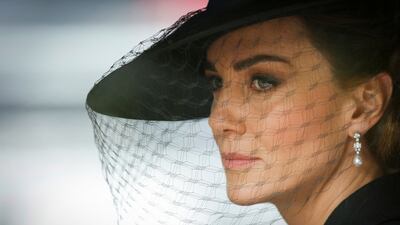
Catherine, Princess of Wales, attends the state funeral service in London. AFP -
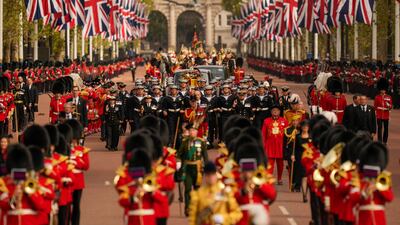
The coffin of Queen Elizabeth is pulled along The Mall following her funeral service in Westminster Abbey. AP -
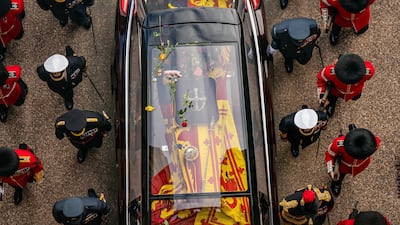
Flowers thrown by the public lie on the hearse carrying the coffin as it arrives at Windsor Castle. AP -

King Charles at the state funeral in London. Reuters -
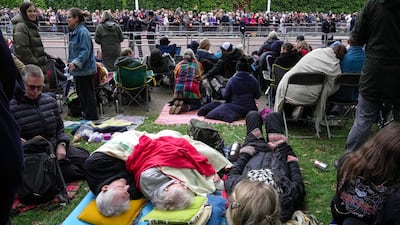
People sleep before the funeral service at Westminster Abbey. AFP -

A giant screen honouring the late queen at Piccadilly Circus in London. EPA -
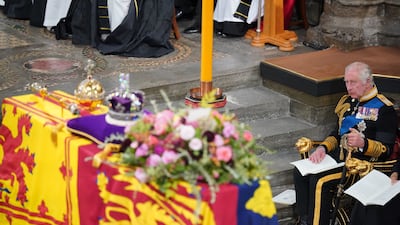
King Charles looks towards the coffin of his mother at Westminster Abbey. Getty Images -
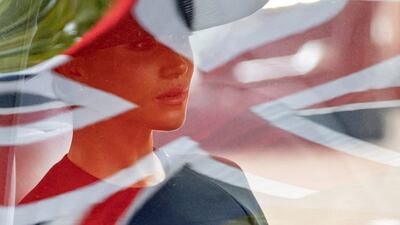
Meghan, Duchess of Sussex, sitting in a car as a British flag is reflected in its window. AFP -
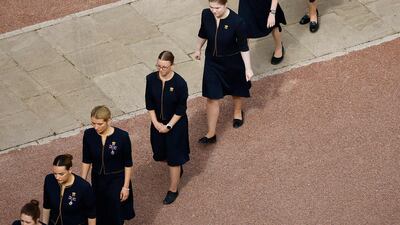
Buckingham Palace household staff return through the gates of the palace after paying their respects. AFP -
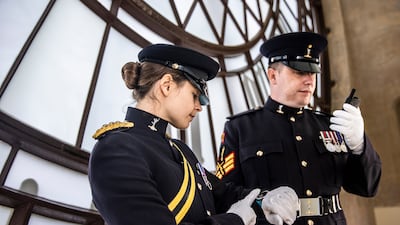
Staff Sergeant Yeoman Darren Fowler, right, and Captain Rebecca Cooper from the Royal Signals at the Elizabeth Tower, checking that Big Ben Chimes in time with gunfire during the state funeral procession. EPA -
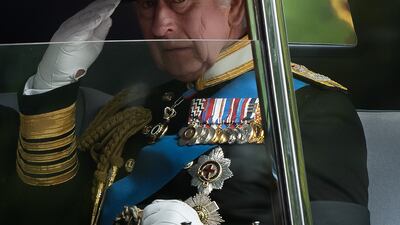
King Charles salutes as he is driven past Wellington Arch in London. Getty Images -

The London skyline is seen as the procession moves down The Mall. Getty Images -
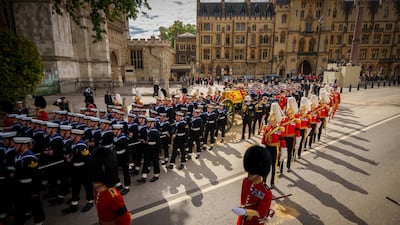
The coffin of the queen is pulled on a gun carriage by Royal Navy sailors from Westminster Abbey. Getty Images -
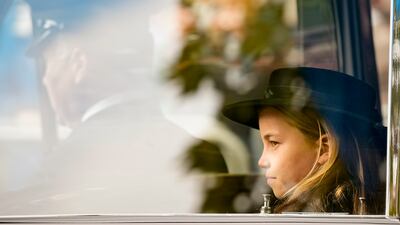
Princess Charlotte arrives by car ahead of the funeral in central London. AP -
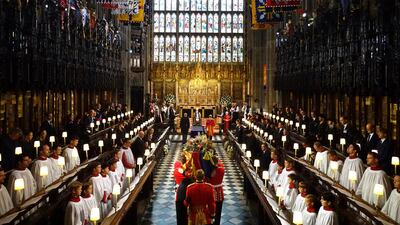
The coffin is carried into St George's Chapel for the Committal Service, in Windsor Castle. AP -

A woman cries in London's Hyde Park while watching the funeral service. AP -
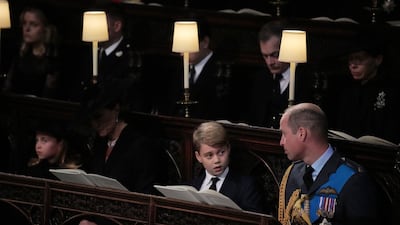
Prince George looks towards his father Prince William during the Committal Service at St George's Chapel. Getty Images -
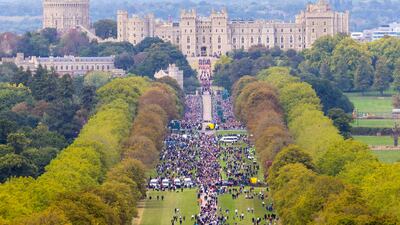
Queen Elizabeth's coffin is driven along the Long Walk towards Windsor Castle. Reuters -
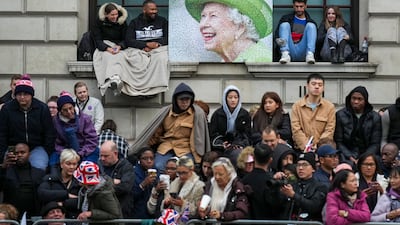
People waiting along the route that the coffin will be pulled on a gun carriage in central London. AP -

King Charles and the Queen Consort Camilla follow the coffin at St George's Chapel. AP -

The Royal State Hearse arrives at Windsor Castle. Getty Images -
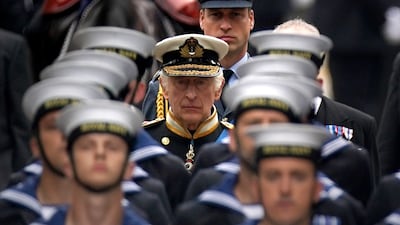
King Charles follows the State Gun Carriage as it carries the coffin at Westminster Abbey. PA -
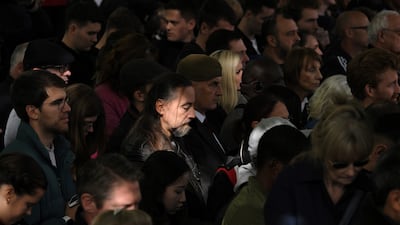
Members of the public gather to see the coffin as it travels from Westminster Abbey to Wellington Arch in London. Getty Images -
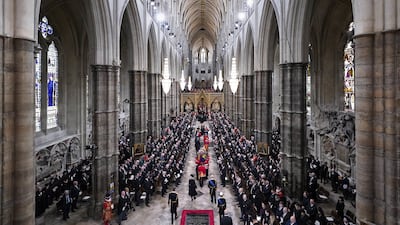
King Charles and members of the royal family follow behind the coffin as it is carried into Westminster Abbey. PA -
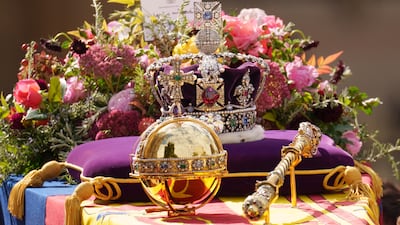
The Imperial State Crown resting on the coffin. Getty Images -
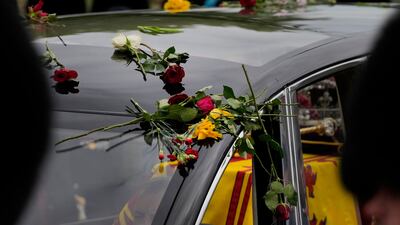
The hearse transporting the coffin is covered in flowers thrown by the public. AFP -
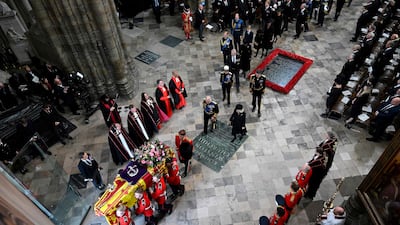
The Bearer Party of The Queen's Company, 1st Battalion Grenadier Guards carries the coffin from Westminster Abbey. AFP



