



Light yellow, cardamom-infused Arabic coffee might be ubiquitous across the Gulf, but Saudi Arabia has promoted its local brews to help protect the kingdom’s heritage.
The Saudi Ministry of Culture has declared 2022 to be the “Year of Saudi coffee” as part of an initiative to highlight its cultural value.
“I have only ever known it to be Arabic coffee, or qahwa as we call it in Arabic, and now everywhere I go, even on the plane, they offer it as 'Saudi coffee', which got me really fascinated and piqued my curiosity,” said Talia Ashgari, who lives in Riyadh.
The government’s move to promote local production has already had an effect, with baristas in Riyadh’s trendy cafes favouring domestic beans over international imports.
-
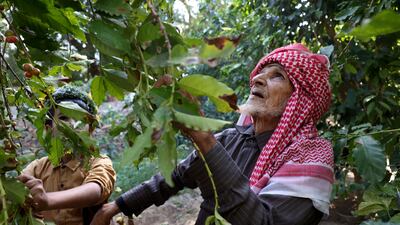
Farah Al Malki, 90, and his grandson Mansour, 11, harvest Khawlani coffee beans at their farm in Saudi Arabia's south-western region of Jizan. All photos: AFP -

Mr Al Malki has a long history with coffee, which spread from Ethiopia to Yemen and then to the rest of the Middle East around the 15th century. "My father inherited it from his grandfathers, and I took over and passed it down to my sons and then on to my grandchildren," he says. -
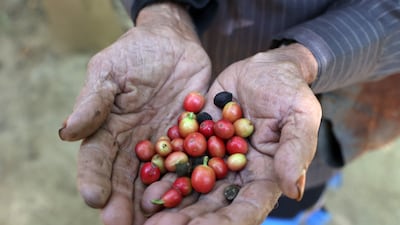
Jizan is known for its red Khawlani coffee beans, often blended with cardamom and saffron to give a yellowish hue of coffee — locally known as ghawa — and a taste markedly different from the bitter black liquid drunk elsewhere in the Middle East and in the West. It remains an integral part of Saudi culture, so much so that the government has designated 2022 as 'The Year of Saudi Coffee'. -

"The biggest issues we used to have were the lack of water and support," says Mr Malki. But with the kingdom's desire to diversify its economy away from oil, alongside a social shift to transform the country's ultra-conservative image and open up to visitors and investors, the government last month began a campaign to promote its coffee. It instructed all restaurants and cafes to use the term "Saudi coffee" instead of Arabic coffee. -
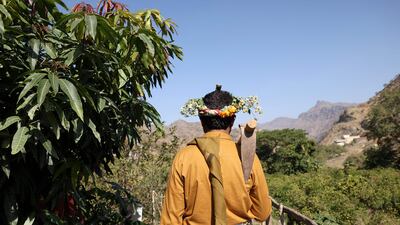
Saudi Aramco, the largely state-owned oil company, announced plans to establish a coffee centre in Jizan using "advanced irrigation techniques to improve agricultural capacity". By the end of 2021, the kingdom had 400,000 coffee trees on 600 farms across the country, producing about 800 tonnes of coffee a year. That is a fraction of what Ethiopia produces, but Saudi Arabia plans to plant 1.2 million Khawlani trees by 2025. -
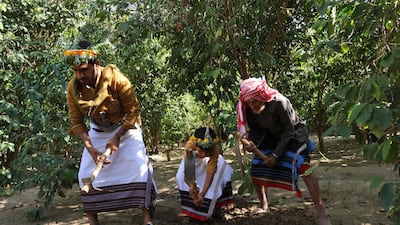
Mr Malki has nine sons, all of whom take part in the coffee industry, ranging from agriculture and packaging to transportation and marketing. On the field every day is his son Ahmed, 42, left, who like his father is dressed in traditional farmer's clothing. He says he has an intimate knowledge of Khawlani coffee beans, explaining: "All farms are organic and free of chemicals." -
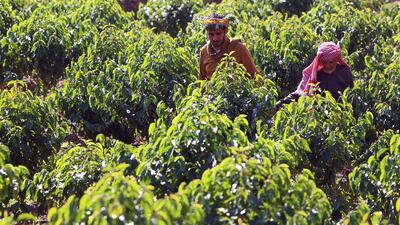
They produce about 2.5 tonnes of coffee beans a year, selling for between $27-$40 a kilogram. -
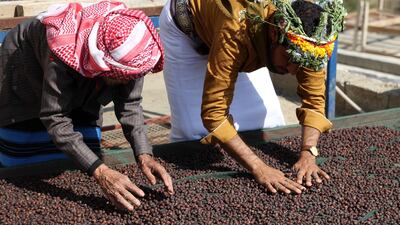
Saudi Arabia has sought to include its cultivation of Khawlani coffee on the list of "intangible cultural heritage of humanity" maintained by the UN cultural agency, Unesco. This, Ahmed says, would be a dream come true. -
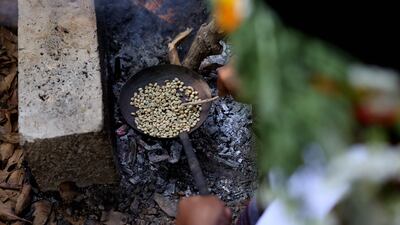
"It will help in supporting farmers and preserving coffee trees as well as attracting foreign investors to the region," he says. "I hope to pass this on to my sons and their sons, and pray it be a source of livelihood for them."


Starbucks co-founder Zev Siegl praised the quality of the khawlani coffee from the south-western region of Jazan when he visited this year.
Farmers in south-western regions including Aseer and Al Bahah grow coffee beans using traditional methods passed down through the generations.
“It takes approximately five years for newly grown coffee plants to bear fruit,” Mayada Badr, chief executive of the Culinary Arts Commission at the Saudi Culture Ministry, told The National.
“The process of harvesting, drying and peeling is also carried out in traditional methods, but sometimes using modern techniques to obtain high-quality crops.”
Ms Badr said that although the culture of drinking coffee was widespread in the region, “the specificity of the practice of preparing Saudi coffee and the combination of the ingredients are unique to the kingdom and differs from other Arab countries”.
The process of farming and brewing coffee is regarded as an authentic symbol of Saudi identity, culture and hospitality, she said.
Hassan Ali, an entrepreneur from Taif, has been stocking his cafe with Saudi beans.
“We have some of the best coffee in the world and the biggest coffee chains in the world are acknowledging that right now,” he said in reference to Mr Siegl’s visit to the kingdom.
“We stopped importing coffee two years ago. Even during Covid-19 we were discovering different coffee farms within the kingdom to set up the future of our coffee shop that would only serve local coffee.
“We no longer need to import when we can harvest beans here and now the situation has changed, you've got the world looking to us.
“It's part of our culture and heritage and makes us proud to finally put Saudi Arabia on the map with the efforts of the Ministry of Culture.”
Saudi Arabia produces about 1,810 tonnes of coffee a year and production has grown through agreements that aim to standardise quality and boost export supply.
Saudi Arabia’s Public Investment Fund in May launched the Saudi Coffee Company to build a national industry supply chain.
Ms Badr said the farmers took a lot of pride in their work.
“They care so much about the quality of their coffee, so they make sure to carry sufficient amounts for daily use when travelling,” she said.
The khawlani coffee bean is the predominant variety in the kingdom and she said the best farms produced it using methods passed down through generations.
But each region has its own traditions, with different flavours changing across the kingdom depending on the spices used.
People in Jazan use coffee husks to prepare what they call “mardom coffee”, which has a sweet taste.
In some southern regions, more water is added to create a lighter brew, with ginger and ajwain seeds adding to the flavour.
In the south-western region of Najran, coffee is often roasted with wormwood and mastic to give the drink a distinctive flavour and aroma. Coffee cups are also smoked with mastic.
Al Bahah, meanwhile, is renowned for its “shadwi coffee”, which is considered one of the finest types in the kingdom.
Efforts to promote Saudi coffee have sparked a lot of public interest, Ms Badr said.
“From contemporary coffee shop concepts to fusion coffee blends, Saudi youth enjoy this traditional drink and take pride in the local culture and identity,” she said.
She said it led others to be innovative and introduce modern brewing methods.

