• Abdul Gafur Khatri teaches young girls the art of Rogan painting. All photos: Abdul Gafur Khatri
    Abdul Gafur Khatri teaches young girls the art of Rogan painting. All photos: Abdul Gafur Khatri
  • The Khatri family of Kutch in Gujarat are the only people in India to practise the 400-year-old Rogan artform.
    The Khatri family of Kutch in Gujarat are the only people in India to practise the 400-year-old Rogan artform.
  • Many families have left the art because it was too labour-intensive with little returns.
    Many families have left the art because it was too labour-intensive with little returns.
  • Initially, only boys were taught the art as girls were not able to pursue their passion after they were married.
    Initially, only boys were taught the art as girls were not able to pursue their passion after they were married.
  • A Tree of Life Rogan painting.
    A Tree of Life Rogan painting.
  • Abdul Gafur Khatri with his pupils.
    Abdul Gafur Khatri with his pupils.
  • In Rogan painting, a needle is dabbed into ink and then rolled and dragged to form geometric or floral patterns.
    In Rogan painting, a needle is dabbed into ink and then rolled and dragged to form geometric or floral patterns.
  • Many pupils drop out of classes because of the complexity of the art, Mr Khatri says.
    Many pupils drop out of classes because of the complexity of the art, Mr Khatri says.
  • Hours of dedication and patience are required to produce even an A4-sized piece of Rogan art.
    Hours of dedication and patience are required to produce even an A4-sized piece of Rogan art.
  • Since 2010, the Khatri family has trained more than 400 girls in the art of Rogan painting.
    Since 2010, the Khatri family has trained more than 400 girls in the art of Rogan painting.
  • The Khatri family wish to have more pupils so the artform can be kept alive.
    The Khatri family wish to have more pupils so the artform can be kept alive.

Indian family keeps dying art of Rogan painting alive by teaching young girls


  • English
  • Arabic

A thin thread of paint hangs from a needle as it is slowly guided with deft turns of the hand into a pattern on a piece of cloth.

The process is repeated a few more times until a floral design is ready within minutes.

Sumer Khatri shows off the beautiful pattern while explaining the intricacies of Rogan painting and the struggles his family face to keep the art alive.

Rogan painting is a traditional art of cloth painting practised only in Kutch district of Gujarat, India.

The art, which originated in Iran, is believed to be more than 400 years old and gets its name from the Persian word for "oil", from the main ingredient of castor oil in the paint.

The art of Rogan painting is believed to be more than 400 years old. Photo: Abdul Gafur Khatri

After India’s independence in 1947, only four families in three villages of Gujarat practised this art.

By 1975, the three other families had given it up, as it hardly made a decent living, and took to other means of livelihood.

Since then, the Khatri family in Nirona village is the only family who have kept it alive, in spite of the difficulties.

Sumer Khatri's father, Abdul Gafur, fondly referred to as Gafur Bhai, the head of the Khatri family, is credited with having revived the art for which he was awarded Padma Shri — India's fourth highest civilian award — in November 2021.

“Rogan art is a very difficult and time-consuming form of artwork with low returns," he tells The National.

Earlier, the practice was used as a barter. For marriages, Mr Khatri's family would make the ceremonial dresses, bedcovers, table covers and more using Rogan art. Weddings and festivities were their main source of income.

Initially Rogan painting was only taught to boys because women were not able to practise the intricate art after they were married. Photo: Abdul Gafur Khatri

Even when the whole family was involved in producing the art, it still did not fetch enough to feed all.

“I left school after fourth grade and focused on the art to earn more money. So did my siblings,” says Gafur Bhai.

Women had to do daily chores and contribute to the family budget, so they were encouraged to do simpler artwork such as bandhej and bandhani (tie and die) which would fetch about 2 rupees, which was quite a deal in those days for the time spent.

Over the years, the practice became so rigid that women would naturally devote their time to other artforms.

Two of his Mr Khatri's nieces also learnt this art, but were unable to pursue their passion after they were married. This discouraged the Khatri family from teaching the artform to other female members.

But word soon got around that the family taught the art to only male members of the family.

Many families gave up the art because it was too labour intensive with small returns. Photo: Abdul Gafur Khatri

“Often we would hear of this allegation that our family was secretive and we don’t show or teach the art process," Sumer Khatri says.

"Things got to such a state that in 2010 an international NGO from Paris, composed of four officials, landed at our home.

"They asked us the reason for the secretiveness and discrimination in teaching Rogan painting."

Gafur Bhai took this as an opportunity to refute all of the claims.

As he demonstrated and explained the intricacies of the art to the team, the officials realised there had been some miscommunication, or a deliberate attempt to bring the family into disrepute.

After the NGO visit, Gafur Bhai decided he would provide Rogan art classes for women only.

“We take in girls to coach them on this art from all communities” he says.

Abdul Gafur Khatri with his pupils. Photo: Abdul Gafur Khatri

Rogan art does not use previously drawn outlines. It is purely from imagination. Hours of dedication and patience are required to produce just one A4-sized fabric.

In the classes, an artist from the Khatri family teaches girls how to dab the needle into the ink, which is a kind of semi-fluid paste, rolling it and dragging the fine thread of ink to make geometric or floral patterns.

Just this basic initiation into the art takes two to three hours.

Since the classes opened in 2010, more than 400 girls have been trained by the Khatri family. The first batch had only 15 girls.

Seeing the complexity of the art, initially the girls were hesitant to enrol. The Khatris had to convince them that one member of the family would be there to guide them.

There is no minimum qualification required for this training but the maximum age is 15 years.

When asked how he perceives the future of the art, Gafur Bhai says he's keen to have more students so that the Rogan is kept alive.

"I sincerely hope Rogan painting would get a heritage tag, which would help to preserve and pursue the art well and also prevent anyone else from faking it," he says.

Kinnal dolls: how one Indian man is keeping a traditional art alive through Instagram - in pictures

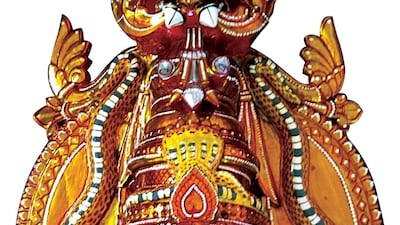
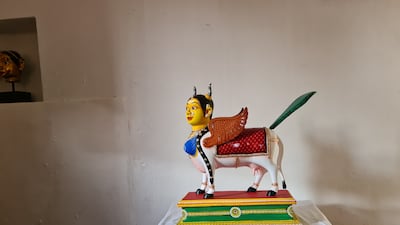
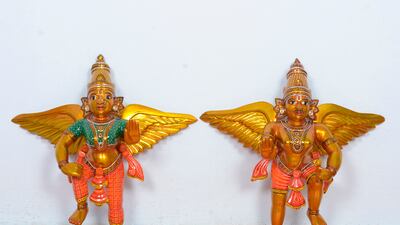
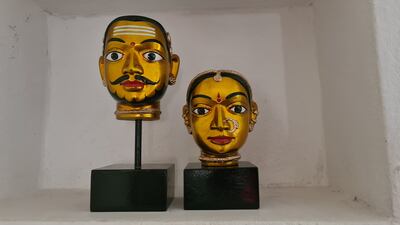
  • The making of Kinnal toys is believed to date back to the 15th or 16th centuries
    The making of Kinnal toys is believed to date back to the 15th or 16th centuries
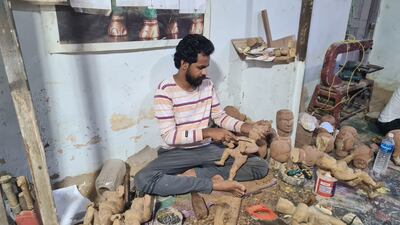
  • Santoshkumar Chitragar is keeping the art of making Kinnal toys alive by selling online and promoting his work through social media
    Santoshkumar Chitragar is keeping the art of making Kinnal toys alive by selling online and promoting his work through social media
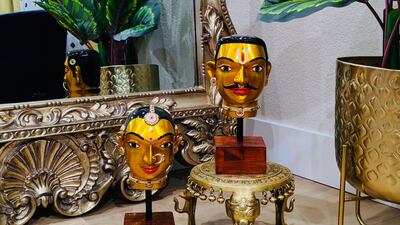
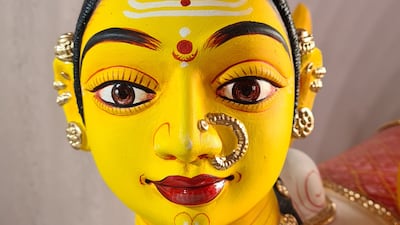
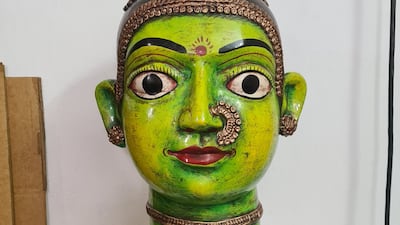
  • Santoshkumar Chitragar creates smaller idols with attention to detail and finish
    Santoshkumar Chitragar creates smaller idols with attention to detail and finish
  • The toys are made from lightweight Polki Marra wood
    The toys are made from lightweight Polki Marra wood
  • Kinnal toy artists belong to a community called Chitragars, who make figurines of icons, gods and goddesses
    Kinnal toy artists belong to a community called Chitragars, who make figurines of icons, gods and goddesses
  • The process of creating these handmade dolls, which can measure between 15 centimetres and 4.5 metres high, is elaborate
    The process of creating these handmade dolls, which can measure between 15 centimetres and 4.5 metres high, is elaborate
  • Santoshkumar Chitragar is popularising the art form through Instagram
    Santoshkumar Chitragar is popularising the art form through Instagram
  • The art form was popular during the time of the Vijayanagara Empire
    The art form was popular during the time of the Vijayanagara Empire
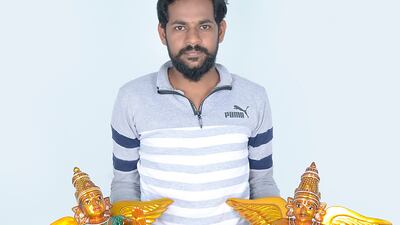
  • Santoshkumar Chitragar with two of his handmade figurines
    Santoshkumar Chitragar with two of his handmade figurines
The%20Super%20Mario%20Bros%20Movie
%3Cp%3E%3Cstrong%3EDirectors%3A%3C%2Fstrong%3E%20Aaron%20Horvath%20and%20Michael%20Jelenic%0D%3Cbr%3E%3Cstrong%3EStars%3A%3C%2Fstrong%3E%20Chris%20Pratt%2C%20Anya%20Taylor-Joy%2C%20Charlie%20Day%2C%20Jack%20Black%2C%20Seth%20Rogen%20and%20Keegan-Michael%20Key%0D%3Cbr%3E%3Cstrong%3ERating%3A%3C%2Fstrong%3E%201%2F5%3C%2Fp%3E%0A

Mercer, the investment consulting arm of US services company Marsh & McLennan, expects its wealth division to at least double its assets under management (AUM) in the Middle East as wealth in the region continues to grow despite economic headwinds, a company official said.

Mercer Wealth, which globally has $160 billion in AUM, plans to boost its AUM in the region to $2-$3bn in the next 2-3 years from the present $1bn, said Yasir AbuShaban, a Dubai-based principal with Mercer Wealth.

Within the next two to three years, we are looking at reaching $2 to $3 billion as a conservative estimate and we do see an opportunity to do so,” said Mr AbuShaban.

Mercer does not directly make investments, but allocates clients’ money they have discretion to, to professional asset managers. They also provide advice to clients.

“We have buying power. We can negotiate on their (client’s) behalf with asset managers to provide them lower fees than they otherwise would have to get on their own,” he added.

Mercer Wealth’s clients include sovereign wealth funds, family offices, and insurance companies among others.

From its office in Dubai, Mercer also looks after Africa, India and Turkey, where they also see opportunity for growth.

Wealth creation in Middle East and Africa (MEA) grew 8.5 per cent to $8.1 trillion last year from $7.5tn in 2015, higher than last year’s global average of 6 per cent and the second-highest growth in a region after Asia-Pacific which grew 9.9 per cent, according to consultancy Boston Consulting Group (BCG). In the region, where wealth grew just 1.9 per cent in 2015 compared with 2014, a pickup in oil prices has helped in wealth generation.

BCG is forecasting MEA wealth will rise to $12tn by 2021, growing at an annual average of 8 per cent.

Drivers of wealth generation in the region will be split evenly between new wealth creation and growth of performance of existing assets, according to BCG.

Another general trend in the region is clients’ looking for a comprehensive approach to investing, according to Mr AbuShaban.

“Institutional investors or some of the families are seeing a slowdown in the available capital they have to invest and in that sense they are looking at optimizing the way they manage their portfolios and making sure they are not investing haphazardly and different parts of their investment are working together,” said Mr AbuShaban.

Some clients also have a higher appetite for risk, given the low interest-rate environment that does not provide enough yield for some institutional investors. These clients are keen to invest in illiquid assets, such as private equity and infrastructure.

“What we have seen is a desire for higher returns in what has been a low-return environment specifically in various fixed income or bonds,” he said.

“In this environment, we have seen a de facto increase in the risk that clients are taking in things like illiquid investments, private equity investments, infrastructure and private debt, those kind of investments were higher illiquidity results in incrementally higher returns.”

The Abu Dhabi Investment Authority, one of the largest sovereign wealth funds, said in its 2016 report that has gradually increased its exposure in direct private equity and private credit transactions, mainly in Asian markets and especially in China and India. The authority’s private equity department focused on structured equities owing to “their defensive characteristics.”

MAIN CARD

Bantamweight 56.4kg
Abrorbek Madiminbekov v Mehdi El Jamari

Super heavyweight 94 kg
Adnan Mohammad v Mohammed Ajaraam

Lightweight 60kg
Zakaria Eljamari v Faridoon Alik Zai

Light heavyweight 81.4kg
Mahmood Amin v Taha Marrouni

Light welterweight 64.5kg
Siyovush Gulmamadov v Nouredine Samir

Light heavyweight 81.4kg
Ilyass Habibali v Haroun Baka

Stats at a glance:

Cost: 1.05 billion pounds (Dh 4.8 billion)

Number in service: 6

Complement 191 (space for up to 285)

Top speed: over 32 knots

Range: Over 7,000 nautical miles

Length 152.4 m

Displacement: 8,700 tonnes

Beam:   21.2 m

Draught: 7.4 m

The specs: 2018 Chevrolet Trailblazer

Price, base / as tested Dh99,000 / Dh132,000

Engine 3.6L V6

Transmission: Six-speed automatic

Power 275hp @ 6,000rpm

Torque 350Nm @ 3,700rpm

Fuel economy combined 12.2L / 100km

The specs: 2019 BMW X4

Price, base / as tested: Dh276,675 / Dh346,800

Engine: 3.0-litre turbocharged in-line six-cylinder

Transmission: Eight-speed automatic

Power: 354hp @ 5,500rpm

Torque: 500Nm @ 1,550rpm

Fuel economy, combined: 9.0L / 100km

F1 The Movie

Starring: Brad Pitt, Damson Idris, Kerry Condon, Javier Bardem

Director: Joseph Kosinski

Rating: 4/5

Ferrari 12Cilindri specs

Engine: naturally aspirated 6.5-liter V12

Power: 819hp

Torque: 678Nm at 7,250rpm

Price: From Dh1,700,000

Available: Now

Ads on social media can 'normalise' drugs

A UK report on youth social media habits commissioned by advocacy group Volteface found a quarter of young people were exposed to illegal drug dealers on social media.

The poll of 2,006 people aged 16-24 assessed their exposure to drug dealers online in a nationally representative survey.

Of those admitting to seeing drugs for sale online, 56 per cent saw them advertised on Snapchat, 55 per cent on Instagram and 47 per cent on Facebook.

Cannabis was the drug most pushed by online dealers, with 63 per cent of survey respondents claiming to have seen adverts on social media for the drug, followed by cocaine (26 per cent) and MDMA/ecstasy, with 24 per cent of people.

How to apply for a drone permit
  • Individuals must register on UAE Drone app or website using their UAE Pass
  • Add all their personal details, including name, nationality, passport number, Emiratis ID, email and phone number
  • Upload the training certificate from a centre accredited by the GCAA
  • Submit their request
What are the regulations?
  • Fly it within visual line of sight
  • Never over populated areas
  • Ensure maximum flying height of 400 feet (122 metres) above ground level is not crossed
  • Users must avoid flying over restricted areas listed on the UAE Drone app
  • Only fly the drone during the day, and never at night
  • Should have a live feed of the drone flight
  • Drones must weigh 5 kg or less
Avatar%3A%20The%20Way%20of%20Water
%3Cp%3E%3Cstrong%3EDirector%3A%20%3C%2Fstrong%3EJames%20Cameron%3C%2Fp%3E%0A%3Cp%3E%3Cstrong%3EStars%3A%20%3C%2Fstrong%3ESam%20Worthington%2C%20Zoe%20Saldana%2C%20Sigourney%20Weaver%3C%2Fp%3E%0A%3Cp%3E%3Cstrong%3ERating%3A%20%3C%2Fstrong%3E3.5%2F5%3C%2Fp%3E%0A
The White Lotus: Season three

Creator: Mike White

Starring: Walton Goggins, Jason Isaacs, Natasha Rothwell

Rating: 4.5/5

COMPANY%20PROFILE
%3Cp%3E%3Cstrong%3ECompany%20name%3A%3C%2Fstrong%3E%20Switch%20Foods%3Cbr%3E%3Cstrong%3EStarted%3A%3C%2Fstrong%3E%202022%3Cbr%3E%3Cstrong%3EFounder%3A%3C%2Fstrong%3E%20Edward%20Hamod%3Cbr%3E%3Cstrong%3EBased%3A%3C%2Fstrong%3E%20Abu%20Dhabi%2C%20UAE%3Cbr%3E%3Cstrong%3EIndustry%3A%3C%2Fstrong%3E%20Plant-based%20meat%20production%3Cbr%3E%3Cstrong%3ENumber%20of%20employees%3A%3C%2Fstrong%3E%2034%3Cbr%3E%3Cstrong%3EFunding%3A%3C%2Fstrong%3E%20%246.5%20million%3Cbr%3E%3Cstrong%3EFunding%20round%3A%3C%2Fstrong%3E%20Seed%3Cbr%3E%3Cstrong%3EInvestors%3A%3C%2Fstrong%3E%20Based%20in%20US%20and%20across%20Middle%20East%3C%2Fp%3E%0A
Race card

6.30pm: Handicap (TB) $68,000 (Dirt) 1,200m

7.05pm: Meydan Cup – Listed Handicap (TB) $88,000 (Turf) 2,810m

7.40pm: UAE 2000 Guineas – Group 3 (TB) $125,000 (D) 1,600m

8.15pm: Firebreak Stakes – Group 3 (TB) $130,000 (D) 1,600m

9.50pm: Meydan Classic – Conditions (TB) $$50,000 (T) 1,400m

9.25pm: Dubai Sprint – Listed Handicap (TB) $88,000 (T) 1,200m

MATCH INFO

Uefa Champions League semi-final, first leg
Bayern Munich v Real Madrid

When: April 25, 10.45pm kick-off (UAE)
Where: Allianz Arena, Munich
Live: BeIN Sports HD
Second leg: May 1, Santiago Bernabeu, Madrid

Updated: July 01, 2022, 6:02 PM