


It would be fair to say that Pulitzer Prize-winning cartoonist Jim Morin was not former president George W Bush’s greatest fan — and even now, he remains mystified as to why the US went into Iraq in 2003.
“I don’t think he knew why we were there,” Mr Morin says as he reflects on the conflict nearly two decades after it began.
“In terms of the human lives lost, it certainly was not worth it.”
The 69-year-old cartoonist’s misgivings about the war and the former president are hardly a secret: Mr Morin is the artist behind Ambushed, a coruscating chronicle of the Bush years produced with political scientist Walter Clemens.
He pulled few punches as he cast a sceptical eye over the administration’s record in the Middle East and at home.
The cartoons are scathing: one likens the Bush Cabinet to the Keystone Cops — fictional, humorously incompetent policemen — and another depicts a hapless president careening down a waterfall into the chaotic Iraq war.
“My view is he didn’t expect to be elected and he went to his father [former president George H W Bush] and asked ‘What the hell do I do?” Mr Morin tells The National.
“And George Sr says, ‘Dick Cheney will help you out,’” referring to the elder Bush's vice president.

There were a lot of people in George W Bush’s administration who were part of his father’s circle, he added, and it took some time for the former president to “find himself”.
“That's when I really respected him and I found things to like about him, but it was too late,” Mr Morin says.
Now living in the state of Maine, Mr Morin has retired from political cartooning, ending an award-strewn career that lasted more than four decades.
He spoke to The National at the Ogunquit Museum of American Art in southern Maine, a seaside town and famous artists’ colony for more than a century.
Starting out
Mr Morin, who lived under eight US presidents, has used his pen to observe, comment on and often ridicule the American political elite for decades. His fascination with cartooning dates back to his teenage years.
“I was into cartooning and into painting when I was a kid,” Mr Morin says.
French artist Honore-Victorin Daumier "was my first hero and he still is. He’s just a wonderful, wonderful cartoonist.”
He fondly recalls discovering the work of cartoonists such as Herbert Lawrence Block and Tony Auth, who drew for The Philadelphia Inquirer, both of whom served as major inspirations for him to enter the world of cartoons.
The Watergate scandal in the early 1970s — which revealed that former Republican president Richard Nixon was connected to an attempt to steal information from Democratic National Committee headquarters in Washington — led to “a resurgence in the art form” due to all of the “great characters” involved, he says, and spurred his interest even further.
Watergate scandal turns 50 — in pictures
-
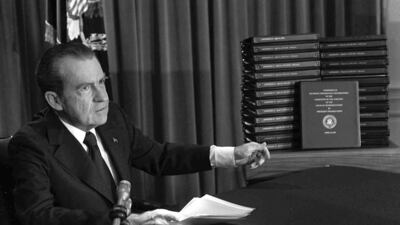
Former US president Richard Nixon points to transcripts of tapes after he announced during a televised speech that he would turn them over to House of Representatives impeachment investigators during the Watergate scandal. AP -

John Ehrlichman, a key figure in the Watergate scandal, was convicted of conspiracy and perjury and served 18 months in prison. AP -
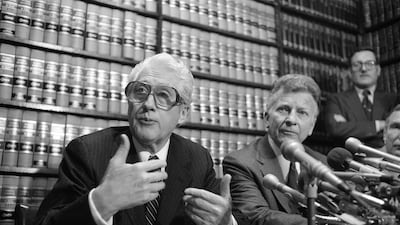
FBI official Mark Felt was the 'Washington Post' informant that helped them break the Watergate story. AP -
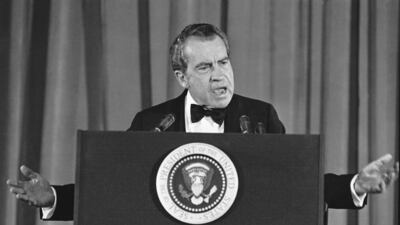
Nixon tells a group of Republican campaign contributors that he will get to the bottom of the Watergate scandal during a speech on May 9, 1973, in Washington. AP -
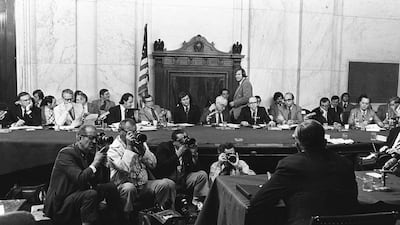
The Senate Watergate Committee hearings on Capitol Hill in Washington took place in 1973. AP -

HR Haldeman, former top Nixon aide, speaks before the Senate Watergate Committee in Washington on July 31, 1973. AP -

Named in the Watergate scandal, from left to right, are G Gordon Liddy, White House counsel John W Dean III, former attorney general John Mitchell, and former Nixon deputy campaign manager Jeb Stuart Magruder. AP -
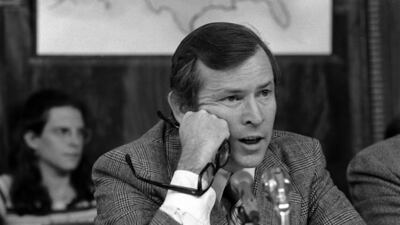
Howard Baker, vice chairman of the Senate Watergate Investigating Committee, questions James McCord during a hearing in Washington, on May 18, 1973. AP -

Nixon says goodbye with a victorious salute to his staff members outside the White House as he boards a helicopter after resigning the presidency on August 9, 1974. AP -

The traumas of Watergate and January 6 are a half century apart, in vastly different eras, and they were about different things. AP -
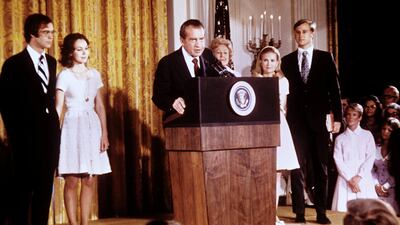
Nixon gives a speech at the White House following his resignation from the presidency after the Watergate scandal. Consolidated News Pictures / AFP -

Parking space D32 in the garage underneath the Oakhill Office Building, where 'Washington Post' reporter Bob Woodward would meet his source known as 'Deep Throat' to exchange notes about the Watergate scandal, in Rosslyn, Virginia. Getty Images / AFP -
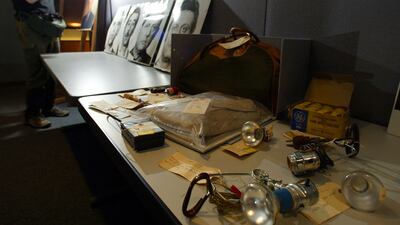
Evidence from the Watergate break-in at the Democratic National Committee headquarters in Washington. AFP -
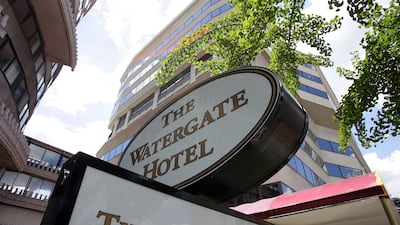
The Watergate buildings feature office suites, a hotel and single-family residences. Getty Images / AFP -
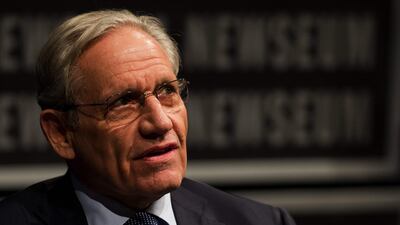
Woodward was a cub reporter when he and veteran 'Washington Post' reporter Carl Bernstein broke the Watergate story. AFP -

A break-in by five men looking to install microphones at the Watergate and take pictures of documents to find compromising information on Nixon's opponents led to the president's downfall. AFP -
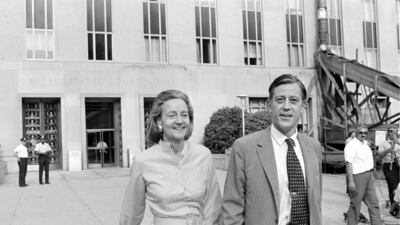
Former 'Washington Post’s' executive editor Ben Bradlee and publisher Katharine Graham seen leaving the US district court in Washington. AP -
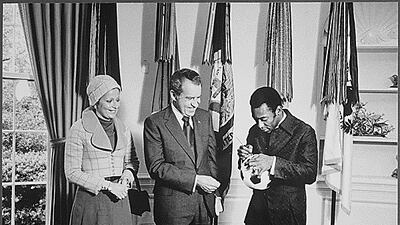
Nixon met football star Pele in 1973 as rumblings of the Watergate scandal were beginning to surface. Photo: US National Archives -
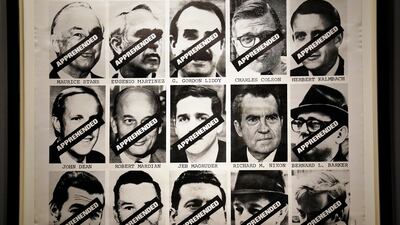
A wanted poster features key people involved in the Watergate scandal at the National Portrait Gallery in Washington. EPA -
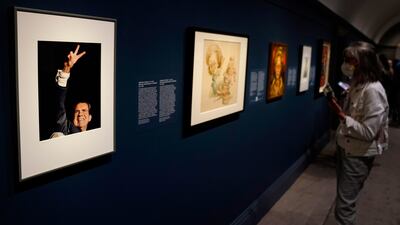
The exhibition presents illustrations from the 50th anniversary of the Watergate scandal. EPA -

A photograph of Mark Felt and 'Time' magazine cover artwork called 'Nixon's Palace Guard' are part of the display. EPA -
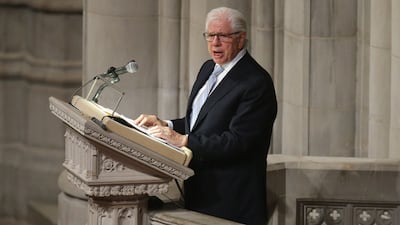
Pulitzer Prize-winning journalist Carl Bernstein eulogises his former boss and 'Washington Post' executive editor Ben Bradlee at the National Cathedral in Washington. Getty Images / AFP -
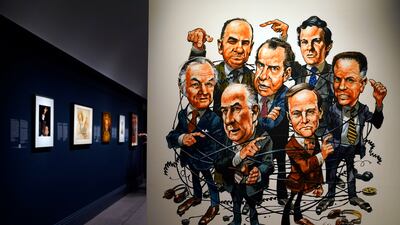
A caricature which appeared on the cover of 'Time' magazine in April 1973. EPA -
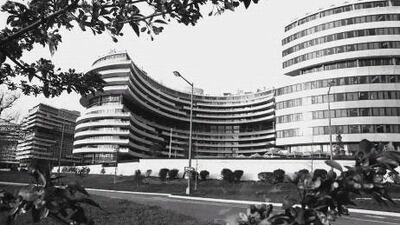
The luxurious Watergate complex in Washington where the Democratic National Committee had its offices in 1973. AP -

The exterior of the modern Watergate Hotel in Washington. Photo: Ron Blunt -
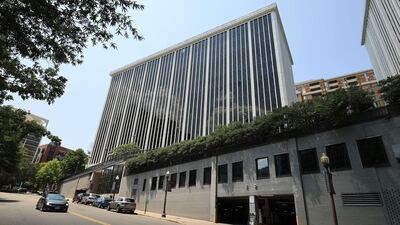
The location of the clandestine meetings between Woodward and Mark Felt in 1972 and 1973 were kept secret until Felt came forward and revealed himself to be Deep Throat in 2005. Getty Images / AFP -

A historical marker stands outside the parking garage underneath the Oakhill Office Building in Rosslyn, Virginia. Getty Images / AFP -
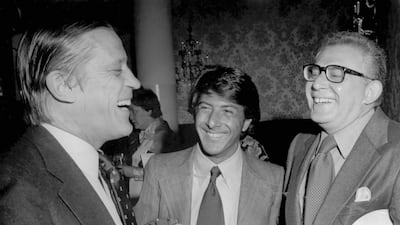
Ben Bradlee, actor Dustin Hoffman and Harry Rosenfeld talk at the premiere of 'All the President's Men' at the Kennedy Centre in Washington. The Washington Post / AP


Mr Morin’s first break came while he was studying at Syracuse University, where a friend asked if he would like to draw for the college paper.
“It started with one cartoon a week, then two, then three and then four,” he says.
“I just abandoned my studies and just started drawing five cartoons a week for The Daily Orange. It was invaluable experience and critical for getting me a job when I came out of college.”
His stint at the college daily provided him with a body of work that he showed to The Beaumont Enterprise, a Texas-based paper with a circulation of 60,000. It wasn't much, he says, but it was a start.
“The minute I got there, I started to send my work to Time, Newsweek, and US News and World Report.”
From Beaumont, he moved on to The Richmond Inquirer in Virginia and then The Miami Herald in 1978, where he remained until his retirement in 2020.
'You think you're going to go mad'
Producing a daily cartoon was initially challenging.
“You're starting out, it really is a grind and you think you're going to go mad,” Mr Morin says.
“You worry about not thinking up an idea and you're worrying about the drawing being terrible and all that stuff.”
Gradually, rather than fretting about meeting a deadline, Mr Morin learnt to relax, keeping an eye on the news. Eventually, ideas for cartoons began to come to him in droves.
“Once I knew what I wanted to say, the idea for the cartoon just happens.”
Such was the popularity of Mr Morin’s cartoons that he was asked to do animated versions.
Not only did he draw the pictures, he did the voices as well — using technical wizardry to produce surprisingly accurate imitations.
The arrival of Donald Trump — “a despicable man” — posed fresh opportunities, as well as challenges.

“My view was that you could draw Trump cartoons five days a week,” he says.
“People wanted some relief, but he was so dangerous, you couldn’t not focus on him.”
Drawing conclusions
Retirement, which has enabled Mr Morin to devote more time to painting, means he consumes news out of interest rather than as a professional obligation.
“I specifically keep up with global warming and the effects of it. It’s impossible to ignore it.”
So, after 40 years in the business, just how much influence do cartoonists have?
Mr Morin guffaws at the question: “George Bush was re-elected — that’s how powerful my cartoons are.”
He says that the level of influence cartoons have is not enough to “convert” people.
“I have met a few people who have been, but I don’t expect it,” he says.
Still, Mr Morin and other cartoonists play an important role in helping people “clarify” their opinions.
“Some people have a feeling about something and they see a cartoon which clarifies their views,” he says. “That’s what I have been told by members of my audience.
“What I am thinking is that they just couldn’t verbalise it and the image crystallises that feeling for them.”

