


We live in the deadliest of times since the Second World War. According to the Uppsala Conflict Data Programme, there were 130 armed conflicts in the world by the year 2021 killing 2.9 million people, sharply up from the 86 conflicts that killed 38,000 at the turn of the millennium. The current Russia-Ukraine war adds to the toll.
This does not convey the full horrors of contemporary wars. Presently, two billion people – a quarter of global humanity – are directly and indirectly affected. Ten times more civilians than combatants are killed or injured. They are also displaced, impoverished, raped, tortured and starved as today’s conflicts are often a no-holds-barred affair, as in Ethiopia’s civil war in Tigray. They also last longer – an average of a decade or more. For example, in Syria or Yemen.
It is against that backdrop that the 75th World Health Assembly (WHA) of ministers from 194 countries gathered in Geneva on May 22-28 under the theme of “health for peace, peace for health”. WHA is the decision-making body of the World Health Organisation (WHO) whose mission is to enable everyone, everywhere achieve a safe and healthy life.
Founded in 1948, WHO defines health as complete physical, mental and social well-being and not just the absence of disease or infirmity. It is also a fundamental right under the 1948 Universal Declaration of Human Rights. Self-evidently, wars are not good for health, and it is right that WHO should turn its mind to it.
However, there is a dilemma at the core of the health-conflict nexus. Healthier populations produce stronger warriors. Conversely, strategists know that attacking the enemy’s civilian infrastructure such as food, water and electricity will sap an opponent’s health and well-being, and so its war-making capacity.
-

Ukrainian servicemen in a shelter at the frontline near Kharkiv. AP -

A Ukrainian and his puppy in the Donetsk region. AP -
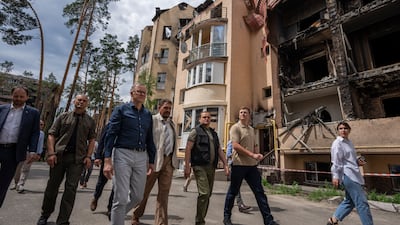
Australian Prime Minister Anthony Albanese, third left, is shown apartment buildings damaged by Russian shelling during his visit to Irpin on the outskirts of Kyiv. AP -
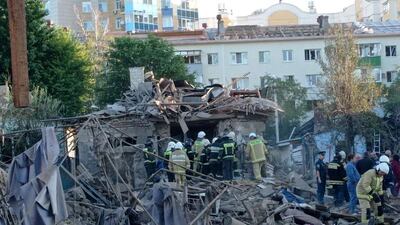
Rescue specialists work at the site of a destroyed residential building after blasts in Belgorod, Russia. Reuters -
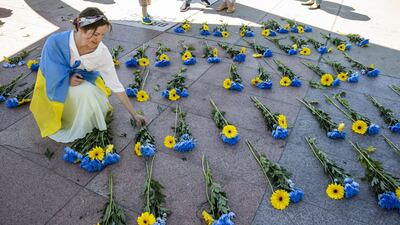
A woman lays flowers during a demonstration against the invasion of Ukraine in front of the Palais des Nations, in Geneva, Switzerland. EPA -
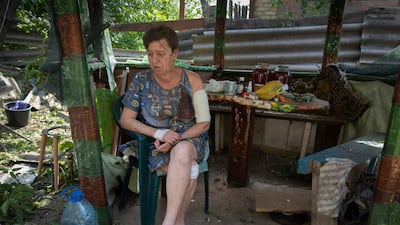
A woman injured when her house was damaged by the Russian shelling sits in the yard of her house, in Bakhmut, Ukraine. AP -
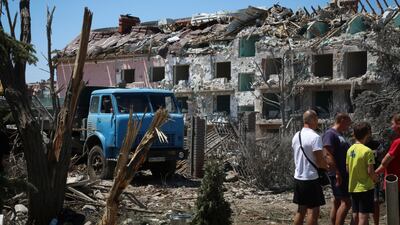
Local residents stand next to a damaged residential building in the town of Serhiivka, about 50 kilometres south-west of Odesa, Ukraine. AP -

Viktor Shevchenko stands in a crater to show its depth after a Russian shelling in the Saltivka district in Kharkiv. AP -

An image taken from a video provided by the Ukrainian Presidential Press Office purports to show the moment a missile struck the shopping mall in Kremenchuk. AP -

People watch as smoke rises after a Russian missile strike hit a crowded shopping mall, in Kremenchuk. AP -
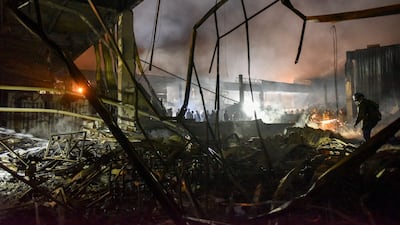
Firefighters clean the rubble of the destroyed Amstor shopping mall in Kremenchuk. EPA -
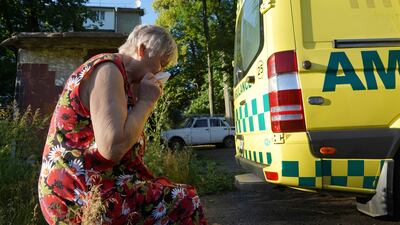
A woman cries after the body of her husband, who was killed in the yard of an apartment building during shelling, was loaded into an ambulance in Kharkiv, Ukraine. AP -

Firefighters and rescue workers at the destroyed Amstor shopping mall. EPA -
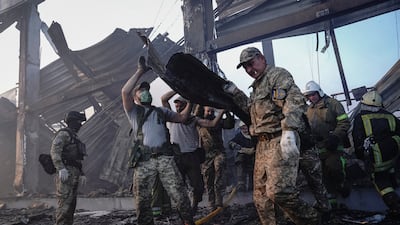
Rescuers work at the site of a shopping mall hit by a Russian missile strike, in Kremenchuk. Reuters -

A couple wounded by a Russian missile strike hold hands in a hospital, in Kremenchuk. Reuters -
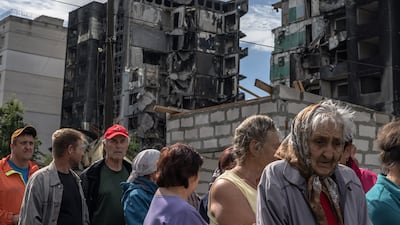
People wait to receive humanitarian aid in front of a residential building damaged during a Russian attack in Borodyanka, Ukraine. EPA -
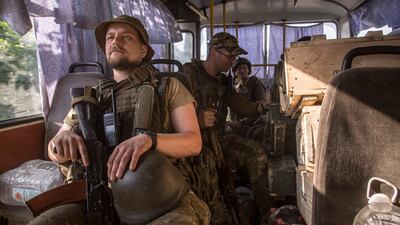
Ukrainian servicemen take a bus to their positions near Severodonetsk, in Luhansk area. EPA -
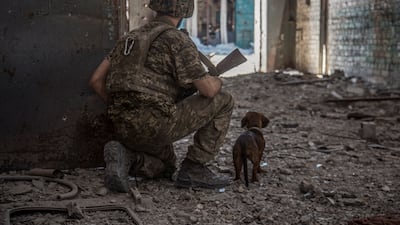
A Ukrainian service member and a dog in the industrial area of the city of Severodonetsk. Reuters -
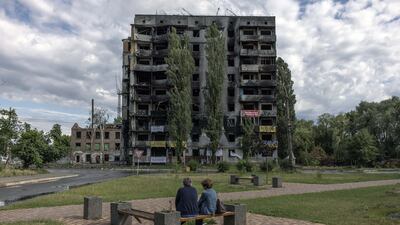
A couple sits in front of a residential building that was damaged during a Russian attack, in Borodyanka. EPA -
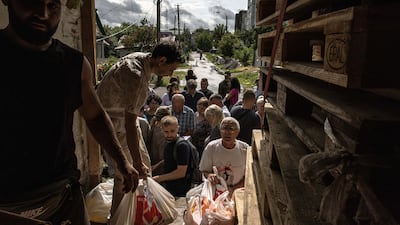
Local residents receive humanitarian aid in Borodyanka. EPA -
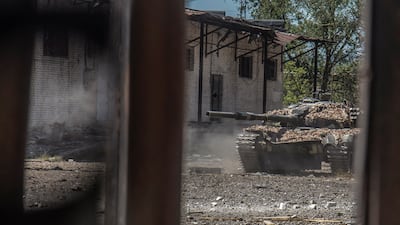
A Ukrainian armed forces tank in Severodonetsk. Reuters -
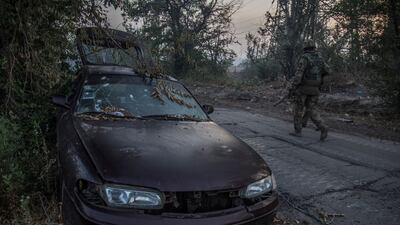
Ukrainian service members walk past a damaged car in Severodonetsk. Reuters -
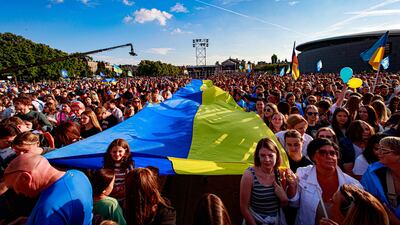
A giant Ukrainian flag is held up during the benefit concert 'Embrace Ukraine' on the Museumplein in Amsterdam. The free event will raise money for victims of the war in Ukraine and the purchase of mobile X-ray equipment that the country needs. EPA -
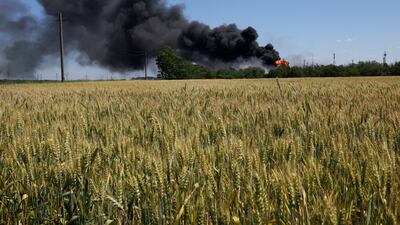
A fire from a gas processing plant continues to burn behind a field of wheat after it was hit by shelling a few days earlier in Andriivka, in the Kharkiv region. Reuters -
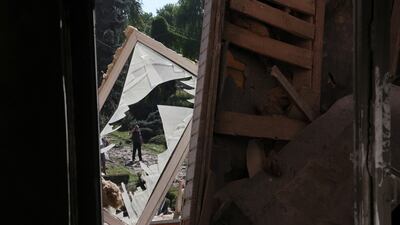
An onlooker takes in the damage from overnight shelling on Kharkiv's Housing and Communal College. Reuters -
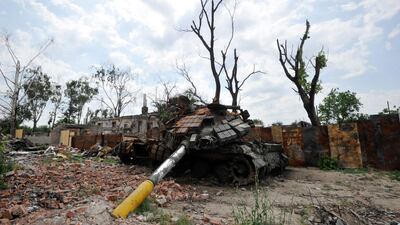
A destroyed tank in the village of Novoselivka, outside Chernigiv. AFP -
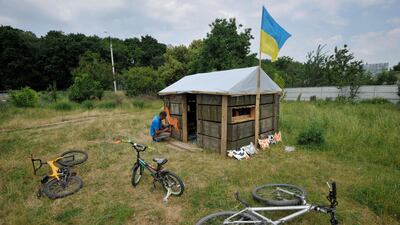
A man decorates a toy cabin for children made from used ammunition crates in the village of Novoselivka, outside Chernigiv. AFP -
An internal view of the Housing and Communal College building damaged by recent shelling in Kharkiv. EPA


Contagious diseases provide an example of health affecting the course of war. For example, the Crusades in the Middle East and the colonial conquest of the Americas. Deliberate disease spread was tried as a weapon as Napoleon attempted with malaria against the English, and the Nazis against the Allies. Nowadays, we call this bioterrorism, a growing risk at a time when deadly organisms such as Ebola are emerging in the context of climate and environmental change. Additional are the lethal health risks from chemical or nuclear weapons.
Meanwhile, we know from numerous recent pandemics such as human and avian influenza, HIV and Aids, Sars, and Ebola that diseases know no boundaries, and require international co-operation. But, as the ongoing altercations over Covid-19 vaccines and earlier shortages of essential drugs illustrate, access to medical technologies can become an existentialist matter. This has securitised global health and politicised it as a critical agenda for G7, G20 and regional forums.
With health becoming a security matter, its direct targeting gets justified. We see increasing attacks against hospitals, clinics, ambulances, medical supplies and workers. WHO’s surveillance system indicates that there were 343 attacks in 2020 rising to 832 in 2021. And with 453 attacks already registered this year, 2022 could go higher. The statistics underestimate prevalence. Not all attacks are reported and the WHO recording system covers just 17 countries.
Ukraine leads the pack of countries where health care is under assault, followed by Myanmar, Afghanistan, Central African Republic and Syria. Yemen and several African nations such as Sudan, Nigeria, Democratic Republic of Congo and Libya are also prominent.
This happens despite many norms and laws prohibiting attacks on health care and civilians, including the Geneva Conventions, international human rights frameworks, and referrals to the International Criminal Court. These modern constructs build on values as old as humanity itself. In every corner of the world and across all cultures and religions, the sanctity of the healer and their business has always occupied a special place. It seems that our ancestors who fought many brutal wars had also figured out a package of moral and ethical rules to limit their damage.
But these taboos are no longer enough. How has our humanity got so degraded? Epidemiologists seek scientific – not moral – explanations. Some postulate that conflict spread is like a disease, akin to that caused by an infectious virus. Therefore, public health epidemic-reversal strategies should be tried. It means detecting and interrupting potentially violent situations, identifying and changing the thinking and behaviour of those most likely to be violent, and changing group norms that perpetuate the use of violence. The “cure violence” theory has had some success with domestic and community violence in the West.
-

Debris lies scattered in front of Al Remal Clinic, Gaza's sole Covid-19 testing laboratory, following Israeli air strikes in Gaza City. Bloomberg -

Ryad Eshkuntana checks on his daughter Suzy as they receive treatment at Al Shifa hospital in Gaza City on May 19, 2021 after an Israeli air strike that killed his wife and other children. AFP -

Palestinians walk past a clinic in Gaza City run by the medical charity Medecins Sans Frontieres that was damaged in Israeli air strikes. AFP -

The Palestinian Ministry of Health in Gaza City which was heavily damaged by Israeli bombardment. AFP -

A Palestinian medic assists a patient out of a damaged clinic run by Medecins Sand Frontieres in Gaza City. AFP -

A wounded Palestinian man lies on a bed in Al Shifa hospital in Gaza City. Reuters


But local quarrels are far from macro-level wars. Nevertheless, comparable approaches are used by diplomats and development practitioners to address the grievances that underlie modern conflicts. Commonly, this is disgruntlement from contested governance and rights, and desperation of poor people denied their basic livelihoods. But peace dividends from diplomatic and poverty alleviation efforts are rare.
Could other health-inspired strategies foster peace? In Afghanistan, I saw the Taliban carrying flasks of polio vaccine during vaccination ceasefires. During Sri Lanka’s bitter civil war, I listened to potential suicide bombers in trauma-counselling centres undergoing change of heart and mind.
In the 1990s Bosnia war, I helped share medical resources to build co-operation across the Muslim-Serb divide, despite the parallel Srebrenica genocide. In Sudan, even as the Darfur genocide unfolded, I used my position at the UN to push for a change in regulations to ease the access of reproductive and sexual health care to women who were raped.
In Sierra Leone, as a British government official, I went on community radio Kiss FM to negotiate with the rebels whose vicious conduct was legendary even as they demanded their favourite hard rock music to be aired in return for not chopping the limbs of their opponents. In Haiti, I heard how rumours of a cholera outbreak that threatened an explosion were defused by paramedics correcting misinformation.
There are countless examples of similar useful health interventions. But sadly, these countries where I worked are still troubled. Perhaps that is because while health-to-peace interventions are well-intentioned, they appear to work by reinforcing mutual self-interest arising from co-operating across warring divides. In short, they appeal to the selfish part of the human psyche and not the unconditionality that is at the heart of the healing task.
That is why major humanitarian bodies such as the International Red Cross and Red Crescent and Medecins Sans Frontieres are loath to endorse the notion of health as a bridge for peace. Because, by doing so, it may politicise impartial humanitarian action, and reduce unfettered access to those who need help. But neither has this traditionalist caution stemmed assaults on the humanitarian medical mission.
The political economy of armed conflict suggests that while all wars eventually end, they do so only when one or the other side wins or grinds each other to a halt. Then the balance shifts towards making peace. Therefore, the best we can claim for health interventions in conflict is that they may temporarily defuse violence. That is worth achieving, but could we do more?
Health professionals and the WHO must go beyond counting destroyed hospitals and lamenting lost lives. They must figure out better strategies not just to pick up the broken pieces but to prevent and reduce the brutality of today’s conflicts. Only by doing that can we keep alive the notion of a shared humanity. That is an essential pre-requisite for whenever warring peoples become ready to give peace a chance.

