



The mysteries of space have confounded and astounded humankind throughout history.
The relentless search for answers to the secrets in the skies has inspired the world to put feet on the Moon and continue to embark on journeys into space to deepen our understanding of the universe around us.
The thirst for knowledge was further fuelled by sightings of flying objects and what appeared to be messages from other galaxies.
Earlier this week, China claimed to have received mysterious signals from what could be an “alien civilisation”, but then deleted the report.
Recently, Nasa formed an independent team of researchers that will study sightings of unidentified aerial phenomena, a term now used by the space agency to refer to UFOs (unidentified flying objects).
Thousands of UFO reports are filed each year from people around the world, although Nasa has never referred to any of these sightings as “aliens”.
Scientists say these sightings often have a simple explanation. But for some, incidents are still an enigma.
The National lists five of the strangest space mysteries reported over the years.
Unidentified object flies past SpaceX crew capsule
Last year, an unidentified object flew dangerously close to a SpaceX Crew Capsule.
The object streaked past the spacecraft only minutes after it had separated from its Falcon 9 rocket booster.
The unusual event was caught on camera and took the internet by storm, with many users spooked by the incident.
Some experts said it must have been ice from liquid oxygen in the rocket, but neither SpaceX or Nasa confirmed this assertion.
Minutes before the object flew past their capsule, astronauts on the spacecraft were asked to put their suits on immediately and secure themselves into their seats.
China receives signals from 'alien civilisation'
Earlier this week, China said its enormous Sky Eye telescope may have received signals from “alien civilisations”.
A report was published by China’s Science and Technology Daily on June 14, which was later deleted without explanation.
But the news quickly went viral and was trending on Twitter, with news organisations around the world reporting the findings.
The signals were picked up by China’s Aperture Spherical Radio Telescope, also called Sky Eye, the largest radio telescope in the world.
It has been searching for extraterrestrial life since 2019 by scanning for radio signals in deep space.
Zhang Tongjie, head scientist at China Extraterrestrial Civilisation Research Group, said that the signals could have been some kind of radio interference, and that more research was needed.
A ‘doorway’ on Mars?
Last month, social media was abuzz with news that a Nasa rover had found an “alien door” on Mars.
Some of the pictures that were circulating online were very convincing, but they were zoomed in significantly, which made the “door” appear larger than it is.

Experts said the formation was a narrow, naturally occurring crevice in the rocky, barren terrain, according to AP.
The images were taken by the Curiosity rover, which was investigating a region on Mount Sharp on Mars, an area that could hold further evidence that shows the planet was once wet and then dried out.
Nasa’s Perseverance rover, which landed on Mars last year, is searching for signs of ancient life.
‘Mystery hut' on the Moon
Earlier this year, images of a “mystery hut” on the Moon’s far side went viral.
They were taken by China’s Yutu 2, a robotic lunar rover that landed on the Moon in early 2019.
The structure certainly had a strange shape and baffled many social media users.
But after driving for two weeks, the rover got close enough to the mystery object to take clearer images of it.
Turns out it was only a rabbit-shaped rock.
The rover’s team described it as a ‘jade rabbit’, a figure from Chinese mythology that lives on the Moon.
Mysterious radio signals from centre of our galaxy
Last year, scientists were puzzled after unknown radio signals were being received from the centre of the Milky Way.
There were several signals recorded in the past year, but astronomers were unable to find the source.
A study in the Nature Journal suggests that they could have been coming from hidden planets.
Exoplanets: 10 terrifying worlds in our galaxy — in pictures
-
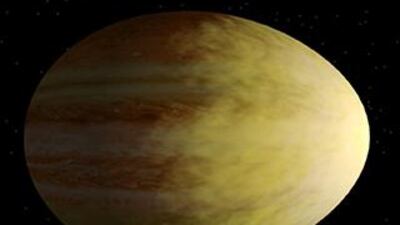
WASP-12b is a planet that will be destroyed by its parent star in 10 million years. The star is so hot that it is tearing apart the planet’s atmosphere, with the extreme gravity causing giant tidal forces that are stretching the planet into the shape of an egg. All photos: Nasa -
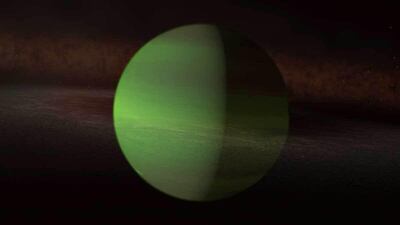
AU Microscopii b is constantly blasted with deadly X-rays and other radiation from its star. The gas giant exoplanet takes 8.5 days to complete one orbit around its star. It was discovered in 2020. -

KELT-9b was discovered in 2017 and has a mass nearly three times bigger than Jupiter, but is only half as dense as the planet. It has a dayside temperature of more than 4,315°C and orbits a star (pictured) that is almost twice as large and hot as the Sun, which blasts the planet with high levels of ultraviolet radiation. -

Kepler 16b is a rocky planet that orbits two stars. It lies in a habitable zone, where liquid water could exist. -

PSR B1257+12 b was discovered in 1994 and is described by scientists as “one of the creepiest ones”. It orbits a pulsar – a rapidly rotating neutron star, which is the dense core of a massive star that exploded. The planet, like any other the orbits a pulsar, is inhospitable and is bombarded with constant radiation from its star. -
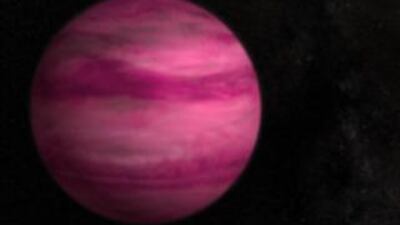
GJ 504 b is four times the size of Jupiter and is 57 light-years away from Earth. Nasa reports that this world is still glowing from the heat of its formation and its colour would appear as a dull magenta. -

TYC 8998-760-1 b is a brown dwarf that was formed so recently, its powerful glow can be detected by ground-based telescope. Nasa classifies this planet as a brown dwarf, meaning it is considered neither a star or a planet, and somewhere in between. -

55 Cancri e is a lava planet. Its surface is uninhabitable as it is covered in molten lava. The sky in this world sparkles when the surface lava reflects on the dark side of the planet. Only one side of the planet faces the star, the other is completely dark. -
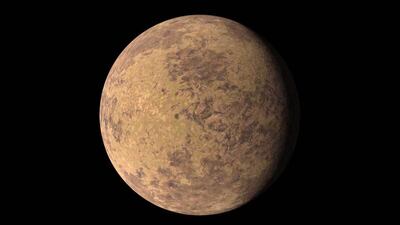
TOI-849 b was discovered in 2020. The planet’s atmosphere is being stripped away because it is so close to its parent star. It is 40 times the mass of Earth and has little or no atmosphere. Surface temperature on the planet is about 1,500°C. -

Kepler-10b is another lava world, which orbits too closely to its star. Daytime temperatures on this planet are more than 1,371°C – hotter than the lava on Earth.



