


The Arabic word of the week requires patience and guidance to hone, but can develop into a means of living and artistry.
Herfe is craft, trade or profession. But it is not like the way we think of a career or occupation (mihna) today. Historically, artisans, or herfiyoon, had to undertake years of apprenticeship under a master craftsperson before developing the skills necessary to start an independent practice. Of course, we could find an analogy in the contemporary academic setting, but a person’s herfe, especially in the Arab world, became such a defining facet that, generations later, we still find their descendants named after their trade.
As such, as we unpack some of the common heraf (plural of herfe), you might recognise some of the words as surnames of friends, colleagues and celebrities.
Najjar is carpenter. Khayat is tailor. Lahham is welder or butcher. Haddad is a blacksmith. Khabbaz is a baker. Halawanji is a person who makes sweets. Iskafi is a cobbler.

The arts are also considered heraf, including painting, or fann el rasem; sculpting, or alnahet; photography, or fann el tasweer; as well as khattat, or calligrapher.
But in some Arab countries the professions are known by other names. In Iraq, naqar is najjar. Ashkab is iskafi. Ashbar is khayyat.
The word herfe also gives us the opportunity to delve into the local crafts. In the Khaleej, these skills were developed over time as a direct result of need and demand. They also express a range of artistic sensibilities.
For instance, Bedouin in the UAE practised a traditional form of weaving called sadu, which uses the wool of sheep, camels and goats and incorporates intricate geometric designs that reflect social identity as well as the surrounding environment. The practice has been used to create traditional bait al shaar, a form of tent, as well as dividers inside. Camels were also fitted with vibrant and colourful accessories made of sadu.
In 2011, sadu was inscribed on the Unesco List of Intangible Cultural Heritage in Need of Urgent Safeguarding.
Scroll through the gallery below to see 12 UAE traditions on Unesco's list, including sadu
-

Arabic calligraphy is the latest addition from the UAE, among other countries, to Unesco's intangible cultural heritage lists. AFP -
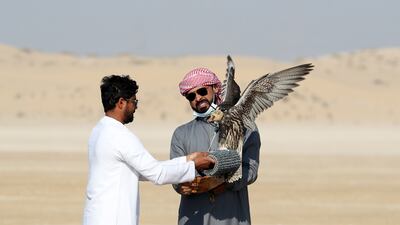
Falconry has been practised in the Arab region for 4,000 years, mainly by desert-dwelling Bedouins as an important form of hunting and fishing in a land with scarce natural resources. Pawan Singh / The National -
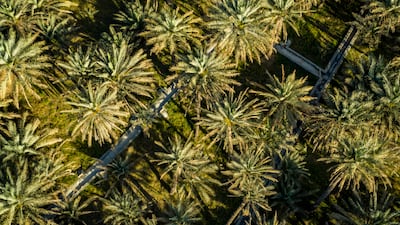
Learn more about al aflaj system in Al Ain in 'Emirates from Above', a National Geographic film. The traditional irrigation network system in the UAE has been added to Unesco's list. -
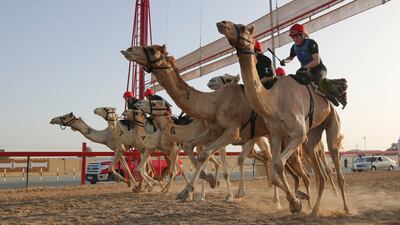
Camel racing, an age-old tradition in the region, is still as popular today. EPA -
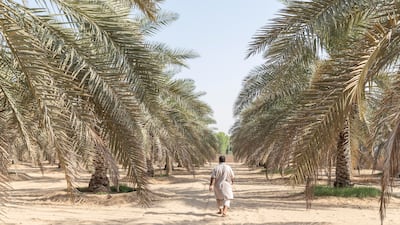
Date palms have been used for centuries for myriad purposes around the Gulf, including the UAE. It was added by Unesco in 2019. Antonie Robertson / The National -
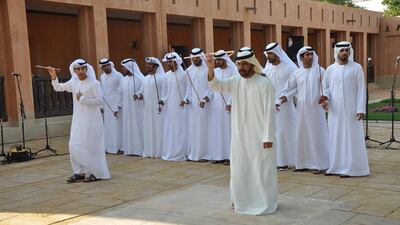
Al azi poetry has been offered protected status by Unesco to develop a clear national identity in the UAE. -
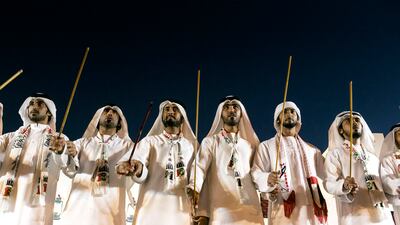
Al rafza is a traditional art form performed by men during special occasions, from weddings to national festivals. Reem Mohammed / The National -
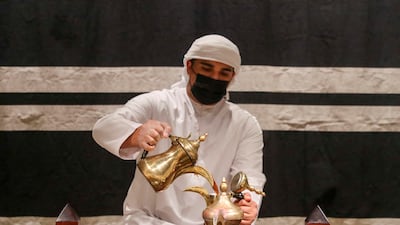
The serving of Arabian coffee is a vital part of hospitality in the region and 'considered a ceremonial act of generosity', says the Unesco inscription. Khushnum Bhandari / The National -
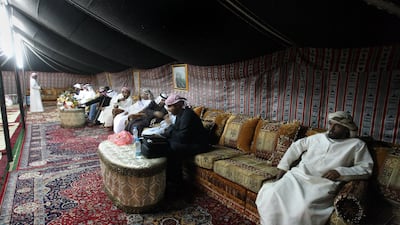
The majlis, a cultural and social space prevalent throughout the region, was added in 2015 on behalf of the UAE, Saudi Arabia, Oman and Qatar. Jaime Puebla / The National -
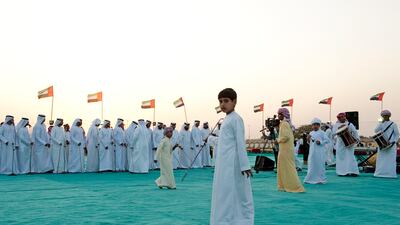
Al ayyala is a cultural performance practised in north-western Oman and throughout the UAE. It was added in 2014. -
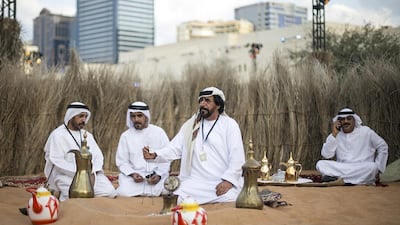
Al taghrooda, traditional Bedouin chanted poetry, was added in 2012. Mona Al Marzooqi / The National -
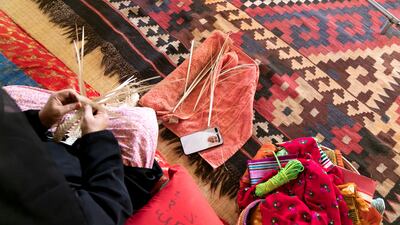
Sadu, a traditional weaving technique, is on the list twice, once for the UAE and once for Saudi Arabia and Kuwait. It was added for the UAE in 2011. Reem Mohammed / The National


Khoos is another form of weaving that involves braiding palm fronds to form an object. The objects made often serve a functional purpose, such as the circular surood, on which food is placed, or the fan-like mahafah, used to cool oneself or fan a flame.
Another traditional craft is talli. A form of embroidery, talli involves using cotton or silk threads intertwined with gold and silver to decorate the collars, sleeves and hems of the kandura and thawb.
Then there is boat building, or herfet sinaat el sofon, which played a crucial role in helping develop trade relations across the Arabian Gulf and the Indian Ocean. The boats, which were used for pearling and fishing expeditions, made up the backbone of the local economy.
Finally, two sayings around the theme of herfe, both of which imply that an artisan rarely uses their skills for themselves: Bab el najjar makhloue, which translates to “the carpenter’s door is broken”; and bait el iskafi hafi, which translates as “the cobbler’s house is barefoot”.
Scroll through the gallery below to see The National's pick of Arabic words of the week
-
'Alwan': Arabic word for colours can paint and reveal. -

'Jamal': Arabic word for beauty, be it literal or figurative. -

'Najm': Arabic word for star glimmers with ambition, fame and the night sky. -
'Kareem': Arabic word for generosity resonates with honour. -
'Waraq': Arabic word for paper can be orderly or duplicitous. -
'Hudood': the Arabic word for borders maps out social and political boundaries. -

'Rooh': Arabic word for 'spirit' and 'soul' can also mean 'go'. -
'Tayeb': an Arabic word for the well-mannered and the flavoursome. -
'Mustaqbal': Arabic word for future can inspire and unnerve. -
'Nashef': Arabic word for dry has wide range of uses. -

'Helu': the sweetest word in Arabic, depending on how you use it. -

'Hurriyeh': the Arabic word for freedom - from the personal to the potted. -

'Ain': Arabic word for eye is a symbol of affection, envy and desire. -

'Akel': Arabic word for food can refer to home-cooked meals, embezzlement, fire and rust. -

'Herfe': Arabic word for craft is about breadwinning and artistry.



