


On a visit to Mosul last month, I was stunned at the state of the Old City five years after its liberation from ISIS. At the entrance to Iraq’s second-largest city, the smiling faces of the Iranian general Qassem Suleimani and the Iraqi Shiite militia leader Abu Mahdi Al Muhandis, both assassinated in a US drone strike in 2020, project power even from beyond the grave on a poster that declares: “Oh Martyrs, the mosques, churches and temples of Ninewa will not forget your blood."
Prominently posted in front of one of the city’s churches was the photo of Qais Al Khazali, the notorious leader of the Shiite militia Asaib Ahl Al Haq, unsmiling, clad in a white turban alongside the Iraqi flag.
I walked down streets, observing the gutted stores, pulverised houses and piles of rubble strewn with skeletons and ordnance – the urbicide of a city once renowned for its commerce, culture and cosmopolitanism. In 2017, in the battle to liberate the city, tens of thousands were killed by ISIS, Iraqi Security Forces, Shiite militias and coalition air power. The exact number will never be known. For those who still live here, there are only a couple of hours of electricity a day from the grid, limited employment opportunities and plenty of humiliation and open sores. Few “Maslawis”, as the residents of Mosul are called, have returned to rebuild their homes – they are dead, displaced or detained.
Unesco estimates that 80 per cent of the Old City was destroyed. It has begun rehabilitating cultural heritage to “revive the spirit of Mosul”, financed largely by the UAE and the EU. One of their local engineers showed me around what remains of the 12th-century Nuri Mosque where, in 2014, Abu Bakr Al Baghdadi had announced the establishment of the caliphate from its pulpit. He pointed out how ISIS had embedded IEDs in the walls – which fortunately had not detonated. But bombardments had stripped the mosque of its outer complex. And ISIS had blown up the iconic minaret, nicknamed Al Hadba (the hunchback). It is being recreated, tilting slightly as per the original. The renovated site will also display the newly excavated prayer hall and ablution rooms, which had been covered up after restoration work in 1944 and which were recently discovered when clearing away the debris.
In the evening, I visited the Bytna Institution for Culture, Heritage and Arts, established in 2019 in a century-old house a stone’s throw from the Nuri Mosque. In one of the renovated rooms, displayed on dozens of small wooden shelves, are old objects from bygone eras – a water bowl for ablutions, an iron, a coffee pot, a knife. Taking pride of place at the centre of one wall is a photo of three dignitaries, a Muslim, a Christian and a Jew sitting together – a memento of the multicultural city of a bygone era. On the roof, which has been turned into a cafe, I sat with a group of Iraqis and Brits who work for the Halo Trust, a mine-clearance NGO of which I am a trustee, drinking dried lime tea. Surrounding us were massive photos of Mosul in its halcyon days.
Before leaving Mosul, we scrambled down the bank of the Tigris. Looking across the river, one of my British colleagues recited by heart the opening stanza of John Masefield’s poem Cargoes.
"Quinquireme of Nineveh from distant Ophir, Rowing home to haven in sunny Palestine, With a cargo of ivory, And apes and peacocks, Sandalwood, cedarwood, and sweet white wine."
Beneath the ruins of Bash Tapia, the 12th-century castle famed for its role in withstanding the siege of the Persian leader Nadir Shah in 1744, we planted a few trees with a local NGO, Green Mosul – seeds of hope in a city that is still grieving.

In contrast with Mosul, Ramadi has little cultural heritage to boast of. It is known in western imagination only as a byword for resistance to US forces – and as the seat of the Anbar Awakening, the Sunni resistance that turned against Al Qaeda in Iraq. It, too, had been devastated in the fight against ISIS. But Anbar is now one of the most stable regions in the country. In Ramadi, there is no visible presence of Shiite militias – nor their posters. Displaced Anbaris have returned to their homes. And there is a construction boom.
Waleed, a well-groomed Ramadi resident in his twenties, was excited to show me the progress his hometown has made since liberation from ISIS. One evening, we went to Chocolate Sarayi, where we ordered the most delicious waffles and ice-cream. Afterwards, we strolled along the Euphrates. “It’s just like Paris!” Waleed declared with a big smile. I had to laugh. It was not quite the riverside walk of the Seine, but it was paved, with a springy running track, trash cans and solar lights. Waleed was keen to show me more. We drove through a newly built underground tunnel; stopped off at a supermarket selling kinder eggs, M&Ms, Cuban cigars in a humidor and perfumes; and passed Viking Burger, Ghost Burger and Hajji Ziyad kebab. We saw the renovated mosque, the new shopping mall, a high-rise five-star hotel, a bar.
While we drove, we shared war stories from an era long past. Waleed pointed out Camp Ramadi, the water tower out of which US snipers had once trained their sights on insurgents, the home of a leader of the Awakening – former landmarks that no longer define the city. Ramadi has been totally transformed from the place I once knew. The scars of war are rapidly receding. The city is flourishing.
My visit to Iraq left me pondering why the trajectories of Mosul and Ramadi are so different – and what the future of the country might hold. In Christopher Blattman’s Why we fight: the roots of war and the path to peace, I found a fresh lens through which to analyse the country. From extensive research around the globe, and drawing on the work of economists, political scientists, psychologists and sociologists, Blattman shows that war is the exception not the rule – that even the bitterest rivals prefer peace because war is so ruinous. It was a reminder that, through the centuries, Iraqis have mostly lived peacefully together.
Blattman identifies five logical ways that politicking can break down, pushing opponents to “bargain through bloodshed”. They include “unchecked interests” of unaccountable leaders who expect to gain personally from conflict; “intangible incentives”, such as vengeance, God’s will, status, freedom and combatting injustice; “uncertainty”, not knowing an opponents’ strength or resolve or how they will act – so attacking even if it is detrimental; “commitment problem”, when no bargains appear credible; and “misperceptions", which interfere with compromise.
After 2003, all five of these conditions had been present to a lesser or greater degree: a new elite that was not rooted in society nor had grassroots support; a desire for revenge for the atrocities committed by Saddam Hussein’s regime; the rejection of foreign occupation; lack of trust among the elites to strike agreements; and American misunderstanding of the complexity of Iraqi society, which led to the accentuating of divides and sub-identities at the expense of national cohesion. Hundreds of thousands of Iraqis had died violent deaths as a result.
Blattman does not regard “poverty, scarcity, natural resources, climate change, ethnic fragmentation, polarisation, injustices and arms” as necessarily interrupting incentives for peace nor as the causes of war – although he acknowledges they can be accelerants of conflict.
What Blattman’s research reveals is that stable societies are ones that manage competition peacefully. They have built insulation through economic, social and cultural interdependence; distribution of power through institutional checks and balances; rules and enforcement, through the law, the state, and social norms; and interventions to deter violence.
Such insulation against violence is partially evident in parts of Iraq today – but not in others.
The social fabric of Mosul has been devastated. The Sunni population is blamed by the Shiite militias for allowing ISIS to take over the city. And the Shiite militiamen – many of whom are from the south of the country – control access through checkpoints, impose taxes and intimidate the residents. This parasitical, extortionist behaviour has deterred private investment. Furthermore, Ninewa is deeply divided along ethnic and religious lines, as well as urban and rural. The urban Sunni Arab Maslawis have been weakened, with no legitimate, recognised leadership of the province with a strong voice in Baghdad.
Ramadi, in contrast, is a homogenous Sunni community linked through the strong connections of the Dulaim tribe. Mohamad Halbousi, the former governor of Anbar province, is currently Speaker of the Iraqi Parliament in Baghdad. He rose to prominence due to his co-operation with Shiite militias and a deal with Iran. Since then, he has gained a monopoly on power, silencing his opposition and ensuring the Iraqi military – not militias – secures the city. He has proven adept at attracting funds from the Gulf, creating the construction boom in his hometown of Ramadi. In contrast with Blattman’s analysis, Iraqis credit Ramadi’s apparent prosperity not to a system that peacefully manages competition but to strongman rule.
In fact, it is in the very political system that was established after 2003 to ensure pluralism that the greatest threat to Iraq’s stability lies. In 2019, a young generation of Iraqis took to the streets en masse to demand not only that politicians resign but that the sectarian kleptocratic system itself be replaced with a government that delivered jobs and services. A new government, led by Mustafa Kadhimi as Prime Minister, and Barham Salih as President, made some reforms but struggled to deliver the fundamental changes that the protesters demanded. In October 2021, a national election was held once more. Six months later, however, a new government has yet to be formed. Negotiations could go on indefinitely with a real risk of renewed violence from Shiite militia angry at being excluded from power – and protests from young Iraqis demanding change. Nor does the constitution help. It does not represent a compromise between different groups. It was drafted quickly, without proper public debate, with key issues left unresolved, and with power diffused so as to prevent the return of a dictator.
On my last Friday in Baghdad, I went with an old friend, Gen Nasier Abadi, to Mutanabbi Street, the bookseller’s street named after the 10th-century Iraqi poet. Devastated by a bombing in 2007, the street is repaved, painted and packed with vendors selling their wares to crowds of Iraqis. We wandered around the Baghdad cultural centre, a restored Ottoman building, in which artisans were selling trinkets and paintings. A young woman approached me to tell me how happy she was to see a tourist in her country, and gave me a bracelet. Different rooms in the building displayed antiquities; a library; old photos from Iraq under the monarchy through to the 1958 revolution; a meeting hall. The rooms bore the names of distinguished Iraqis, such as the historian Ahmed Sousa, the sociologist Ali Al Wardi, the artist and sculptor Jawad Saleem – Jewish, Shiite and Sunni.
Nearby in Al Qishlah Park, an Iraqi musician sang and the crowd clapped along. A local NGO displayed an exhibit warning of the perils of drug addiction. A crowd of young Iraqi men, with their hair gelled up three inches high, sat together under a canopy in fierce debate. I took a selfie at the foot of the clocktower, with a young Iraqi man who told me that his family is comprised of all the components of the country and that he is working on a study of the visual identity of Iraq. A large boat blaring music took Iraqis, young and old, male and female, on a pleasure ride up and down the Tigris.
-

Emma Sky on the Tigris with General Nasier. Photo: Emma Sky -
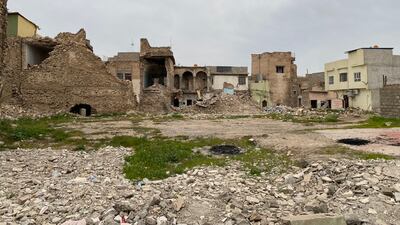
Mosul old city. Photo: Emma Sky -
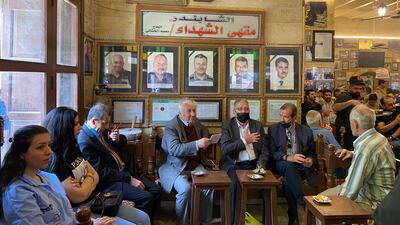
Baghdad's Shahbandar cafe. Photo: Emma Sky -

Qays Khazali poster in front of church in Mosul. Photo: Emma Sky -
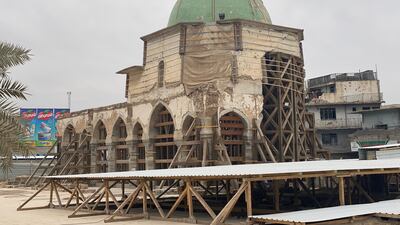
Al Nuri Mosque today, where reconstruction is beginning in Mosul but missing its historic minaret. Photo: Emma Sky -
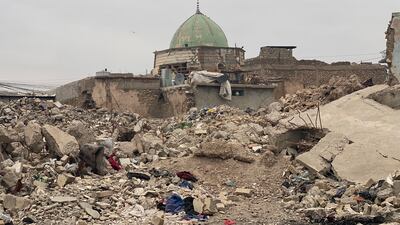
Mosul old city. Photo: Emma Sky -
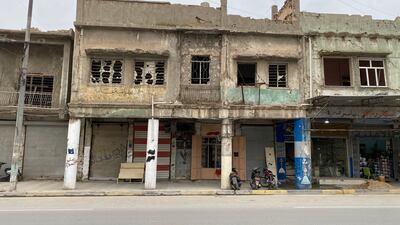
Mosul old city. Photo: Emma Sky -
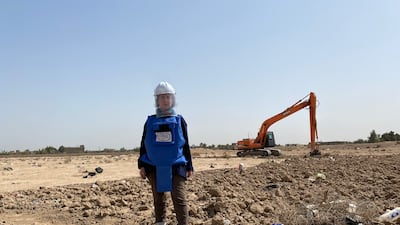
Emma Sky mine clearing as part of role in Halo Trust. Photo: Emma Sky -
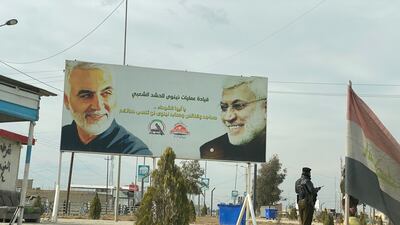
Qassem Suleimani and Abu Mahdi Al Muhandis on a poster at the entrance to Mosul, put up by militias. They have no popular support there - imposed on people. Photo: Emma Sky


“See that iron bridge,” said the ticket collector on the jetty as he pointed out to me the 80-year-old Sarafiya Bridge. “That was built by the British. What did the Americans do for us? Nothing!” In truth, there is little to be seen of the trillion dollars that the US spent in Iraq, I reflected to Gen Abadi as we took a small boat across the Tigris to the other bank to luncheon on masgouf, the famed Iraqi barbecued fish.
Regardless of the political paralysis in Baghdad, civil society has firmly taken root in Iraq. This development can be credited to a new generation that has no connection to the Saddam era, that rejects Islamism in all its forms, and that embraces diversity and civic discourse. This generation is not hostile to the West – despite the bitter memory of occupation. It is rooted in an era when Iraqis were not defined by their sect or ethnicity. It is consciously cultivated by interventions, not to divide the citizens, but to create a shared public space.
As Blattman's book reveals, the path to peace is piecemeal. “It’s winding, often hard to find, full of obstacles." In the case of Iraq, as I discovered during my trip, it is undoubtedly there.
Emma Sky is director at Yale’s International Leadership Centre. She served with the Coalition in Iraq from 2003-2004 and 2007-2010, and is author of The Unraveling: High Hopes and Missed Opportunities in Iraq

