While serving as vice president under Barack Obama, Joe Biden emerged as a vocal supporter of the Eastern Mediterranean gas pipeline that would connect Israel’s offshore gas reserves to Europe.
The long-planned project that would run from Israeli waters through Cyprus and Greece, then onwards into Europe, had bipartisan support in the US.
And in 2020 with the backing of former president Donald Trump's administration, the three countries signed an agreement aiming to complete the roughly $6 billion pipeline by 2025.
But as president, Mr Biden has had a change of heart. US officials informed Israel and Greece last month that the US would no longer support the project, citing environmental concerns over impacts at odds with the administration's move away from fossil fuels.
Henri Barkey, an adjunct senior fellow at the Council on Foreign Relations, said it was “a bizarre thing” for the Biden administration to tell its allies that it no longer supported the pipeline given the timing and the optics.
The US has repeatedly called for Europe to wean itself off of Russian natural gas amid a potential invasion of Ukraine and has long sought to pursue its broader interests in the Middle East by promoting energy co-operation between its regional partners.
“The United States was interested in that because it was a way of increasing co-operation between Cyprus, Turkey and Egypt and it had also ramifications for the other countries in the Middle East,” Mr Barkey told The National.
Mr Biden himself touted the project as a “new opportunity” and a geopolitical “win-win” that could help ameliorate long-standing tension between Turkey and its regional rivals during remarks he made at Harvard University in 2014.
“Turkey fully understands that it is no longer in its interests, they have no interest to have troops remaining in Cyprus,” Mr Biden said at the time.
He added that President Recep Tayyip Erdogan recognised “an overwhelming self-interest for Turkey in taking advantage of the significant resources, particularly gas, that are in the Eastern Mediterranean".
The then-vice president was certainly correct on the second point, but Mr Erdogan opted instead to pursue Turkey’s self-interest in gas through aggressive offshore oil exploration in disputed waters claimed by Cyprus.
Tension in the Eastern Mediterranean boiled over during the Trump administration, with Turkish war vessels accompanying its drill ships near Cyprus, ultimately butting heads with Greek, French and UAE naval fleets.
Turkey also signed an agreement with western Libya’s Tripoli-based government, which emphasised dubiously expansive Turkish claims over a large bulk of Eastern Mediterranean waters — in part to push back against the proposed pipeline.
Still, Turkey and Israel have sought to mend ties in recent months, with Mr Erdogan due to meet Israeli President Isaac Herzog next month after the two countries expelled each other’s ambassadors in 2018.
Mr Erdogan wasted no time in taking a victory lap after the Biden administration cancelled the pipeline, asserting that Israel could provide natural gas to Europe through Turkey instead of through Cyprus.
“There’s no question that if there was a pipeline built from Cyprus to Greece to Europe, the Turks would probably create serious problems,” said Mr Barkey.
Additionally, Europe has emphasised green energy and renewables as the path towards lessening its dependence on Russian natural gas.
But even as the US objected to the Nord Stream 2 gas pipeline from Russia to Germany, few American officials actually expected the Eastern Mediterranean pipeline from Israel to go forward.
A former Trump administration official familiar with the matter told The National that the US never gave the pipeline its “full-throttled support” and that the Energy Department had conducted an analysis finding that the project was not economically viable.
“The pipeline from the beginning was always seen as being a little bit of a pipe dream because it was very expensive,” said Mr Barkey. “It was political, sure. There were American companies involved, but this is not a huge stake.”
Still, he noted that “American support always effects a good housekeeping seal".
“When you have American buy-in, it’s easier for banks to provide financing for more countries to be interested. In that sense, what the US says is important.”
The Biden administration has instead opted to lend the much-sought US imprimatur to other energy projects in the region.
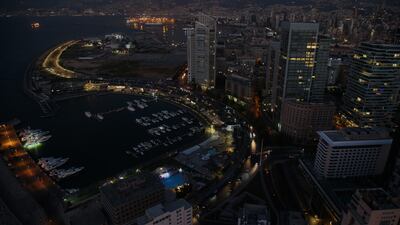
Lebanon's electricity crisis - in pictures
A State Department representative told The National that the Biden administration instead supports a submarine power cable in the Eastern Mediterranean to connect the Greek, Cypriot, Israeli and Egyptian power grids and “pave the way for a clean energy transition in the region and Europe".
“In line with US climate priorities, the United States looks critically at new fossil fuel infrastructure projects to ensure US support is not directed to carbon-intensive sources and does not result in future stranded assets as we accelerate the clean energy transition,” said the representative.
The representative noted, however, that the US is still supportive of some projects to diversify natural gas supplies in Greece, North Macedonia and Bulgaria, “which will be completed sooner — and at a much lower cost — than the East Med gas pipeline".
At the same time, the former Trump administration official told The National that the Energy Department under Mr Biden has refused to release a report that examines the potential for exporting natural gas from Iraqi Kurdistan through Turkey and into Europe given the hesitancy to use fossil fuels.
Conversely, the Biden administration has also thrown its support behind a World Bank-funded gas pipeline from Egypt through Jordan and Syria and into Lebanon.
But Republicans on Capitol Hill have objected to the project on the grounds that it would run afoul of a 2019 Syria sanctions law — despite the Biden administration’s assertions to the contrary.
And while Lebanon and Israel technically remain at war, the Israelis have also expressed interest in exporting natural gas to Lebanon via Jordan and then into Syria.
Amos Hochstein, the senior US adviser for energy security, arrived in Lebanon this week to pursue a separate, ongoing US effort to enable talks with Israel demarcating the maritime border in the energy-rich oceans between the two adversaries.
Although Mr Hochstein had supported the Eastern Mediterranean pipeline when he served in a similar position during the Obama administration, his diplomatic efforts under Mr Biden are more indicative of where US energy priorities in the region currently lie.

Mercer, the investment consulting arm of US services company Marsh & McLennan, expects its wealth division to at least double its assets under management (AUM) in the Middle East as wealth in the region continues to grow despite economic headwinds, a company official said.
Mercer Wealth, which globally has $160 billion in AUM, plans to boost its AUM in the region to $2-$3bn in the next 2-3 years from the present $1bn, said Yasir AbuShaban, a Dubai-based principal with Mercer Wealth.
“Within the next two to three years, we are looking at reaching $2 to $3 billion as a conservative estimate and we do see an opportunity to do so,” said Mr AbuShaban.
Mercer does not directly make investments, but allocates clients’ money they have discretion to, to professional asset managers. They also provide advice to clients.
“We have buying power. We can negotiate on their (client’s) behalf with asset managers to provide them lower fees than they otherwise would have to get on their own,” he added.
Mercer Wealth’s clients include sovereign wealth funds, family offices, and insurance companies among others.
From its office in Dubai, Mercer also looks after Africa, India and Turkey, where they also see opportunity for growth.
Wealth creation in Middle East and Africa (MEA) grew 8.5 per cent to $8.1 trillion last year from $7.5tn in 2015, higher than last year’s global average of 6 per cent and the second-highest growth in a region after Asia-Pacific which grew 9.9 per cent, according to consultancy Boston Consulting Group (BCG). In the region, where wealth grew just 1.9 per cent in 2015 compared with 2014, a pickup in oil prices has helped in wealth generation.
BCG is forecasting MEA wealth will rise to $12tn by 2021, growing at an annual average of 8 per cent.
Drivers of wealth generation in the region will be split evenly between new wealth creation and growth of performance of existing assets, according to BCG.
Another general trend in the region is clients’ looking for a comprehensive approach to investing, according to Mr AbuShaban.
“Institutional investors or some of the families are seeing a slowdown in the available capital they have to invest and in that sense they are looking at optimizing the way they manage their portfolios and making sure they are not investing haphazardly and different parts of their investment are working together,” said Mr AbuShaban.
Some clients also have a higher appetite for risk, given the low interest-rate environment that does not provide enough yield for some institutional investors. These clients are keen to invest in illiquid assets, such as private equity and infrastructure.
“What we have seen is a desire for higher returns in what has been a low-return environment specifically in various fixed income or bonds,” he said.
“In this environment, we have seen a de facto increase in the risk that clients are taking in things like illiquid investments, private equity investments, infrastructure and private debt, those kind of investments were higher illiquidity results in incrementally higher returns.”
The Abu Dhabi Investment Authority, one of the largest sovereign wealth funds, said in its 2016 report that has gradually increased its exposure in direct private equity and private credit transactions, mainly in Asian markets and especially in China and India. The authority’s private equity department focused on structured equities owing to “their defensive characteristics.”
UAE tour of the Netherlands
UAE squad: Rohan Mustafa (captain), Shaiman Anwar, Ghulam Shabber, Mohammed Qasim, Rameez Shahzad, Mohammed Usman, Adnan Mufti, Chirag Suri, Ahmed Raza, Imran Haider, Mohammed Naveed, Amjad Javed, Zahoor Khan, Qadeer Ahmed
Fixtures:
Monday, 1st 50-over match
Wednesday, 2nd 50-over match
Thursday, 3rd 50-over match
UAE currency: the story behind the money in your pockets
THE SPECS
Engine: 2.0-litre 4-cylinder turbo
Power: 275hp at 6,600rpm
Torque: 353Nm from 1,450-4,700rpm
Transmission: 8-speed dual-clutch auto
Top speed: 250kph
Fuel consumption: 6.8L/100km
On sale: Now
Price: Dh146,999
Kandahar%20
%3Cp%3E%3Cstrong%3EDirector%3A%3C%2Fstrong%3E%20Ric%20Roman%20Waugh%3C%2Fp%3E%0A%3Cp%3E%3Cstrong%3EStars%3A%C2%A0%3C%2Fstrong%3EGerard%20Butler%2C%20Navid%20Negahban%2C%20Ali%20Fazal%3C%2Fp%3E%0A%3Cp%3E%3Cstrong%3ERating%3A%3C%2Fstrong%3E%202.5%2F5%3C%2Fp%3E%0A
Vikram%20Vedha
%3Cp%3E%3Cstrong%3EDirectors%3A%3C%2Fstrong%3E%20Gayatri%2C%20Pushkar%3C%2Fp%3E%0A%3Cp%3E%3Cstrong%3EStars%3A%3C%2Fstrong%3E%20Hrithik%20Roshan%2C%20Saif%20Ali%20Khan%2C%20Radhika%20Apte%3C%2Fp%3E%0A%3Cp%3E%3Cstrong%3ERating%3A%C2%A0%3C%2Fstrong%3E3.5%2F5%3C%2Fp%3E%0A
Company%20profile
%3Cp%3E%3Cstrong%3EName%3A%3C%2Fstrong%3E%20WonderTree%3Cbr%3E%3Cstrong%3EStarted%3A%3C%2Fstrong%3E%20April%202016%3Cbr%3E%3Cstrong%3ECo-founders%3A%3C%2Fstrong%3E%20Muhammad%20Waqas%20and%20Muhammad%20Usman%3Cbr%3E%3Cstrong%3EBased%3A%3C%2Fstrong%3E%20Karachi%2C%20Pakistan%2C%20Abu%20Dhabi%2C%20UAE%2C%20and%20Delaware%2C%20US%3Cbr%3E%3Cstrong%3ESector%3A%3C%2Fstrong%3E%20Special%20education%2C%20education%20technology%2C%20assistive%20technology%2C%20augmented%20reality%3Cbr%3EN%3Cstrong%3Eumber%20of%20staff%3A%20%3C%2Fstrong%3E16%3Cbr%3E%3Cstrong%3EInvestment%20stage%3A%20%3C%2Fstrong%3EGrowth%3Cbr%3E%3Cstrong%3EInvestors%3A%3C%2Fstrong%3E%20Grants%20from%20the%20Lego%20Foundation%2C%20UAE's%20Anjal%20Z%2C%20Unicef%2C%20Pakistan's%20Ignite%20National%20Technology%20Fund%3C%2Fp%3E%0A
The specs
Engine: 1.6-litre 4-cyl turbo
Power: 217hp at 5,750rpm
Torque: 300Nm at 1,900rpm
Transmission: eight-speed auto
Price: from Dh130,000
On sale: now
Who's who in Yemen conflict
Houthis: Iran-backed rebels who occupy Sanaa and run unrecognised government
Yemeni government: Exiled government in Aden led by eight-member Presidential Leadership Council
Southern Transitional Council: Faction in Yemeni government that seeks autonomy for the south
Habrish 'rebels': Tribal-backed forces feuding with STC over control of oil in government territory
Day 1 results:
Open Men (bonus points in brackets)
New Zealand 125 (1) beat UAE 111 (3)
India 111 (4) beat Singapore 75 (0)
South Africa 66 (2) beat Sri Lanka 57 (2)
Australia 126 (4) beat Malaysia -16 (0)
Open Women
New Zealand 64 (2) beat South Africa 57 (2)
England 69 (3) beat UAE 63 (1)
Australia 124 (4) beat UAE 23 (0)
New Zealand 74 (2) beat England 55 (2)
%3Cp%3E%3Cstrong%3EFixtures%3C%2Fstrong%3E%3Cbr%3E%3Cbr%3ESaturday%2C%20May%2028%2C%20United%20States%20v%20Scotland%3Cbr%3ESunday%2C%20May%2029%2C%20United%20States%20v%20Scotland%3Cbr%3ETuesday%2C%20May%2031%2C%20UAE%20v%20Scotland%3Cbr%3EWednesday%2C%20June%201%2C%20UAE%20v%20United%20States%3Cbr%3EFriday%2C%20June%203%2C%20UAE%20v%20Scotland%3Cbr%3ESaturday%2C%20June%204%2C%20UAE%20v%20United%20States%3Cbr%3E%3Cbr%3E%3Cstrong%3EUAE%20squad%3A%20%3C%2Fstrong%3EAhmed%20Raza%20(captain)%2C%20Chirag%20Suri%2C%20Muhammad%20Waseem%2C%20Vriitya%20Aravind%2C%20CP%20Rizwan%2C%20Basil%20Hameed%2C%20Rohan%20Mustafa%2C%20Kashif%20Daud%2C%20Karthik%20Meiyappan%2C%20Zahoor%20Khan%2C%20Junaid%20Siddique%2C%20Alishan%20Sharafu%2C%20Akif%20Raja%2C%20Rahul%20Bhatia%3Cbr%3E%3Cbr%3E%3Cstrong%3ETable%3C%2Fstrong%3E%3Cbr%3E1.%20Oman%2032%2019%2011%2040%20%2B0.156%3Cbr%3E2.%20Scotland%2016%2011%203%2024%20%2B0.574%3Cbr%3E3.%20UAE%2018%2010%206%2022%20%2B0.22%3Cbr%3E4.%20Namibia%2014%207%207%2014%20%2B0.096%3Cbr%3E5.%20United%20States%2016%207%209%2014%20-0.229%3Cbr%3E6.%20Nepal%2012%206%206%2012%20%2B0.113%3Cbr%3E7.%20Papua%20New%20Guinea%2020%201%2019%202%20-0.856%3C%2Fp%3E%0A
SPEC%20SHEET%3A%20SAMSUNG%20GALAXY%20Z%20FLIP%204
%3Cp%3E%3Cstrong%3EDisplay%3A%20%3C%2Fstrong%3EMain%20%E2%80%93%206.7%22%20FHD%20Dynamic%20Amoled%202X%2C%202640%20x%201080%2C%2022%3A9%2C%20425ppi%2C%20HDR10%2B%2C%20up%20to%20120Hz%3B%20cover%20%E2%80%93%201.9%22%20Super%20Amoled%2C%20512%20x%20260%2C%20302ppi%3C%2Fp%3E%0A%3Cp%3E%3Cstrong%3EProcessor%3A%3C%2Fstrong%3E%20Qualcomm%20Snapdragon%208%2B%20Gen%201%2C%204nm%2C%20octa-core%3B%20Adreno%20730%20GPU%3C%2Fp%3E%0A%3Cp%3E%3Cstrong%3EMemory%3A%3C%2Fstrong%3E%208GB%3C%2Fp%3E%0A%3Cp%3E%3Cstrong%3ECapacity%3A%3C%2Fstrong%3E%20128%2F256%2F512GB%3C%2Fp%3E%0A%3Cp%3E%3Cstrong%3EPlatform%3A%3C%2Fstrong%3E%20Android%2012%2C%20One%20UI%204.1.1%3C%2Fp%3E%0A%3Cp%3E%3Cstrong%3EMain%20camera%3A%3C%2Fstrong%3E%20Dual%2012MP%20ultra-wide%20(f%2F2.2)%20%2B%2012MP%20wide%20(f%2F1.8)%2C%20OIS%2C%20portrait%2C%20super%20slo-mo%2C%20hyperlapse%3C%2Fp%3E%0A%3Cp%3E%3Cstrong%3EVideo%3A%3C%2Fstrong%3E%204K%4030%2F60fps%2C%20full-HD%4030%2F60fps%2C%20HD%4030fps%3B%20slo-mo%40240%2F960fps%3B%20HDR10%2B%3C%2Fp%3E%0A%3Cp%3E%3Cstrong%3EFront%20camera%3A%3C%2Fstrong%3E%2010MP%20(f%2F2.4)%3C%2Fp%3E%0A%3Cp%3E%3Cstrong%3EBattery%3A%3C%2Fstrong%3E%203700mAh%2C%2025W%20fast%20charging%2C%2015W%20wireless%20charging%2C%20reverse%20wireless%20charging%2C%20'all-day'%20life%3C%2Fp%3E%0A%3Cp%3E%3Cstrong%3EConnectivity%3A%3C%2Fstrong%3E%205G%3B%20Wi-Fi%2C%20Bluetooth%205.2%2C%20NFC%20(Samsung%20Pay)%3C%2Fp%3E%0A%3Cp%3E%3Cstrong%3EI%2FO%3A%3C%2Fstrong%3E%20USB-C%3C%2Fp%3E%0A%3Cp%3E%3Cstrong%3ECards%3A%3C%2Fstrong%3E%20Nano-SIM%20%2B%20eSIM%3B%20no%20microSD%20slot%3C%2Fp%3E%0A%3Cp%3E%3Cstrong%3EColours%3A%3C%2Fstrong%3E%20Bora%20purple%2C%20graphite%2C%20pink%20gold%2C%20blue%3B%20Bespoke%20Edition%20in%20select%20countries%3C%2Fp%3E%0A%3Cp%3E%3Cstrong%3EIn%20the%20box%3A%3C%2Fstrong%3E%20Flip%204%2C%20USB-C-to-USB-C%20cable%3C%2Fp%3E%0A%3Cp%3E%3Cstrong%3EPrice%3A%3C%2Fstrong%3E%20Dh3%2C799%20%2F%20Dh3%2C999%20%2F%20Dh4%2C449%3C%2Fp%3E%0A
The specs
Engine: 3.5-litre twin-turbo V6
Power: 380hp at 5,800rpm
Torque: 530Nm at 1,300-4,500rpm
Transmission: Eight-speed auto
Price: From Dh299,000 ($81,415)
On sale: Now
COMPANY PROFILE
Name: Qyubic
Started: October 2023
Founder: Namrata Raina
Based: Dubai
Sector: E-commerce
Current number of staff: 10
Investment stage: Pre-seed
Initial investment: Undisclosed
Specs
Engine: Electric motor generating 54.2kWh (Cooper SE and Aceman SE), 64.6kW (Countryman All4 SE)
Power: 218hp (Cooper and Aceman), 313hp (Countryman)
Torque: 330Nm (Cooper and Aceman), 494Nm (Countryman)
On sale: Now
Price: From Dh158,000 (Cooper), Dh168,000 (Aceman), Dh190,000 (Countryman)