• In Dubai at the temple site, the topping out is under way with nine brass 'kalashas' or spires fitted to the domes. Ruel Pableo for The National
    In Dubai at the temple site, the topping out is under way with nine brass 'kalashas' or spires fitted to the domes. Ruel Pableo for The National
  • Set to open in October, Dubai's new Hindu temple will have the capacity to welcome up to 6,000 people a day. Ruel Pableo for The National
    Set to open in October, Dubai's new Hindu temple will have the capacity to welcome up to 6,000 people a day. Ruel Pableo for The National
  • Marble pillars are being prepared in Makrana, Rajasthan, and will be brought to the site in Jebel Ali. Photo: Raju Shroff
    Marble pillars are being prepared in Makrana, Rajasthan, and will be brought to the site in Jebel Ali. Photo: Raju Shroff
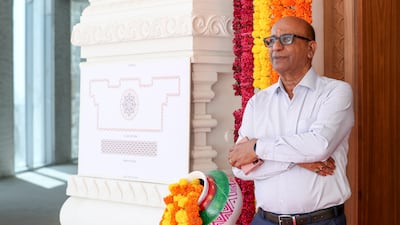
  • Architect Raghav Arora checks the design plans at the Hindi temple construction site in Jebel Ali. All photos hereafter: Ruel Pableo for The National
    Architect Raghav Arora checks the design plans at the Hindi temple construction site in Jebel Ali. All photos hereafter: Ruel Pableo for The National
  • As well as in Makrana, interior elements are being crafted in Al Quoz workshops.
    As well as in Makrana, interior elements are being crafted in Al Quoz workshops.
  • Glass-reinforced concrete moulds are being used in the construction.
    Glass-reinforced concrete moulds are being used in the construction.
  • The project is taking shape, is on budget and ahead of schedule.
    The project is taking shape, is on budget and ahead of schedule.
  • Interior designs and products, such as this handrail, are being prepared at DRA Product Designs Industry in Al Quoz.
    Interior designs and products, such as this handrail, are being prepared at DRA Product Designs Industry in Al Quoz.
  • Heavy wooden doors will soon be installed at the temple.
    Heavy wooden doors will soon be installed at the temple.
  • Featured patterns are intended to be geometric and not all typically Hindu.
    Featured patterns are intended to be geometric and not all typically Hindu.
  • The facade will feature a mix of mashrabiya and Arabic patterned lattice screens, as well as traditional Hindu designs.
    The facade will feature a mix of mashrabiya and Arabic patterned lattice screens, as well as traditional Hindu designs.
  • The plan is that the temple provides not only a Hindu space but also a place for peace and meditation.
    The plan is that the temple provides not only a Hindu space but also a place for peace and meditation.
  • People of all faiths will be welcome.
    People of all faiths will be welcome.
  • A view from the top of the temple at the construction site in Jebel Ali.
    A view from the top of the temple at the construction site in Jebel Ali.
  • Cranes will lift the completed spires on to the roof in an operation that will take a few days to complete.
    Cranes will lift the completed spires on to the roof in an operation that will take a few days to complete.
  • Special permission was sought from authorities before fitting the brass spires that soar high above the surrounding places of worship.
    Special permission was sought from authorities before fitting the brass spires that soar high above the surrounding places of worship.
  • ‘The kalash has great significance as it draws in the energy,’ says Raju Shroff, a trustee of Dubai’s Sindhi Guru Darbar temple trust.
    ‘The kalash has great significance as it draws in the energy,’ says Raju Shroff, a trustee of Dubai’s Sindhi Guru Darbar temple trust.
  • The Hindu god Shiv will be the main deity placed in the central podium along with 14 others.
    The Hindu god Shiv will be the main deity placed in the central podium along with 14 others.
  • The temple will also have a section for the Sikh holy book – the Guru Granth Sahib.
    The temple will also have a section for the Sikh holy book – the Guru Granth Sahib.
  • People have already begun visiting the temple to take photos of the structure.
    People have already begun visiting the temple to take photos of the structure.
  • During festivals such as Diwali, more than 100,000 Hindus could visit in a weekend.
    During festivals such as Diwali, more than 100,000 Hindus could visit in a weekend.
  • The first floor will be a dedicated prayer space with the open terrace reserved for ceremonies where devotees can pray around a fire.
    The first floor will be a dedicated prayer space with the open terrace reserved for ceremonies where devotees can pray around a fire.
  • On the lower level, a banquet hall will be used for weddings, birthdays or condolence prayers.
    On the lower level, a banquet hall will be used for weddings, birthdays or condolence prayers.
  • A mediation studio and teaching area have been set aside where volunteers can teach children.
    A mediation studio and teaching area have been set aside where volunteers can teach children.
  • The community space is equipped with a kitchen that can cater for more than 1,000 people.
    The community space is equipped with a kitchen that can cater for more than 1,000 people.
  • Land for the new temple in Jebel Ali was allotted by the Dubai government in 2019 and construction began a year later.
    Land for the new temple in Jebel Ali was allotted by the Dubai government in 2019 and construction began a year later.
  • Raghav Arora shows the design for the temple, scheduled to open in October.
    Raghav Arora shows the design for the temple, scheduled to open in October.

Dubai's Hindu temple: a glimpse at the architectural marvel rising in the desert


Ramola Talwar Badam
  • English
  • Arabic

With nine soaring spires, ornate pillars and handcrafted sculptures, Dubai's Hindu temple is fast rising in the Jebel Ali desert.

When ready to open in October, the house of worship will be able to welcome 6,000 people a day.

Work is advancing rapidly at the temple in Jebel Ali but The National also saw first-hand the epic scale of the task with workshops in Al Quoz running at full throttle to complete the work in time.

Craftsmen cut long steel bars and splice up thick wooden strips that will form part of the temple’s rich interior. From massive walnut-wood doors to tall concrete pillars decorated with bells, elephants and flower motifs, the interior elements are being crafted in Al Quoz workshops.

Inside one, workmen used precision tools to press out lotus designs from stainless steel bars. Others add a deep bronze coat of paint to aluminium screens.

It’s not only a Hindu space but a space for peace and meditation
Raghav Arora,
architect

In an adjoining factory, workers polish four-metre high, 90-kilogram wooden doors that will soon be installed at the temple 20 kilometres away in Dubai's Jebel Ali neighbourhood.

“The idea was that on the facade, we wanted the patterns to be geometric and not typically Hindu," said architect, Raghav Arora, director of City Diamond Contracting, of the facade, which is a mix of mashrabiya, Arabic patterned lattice screens, and traditional Hindu designs.

“The temple wants to attract not just people of the Hindu faith but of any faith to come and learn about Hindu culture. It’s not only a Hindu space but a space for peace and meditation," he said.

Mashrabiya screens inspired by Arabic architecture and infused with Hindu geometric patterns at the temple site in Jebel Ali. Ruel Pableo for The National

"The motifs signify universal peace, tolerance and harmony."

Three workshops handle concrete moulds, metal lattice work and wood carvings being completed for the temple’s October opening.

“We used tiles to reduce the weight of the building and it’s easier to maintain,” Mr Arora said.

Marble carvings in India

Marble pillars are being carved in Makrana in India's Rajasthan state and will be brought to the temple site in Jebel Ali, Dubai. Photo: Raju Shroff

Thousands of miles away in Makrana village in India's northern Rajasthan state, artisans are hand-carving intricate arched entrances topped with decorative elephant heads.

Delicate patterned podiums are being finished for an expansive prayer hall in which Hindu deities will be placed. Craftsmen and women prepare slabs of marble flooring with striking emerald and saffron inlays that will be shipped to Dubai from Makrana, famous for its pure white marble and skilled artisans.

Raju Shroff, a trustee of Dubai’s Sindhi Guru Darbar temple trust, returned this week from Makrana, after a short trip to check on the progress of the hand carvings.

“The overall look is of a contemporary temple but where the gods will be housed will be authentic architecture in keeping with Indian heritage and history,” he said.

“For the marble work we went to the source in India where specialist families have been engaged in the artisan work of engraving for hundreds of years.”

Guidance was also sought from a specialist temple architect from India using "vastu shastra", an Indian form of architecture, for Dubai's distinctive concrete and steel temple clad with white porcelain tiles.

Another temple being built in Abu Dhabi is likely to be complete next year.

Soaring spires

One of nine brass kalashas, or spires, being installed at the top of the Hindu temple being built in Jebel Ali. Ruel Pableo for The National

In Dubai at the temple site, the topping out is under way with nine brass "kalashas" or spires fitted to the domes.

Cranes lift the spires on to the roof in an operation that will take a few days to complete. This signifies completion of the main construction work. Special permission was sought from authorities before fitting the brass spires that soar high above the surrounding places of worship.

“The kalash has great significance as it draws in the energy,” Mr Shroff said.

“Once this is complete, it will be a landmark that will stand out and can be seen from the main Sheikh Zayed Road.

“This also means the temple will soon be ready to host the murtis [deities].”

The deities are being hand-sculpted from black and white marble in Jaipur and Chennai in India.

The Hindu god Shiv will be the main deity placed in the central podium along with 14 others.

“We wanted to represent different communities so the temple will have gods from South India and goddesses from the East.

“This is not a Krishna temple, or a Shiva or Jain temple, it is a Hindu temple. We are trying to bring in everybody so people from the south and north of India can worship here.”

The temple will also have a section for the Sikh holy book – the Guru Granth Sahib.

Temple layout

Decorative moulds cast in glass-reinforced concrete are used for the columns to keep the temple structure light in weight. Ruel Pableo for The National

People have already begun visiting the temple to take photos of the structure that will welcome up to 6,000 worshippers each day.

More than 25,000 people are expected at weekends once the wooden doors are thrown open later this year.

During festivals such as Diwali, more than 100,000 Hindus will visit.

The statistics for the building are no less impressive with 900 tonnes of steel; 6,000 cubic metres of concrete; and 1,500 square metres of marble used in the construction.

Sunlight streams into the large 5,000 sq ft prayer hall with a vast skylight from which a collection of bells will be suspended.

The first floor will be a dedicated prayer space with the open terrace reserved for ceremonies where devotees can pray around a fire.

On the lower level, a banquet hall will be used for weddings, birthdays or condolence prayers.

On the same level, a mediation studio and teaching area have been set aside where volunteers can teach children anything from the Sanskrit language to classical Indian dance.

The community space is equipped with a kitchen that can cater for more than 1,000 people.

A lot of people want to get married in a temple, they don’t want a ceremony in a hotel,” Mr Shroff said.

“We don’t want to disturb people praying upstairs so there can be a short wedding ritual upstairs after which they can go down to the community hall.”

A growing community

The temple in Jebel Ali will open in October. Ruel Pableo for The National

There are two small temples in the Bur Dubai area to which Hindu worshippers flock.

Built by the community in the 1950s, the temples are housed in rooms inside an existing building and devotees requested a larger space from authorities.

Land for the new temple in Jebel Ali was allotted by the Dubai government in 2019 and construction began a year later.

The new temple is located in a neighbourhood dedicated to places of worship – it shares a boundary wall with a Sikh gurdwara and is across the road from two Christian churches.

The trust is grateful that Dubai authorities issued clearance and approval through online meetings during the Covid-19 pandemic.

The Sindhi Guru Darbar temple trust, that also manages the old temple in Bur Dubai, will manage the new place of worship that will cost an estimated Dh65 million ($17.7m).

“We are on budget and ahead of time,” Mr Shroff said.

“Our target was to finish construction in two years and we are way ahead of schedule.

“We have amazing people who put their heart and soul into it. We will still officially open in October but the soft opening will move up. Everyone is excited to complete this.”

Prayer service at Dubai's Hindu temple - in pictures

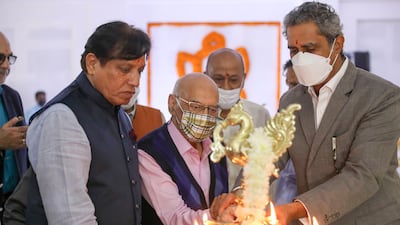
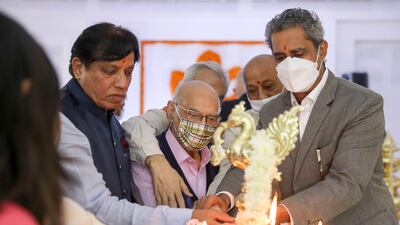
  • Trustees and guests light a candle at the beginning of a prayer ceremony for the topping of the Hindu temple at Jebel Ali in Dubai. All photos: Khushnum Bhandari / The National
    Trustees and guests light a candle at the beginning of a prayer ceremony for the topping of the Hindu temple at Jebel Ali in Dubai. All photos: Khushnum Bhandari / The National
  • Guests attend a prayer ceremony to celebrate the new Hindu temple which is being built in Jebel Ali, Dubai.
    Guests attend a prayer ceremony to celebrate the new Hindu temple which is being built in Jebel Ali, Dubai.
  • A brass spire is inscribed before a prayer ceremony to mark the continuing construction of the temple.
    A brass spire is inscribed before a prayer ceremony to mark the continuing construction of the temple.
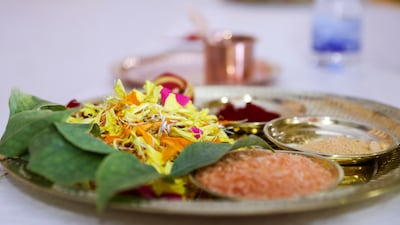
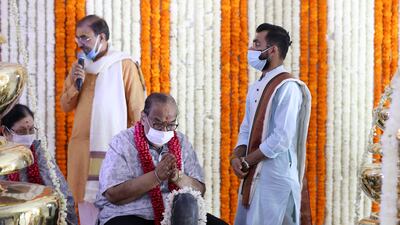
  • Offerings are set on a puja tray before the prayer ceremony.
    Offerings are set on a puja tray before the prayer ceremony.
  • Guests at the service said the ceremony brought a sense of completeness as construction continues.
    Guests at the service said the ceremony brought a sense of completeness as construction continues.
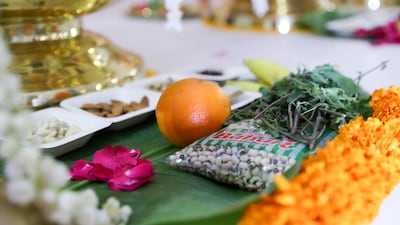
  • Priests recited Sanskrit verses and offerings included rice and flowers.
    Priests recited Sanskrit verses and offerings included rice and flowers.
  • Trustees and guests light a candle at the ceremony for the Hindu temple at Jebel Ali, which is scheduled to open in October.
    Trustees and guests light a candle at the ceremony for the Hindu temple at Jebel Ali, which is scheduled to open in October.
  • Another puja offering.
    Another puja offering.
  • Gopal Kookani, general manager of the new Hindu temple, said the gathering to mark the work so far had given him goosebumps.
    Gopal Kookani, general manager of the new Hindu temple, said the gathering to mark the work so far had given him goosebumps.
  • Trustees and VIPs light candles.
    Trustees and VIPs light candles.
  • Temple officials said construction work is about 85 per cent complete.
    Temple officials said construction work is about 85 per cent complete.
  • An architect's model of the Hindu temple at Jebel Ali.
    An architect's model of the Hindu temple at Jebel Ali.
  • Guests attend the prayer ceremony, at which organisers said would be a maximum of 75 people in compliance with Dubai's coronavirus regulations.
    Guests attend the prayer ceremony, at which organisers said would be a maximum of 75 people in compliance with Dubai's coronavirus regulations.
  • 'Tolerance is a way of life in this country,' said general manager of the temple Gopal Kookani.
    'Tolerance is a way of life in this country,' said general manager of the temple Gopal Kookani.
Updated: February 12, 2022, 11:53 AM