



This is a dream come true, says Ahmed Al Hashemi with a smile, walking along the new railway bridge towards Dubai.
Underneath is the E77 motorway, to the west the sprawling Expo 2020 Dubai site and across in the east the vast UAE desert.
Just a few decades ago camel trains would have passed through between Abu Dhabi and Fujairah. An arduous journey that could take days.
But now an iron railway is carving a permanent route through the country, with diesel engines cutting the journey time to about 100 minutes.
The National was granted rare access to the Abu Dhabi to Dubai line, and the journey we took offers a taste of what passengers can expect once the service is launched.
“We are building something here for generations to come,” says Mr Al Hashemi, the executive director of the passengers sector at Etihad Rail.
We begin the trip at the railhead in Abu Dhabi’s Saih Shuaib. It is a sprawling industrial site with its own factory for making railway sleepers and stacks of new line waiting to be laid.
“The line is just behind this dune,” says Mr Al Hashemi. Passenger services have not started yet so we are travelling on an inspection train. “It is where all the trains between Abu and Dubai will run.”
The driver blasts the horn, backs onto the mainline and then we pick up speed as we travel down towards Dubai. On both sides, the UAE’s scenery unfolds. We pass sand dunes, ghaf trees, homes and factories. The track then curves parallel to Emirates Road (E611) with the trucks, buses and cars on the busy motorway appearing like dots in the distance.
Next is Al Maktoum Airport, with Emirates A380s on the airport’s aprons visible from the windows. The journey is smooth, with the quiet broken only occasionally by the driver sounding the horn. It is probably among the first few times that a train’s horn has been heard in this part of the UAE. Soon it will become commonplace. In under an hour we reach our destination: the new bridge that allows the train to cross the E77 (Expo Road).
“This is a major highway that I have been through many times in my life,” says Mr Al Hashemi, standing on the bridge and gazing down the motorway.
“If you asked me years ago if there’d be a railway line crossing the country through this very same point, it would sound like a dream.
“But today it is a reality.”
The awesome scale of the project is evident from the bridge. Laying down railway line is sometimes called “ironing the land” and it is no misnomer. Metal tracks are being put down in both directions at a rapid pace, while workers build bridges, relocate pipes and cables, and help to rehome wildlife, where needed. We travel over bridges, past power lines and beside forests.
Huge stockpiles of ballast – the angular rocks used on the trackbed that have been quarried from the UAE’s mountains – are piled at intervals along the way. It is clearly a herculean effort.

A launch date for the passenger service has not been announced yet but the line will first connect 11 cities and locations across the UAE. Future route additions are expected, and this brief journey also provides a glimpse at the railway's potential to create new neighbourhoods.
Places that once seemed remote will now be just a short train ride away. And where the railway now passes through empty desert, soon towns could spring up.
But Etihad Rail also offers a more poetic and unburdened way to get around that harks back to a golden age of travel. The stations, Etihad Rail say, will become “urban centres” and aim to celebrate the romance of travel, bringing to mind the great railway stations of the world, such as New York’s Grand Central Station and London’s St Pancras. Freed from the stress of the roads and with more time on their hands, the railway will encourage passengers to relax.
For now, though, the sun has set and we must return. The driver takes us back up the line to Abu Dhabi as the train’s light cuts a beam through the darkness, while a full moon is out by the time we get back to the railhead.
“I remember standing on a sand dune or on a hill or mountain,” says Mr Al Hashemi, reflecting on his early days with the railway.
“To come back and see tracks laid? It fills me with pride.”
This story was first published in January 2022
What Etihad Rail's passenger trains will look like - in pictures
-

A rendering of a train to be used on the UAE’s new passenger rail service. All Photos: Etihad Rail -
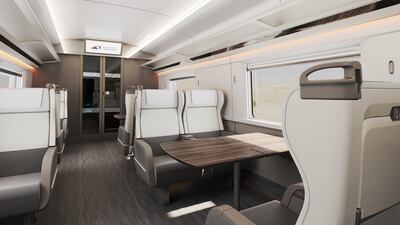
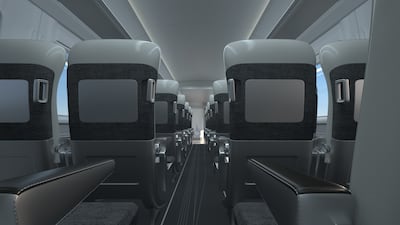
Passenger cabins are spacious, allowing people to travel in comfort. -
The commercial benefits of moving cargo meant the initial focus was on freight. -

Now the focus has turned to the passenger network. -
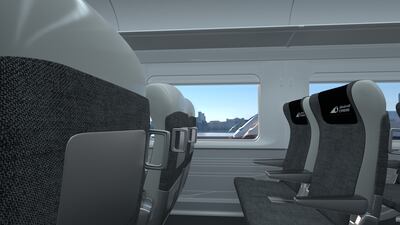
The service will offer a reliable, safe, efficient, comfortable and environmentally friendly way to travel across the region. -

Etihad Rail is working closely with the Federal Transport Authority and transport authorities throughout the country to develop existing networks to improve passenger connections. -
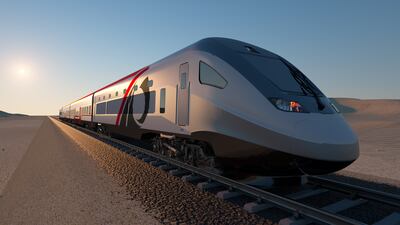
Eventually, population centres across the UAE will be connected to neighbouring GCC countries. -

Passenger carriages will feature sleek, well-equipped cabins. -
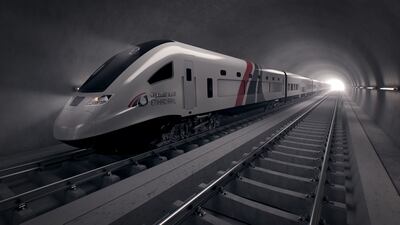
Work on Etihad Rail began in 2009. -
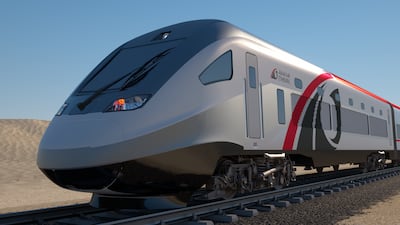
Greenhouse gases will be slashed by more than 2.2 million tonnes a year once the network is fully operational. -
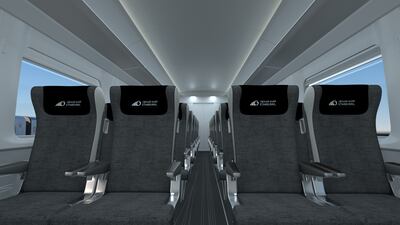
The new passenger rail service is expected to significantly reduce road congestion and the number of traffic accidents.



