Sheikh Mohamed bin Zayed, Crown Prince of Abu Dhabi and Deputy Supreme Commander of the Armed Forces, embraces Buretaake Ioane, 15, at the awards in 2020. His school, Eutan Tarawa Ieta Junior Secondary School in the Republic of Kiribati, won first place in its region in the "global high schools" category. Antonie Robertson / The National
Sheikh Mohamed bin Zayed, Crown Prince of Abu Dhabi and Deputy Supreme Commander of the Armed Forces, embraces Buretaake Ioane, 15, at the awards in 2020. His school, Eutan Tarawa Ieta Junior Secondar

Zayed Sustainability Prize: record 4,000 entries from 151 countries


  • English
  • Arabic

The Zayed Sustainability Prize has attracted a record 4,000 submissions from 151 countries around the globe.

Brazil, India, Kenya, the US and China are among the top countries represented, with the number of entries increasing by about 70 per cent compared with previous years.

Submissions this year address the Covid-19 pandemic through mobile clinics, for example, while other critically urgent issues included water scarcity and food security.

The annual $3 million prize supports green projects chiefly in food and health that also help the environment.

Since its launch in 2008, it has changed the lives of more than 352 million people in 150 countries.

From a project to help villagers in Cambodia gain access to clean water to a smartphone app that allows farmers to tackle crop diseases, the many projects over the years have changed the world.

The prize will be awarded in January and comes after a critical few months in the battle against climate change. Central to this is the Cop26 summit in Glasgow in November.

We are proud and encouraged to have received so many applications despite the difficult conditions the world is facing

“Inspired by the legacy of the UAE’s Founding Father, the late Sheikh Zayed bin Sultan Al Nahyan, the prize continues to demonstrate the UAE’s commitment to promoting sustainability and humanitarianism," said Dr Sultan Al Jaber, UAE Minister of Industry and Advanced Technology and director general of the prize.

"We are proud and encouraged to have received so many applications despite the difficult conditions the world is facing and we will move forward with purpose as the prize continues to fulfil its role in supporting innovators and forward-thinking organisations who seek to change our world for the better.

“As the international community continues to unite around ambitious climate action in the lead up to Cop26, the high level of participation registered this year further demonstrated that creative, sustainable solutions could come from every part of the world, and importantly can deliver tangible economic benefits along with social progress."

The prize postponed its 2021 cycle because of the pandemic, but entries were automatically considered alongside the latest applicants.

Food (1,201) and health (879) were the categories that attracted the most entries, followed by energy (759) and water (627). With 534 submissions, the "global high schools" category underlines the commitment of young people to saving the planet.

Submissions in health are particularly important, coming during a pandemic that has caused chaos around the globe. A high number of entries address Covid-19, such as telehealth solutions and mobile clinics.

In the water category, many entries are geared towards extraction, filtration and wastewater purification technology, especially in relation to pandemics and natural disasters.

Other submissions in transmission and distribution may be a response to water scarcity and the water crisis the world is facing.

Another encouraging trend for the future of sustainability is number of submissions from high schools.

A large number of entries in the global high schools category proposed school garden projects to help feed schools and the most needy families in their communities.

Now a committee comprising globally renowned experts will assess shortlisted entries and choose the finalists. The winners will be announced during Abu Dhabi Sustainability Week in January.

Each category winner receives a prize fund of $600,000. The prize for the global high schools category will be shared equally among six winning schools from six world regions.

UAE-funded project brings solar light to more than 20,000 people in Indonesia

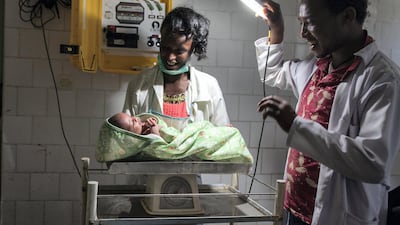
  • We Care Solar provided solar suitcases to maternity hospitals in Ntinda, Kampala in Uganda. Photos: Zayed Sustainability Prize
    We Care Solar provided solar suitcases to maternity hospitals in Ntinda, Kampala in Uganda. Photos: Zayed Sustainability Prize
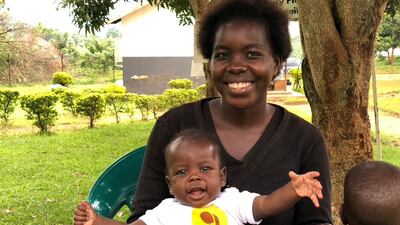
  • Jane, from Uganda, named her baby Miracle after he was delivered in a hospital with no electricity.
    Jane, from Uganda, named her baby Miracle after he was delivered in a hospital with no electricity.
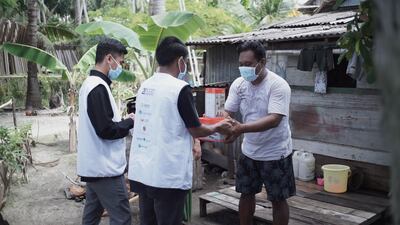
  • Zayed Sustainability Prize distributes 3,600 solar lanterns to families living on an off-grid Indonesian island.
    Zayed Sustainability Prize distributes 3,600 solar lanterns to families living on an off-grid Indonesian island.
  • Residents of Tonle Sap Lake area in Cambodia now have free access to clean drinking water.
    Residents of Tonle Sap Lake area in Cambodia now have free access to clean drinking water.
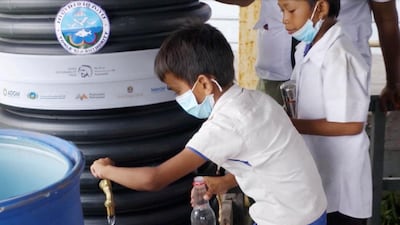
  • Pupils at a school in Cambodia's Tonle Sap have access to clean water thanks to the Zayed Sustainability Prize. Courtesy: Zayed Sustainability Prize
    Pupils at a school in Cambodia's Tonle Sap have access to clean water thanks to the Zayed Sustainability Prize. Courtesy: Zayed Sustainability Prize
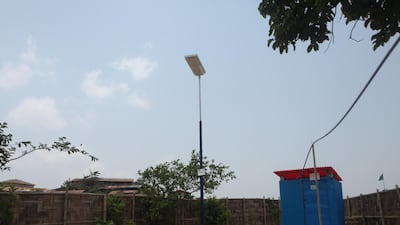
  • A solar-powered lamppost lights the way for refugees in Cox’s Bazar, Bangladesh.
    A solar-powered lamppost lights the way for refugees in Cox’s Bazar, Bangladesh.
  • Solar street lights are set up at a refugee camp in Jordan.
    Solar street lights are set up at a refugee camp in Jordan.
Three-day coronation

Royal purification

The entire coronation ceremony extends over three days from May 4-6, but Saturday is the one to watch. At the time of 10:09am the royal purification ceremony begins. Wearing a white robe, the king will enter a pavilion at the Grand Palace, where he will be doused in sacred water from five rivers and four ponds in Thailand. In the distant past water was collected from specific rivers in India, reflecting the influential blend of Hindu and Buddhist cosmology on the coronation. Hindu Brahmins and the country's most senior Buddhist monks will be present. Coronation practices can be traced back thousands of years to ancient India.

The crown

Not long after royal purification rites, the king proceeds to the Baisal Daksin Throne Hall where he receives sacred water from eight directions. Symbolically that means he has received legitimacy from all directions of the kingdom. He ascends the Bhadrapitha Throne, where in regal robes he sits under a Nine-Tiered Umbrella of State. Brahmins will hand the monarch the royal regalia, including a wooden sceptre inlaid with gold, a precious stone-encrusted sword believed to have been found in a lake in northern Cambodia, slippers, and a whisk made from yak's hair.

The Great Crown of Victory is the centrepiece. Tiered, gold and weighing 7.3 kilograms, it has a diamond from India at the top. Vajiralongkorn will personally place the crown on his own head and then issues his first royal command.

The audience

On Saturday afternoon, the newly-crowned king is set to grant a "grand audience" to members of the royal family, the privy council, the cabinet and senior officials. Two hours later the king will visit the Temple of the Emerald Buddha, the most sacred space in Thailand, which on normal days is thronged with tourists. He then symbolically moves into the Royal Residence.

The procession

The main element of Sunday's ceremonies, streets across Bangkok's historic heart have been blocked off in preparation for this moment. The king will sit on a royal palanquin carried by soldiers dressed in colourful traditional garb. A 21-gun salute will start the procession. Some 200,000 people are expected to line the seven-kilometre route around the city.

Meet the people

On the last day of the ceremony Rama X will appear on the balcony of Suddhaisavarya Prasad Hall in the Grand Palace at 4:30pm "to receive the good wishes of the people". An hour later, diplomats will be given an audience at the Grand Palace. This is the only time during the ceremony that representatives of foreign governments will greet the king.

How to apply for a drone permit
  • Individuals must register on UAE Drone app or website using their UAE Pass
  • Add all their personal details, including name, nationality, passport number, Emiratis ID, email and phone number
  • Upload the training certificate from a centre accredited by the GCAA
  • Submit their request
What are the regulations?
  • Fly it within visual line of sight
  • Never over populated areas
  • Ensure maximum flying height of 400 feet (122 metres) above ground level is not crossed
  • Users must avoid flying over restricted areas listed on the UAE Drone app
  • Only fly the drone during the day, and never at night
  • Should have a live feed of the drone flight
  • Drones must weigh 5 kg or less
England squads for Test and T20 series against New Zealand

Test squad: Joe Root (capt), Jofra Archer, Stuart Broad, Rory Burns, Jos Buttler, Zak Crawley, Sam Curran, Joe Denly, Jack Leach, Saqib Mahmood, Matthew Parkinson, Ollie Pope, Dominic Sibley, Ben Stokes, Chris Woakes

T20 squad: Eoin Morgan (capt), Jonny Bairstow, Tom Banton, Sam Billings, Pat Brown, Sam Curran, Tom Curran, Joe Denly, Lewis Gregory, Chris Jordan, Saqib Mahmood, Dawid Malan, Matt Parkinson, Adil Rashid, James Vince

360Vuz PROFILE

Date started: January 2017
Founder: Khaled Zaatarah 
Based: Dubai and Los Angeles
Sector: Technology 
Size: 21 employees
Funding: $7 million 
Investors: Shorooq Partners, KBW Ventures, Vision Ventures, Hala Ventures, 500Startups, Plug and Play, Magnus Olsson, Samih Toukan, Jonathan Labin

Indoor cricket in a nutshell

Indoor Cricket World Cup - Sep 16-20, Insportz, Dubai

16 Indoor cricket matches are 16 overs per side

8 There are eight players per team

There have been nine Indoor Cricket World Cups for men. Australia have won every one.

5 Five runs are deducted from the score when a wickets falls

Batsmen bat in pairs, facing four overs per partnership

Scoring In indoor cricket, runs are scored by way of both physical and bonus runs. Physical runs are scored by both batsmen completing a run from one crease to the other. Bonus runs are scored when the ball hits a net in different zones, but only when at least one physical run is score.

Zones

A Front net, behind the striker and wicketkeeper: 0 runs

B Side nets, between the striker and halfway down the pitch: 1 run

Side nets between halfway and the bowlers end: 2 runs

Back net: 4 runs on the bounce, 6 runs on the full