



The UAE will take part in a Nasa human research programme that involves placing an Emirati in near-isolation to test the effects of spaceflight on the human body and behaviour.
This is the second analogue mission secured by the Emirates following Emirati engineer Saleh Al Ameri’s stay in a Russian facility with five other international crew members. In July they will complete the eight-month mission, called Sirius 20/21.
Analogue missions are designed to mimic long-duration space missions and usually involve confining a small team to a habitat where they carry out “space missions”.
An Emirati, yet to be identified, will participate in Nasa’s Human Exploration Research Analogue (Hera) programme in 2023.
A US delegation visited the Emirates last week, with the help of the US embassy in Abu Dhabi, to discuss the research the Emirati crew member will be carrying out during the experiment.

Sam Scimemi, senior assistant in Nasa’s human exploration and operations mission directorate, spoke to The National about the upcoming mission, as well how the relationship between the US space agency and the UAE is growing.
“One of the main reasons we're here today is to discuss the research that will be going on for the Emirati participant in the Hera analogue mission at the Johnson Space Centre next year,” he said.
“It is a simulation of a Mars-type transit vehicle that we have at the Johnson Space Centre. It simulates long-duration missions, where four crew members simulate what would happen on a mission to Mars.
“We just started these discussions three years ago as sort of a precursor mission to the expected development of the Mars Science City for the Mohammed bin Rashid Space Centre.”
Hera is a three-storey habitat that offers isolation, confinement and remote conditions that are experienced during space exploration missions.
There have been six campaigns under the programme so far, each of which included four to five missions, and ranged in duration from one to 45 days. It is not clear how long the mission involving the Emirati participant will be.
The UAE is planning to build analogue facilities at the planned Dh500 million Mars Science City, a research centre that will simulate the environment of Mars, with pressurised biodomes and robotics labs.
This will help to give Emiratis an increased access to missions. The country will also benefit from analogue missions because it has long-term plans to send Emiratis to the lunar surface and to build a human base on Mars by 2117.
Nasa and UAE partnership in space
The UAE and US have been increasing their relationship in space exploration, including human spaceflight and research programmes.
An Emirati astronaut will be part of the Nasa-SpaceX Crew-6 mission next spring and will spend six months on the International Space Station.
“Our discussions about co-operation started several years ago,” Mr Scimemi said.
“We exchanged ideas and ways to co-operate with each other. All those discussions eventually led to the first Emirati on the space station via the Soyuz rocket.
“Then those activities continued through to where we are today, with having an Emirati fly on a US commercial crew vehicle to the space station next spring.”
Mr Scimemi said that the Emirati astronaut will be “effectively integrated into the mission and will be expected to do everything that a US astronaut would be doing”.
-
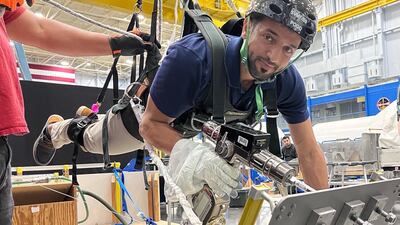
Sultan Al Neyadi undergoes spacewalk training in Houston, Texas in 2021. He will now blast off for a six-month tour on the International Space Station in 2023. Photo: Sultan Al Neyadi Twitter -
Dr Al Neyadi holding a camera that is used during spacewalks. He is the astronaut going on the next space mission. -
Hazza Al Mansouri, left, and Sultan Al Neyadi graduated from Nasa's training programme in May 2022, and are now eligible for space missions led by the US space agency. All photos: MBRSC -
Nasa has been awarding these lapel pins since 1963 to astronauts who complete basic training. The silver ones are given to those who have completed their training, but are yet to fly to space. Gold ones are awarded to astronauts who have already flown to space. -
Maj Al Mansouri received the gold Nasa astronaut pin because he has already flown to space. -
Dr Al Neyadi received the silver Nasa astronaut pin. He is set to blast off for ISS in 2023. -
UAE astronauts with Nasa astronaut Reid Wiseman.

The UAE also worked with three US universities to make its Mars mission a reality, in which the Hope spacecraft reached the Red Planet’s orbit in February last year.
More recently, the Emirates Mars Mission has teamed up with Nasa’s Maven (Mars Atmosphere and Volatile Evolution) mission to exchange and analyse data.
The country hopes to continue its collaboration with the US to carry out its next ambitious mission ― a spacecraft that will perform a Venus fly-by, explore seven asteroids in the main asteroid belt and then attempt a landing on the last one.
There are also discussions taking place between the UAE and Nasa about how the Emirates can participate in the Artemis programme, which aims to build a sustainable human presence on the Moon, so astronauts can eventually use that as a base from which to travel to Mars.
Mr Scimemi said Nasa is open to partnership with the Emirates in that area, and that the country could possibly contribute robotics or other capabilities.
“It really comes down to where the UAE government wants to take its space activities,” he said.
“Nasa is open to any contribution and collaborative activities for most countries and our allies.
“This is not a one-time visit. So, after the MBRSC and UAE Space Agency get their long-term plans together, we’re certainly open to discussing those plans with the agencies here.”

