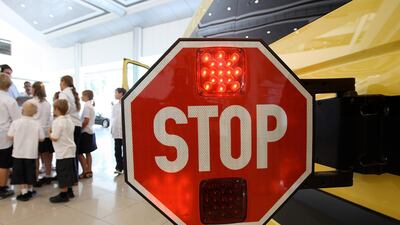
Motorists should halt at least five metres behind parked school buses to ensure pupil safety. Pawan Singh / The National

Don't ignore school bus stop signs, motorists warned


  • English
  • Arabic

Motorists must halt when they see a school bus open its red stop sign, police have warned.

Abu Dhabi Police on Wednesday said motorists should wait at least five metres behind to ensure pupil safety.

School bus drivers are expected to flash the stop signs on their vehicles when they pick up pupils or let them disembark.

The sign indicates to other road users that they must wait to pass until all children are safely out of the way.

The warning comes as pupils across the country return to school.

"On single-lane roads, drivers in both directions should stop at a distance of at least five metres if the school bus sign is open," said police.

"On a dual carriageway, the driver headed in the same direction of the bus must stop."

Drivers who flout the rules face a fine of Dh1,000 and 10 black points on their driving licences. Bus drivers can also be fined Dh500 and slapped six black points.

Police said traffic patrols will be stepped up to catch anyone breaking the rules roads.

Western Region Asia Cup T20 Qualifier

Sun Feb 23 – Thu Feb 27, Al Amerat, Oman

The two finalists advance to the Asia qualifier in Malaysia in August


Group A

Bahrain, Maldives, Oman, Qatar

Group B

UAE, Iran, Kuwait, Saudi Arabia


UAE group fixtures

Sunday Feb 23, 9.30am, v Iran

Monday Feb 25, 1pm, v Kuwait

Tuesday Feb 26, 9.30am, v Saudi


UAE squad

Ahmed Raza, Rohan Mustafa, Alishan Sharafu, Ansh Tandon, Vriitya Aravind, Junaid Siddique, Waheed Ahmed, Karthik Meiyappan, Basil Hameed, Mohammed Usman, Mohammed Ayaz, Zahoor Khan, Chirag Suri, Sultan Ahmed

Timeline

1947
Ferrari’s road-car company is formed and its first badged car, the 125 S, rolls off the assembly line

1962
250 GTO is unveiled

1969
Fiat becomes a Ferrari shareholder, acquiring 50 per cent of the company

1972
The Fiorano circuit, Ferrari’s racetrack for development and testing, opens

1976
First automatic Ferrari, the 400 Automatic, is made

1987
F40 launched

1988
Enzo Ferrari dies; Fiat expands its stake in the company to 90 per cent

2002
The Enzo model is announced

2010
Ferrari World opens in Abu Dhabi

2011
First four-wheel drive Ferrari, the FF, is unveiled

2013
LaFerrari, the first Ferrari hybrid, arrives

2014
Fiat Chrysler announces the split of Ferrari from the parent company

2015
Ferrari launches on Wall Street

2017
812 Superfast unveiled; Ferrari celebrates its 70th anniversary

Global Fungi Facts

• Scientists estimate there could be as many as 3 million fungal species globally
• Only about 160,000 have been officially described leaving around 90% undiscovered
• Fungi account for roughly 90% of Earth's unknown biodiversity
• Forest fungi help tackle climate change, absorbing up to 36% of global fossil fuel emissions annually and storing around 5 billion tonnes of carbon in the planet's topsoil

GOLF’S RAHMBO

- 5 wins in 22 months as pro
- Three wins in past 10 starts
- 45 pro starts worldwide: 5 wins, 17 top 5s
- Ranked 551th in world on debut, now No 4 (was No 2 earlier this year)
- 5th player in last 30 years to win 3 European Tour and 2 PGA Tour titles before age 24 (Woods, Garcia, McIlroy, Spieth)

Company%C2%A0profile
%3Cp%3E%3Cstrong%3ECompany%20name%3A%20%3C%2Fstrong%3ELeap%0D%3Cbr%3E%3Cstrong%3EStarted%3A%20%3C%2Fstrong%3EMarch%202021%0D%3Cbr%3E%3Cstrong%3EFounders%3A%3C%2Fstrong%3E%20Ziad%20Toqan%20and%20Jamil%20Khammu%0D%3Cbr%3E%3Cstrong%3EBased%3A%3C%2Fstrong%3E%20Dubai%0D%3Cbr%3E%3Cstrong%3ESector%3A%20%3C%2Fstrong%3EFinTech%0D%3Cbr%3E%3Cstrong%3EInvestment%20stage%3A%20%3C%2Fstrong%3EPre-seed%0D%3Cbr%3E%3Cstrong%3EFunds%20raised%3A%3C%2Fstrong%3E%20Undisclosed%0D%3Cbr%3E%3Cstrong%3ECurrent%20number%20of%20staff%3A%20%3C%2Fstrong%3ESeven%3C%2Fp%3E%0A
COMPANY%20PROFILE%20
%3Cp%3E%3Cstrong%3EName%3A%3C%2Fstrong%3E%20Haltia.ai%0D%3Cbr%3E%3Cstrong%3EStarted%3A%3C%2Fstrong%3E%202023%0D%3Cbr%3E%3Cstrong%3ECo-founders%3A%3C%2Fstrong%3E%20Arto%20Bendiken%20and%20Talal%20Thabet%0D%3Cbr%3E%3Cstrong%3EBased%3A%3C%2Fstrong%3E%20Dubai%2C%20UAE%0D%3Cbr%3E%3Cstrong%3EIndustry%3A%3C%2Fstrong%3E%20AI%0D%3Cbr%3E%3Cstrong%3ENumber%20of%20employees%3A%3C%2Fstrong%3E%2041%0D%3Cbr%3E%3Cstrong%3EFunding%3A%3C%2Fstrong%3E%20About%20%241.7%20million%0D%3Cbr%3E%3Cstrong%3EInvestors%3A%3C%2Fstrong%3E%20Self%2C%20family%20and%20friends%26nbsp%3B%3C%2Fp%3E%0A

Mercer, the investment consulting arm of US services company Marsh & McLennan, expects its wealth division to at least double its assets under management (AUM) in the Middle East as wealth in the region continues to grow despite economic headwinds, a company official said.

Mercer Wealth, which globally has $160 billion in AUM, plans to boost its AUM in the region to $2-$3bn in the next 2-3 years from the present $1bn, said Yasir AbuShaban, a Dubai-based principal with Mercer Wealth.

Within the next two to three years, we are looking at reaching $2 to $3 billion as a conservative estimate and we do see an opportunity to do so,” said Mr AbuShaban.

Mercer does not directly make investments, but allocates clients’ money they have discretion to, to professional asset managers. They also provide advice to clients.

“We have buying power. We can negotiate on their (client’s) behalf with asset managers to provide them lower fees than they otherwise would have to get on their own,” he added.

Mercer Wealth’s clients include sovereign wealth funds, family offices, and insurance companies among others.

From its office in Dubai, Mercer also looks after Africa, India and Turkey, where they also see opportunity for growth.

Wealth creation in Middle East and Africa (MEA) grew 8.5 per cent to $8.1 trillion last year from $7.5tn in 2015, higher than last year’s global average of 6 per cent and the second-highest growth in a region after Asia-Pacific which grew 9.9 per cent, according to consultancy Boston Consulting Group (BCG). In the region, where wealth grew just 1.9 per cent in 2015 compared with 2014, a pickup in oil prices has helped in wealth generation.

BCG is forecasting MEA wealth will rise to $12tn by 2021, growing at an annual average of 8 per cent.

Drivers of wealth generation in the region will be split evenly between new wealth creation and growth of performance of existing assets, according to BCG.

Another general trend in the region is clients’ looking for a comprehensive approach to investing, according to Mr AbuShaban.

“Institutional investors or some of the families are seeing a slowdown in the available capital they have to invest and in that sense they are looking at optimizing the way they manage their portfolios and making sure they are not investing haphazardly and different parts of their investment are working together,” said Mr AbuShaban.

Some clients also have a higher appetite for risk, given the low interest-rate environment that does not provide enough yield for some institutional investors. These clients are keen to invest in illiquid assets, such as private equity and infrastructure.

“What we have seen is a desire for higher returns in what has been a low-return environment specifically in various fixed income or bonds,” he said.

“In this environment, we have seen a de facto increase in the risk that clients are taking in things like illiquid investments, private equity investments, infrastructure and private debt, those kind of investments were higher illiquidity results in incrementally higher returns.”

The Abu Dhabi Investment Authority, one of the largest sovereign wealth funds, said in its 2016 report that has gradually increased its exposure in direct private equity and private credit transactions, mainly in Asian markets and especially in China and India. The authority’s private equity department focused on structured equities owing to “their defensive characteristics.”

The President's Cake

Director: Hasan Hadi

Starring: Baneen Ahmad Nayyef, Waheed Thabet Khreibat, Sajad Mohamad Qasem 

Rating: 4/5

UAE currency: the story behind the money in your pockets
The five pillars of Islam

1. Fasting 

2. Prayer 

3. Hajj 

4. Shahada 

5. Zakat
