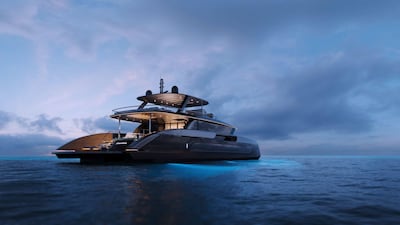
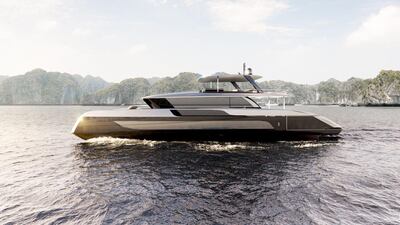
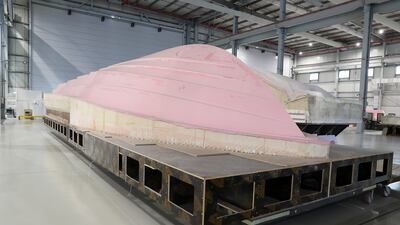
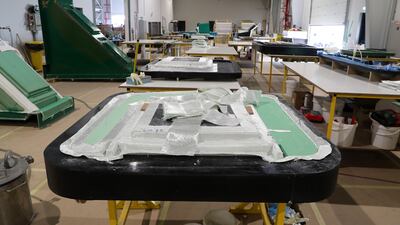
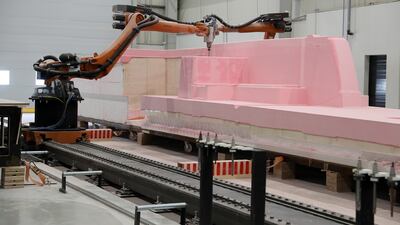
A luxury yacht builder from Poland has begun manufacturing multimillion-dollar boats in Ras Al Khaimah, with the first vessels to ship out by the end of the year.
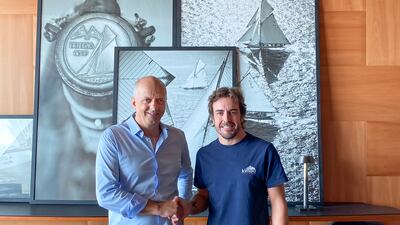
Sunreef Yachts has built high-end catamarans for more than two decades in its Gdansk factories, with buyers including tennis player Rafael Nadal and Formula One driver Fernando Alonso.
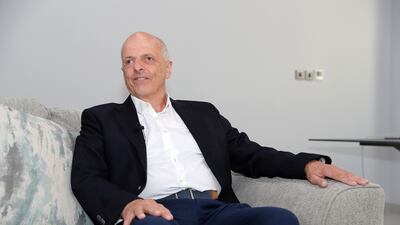
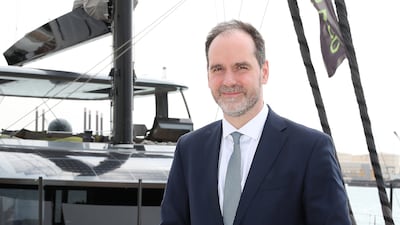
Keen to expand beyond Europe, the company’s French founder Francis Lapp chose the UAE as the base for his first overseas shipyard two years ago.
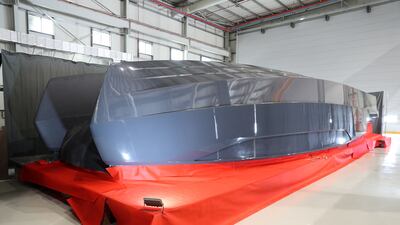
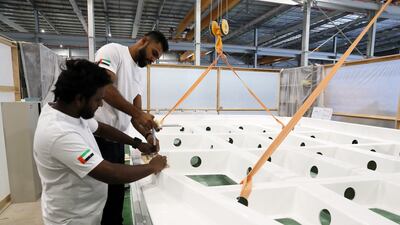
The shipyard in Ras Al Khaimah has started production of twin-hull yachts and was formally inaugurated on Monday by Sheikh Saud bin Saqr Al Qasimi, Ruler of Ras Al Khaimah.
For the future of boating, this is the best place. This is the right place
Francis Lapp,
Sunreef
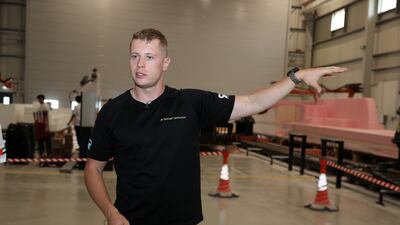
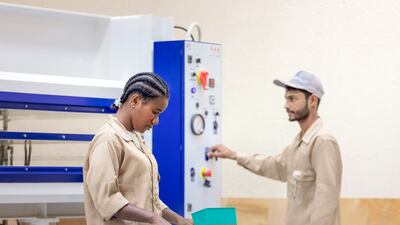
More than 180 staff are employed at the site. The company aims to provide jobs to more than 600 by the end of the year.
“My vision was to make something here – to show that Ras Al Khaimah is the right place for a shipyard, to be closer to Asia and Australia,” Mr Lapp told The National.
“For the future of boating, this is the best place. I did not want to have it all in Europe. To make [vessels] in Turkey or somewhere else was also a possibility. I chose this, this is the right place.”
Crafting luxury
Mr Lapp moved from Poland, his home of 30 years, to Dubai four years ago. He now travels almost every day to the Ras Al Khaimah port to supervise the production of the spacious yachts.
“When I started in Poland in 2002, Poland was not popular for super luxury yachts, only for big ships,” he said.
“We brought luxury to Poland and now we are doing the same in Ras Al Khaimah.”
The Dh100 million ($27.2 million) shipyard will cater to a growing demand for spacious yachts. Construction is already under way on a second shipyard at the site to cope with orders worth $170 million to be delivered over the next two years.
The majority of orders come from Europe, while the company also has clients from Australia, Asia and the US.
The Ras Al Khaimah shipyard will first produce midrange 44 foot to 88 foot catamarans with solar-panelled roofs, with the vessels priced between $1.5 million and $12 million.
The luxury transatlantic 140-foot yachts built in the company’s Polish shipyard cost up to $50 million.
Luxury is seclusion
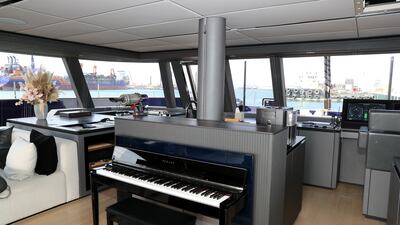
Often described as floating villas, the boats are tailor-made for each client, with features including walnut wood interiors, granite kitchen and dining areas, master suites with walk-in dressing rooms and private balconies. Storage space can also be added for jet skis and kayaks.
“Luxury is not only to show the boat in front of Bulgari hotel in Dubai,” said Mr Lapp, 66. “Luxury, too, is an island, a place where you are alone.”
He said the boats allowed celebrities and sports stars such as Alonso to steer clear of the public eye.
“He has enough of show in Formula One,” Mr Lapp said. “He wants to go someplace and not be photographed, no press, nothing, to have a nice holiday.
“That’s why people are choosing our products, our catamarans, to go to someplace where you cannot go with normal boats.”
Longer trips, further afield
The time clients spent sailing has increased over the past few years, with people extending their voyages from a matter of weeks to months.
“Now clients stay two or three months on the boat in the summer, bring their family, make a long trip,” said Mr Lapp, who has sailed with his family from Monaco to Dubai.
Polish government officials believe more companies will follow Sunreef’s example and expand operations in the UAE.
The Polish Business Council in Dubai was recently inaugurated, with more companies expected to open in the Emirates.
“I feel proud. It is a symbol of our deepening economic co-operation,” said Ignacy Niemczycki, a senior official in Poland’s Ministry of Economic Development and Technology.
“It’s the first large Polish investment in the UAE and my hope is this paves the way for others.”
UAE is home
Mr Lapp plans to move his family from Dubai to Ras Al Khaimah next year, once his teenage daughter heads off to study at university.
“I love Dubai and the UAE. I feel my home is here,” he said.
He wants the shipyard in Ras Al Khaimah to be used to deliver the same vessels as the Gdansk site. “Now our clients are asking us about quality and I say, ‘Yes, for sure, the quality will be the same in Ras Al Khaimah,” he said.
“We will bring this same level of quality of Poland that we did in the last 20 years to Ras Al Khaimah. I do not want to be number two. Every morning my challenge is how – in innovation, quality - how to be number one.”

In numbers: China in Dubai
The number of Chinese people living in Dubai: An estimated 200,000
Number of Chinese people in International City: Almost 50,000
Daily visitors to Dragon Mart in 2018/19: 120,000
Daily visitors to Dragon Mart in 2010: 20,000
Percentage increase in visitors in eight years: 500 per cent
Key facilities
- Olympic-size swimming pool with a split bulkhead for multi-use configurations, including water polo and 50m/25m training lanes
- Premier League-standard football pitch
- 400m Olympic running track
- NBA-spec basketball court with auditorium
- 600-seat auditorium
- Spaces for historical and cultural exploration
- An elevated football field that doubles as a helipad
- Specialist robotics and science laboratories
- AR and VR-enabled learning centres
- Disruption Lab and Research Centre for developing entrepreneurial skills
Where to donate in the UAE
The Emirates Charity Portal
You can donate to several registered charities through a “donation catalogue”. The use of the donation is quite specific, such as buying a fan for a poor family in Niger for Dh130.
The General Authority of Islamic Affairs & Endowments
The site has an e-donation service accepting debit card, credit card or e-Dirham, an electronic payment tool developed by the Ministry of Finance and First Abu Dhabi Bank.
Al Noor Special Needs Centre
You can donate online or order Smiles n’ Stuff products handcrafted by Al Noor students. The centre publishes a wish list of extras needed, starting at Dh500.
Beit Al Khair Society
Beit Al Khair Society has the motto “From – and to – the UAE,” with donations going towards the neediest in the country. Its website has a list of physical donation sites, but people can also contribute money by SMS, bank transfer and through the hotline 800-22554.
Dar Al Ber Society
Dar Al Ber Society, which has charity projects in 39 countries, accept cash payments, money transfers or SMS donations. Its donation hotline is 800-79.
Dubai Cares
Dubai Cares provides several options for individuals and companies to donate, including online, through banks, at retail outlets, via phone and by purchasing Dubai Cares branded merchandise. It is currently running a campaign called Bookings 2030, which allows people to help change the future of six underprivileged children and young people.
Emirates Airline Foundation
Those who travel on Emirates have undoubtedly seen the little donation envelopes in the seat pockets. But the foundation also accepts donations online and in the form of Skywards Miles. Donated miles are used to sponsor travel for doctors, surgeons, engineers and other professionals volunteering on humanitarian missions around the world.
Emirates Red Crescent
On the Emirates Red Crescent website you can choose between 35 different purposes for your donation, such as providing food for fasters, supporting debtors and contributing to a refugee women fund. It also has a list of bank accounts for each donation type.
Gulf for Good
Gulf for Good raises funds for partner charity projects through challenges, like climbing Kilimanjaro and cycling through Thailand. This year’s projects are in partnership with Street Child Nepal, Larchfield Kids, the Foundation for African Empowerment and SOS Children's Villages. Since 2001, the organisation has raised more than $3.5 million (Dh12.8m) in support of over 50 children’s charities.
Noor Dubai Foundation
Sheikh Mohammed bin Rashid Al Maktoum launched the Noor Dubai Foundation a decade ago with the aim of eliminating all forms of preventable blindness globally. You can donate Dh50 to support mobile eye camps by texting the word “Noor” to 4565 (Etisalat) or 4849 (du).
Who's who in Yemen conflict
Houthis: Iran-backed rebels who occupy Sanaa and run unrecognised government
Yemeni government: Exiled government in Aden led by eight-member Presidential Leadership Council
Southern Transitional Council: Faction in Yemeni government that seeks autonomy for the south
Habrish 'rebels': Tribal-backed forces feuding with STC over control of oil in government territory
World Sevens Series standing after Dubai
1. South Africa
2. New Zealand
3. England
4. Fiji
5. Australia
6. Samoa
7. Kenya
8. Scotland
9. France
10. Spain
11. Argentina
12. Canada
13. Wales
14. Uganda
15. United States
16. Russia
THE BIO
Favourite author - Paulo Coelho
Favourite holiday destination - Cuba
New York Times or Jordan Times? NYT is a school and JT was my practice field
Role model - My Grandfather
Dream interviewee - Che Guevara
UAE currency: the story behind the money in your pockets
POWERWASH%20SIMULATOR
%3Cp%3E%3Cstrong%3EDeveloper%3A%3C%2Fstrong%3E%20FuturLab%3Cbr%3E%3Cstrong%3EPublisher%3A%20%3C%2Fstrong%3ESquare%20Enix%20Collective%3Cbr%3E%3Cstrong%3EConsole%3A%20%3C%2Fstrong%3ENintendo%20Switch%2C%3Cstrong%3E%20%3C%2Fstrong%3EPlayStation%204%20%26amp%3B%205%2C%20Xbox%20Series%20X%2FS%20and%20PC%3Cbr%3E%3Cstrong%3ERating%3A%3C%2Fstrong%3E%204%2F5%3C%2Fp%3E%0A
UAE cricketers abroad
Sid Jhurani is not the first cricketer from the UAE to go to the UK to try his luck.
Rameez Shahzad Played alongside Ben Stokes and Liam Plunkett in Durham while he was studying there. He also played club cricket as an overseas professional, but his time in the UK stunted his UAE career. The batsman went a decade without playing for the national team.
Yodhin Punja The seam bowler was named in the UAE’s extended World Cup squad in 2015 despite being just 15 at the time. He made his senior UAE debut aged 16, and subsequently took up a scholarship at Claremont High School in the south of England.
UAE currency: the story behind the money in your pockets
The%20specs
%3Cp%3E%3Cstrong%3EEngine%3A%3C%2Fstrong%3E%20Dual%20synchronous%20electric%20motors%0D%3Cbr%3E%3Cstrong%3EPower%3A%20%3C%2Fstrong%3E660hp%0D%3Cbr%3E%3Cstrong%3ETorque%3A%20%3C%2Fstrong%3E1%2C100Nm%0D%3Cbr%3E%3Cstrong%3ETransmission%3A%20%3C%2Fstrong%3ESingle-speed%20automatic%0D%3Cbr%3E%3Cstrong%3ETouring%20range%3A%20%3C%2Fstrong%3E488km-560km%0D%3Cbr%3E%3Cstrong%3EPrice%3A%20%3C%2Fstrong%3EFrom%20Dh850%2C000%20(estimate)%0D%3Cbr%3E%3Cstrong%3EOn%20sale%3A%20%3C%2Fstrong%3EOctober%3C%2Fp%3E%0A
MATCH INFO
What: 2006 World Cup quarter-final
When: July 1
Where: Gelsenkirchen Stadium, Gelsenkirchen, Germany
Result:
England 0 Portugal 0
(Portugal win 3-1 on penalties)
Seven%20Winters%20in%20Tehran
%3Cp%3E%3Cstrong%3EDirector%20%3A%3C%2Fstrong%3E%20Steffi%20Niederzoll%3C%2Fp%3E%0A%3Cp%3E%3Cstrong%3EStarring%3A%3C%2Fstrong%3E%20Reyhaneh%20Jabbari%2C%20Shole%20Pakravan%2C%20Zar%20Amir%20Ebrahimi%3C%2Fp%3E%0A%3Cp%3E%3Cstrong%3ERating%3A%3C%2Fstrong%3E%204%2F5%3C%2Fp%3E%0A
Mercer, the investment consulting arm of US services company Marsh & McLennan, expects its wealth division to at least double its assets under management (AUM) in the Middle East as wealth in the region continues to grow despite economic headwinds, a company official said.
Mercer Wealth, which globally has $160 billion in AUM, plans to boost its AUM in the region to $2-$3bn in the next 2-3 years from the present $1bn, said Yasir AbuShaban, a Dubai-based principal with Mercer Wealth.
“Within the next two to three years, we are looking at reaching $2 to $3 billion as a conservative estimate and we do see an opportunity to do so,” said Mr AbuShaban.
Mercer does not directly make investments, but allocates clients’ money they have discretion to, to professional asset managers. They also provide advice to clients.
“We have buying power. We can negotiate on their (client’s) behalf with asset managers to provide them lower fees than they otherwise would have to get on their own,” he added.
Mercer Wealth’s clients include sovereign wealth funds, family offices, and insurance companies among others.
From its office in Dubai, Mercer also looks after Africa, India and Turkey, where they also see opportunity for growth.
Wealth creation in Middle East and Africa (MEA) grew 8.5 per cent to $8.1 trillion last year from $7.5tn in 2015, higher than last year’s global average of 6 per cent and the second-highest growth in a region after Asia-Pacific which grew 9.9 per cent, according to consultancy Boston Consulting Group (BCG). In the region, where wealth grew just 1.9 per cent in 2015 compared with 2014, a pickup in oil prices has helped in wealth generation.
BCG is forecasting MEA wealth will rise to $12tn by 2021, growing at an annual average of 8 per cent.
Drivers of wealth generation in the region will be split evenly between new wealth creation and growth of performance of existing assets, according to BCG.
Another general trend in the region is clients’ looking for a comprehensive approach to investing, according to Mr AbuShaban.
“Institutional investors or some of the families are seeing a slowdown in the available capital they have to invest and in that sense they are looking at optimizing the way they manage their portfolios and making sure they are not investing haphazardly and different parts of their investment are working together,” said Mr AbuShaban.
Some clients also have a higher appetite for risk, given the low interest-rate environment that does not provide enough yield for some institutional investors. These clients are keen to invest in illiquid assets, such as private equity and infrastructure.
“What we have seen is a desire for higher returns in what has been a low-return environment specifically in various fixed income or bonds,” he said.
“In this environment, we have seen a de facto increase in the risk that clients are taking in things like illiquid investments, private equity investments, infrastructure and private debt, those kind of investments were higher illiquidity results in incrementally higher returns.”
The Abu Dhabi Investment Authority, one of the largest sovereign wealth funds, said in its 2016 report that has gradually increased its exposure in direct private equity and private credit transactions, mainly in Asian markets and especially in China and India. The authority’s private equity department focused on structured equities owing to “their defensive characteristics.”